CEO's Unexpected Passing: Will ONDO's 'Tokenization Narrative' Change?

marsbitОпубликовано 2026-05-26Обновлено 2026-05-26

Введение

Ondo Finance, a leading project in the RWA (Real World Assets) and tokenization space, faces a significant challenge following the unexpected passing of its founder and CEO, Nathan Allman. Known for his traditional finance background and pivotal role in shaping Ondo's strategy, Allman was central to its evolution from a DeFi structured yield platform to a key player tokenizing assets like US treasuries, stocks, and ETFs. The company announced that President Ian De Bode, a former McKinsey partner with deep experience in digital assets and corporate strategy, will assume the CEO role. The leadership transition presents a critical test for Ondo. While Allman's vision and execution were instrumental in establishing its "tokenization narrative," the project's medium to long-term trajectory will depend on the existing team's ability to maintain business continuity. Analysts note short-term concerns regarding vision continuity, institutional partnerships, and market sentiment for the ONDO token. However, Ondo has built a substantial product suite (OUSG, USDY, Ondo Global Markets) and a management team with strong traditional finance credentials. De Bode's background in strategy and execution may align well with the next phase of RWA growth, which focuses heavily on compliance, scaling, and institutional adoption. Ultimately, the event shifts focus to whether Ondo is a founder-driven story or a sustainable financial infrastructure. Its future as a "first tokenization asset" will b...

Author: The Block

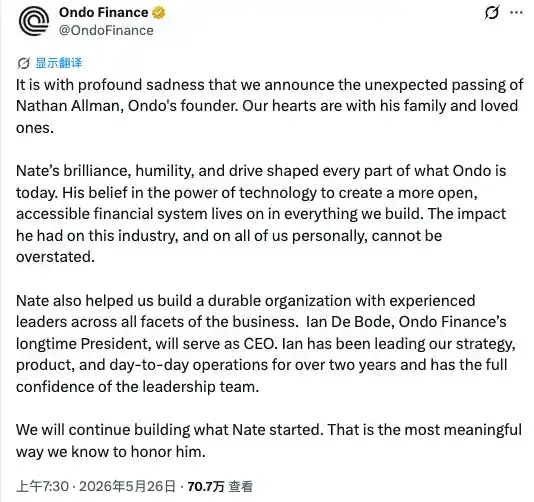
Nathan Allman, the founder and CEO of Ondo Finance, has passed away unexpectedly.

For the RWA (Real World Assets) sector, Nathan Allman was not just a front-facing founder spinning stories. He was one of the core drivers who propelled Ondo from DeFi structured yield products towards the tokenization of US treasuries, dollar-denominated yield assets, stocks, and ETFs. In a sense, when the market today discusses ONDO as the "first tokenization target," a significant part of that narrative stems from the product roadmap and institutional story that Nathan Allman consistently built over the past few years.

According to Ondo Finance's official announcement, Nathan Allman passed away unexpectedly, with the specific cause of death not yet disclosed. Ondo also stated that the company's President, Ian De Bode, will assume the role of CEO. The official announcement specifically mentioned that Nathan's talent, humility, and execution shaped today's Ondo, and the company will continue to advance the work he pioneered.
Nathan Allman was not a typical pure-crypto entrepreneur. He graduated from Brown University, had early experience in private credit investing, and later worked in Goldman Sachs's digital asset team. It was precisely this background that gave Ondo a strong traditional finance DNA from the start: its goal was not to create a DeFi protocol completely detached from the real-world financial system, but rather to repackage the most mature and liquid assets from traditional finance into products that can be held, transferred, combined, and settled on-chain.

In its early days, Ondo was not the RWA leader as we know it today. Back in 2021, Ondo was more like a DeFi structured yield protocol, designing different yield tiers for users with varying risk appetites.

Later, as the on-chain yield environment changed and the demand for stablecoin and US treasury yields grew, Ondo's path became clearer: instead of recreating high-risk yields on-chain, it was better to bring the most stable, largest, and most institutionally acceptable assets from the off-chain world on-chain.

This strategic pivot marked the true beginning of Ondo's entry into the mainstream spotlight.

OUSG, USDY, and Ondo Global Markets essentially constitute the three main pillars of Ondo today. OUSG targets accredited investors, providing on-chain exposure to short-term US treasuries and money market-type assets. USDY is more akin to a US dollar yield product for non-US investors. Ondo Global Markets further tokenizes US stocks and ETFs, allowing investors outside the US to gain exposure to traditional securities markets on-chain.

In other words, Ondo's narrative is not simply about "putting US treasuries on-chain." What it truly aims to do is transform Wall Street assets into foundational building blocks that the crypto world can utilize. Stablecoins solve the problem of US dollar circulation on-chain, while Ondo seeks to address how US dollar assets, US treasury yields, and securities exposure can enter the on-chain financial system.
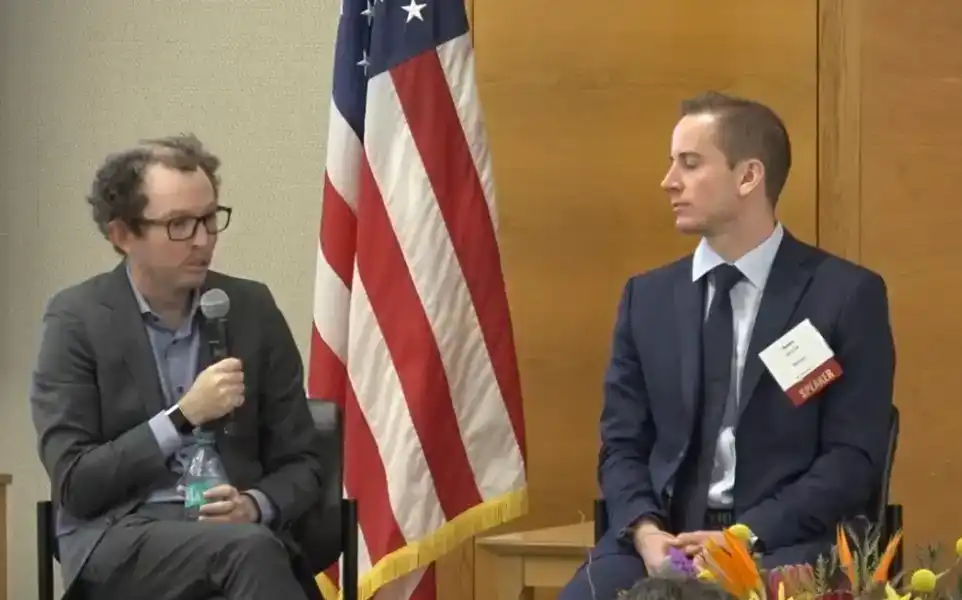
Nathan Allman speaking at the 9th Annual FinTech Conference in Philadelphia in November. Source: YouTube

This also defines Nathan Allman's position within the RWA sector. He did not represent the most aggressive crypto-native route, but rather another path: enabling traditional financial assets to accept on-chain settlement, and allowing on-chain markets to access traditional financial assets. Over the past two years, RWA has been able to re-emerge from an old concept into a mainline narrative, not by empty slogans of "tokenizing everything," but because products like US treasury yields, money market fund tokens, and stock tokenization began to have genuine demand, scale, and compliant pathways. Ondo is one of the most typical projects in this regard.

So, will Nathan Allman's passing affect Ondo?

In the short term, the impact is inevitable. The sudden loss of a founder is a significant event for any project, especially one like Ondo, which heavily relies on institutional partnerships, regulatory communication, and long-term product roadmaps. The market's immediate concerns will likely revolve around three questions: First, whether the founder's vision can still be continued. Second, whether institutional partners will reassess their collaboration pace. Third, whether ONDO, as a tokenization narrative asset, will be re-priced due to the departure of its key figure.

However, in the medium to long term, Ondo is not a project sustained solely by the personal brand of a single founder. Over the past few years, it has built a relatively comprehensive product matrix and assembled a management team with strong traditional finance backgrounds. Particularly, the new CEO, Ian De Bode, is not an unfamiliar outsider parachuted in temporarily, but a key figure within Ondo who has long been responsible for strategy, products, and daily operations.
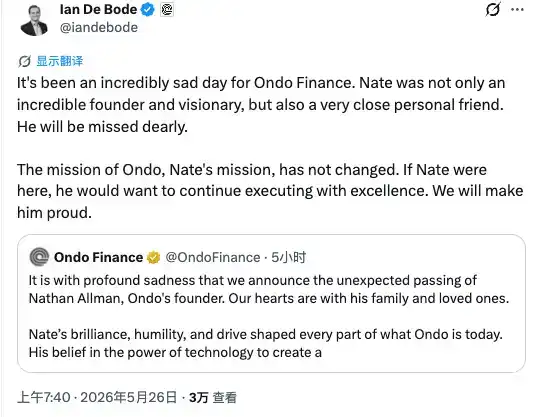
New CEO Ian De Bode posted in remembrance of Nathan Allman

Ian De Bode was previously a partner at McKinsey & Company, where he led its digital assets-related business. After joining Ondo in 2024, he first served as Chief Strategy Officer before becoming President. Ondo's announcement also noted that Ian has led the company's strategy, products, and daily operations for over two years and has the full support of the management team.
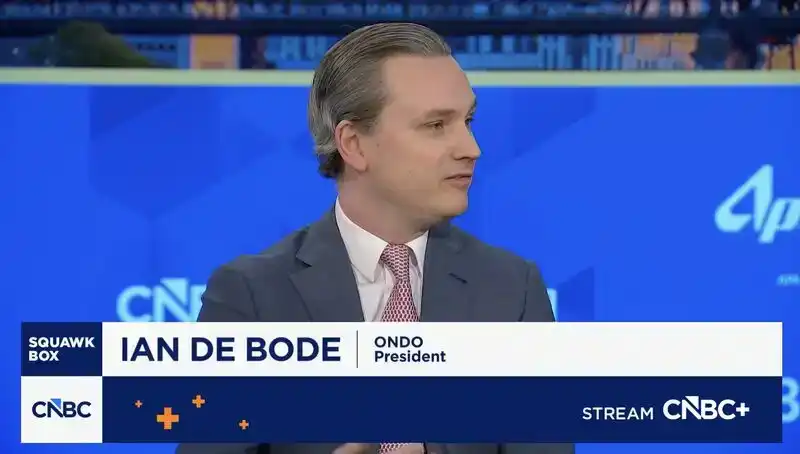
Lan De Bode introduces ONDO on CNBC

Based on their profiles, Ian De Bode and Nathan Allman share similarities: neither came from a purely crypto background; both entered the digital asset industry from traditional finance, consulting, and institutional service systems. Nathan was more of a product and vision-oriented founder, responsible for building Ondo from zero to its current position. Ian leans more towards institutional strategy and execution, familiar with the real demands of large corporations, financial institutions, and senior executives regarding tokenization.

This might be particularly crucial for the next phase of Ondo's journey. The first half of RWA was about narrative and product validation; the second half will inevitably focus on compliance, distribution, liquidity, and institutional partnerships. Whoever can scale asset size, connect brokers, custodians, market makers, public chains, wallets, and trading scenarios, has a chance to turn "tokenization" from a concept into market infrastructure. Ian De Bode's background aligns more closely with the requirements of this phase.

Of course, this doesn't mean Ondo is without risks. ONDO holders need to clearly distinguish one thing: the growth of Ondo's product scale does not automatically equate to the ONDO token receiving direct revenue share. ONDO primarily carries governance, ecosystem, and RWA narrative premium, not the US treasury yields themselves. When the market labels it the "first tokenization target," what's being bought is Ondo's representativeness and growth expectations within the RWA sector, not a direct claim on the cash flows of assets under Ondo's management.

Therefore, Nathan Allman's passing is also a stress test for Ondo. It tests whether this project is merely a founder-driven narrative or has evolved into a set of financial infrastructure capable of sustainable operation.

If Ian De Bode can maintain the product momentum, sustain institutional partnerships, and continue to drive the expansion of Ondo Global Markets, USDY, and OUSG, then the short-term emotional impact may gradually be absorbed by business continuity.

However, if subsequent product development slows down, institutional collaboration voices weaken, or the market begins to question ONDO's value capture capabilities, then this event could also become a node for re-evaluating valuations and the narrative.

For the RWA sector, Nathan Allman's passing is a loss. What he truly leaves behind is not just the Ondo project itself, but a clearer path: the crypto industry doesn't necessarily have to create new assets on-chain; it can also bring the world's largest and most mature financial asset markets into the on-chain world. Whether ONDO can continue to hold the position of the "first tokenization target" will depend not on words of mourning, but on whether the new team can continue to deliver products, asset scale, and genuine demand.

Связанные с этим вопросы

QAccording to the article, what was the original focus of Ondo Finance in 2021, and how did it evolve?

AAccording to the article, in 2021, Ondo Finance was originally more like a DeFi structured yield protocol designed to create different yield tiers for users with varying risk appetites. It later evolved its strategy towards tokenizing real-world assets, specifically focusing on bringing mature, high-liquidity traditional finance assets like U.S. Treasury bonds, equity, and ETFs onto the blockchain.

QWhat are the three main product lines that constitute Ondo Finance's current business focus?

AThe three main product lines that constitute Ondo Finance's current business focus are: 1) OUSG, which provides U.S. Treasury and money market exposure for qualified investors; 2) USDY, a yield-bearing USD product for non-U.S. investors; and 3) Ondo Global Markets, which tokenizes U.S. equities and ETFs to provide market exposure for investors outside the U.S.

QWhat are the key differences in background and role between the late founder Nathan Allman and the new CEO Ian De Bode?

ANathan Allman, the late founder, was described as a product and vision-driven founder with a background in private credit and Goldman Sachs's digital asset team, responsible for building Ondo from scratch. Ian De Bode, the new CEO, has a background as a former McKinsey & Company partner specializing in digital assets. He is characterized as more focused on institutional strategy, execution, and understanding the real-world needs of large corporations and financial institutions regarding tokenization.

QWhat short-term concerns does the market have following Nathan Allman's passing, according to the article?

AThe article states that the market's short-term concerns following Nathan Allman's passing are threefold: 1) Whether the founder's vision can continue; 2) Whether institutional partners will reassess their collaboration pace; and 3) Whether the valuation of the ONDO token, as a key narrative asset for tokenization, will be repriced due to the loss of a core figure.

QWhat does the article suggest is the real value proposition of the ONDO token for its holders?

AThe article clarifies that the real value proposition of the ONDO token for its holders is not direct revenue sharing from Ondo's underlying asset products (like U.S. Treasury yields). Instead, the ONDO token primarily carries governance rights, ecosystem utility, and a premium based on the broader RWA (Real World Assets) narrative and Ondo's growth expectations within that sector.

Похожее

Fei-Fei Li's Team Clarifies the Concept of 'World Models', Sora Merely a Renderer

"World Models" has become a widely used yet confusing term in AI. To address this, a team led by Fei-Fei Li and World Labs proposed a functional taxonomy based on the Partially Observable Markov Decision Process framework. This taxonomy categorizes systems called "world models" into three distinct projections: Renderers, Simulators, and Planners. Renderers, like OpenAI's Sora and other video generation models, focus on producing photorealistic visual outputs for human perception. They prioritize visual fidelity over physical accuracy. Simulators, such as NVIDIA Omniverse, aim to compute precise future environmental states for computational tasks like engineering analysis or digital twins. Planners, like Vision-Language-Action models, take in observations and goals to output executable actions for robots or agents. The article clarifies that most current "world models," including Sora, are primarily Renderers. They generate convincing visuals but lack the core ability to simulate state transitions based on actions, a key requirement for a true world model in classic reinforcement learning definitions. This conceptual confusion has practical implications, leading to potential misalignment in technology selection, investment, and public understanding of AI capabilities. Clear categorization is crucial. It helps enterprises avoid costly mistakes (e.g., using a renderer for robot training), allows investors to accurately assess markets, and enables researchers to build comparable benchmarks. While future systems may integrate these functions, recognizing current boundaries is essential for honest assessment and progress.

marsbit53 мин. назад

Fei-Fei Li's Team Clarifies the Concept of 'World Models', Sora Merely a Renderer

marsbit53 мин. назад

Bloomberg Uncovered: How Do China's Wealthy Circumvent the Annual $50,000 Limit to Transfer Assets?

**Summary: How Wealthy Chinese Circumvent $50,000 Annual Foreign Exchange Limits** Despite China's strict capital controls, including an annual $50,000 per person foreign exchange quota, an estimated $150 billion in funds still leaves the country annually via various gray and underground channels. This report outlines the evolution of China's "capital wall" and the methods used to bypass it. **The Evolving Capital Controls:** * **Foundation (1994):** The system of "current account convertibility with strict capital account controls" was established. * **Quota Set (2007):** The $50,000 individual annual forex purchase limit was formalized. * **Crackdown Begins (2015-2017):** Following market volatility, enforcement tightened. Banks were required to scrutinize transactions, and channels like using UnionPay cards for Hong Kong insurance premiums or buying overseas property were blocked. * **Digital & Legal Upgrades (2024-2026):** Enhanced algorithms now flag suspicious patterns (e.g., "smurfing"). The Common Reporting Standard (CRS) provides Chinese tax authorities with data on citizens' offshore accounts. Unlicensed cross-border brokers have been targeted. **Five Primary Methods for Moving Capital:** 1. **Underground Banking / "Hawala" (Duiqiao):** The largest-scale method. No money crosses borders. Clients pay RMB to a domestic account; an overseas associate deposits equivalent foreign currency into the client's offshore account. Risks include high fees, account freezes, and legal penalties. 2. **"Smurfing" or "Ant Moving":** Using multiple individuals' $50,000 quotas to pool funds for one offshore recipient. Increasingly detected by anti-money laundering algorithms. 3. **Trade Invoice Manipulation:** Businesses over-invoice imports or under-invoice exports via offshore shell companies, creating a pretext to transfer excess funds abroad under the guise of trade. 4. **Channel Migration:** After a crackdown on internet brokers, funds flow toward more compliant but costly channels like major banks' cross-border wealth management services or Qualified Domestic Institutional Investor (QDII) quotas. 5. **Structural Arrangements:** High-net-worth individuals use complex, high-cost legal structures involving offshore trusts, insurance, and investment migration programs to transfer asset ownership. **Regulatory Response: Focusing on People, Not Just Money** The current strategy extends oversight from enterprises to **individual residents**. Tools like CRS allow retroactive visibility into offshore assets. Cryptocurrencies, once seen as a potential loophole, are now actively monitored and prosecuted as an illegal channel. The underlying driver remains: with significant wealth concentrated among millions of affluent households seeking diversification amid domestic economic shifts, the incentive to move assets offshore persists despite regulatory barriers.

marsbit1 ч. назад

Bloomberg Uncovered: How Do China's Wealthy Circumvent the Annual $50,000 Limit to Transfer Assets?

marsbit1 ч. назад

Торговля

Спот
Фьючерсы

Популярные статьи

Как купить S

Добро пожаловать на HTX.com! Мы сделали приобретение Sonic (S) простым и удобным. Следуйте нашему пошаговому руководству и отправляйтесь в свое крипто-путешествие.Шаг 1: Создайте аккаунт на HTXИспользуйте свой адрес электронной почты или номер телефона, чтобы зарегистрироваться и бесплатно создать аккаунт на HTX. Пройдите удобную регистрацию и откройте для себя весь функционал.Создать аккаунтШаг 2: Перейдите в Купить криптовалюту и выберите свой способ оплатыКредитная/Дебетовая Карта: Используйте свою карту Visa или Mastercard для мгновенной покупки Sonic (S).Баланс: Используйте средства с баланса вашего аккаунта HTX для простой торговли.Третьи Лица: Мы добавили популярные способы оплаты, такие как Google Pay и Apple Pay, для повышения удобства.P2P: Торгуйте напрямую с другими пользователями на HTX.Внебиржевая Торговля (OTC): Мы предлагаем индивидуальные услуги и конкурентоспособные обменные курсы для трейдеров.Шаг 3: Хранение Sonic (S)После приобретения вами Sonic (S) храните их в своем аккаунте на HTX. В качестве альтернативы вы можете отправить их куда-либо с помощью перевода в блокчейне или использовать для торговли с другими криптовалютами.Шаг 4: Торговля Sonic (S)С легкостью торгуйте Sonic (S) на спотовом рынке HTX. Просто зайдите в свой аккаунт, выберите торговую пару, совершайте сделки и следите за ними в режиме реального времени. Мы предлагаем удобный интерфейс как для начинающих, так и для опытных трейдеров.

1.4k просмотров всегоОпубликовано 2025.01.15Обновлено 2026.06.02

Как купить S

Sonic: Обновления под руководством Андре Кронье – новая звезда Layer-1 на фоне спада рынка

Он решает проблемы масштабируемости, совместимости между блокчейнами и стимулов для разработчиков с помощью технологических инноваций.

2.3k просмотров всегоОпубликовано 2025.04.09Обновлено 2025.04.09

Sonic: Обновления под руководством Андре Кронье – новая звезда Layer-1 на фоне спада рынка

HTX Learn: Пройдите обучение по "Sonic" и разделите 1000 USDT

HTX Learn — ваш проводник в мир перспективных проектов, и мы запускаем специальное мероприятие "Учитесь и Зарабатывайте", посвящённое этим проектам. Наше новое направление .

1.8k просмотров всегоОпубликовано 2025.04.10Обновлено 2025.04.10

HTX Learn: Пройдите обучение по "Sonic" и разделите 1000 USDT

Обсуждения

Добро пожаловать в Сообщество HTX. Здесь вы сможете быть в курсе последних новостей о развитии платформы и получить доступ к профессиональной аналитической информации о рынке. Мнения пользователей о цене на S (S) представлены ниже.

活动图片