Cardano Is Already Running Behind 200 German Companies, Foundation CEO Says

bitcoinistОпубликовано 2026-04-17Обновлено 2026-04-17

Введение

Cardano Foundation CEO Frederik Gregaard revealed that approximately 200 large German companies are already using Cardano’s blockchain infrastructure—without being aware of it—through agentic AI deployments. These firms leverage Cardano as a security, digital identity, and accountability layer, particularly for verifying AI agents and ensuring data privacy without disclosure. Gregaard emphasized blockchain’s evolving role as a foundational trust layer for AI systems rather than just a payment rail. He noted that regulated stablecoins like USDM are used for microtransactions between AI agents, aligning incentives and enhancing security. He also highlighted Cardano’s regulatory positioning as a commodity, its quantum security features, and potential growth under emerging US and EU legislation. At the time of reporting, ADA was trading at $0.2566.

Cardano is already being used by roughly 200 large companies in Germany through agentic AI deployments, even if those firms do not realize the blockchain is sitting underneath their stack, according to Cardano Foundation CEO Frederik Gregaard. The claim, made during an interview with Jane King on GBBC’s Markets on Chain series from the New York Stock Exchange published April 16, points to a version of blockchain adoption that is less visible to end users but potentially more embedded in enterprise infrastructure.

200 German Companies Use Cardano Without Even Knowing It

Gregaard framed the Cardano Foundation’s role as pushing blockchain into systems people use without necessarily recognizing it. “We have about 200 companies in Germany who live on agentic AI, fairly large companies, and they don’t even know they’re using Cardano as a security layer, as a digital identity layer and as an accountability layer,” he said. “Part of when you have, for instance, agentic AI who’s using data from two different databases, [is] ensuring that the agentic AI is who they say they are, that they have the data they claim without disclosing it, because we want privacy.”

That argument was central to Gregaard’s broader pitch: blockchain, in his view, is becoming an underlying trust and coordination layer for AI-driven systems rather than simply a rails story for tokens or payments. He described a model where users could interact with seamless consumer applications while Cardano handles provenance, identity and compliance in the background. The point was less about visible crypto branding than about infrastructure-level deployment.

Payments still featured prominently. Gregaard said AI agents in some of these systems are already transacting using a regulated stablecoin called USDM, with microtransactions used to meter prompt activity and align incentives between participants. “The AIs are actually paying themselves using regulatory compliant stablecoins,” he said. “There’s a microtransaction happening just to do the prompts. And that’s also part of the security layer, which ensures that one database who has more computing power than the other doesn’t do unlimited prompts and can circumvent the security.”

Why Cardano Could Strive In The EU And US

The interview also tied that enterprise and AI narrative to policy. Gregaard said the US stablecoin framework under the GENIUS Act had moved the market closer to Europe’s MiCA regime, but argued the more consequential shift could come from the Clarity Act. He said he expects that legislation, if passed, to unlock materially broader blockchain usage beyond financial applications, adding that “hundreds of companies” are already waiting on that kind of legal certainty. He further claimed that recent regulatory language had made clear that “Cardano is a commodity,” and suggested the US could move faster than Europe on this front.

Alongside adoption, Gregaard leaned heavily on security. He said Cardano’s on-chain governance model and distributed validator base make it harder to compromise through a single point of failure, a contrast with networks he described as effectively controlled by a small number of insiders. He also argued that Cardano is emerging as a “first level quantum secure environment” through its interoperability with legal entity identity standards, which he said is drawing interest from banks, brokers, exchanges and central securities depositories.

At press time, Cardano traded at $0.2566.
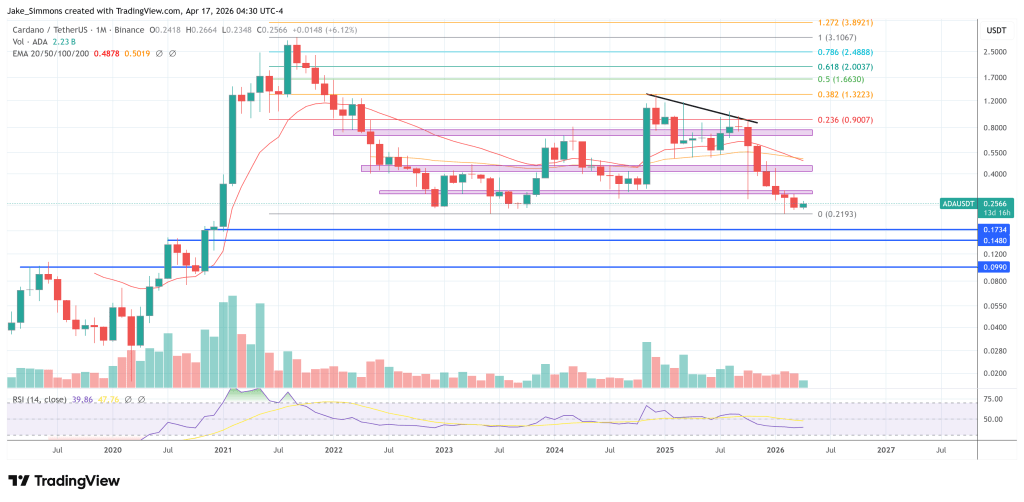
ADA hovers below key resistance, 1-monthly chart | Source: ADAUSDT on TradingView.com

Связанные с этим вопросы

QAccording to the Cardano Foundation CEO, how many large companies in Germany are using Cardano without realizing it, and for what purposes?

AAccording to Cardano Foundation CEO Frederik Gregaard, roughly 200 large companies in Germany are using Cardano as a security layer, a digital identity layer, and an accountability layer in their agentic AI deployments, without even knowing the blockchain is underneath their stack.

QWhat specific type of digital currency are the AI agents using for microtransactions in these systems, and what is its purpose?

AThe AI agents are using a regulated stablecoin called USDM for microtransactions. These microtransactions are used to meter prompt activity and align incentives between participants, and they form part of the security layer to prevent abuse.

QWhat US legislation does Gregaard suggest could unlock significantly broader blockchain usage beyond financial applications?

AGregaard suggests that the Clarity Act, if passed, could unlock materially broader blockchain usage beyond financial applications. He claims that 'hundreds of companies' are waiting for this kind of legal certainty.

QHow does Gregaard contrast Cardano's security model with that of other networks?

AGregaard contrasts Cardano's security by highlighting its on-chain governance model and distributed validator base, which make it harder to compromise through a single point of failure. He contrasts this with networks he describes as effectively controlled by a small number of insiders.

QWhat two key regulatory frameworks does the article mention in the context of stablecoins, and which region does Gregaard suggest might move faster on classifying assets like Cardano?

AThe article mentions the US stablecoin framework under the GENIUS Act and Europe's MiCA regime. Gregaard suggests that the US could move faster than Europe on providing regulatory clarity, recently stating that regulatory language has made clear that 'Cardano is a commodity.'

Похожее

Where the AI Bubble Really Is: Which Layer of Players Are Naked

AI Bubble: Where It Really Is and Who's Swimming Naked This analysis dissects the AI industry not as a single entity but as a five-layer pyramid, arguing that bubbles are concentrated in specific tiers, not uniformly distributed. **Key Distinction from the 2000 Dot-com Bubble:** Unlike 2000, where companies had stock prices before revenue, today's leading AI players have massive, contract-backed revenue driving their valuations. Core infrastructure demand is real, with every GPU running at full capacity for paying customers. **The Five-Layer Pyramid & Bubble Assessment:** * **L0 (Fab/Manufacturing) & Top L4 (Leading AI Apps): NO BUBBLE.** Companies like TSMC, NVIDIA, major cloud providers (Microsoft, Google, Meta, Amazon), and top AI labs have real revenues and orders. Supply is tightly constrained by TSMC's disciplined capacity control and physical limits like power/land for data centers, preventing a supply glut. * **L1 (Memory): BATTLEGROUND.** Sky-high HBM margins could signal a new structural cycle or a classic "boom before bust." The oligopoly of three major players may enforce supply discipline, making this a high-stakes bet. * **L2 (Interconnect/Optical Modules): BUBBLE TERRITORY.** Companies like Lumentum and AAOI have seen stock surges (4-10x) far outpacing revenue growth. This hardware segment has lower physical barriers to expansion than fabs, allowing speculation. It mirrors the 2000 bubble's epicenter—optics. * **L3 (Infrastructure/"GPU Landlords"): VULNERABLE.** GPU leasing companies profit from the current compute shortage but own no long-term moat. Their business model relies on a temporary bottleneck that will ease as big tech expands and new tech (e.g., potential space-based data centers) emerges. * **L4 Long Tail (VC-backed Startups): STRONG BUBBLE SIGNALS.** VC funding concentration in AI is twice that of the 1999 peak. Many startups with little revenue use the valuation logic of successful giants to justify their own, creating high risk of a "valuation crunch" when funding dries up. **Critical Risks to Monitor:** 1. **GPU Depreciation & Accounting:** Companies extending the assumed useful life of GPUs artificially boost profits. The true economic life depends on future generational leaps from NVIDIA. 2. **"GPU Credit" & Off-Balance-Sheet Leverage:** Emerging structures where shell companies borrow to buy GPUs and lease them out (with chipmakers sometimes investing) move debt off major balance sheets. This echoes the "vendor financing" of 2000 and the securitization risks of 2008, though currently small-scale. 3. **TSMC Abandoning Caution:** If the primary supply bottleneck (TSMC's conservative capacity planning) breaks, runaway supply could trigger a bust. 4. **Algorithmic Efficiency Breakthrough:** A major leap in software efficiency could drastically reduce the need for raw compute hardware, undermining the investment thesis. **Conclusion:** The AI boom is expensive and has frothy areas, but its core is underpinned by real demand and physical supply constraints. The bubble risk is layered: most present in optical components, GPU leasing, and the long-tail startup ecosystem, while the foundational chip manufacturing and leading application layers remain relatively solid—for now.

marsbit13 мин. назад

Where the AI Bubble Really Is: Which Layer of Players Are Naked

marsbit13 мин. назад

Standing in the Light: A Comprehensive Guide to the Optical Module and CPO Supply Chain

"Standing in the Light: Understanding the Optical Module and CPO Industry Chain" This article analyzes the critical role of optical communication technology, specifically optical modules and Co-Packaged Optics (CPO), as the "nervous system" for modern AI data centers. With exponential growth in AI computational demands (e.g., NVIDIA's Vera Rubin architecture), traditional electrical interconnects using copper cables face severe bottlenecks in bandwidth, power consumption, and signal integrity over distance. The core function of an optical module is to act as a "translator," converting electrical signals from chips into optical signals for transmission over fiber (and vice-versa). Key internal components include lasers, modulators, photodetectors, drivers, and DSP chips. The industry is currently transitioning from 800G to 1.6T modules. However, the future lies in CPO. This next-generation technology integrates the optical engine directly with the switch ASIC/XPU on the same package substrate, drastically reducing power consumption (by ~3.5x according to NVIDIA), overcoming bandwidth density limits, and minimizing signal attenuation compared to traditional pluggable modules. Key challenges for CPO include advanced packaging capacity (dominated by TSMC), thermal management, repairability, and standardization. The article details the broader technology landscape, including Near-Packaged Optics (NPO, a pragmatic intermediate step), Linear-drive Pluggable Optics (LPO), Optical I/O (OIO for chip-level integration), and Optical Circuit Switches (OCS). A comprehensive CPO industry chain is mapped, highlighting shifting power dynamics: * **Architecture Definers:** NVIDIA, Broadcom, and Marvell now hold greater influence. * **Advanced Packaging & Manufacturing:** TSMC is central; Fabrinet is a key EMS player. * **Lasers ("The Heart"):** A strategic bottleneck. EML lasers are led by Lumentum and Coherent (both receiving major NVIDIA investments). CW lasers, favored for CPO/silicon photonics, see strong Chinese players like Source Photonics and Sicoya. * **Silicon Photonics Chips:** The mainstream path for CPO engines, with key players like Broadcom, Intel, Marvell, and China's Accelink. * **Fiber Connectivity Components:** A major new, high-growth market created by CPO, including Fiber Array Units (FAU), Polarization-Maintaining Fiber (PMF), and MPO connectors. Companies like Tianfu Communication and US Conec are leaders. * **Fiber & Cable:** Experiencing a super-cycle (e.g., Corning, Yangtze Optical Fiber). * **PCB/Substrates:** Requiring advanced materials (e.g., Shengyi Tech). * **DSP & SerDes:** Functions are integrated into switch ASICs in the CPO era (e.g., Broadcom, Astera Labs). * **Optical Module Makers:** Transitioning from standalone module suppliers to providers of optical engines and NPO/LPO solutions while riding the current pluggable boom (e.g., Zhongji Innolight, Eoptolink). The investment timeline is segmented: Short-term (2026-2027) features the "last feast" for pluggable modules and CPO's initial rollout. Medium-term (2027-2029) will see CPO expand and NPO peak. Long-term (2029-2032+) involves CPO/OIO penetration into intra-rack scaling. In conclusion, optical interconnects are fundamental to AI infrastructure. The competitive landscape sees US firms leading in architecture and high-end chips, TSMC in advanced packaging, and Chinese firms holding strong positions in modules, connectivity components, CW lasers, and fiber/cable. The future belongs to companies that can navigate the technological shift from "selling shovels" (modules) to "building highways" (CPO/OIO infrastructure).

marsbit23 мин. назад

Standing in the Light: A Comprehensive Guide to the Optical Module and CPO Supply Chain

marsbit23 мин. назад

Торговля

Спот
Фьючерсы

Популярные статьи

Как купить ADA

Добро пожаловать на HTX.com! Мы сделали приобретение Cardano (ADA) простым и удобным. Следуйте нашему пошаговому руководству и отправляйтесь в свое крипто-путешествие.Шаг 1: Создайте аккаунт на HTXИспользуйте свой адрес электронной почты или номер телефона, чтобы зарегистрироваться и бесплатно создать аккаунт на HTX. Пройдите удобную регистрацию и откройте для себя весь функционал.Создать аккаунтШаг 2: Перейдите в Купить криптовалюту и выберите свой способ оплатыКредитная/Дебетовая Карта: Используйте свою карту Visa или Mastercard для мгновенной покупки Cardano (ADA).Баланс: Используйте средства с баланса вашего аккаунта HTX для простой торговли.Третьи Лица: Мы добавили популярные способы оплаты, такие как Google Pay и Apple Pay, для повышения удобства.P2P: Торгуйте напрямую с другими пользователями на HTX.Внебиржевая Торговля (OTC): Мы предлагаем индивидуальные услуги и конкурентоспособные обменные курсы для трейдеров.Шаг 3: Хранение Cardano (ADA)После приобретения вами Cardano (ADA) храните их в своем аккаунте на HTX. В качестве альтернативы вы можете отправить их куда-либо с помощью перевода в блокчейне или использовать для торговли с другими криптовалютами.Шаг 4: Торговля Cardano (ADA)С легкостью торгуйте Cardano (ADA) на спотовом рынке HTX. Просто зайдите в свой аккаунт, выберите торговую пару, совершайте сделки и следите за ними в режиме реального времени. Мы предлагаем удобный интерфейс как для начинающих, так и для опытных трейдеров.

2.2k просмотров всегоОпубликовано 2024.03.29Обновлено 2026.06.02

Как купить ADA

SNEK: ведущий мемкоин на блокчейне Cardano, открывающий новую эпоху для экосистемы Cardano

SNEK - это дефляционный мемкоин, выпущенный на блокчейне Cardano. Он создаёт децентрализованную культурную и развлекательную ценность за счёт участия глобального сообщества.

2.1k просмотров всегоОпубликовано 2025.10.15Обновлено 2025.10.15

SNEK: ведущий мемкоин на блокчейне Cardano, открывающий новую эпоху для экосистемы Cardano

Неделя обучения по популярным токенам 8: запуск основной сети Ouroboros Leios для ADA ожидается в 2026 году

Основная сеть Ouroboros Leios для ADA, как ожидается, будет запущена в 2026 году, а хардфорк до версии протокола 11 запланирован на I квартал 2026 года.

2.0k просмотров всегоОпубликовано 2026.02.10Обновлено 2026.02.12

Неделя обучения по популярным токенам 8: запуск основной сети Ouroboros Leios для ADA ожидается в 2026 году

Обсуждения

Добро пожаловать в Сообщество HTX. Здесь вы сможете быть в курсе последних новостей о развитии платформы и получить доступ к профессиональной аналитической информации о рынке. Мнения пользователей о цене на ADA (ADA) представлены ниже.

活动图片