Can the Dual Currency Win Strategy Really Weather Bull and Bear Markets? A 6-Year Backtest Provides the Answer

marsbitОпубликовано 2026-02-27Обновлено 2026-02-27

Введение

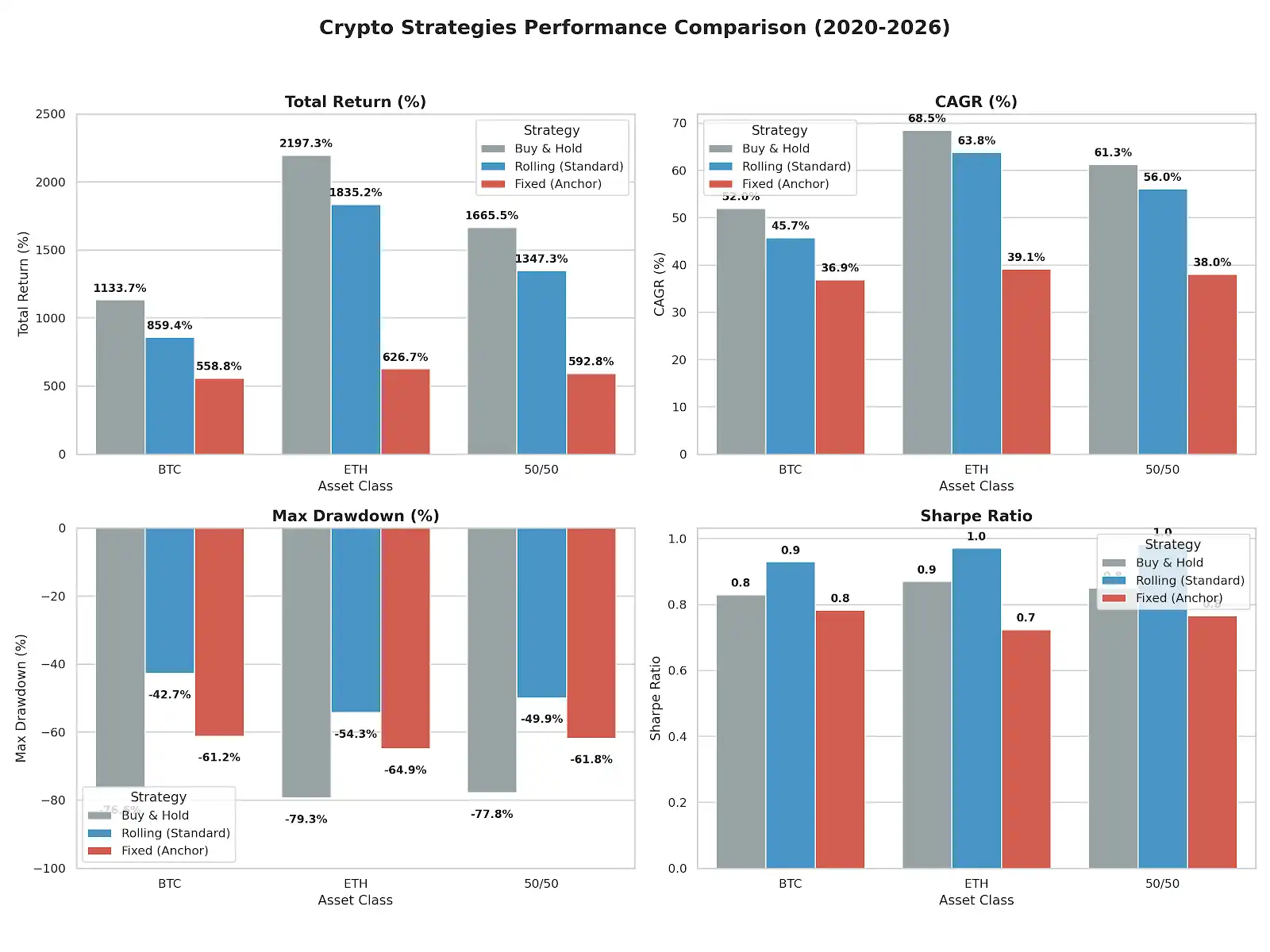
"Can the Dual Currency Win (Wheel Strategy) truly weather bull and bear markets? A 6-year backtest (2020-2026) on Bitcoin and Ethereum provides the answer. The study compared two approaches: the 'Standard Rolling Strike' method, which dynamically sells covered calls at 105% of the current spot price, and the 'Fixed Anchor' method, which stubbornly sells calls at the original, higher cost basis after a drop, refusing to sell at a loss. Key findings reveal a significant performance gap. The Standard method, while sacrificing some upside, demonstrated superior risk-adjusted returns. For a 50/50 BTC/ETH portfolio, it achieved a +1347.32% total return with a -49.9% max drawdown and a Sharpe Ratio of 0.983, outperforming both Buy & Hold (+1665.52%, -77.8% drawdown, 0.85 Sharpe) on risk metrics and crushing the Fixed Anchor method (+592.77%, -61.8% drawdown, 0.766 Sharpe). The data shows the Standard strategy's strength lies in its dynamic adjustment mechanism, continuously resetting its strike price to balance income generation with participation in bullish trends. Conversely, the Fixed Anchor strategy's poor performance highlights the costly pitfall of the 'anchoring bias'—the human tendency to fixate on the entry price. This psychological trap cripples the ability to collect meaningful premium during bear markets and causes investors to miss subsequent bull runs when positions are called away at breakeven. The conclusion is clear: discipline and adaptability are far more valua...

Author: Michel Athayde

Can the Dual Currency Win Strategy Really Weather Bull and Bear Markets?

Using real market data from 2020-2026 for backtesting, we discovered:

Even with the same Dual Currency Win strategy, just by changing how the Calls are sold, the final profit difference can be nearly double.

The data tells us the problem isn't the strategy, it's human nature.

In the crypto market, the "Dual Currency Win" (Wheel Strategy) is often seen as a tool for collecting rent through bull and bear markets. But how do different underlying execution logics reshape long-term profit distribution?

To find the truth, we backtested Bitcoin and Ethereum over a complete bull-bear cycle from 2020-2026. In this sample, which includes crashes and an epic bull market, we compared two截然不同的双币赢玩法:

  • Standard Dual Currency Win (Rolling Strike): Follows the market. After taking delivery of the spot asset, each time a Covered Call is sold dynamically at 105% of the current price.

  • Break-even Type Dual Currency Win (Fixed Anchor): Anchors to cost. Once taking delivery at a high price, no matter how far the price falls, it stubbornly sells Calls at the "last delivery strike price," refusing to give up the chips until breaking even.

This is no longer a simple contest of "selling strategy vs. holding spot," but a deep test of "how trading psychology changes long-term profit distribution."

Core Data: Re-evaluating Risk and Return

(Note: Backtest span 2020-2026, Puts priced at 30% annualized, Calls at 25% annualized, 7-day cycles)

Investment Strategy Total Return Annualized (CAGR) Max Drawdown Sharpe Ratio
BTC HODL (Buy & Hold) +1133.73% 51.95% 0.83
BTC Standard (Rolling) +859.43% 45.72% -42.74% 0.929
BTC Break-even (Fixed) +558.81% 36.88% -61.19% 0.783
--- --- --- --- ---
ETH HODL (Buy & Hold) +2197.31% 68.52% -79.30% 0.87
ETH Standard (Rolling) +1835.21% 63.78% -54.27% 0.971
ETH Break-even (Fixed) +626.74% 39.13% -64.87% 0.724
--- --- --- --- ---
50/50 HODL Portfolio +1665.52% 61.30% <极速赛车开奖网em data-index-in-node="0" data-path-to-node="11,9,3,0">-77.80% 0.85
50/50 Standard Portfolio +1347.32% 56.05% -49.90% 0.983
50/50 Break-even Portfolio +592.77% 38.03% -61.80% 0.766

Faced with this real data, we need to re-examine two core propositions in trading.

The Risk-Return Balancing Act of the Standard Dual Currency Win

Many mistakenly believed the standard strategy would severely underperform in bull markets, but the data proves that with just a 5% upside buffer (spot price * 1.05), it exhibits极强的 risk-return balancing ability over a full cycle.

In the 50/50 portfolio, its Sharpe Ratio (0.983) thoroughly crushed buy-and-hold (0.85) and drastically compressed the nearly -78% abysmal drawdown to -49.9%.

Its advantage doesn't come from predicting the market, but from the mechanism of "continuously dynamically raising the strike price."

With every price change, the standard version relentlessly adjusts its target. Rolling本质上是在牛市中不断“重置成本”,而 Fixed Anchor 却是在不断“确认错误”. The standard version sacrifices a极小部分 of potential暴利上限,换取来了平滑资金曲线的巨大战略纵深.

"Anchoring to Cost" is the Most Expensive Psychological Placebo

The most thought-provoking part of the data is the comprehensive failure of the "Break-even (Fixed Anchor)" type. It fell far short of the standard version in both return and drawdown control.

This exposes the most common weakness in human trading psychology: Anchoring Effect. If you took delivery at a high of 60k, and stubbornly hang a Call at 60k when the price drops to 30k, you not only lose the "bleeding stop" ability of option premiums during the long bear market, but also risk having your chips called away at 60k during a V-shaped market reversal, completely missing the subsequent main upward浪.

The break-even strategy seems conservative, but it's actually using time to fight the trend. And in a trend-driven market, time is often on the side of the trend. Obsessing over "not selling at a loss" is ironically the fastest way to perfectly miss out on major cycle红利.

Conclusion

Markets are full of volatility, but data doesn't lie.

In trending assets like Bitcoin and Ethereum, the real risk is not drawdown, but being limited on the upside by your own psychological anchor.

The standard Dual Currency Win tells us:

As long as you keep adjusting dynamically and rolling continuously, a selling strategy can also coexist with the trend.

And the break-even strategy reminds us:

The market won't change direction because of your cost basis.

Discipline is far more important than breaking even.

Связанные с этим вопросы

QWhat is the main finding of the 6-year backtest (2020-2026) comparing the two versions of the Wheel Strategy?

AThe backtest revealed that the standard 'Rolling Strike' version significantly outperformed the 'Fixed Anchor' version, with the performance gap being nearly double in some cases. The key difference lies not in the strategy itself, but in the human psychology of anchoring to a cost basis.

QHow does the 'Rolling Strike' (Standard) version of the Wheel Strategy manage risk and return compared to simply holding the asset (Buy & Hold)?

AThe 'Rolling Strike' version demonstrated superior risk-adjusted returns. For the 50/50 portfolio, it achieved a higher Sharpe Ratio (0.983 vs 0.85 for Buy & Hold) and significantly reduced the maximum drawdown (-49.9% vs -77.8% for Buy & Hold), while still capturing substantial upside.

QWhy did the 'Fixed Anchor' version of the strategy perform poorly in the backtest?

AThe 'Fixed Anchor' strategy performed poorly because it falls victim to the 'anchoring effect' in behavioral finance. By stubbornly selling calls at the original, higher cost basis during a bear market, it loses the ability to collect meaningful premium ('stop the bleeding') and risks having the asset called away at the break-even point, missing out on a subsequent major bull run.

QAccording to the article, what is the most significant risk when investing in trend assets like Bitcoin and Ethereum using such strategies?

AThe most significant risk is not the price drawdown itself, but the psychological limitation of one's upside potential by being anchored to a specific cost price, which can cause an investor to miss out on major market trends.

QWhat is the core lesson about discipline from the article's conclusion?

AThe core lesson is that maintaining discipline by dynamically adjusting and rolling positions (as in the standard version) is far more important than the psychological desire to simply 'break even' on a trade. The market will not change direction based on an individual's cost basis.

Похожее

This Week's Key Events Preview | U.S. to Release April CPI Data; U.S. Senate Banking Committee to Review "Digital Asset Market Structure Act of 2025"

Weekly News Preview: Key events for May 12-16 include major economic and crypto industry developments. On Tuesday, May 12, the U.S. will release its April CPI data. Additionally, the gaming blockchain Ronin will begin a 10-hour migration to an Ethereum Layer 2, built on OP Stack with EigenDA for data availability. This aims to leverage Ethereum's security and settle RON's annual inflation below 1%. Base's first independent network upgrade, "Base Azul," is scheduled for mainnet activation on Wednesday, May 13, focusing on security, performance, and developer experience enhancements. Thursday, May 14, sees the U.S. Senate Banking Committee voting on the "Digital Asset Market Structure Act of 2025." In other news, Solana DeFi protocol Carrot will shut down, setting a final withdrawal deadline due to impacts from the Drift exploit. The Moscow Exchange will launch futures trading for Solana, Ripple, and Tron indices (RUB-settled) for qualified investors. Multiple service closures are scheduled for Friday, May 15. Dmail Network will begin winding down due to unsustainable infrastructure costs and failed commercialization. Users must export data before this date. Separately, the Cosmos-based lending blockchain UX Chain will fully shut down. Finally, on Saturday, May 16, gaming infrastructure provider Lattice will wind down operations, with its Redstone Layer 2 network ceasing. Users are urged to withdraw assets, especially from contracts like Uniswap pools, before the shutdown.

链捕手55 мин. назад

This Week's Key Events Preview | U.S. to Release April CPI Data; U.S. Senate Banking Committee to Review "Digital Asset Market Structure Act of 2025"

链捕手55 мин. назад

Morning Post | Trump Media Group Releases Q1 Financial Report; Top Three DeFi Applications Return Nearly $100 Million in Revenue to Token Holders in 30 Days; Michael Saylor Shares Bitcoin Tracker Info Again

**Title: Daily Briefing | Trump Media Group Releases Q1 Report; Top 3 DeFi Apps Return Nearly $100M to Token Holders; Michael Saylor Signals Potential Bitcoin Buy** **Summary:** Key developments in the past 24 hours include: * **Economic Outlook:** Goldman Sachs has pushed back its forecast for the next two Federal Reserve interest rate cuts to December 2026 and March 2027, citing persistent inflationary pressures from energy costs. This delayed timeline is expected to tighten liquidity flow into risk assets, including cryptocurrencies. * **DeFi & Revenue:** Data from DefiLlama shows that three leading DeFi applications—Hyperliquid, Pump.fun, and EdgeX—collectively distributed $96.3 million in revenue to their token holders over the last 30 days. This trend highlights a shift in the crypto community's focus towards real protocol earnings and sustainable economic models. * **Corporate Bitcoin Moves:** Michael Saylor, founder of MicroStrategy (note: referred to as 'Strategy' in the text, likely a typographical error), has signaled potential upcoming Bitcoin purchases by posting a "Bitcoin Tracker" update, following a pattern that typically precedes the company's official disclosure of new acquisitions. * **Market Integrity:** Prediction market platform Polymarket announced updates to address platform issues, including identifying and banning clusters of accounts involved in "ghost-fill" activities and implementing measures to prevent bulk account creation. * **Regulation:** The Bank of England Governor warned that stablecoin regulation could lead to tensions between US and international regulators. In South Korea, the National Tax Service has launched a pilot program to entrust seized virtual assets to private custody firms for management. * **Meme Token Trends:** GMGN data lists the top trending meme tokens on Ethereum (e.g., HEX, SHIB), Solana (e.g., FWOG, TROLL), and Base (e.g., SKITTEN, PEPE) over the past day. **Financial Note:** Trump Media & Technology Group reported a Q1 loss of approximately $4 billion, primarily attributed to unrealized losses on its Bitcoin and other digital asset holdings.

链捕手1 ч. назад

Morning Post | Trump Media Group Releases Q1 Financial Report; Top Three DeFi Applications Return Nearly $100 Million in Revenue to Token Holders in 30 Days; Michael Saylor Shares Bitcoin Tracker Info Again

链捕手1 ч. назад

Telegram Takes Direct Control of TON, Social Traffic Rewrites the Public Chain Narrative

Telegram founder Pavel Durov announced that Telegram will replace the TON Foundation as the core driver and largest validator of The Open Network (TON). Key initiatives include a sixfold reduction in transaction fees, performance upgrades, and improved developer tools within the next few weeks. This marks a strategic shift from Telegram merely providing user access to deeply integrating TON into its platform's core infrastructure. The goal is to transform Telegram's massive social traffic into sustainable on-chain activity. While viral mini-apps like Notcoin have demonstrated Telegram's ability to drive user adoption, TON aims to support frequent, low-value transactions inherent to social platforms—such as tipping, in-app payments, and game rewards. Ultra-low fees and sub-second finality (0.6 seconds) are crucial to making blockchain interactions seamless and nearly invisible within the Telegram user experience. However, Telegram's increased central role raises questions about network decentralization. Durov argues that Telegram's participation will attract more large validators, thereby enhancing decentralization. TON also offers high annual staking rewards (18.8%), aiming to retain capital within its ecosystem. The fundamental challenge for TON is no longer leveraging Telegram's user base, but becoming an indispensable, seamless infrastructure layer for Telegram's everyday applications—moving from an adjacent chain to an embedded utility.

marsbit1 ч. назад

Telegram Takes Direct Control of TON, Social Traffic Rewrites the Public Chain Narrative

marsbit1 ч. назад

Торговля

Спот
Фьючерсы
活动图片