BTCC Reports Record $3.7T Trading Volume in 2025, Sets Sights on AI Trading and RWA Growth for 2026

TheNewsCryptoОпубликовано 2026-01-23Обновлено 2026-01-23

Введение

BTCC, the world's longest-running crypto exchange, reported a record 2025 with $3.7 trillion in trading volume and 11 million users—a 60% annual increase. Key growth came from tokenized real-world assets (RWA), which surged 1,792% to $22.7 billion in Q4. The exchange maintained 100%+ reserves and expanded globally through events and partnerships, including an ambassadorship with NBA All-Star Jaren Jackson Jr. For 2026, BTCC plans to focus on three strategic areas: AI-powered trading tools, expansion of RWA offerings, and the launch of a next-generation trading platform. The exchange aims to leverage its 15-year experience to build innovative products aligned with future market trends.

The longest-running cryptocurrency exchange in the world, BTCC, claimed record 2025 performance, with $3.7 trillion in total trading volume and 11 million users worldwide—a 60% rise from the previous year. The exchange is turning its attention to AI-enabled trading tools and more real-world asset offers as it gets closer to its 15th anniversary in 2026.

Highlights of the 2025 Performance

BTCC reported $431 billion in spot trading volume and $3.27 trillion in futures volume for the whole year. Tokenized real-world asset (RWA) trading on the exchange had the most significant rise, with quarterly volumes rising from $1.2 billion in Q1 to $22.7 billion in Q4, a 1,792% increase. The year’s total volume of tokenized futures was $53.1 billion.

With reserves continuously exceeding 100%, BTCC maintained its dedication to openness throughout 2025 via monthly Proof of Reserves (PoR) reports. Additionally, the exchange revamped its VIP program, revised its site-wide user interface, and integrated TradingView for futures trading.

Global Expansion and Industry Recognition

Through a range of community activities, BTCC increased its worldwide footprint in 2025. The exchange held an MVP Night at Taipei Blockchain Week, staged a Summer Festival in Tokyo, took part in TOKEN2049 in Dubai and Singapore, and sponsored the Red Eagle Foundation’s charity golf activities, which raised over $100,000 over the course of the year.

Beyond events, high-profile collaborations helped BTCC increase brand awareness. NBA All-Star Jaren Jackson Jr. became the exchange’s first international brand ambassador. By highlighting Jackson’s identity as a top athlete, music producer, and crypto trader, the partnership unites the sports and cryptocurrency communities.

Numerous industry honors, such as BeInCrypto’s Best Centralized Exchange (Community Choice) award, were given to the exchange in recognition of its work.

Strategic Priorities for 2026

Building on its 15-year operating history, BTCC has identified three areas of concentration for the next year:

  • Features of AI-Powered Trading: AI integration in risk management and trade execution optimization tools for both regular users and expert traders.
  • Real-World Asset Expansion: After tokenized asset trading volume increased 18-fold in 2025, BTCC plans to add more asset classes and trading pairs to its RWA product suite.
  • Next-Generation Trading Platform: Introduction of a new wealth management tool that offers a variety of techniques for various risk profiles in addition to a full trading system that includes derivatives, spot markets, and multi-asset matching engines.

“15 years in this industry has taught us that the real risk isn’t change but standing still,” said Marcus Chen, Product Manager at BTCC. “Our focus for 2026 is translating operational experience into speed: building what traders need for where markets are heading, not where they’ve been.”

BTCC, a prominent international cryptocurrency exchange with over 11 million customers in more than 100 countries, was founded in 2011. With 2023 Defensive Player of the Year and two-time NBA All-Star Jaren Jackson Jr. as a worldwide brand ambassador, BTCC offers safe, easily accessible cryptocurrency trading services with an unparalleled user experience.


TagsBTCCexchange

Связанные с этим вопросы

QWhat was BTCC's total trading volume in 2025 and how much did it grow compared to the previous year?

ABTCC reported a total trading volume of $3.7 trillion in 2025, which represented a 60% increase from the previous year.

QWhich area of BTCC's business saw the most significant growth in 2025, and what was the percentage increase?

ATokenized real-world asset (RWA) trading saw the most significant growth, with quarterly volumes increasing by 1,792% from $1.2 billion in Q1 to $22.7 billion in Q4.

QWho did BTCC partner with as their first international brand ambassador in 2025?

ABTCC partnered with NBA All-Star Jaren Jackson Jr. as their first international brand ambassador.

QWhat are BTCC's three strategic priorities for 2026?

ABTCC's three strategic priorities for 2026 are: 1) AI-Powered Trading features, 2) Real-World Asset expansion, and 3) a Next-Generation Trading Platform.

QHow did BTCC demonstrate its commitment to transparency throughout 2025?

ABTCC maintained its dedication to transparency by publishing monthly Proof of Reserves (PoR) reports, with reserves continuously exceeding 100%.

Похожее

Only a 50% Chance of Passing This Year, Can the CLARITY Bill Succeed Before the Midterm Elections?

The CLARITY Act, which passed the House in July 2025 with strong bipartisan support (294-134), faces a critical juncture in the Senate. The Senate Banking Committee is expected to hold a markup soon, but key issues remain unresolved, including stablecoin yield provisions, DeFi regulations, and securing full Republican committee support. Other contentious points involve the Blockchain Regulatory Certainty Act (BRCA), ethics amendments for government officials, and SEC-related matters. The legislative calendar is tight, with limited time before the midterm elections. If the committee markup is delayed beyond mid-May, the chances of passage in 2026 drop significantly. Senator Cynthia Lummis has warned that failure this year could delay comprehensive crypto market structure legislation until 2030 or later. Galaxy estimates the probability of the CLARITY Act becoming law in 2026 is only about 50%. The bill provides crucial regulatory clarity by defining jurisdictional boundaries between the SEC and CFTC, establishing a path for decentralization, and bringing digital commodity intermediaries under federal regulation. Its passage is seen as vital before potential power shifts in the next Congress, which could bring less favorable leadership to key committees. The timeline is compressed, and the bill must compete for floor time with other priorities like Iran authorization and DHS appropriations. Key hurdles include finalizing the stablecoin yield compromise text, addressing law enforcement concerns about BRCA, and navigating political dynamics around SEC nominations. The outcome of the Banking Committee markup and the level of bipartisan support will be critical indicators of its future success.

marsbit2 мин. назад

Only a 50% Chance of Passing This Year, Can the CLARITY Bill Succeed Before the Midterm Elections?

marsbit2 мин. назад

Dialogue with Xinhuo Chief Economist Fu Peng: Macro Bear Market Expected to End This Year, Prioritize Allocation to Value Assets

Fu Peng, Chief Economist at New Huo Group, discusses the integration of crypto assets into traditional finance, marking a shift from a speculative phase to institutionalization. He highlights the current era as the second major fusion of finance and technology, driven by AI, data, and computing power, with crypto assets becoming part of the FICC+C (Fixed Income, Currencies, Commodities + Crypto) framework. Regulatory clarity in the U.S., such as the GENIUS and Clarity Acts, has paved the way for institutional adoption by defining digital assets as financial instruments. Fu views RWA (Real World Assets) as a tool for asset tokenization rather than a standalone asset class, noting that financial innovation differs between Eastern and Western markets due to cultural approaches to risk and regulation. He emphasizes that stablecoins are essential for future finance, but Asian markets, including Hong Kong, will adopt them cautiously. Macro liquidity now significantly influences crypto markets, as institutional participation increases correlation with traditional assets. Fu suggests the macro-driven bear market may end by year-end, reducing the relevance of Bitcoin’s four-year cycle. For asset allocation, he recommends value-oriented AI stocks for stability, Bitcoin for moderate certainty, and Ethereum for higher volatility.

marsbit9 мин. назад

Dialogue with Xinhuo Chief Economist Fu Peng: Macro Bear Market Expected to End This Year, Prioritize Allocation to Value Assets

marsbit9 мин. назад

Only a 50% Chance of Passing This Year, Can the CLARITY Bill Succeed Before the Midterm Elections?

The CLARITY Act, which passed the U.S. House in July 2025 with strong bipartisan support (294-134), faces a critical juncture in the Senate. The Senate Banking Committee is expected to hold a markup soon, but key issues remain unresolved, including stablecoin yield provisions, DeFi regulations, and securing full Republican committee support. Additional challenges involve the Blockchain Regulatory Certainty Act (BRCA), ethics amendments for government officials, and SEC-related concerns. Galaxy estimates only a 50% chance of the bill becoming law in 2026. The tight legislative calendar, competing priorities like Iran military authorization and DHS appropriations, and the impending midterm elections create significant time pressure. If the bill is not passed before the new Congress convenes in 2027, comprehensive crypto market structure legislation could be delayed until 2030 or later, especially if leadership changes result in less favorable committee chairs. The act provides crucial regulatory clarity by defining the jurisdictional boundaries between the SEC and CFTC, establishing a path for decentralized networks to be classified as non-securities, and bringing digital commodity intermediaries under federal regulation. The outcome of ongoing Senate negotiations, particularly the release of revised text on stablecoin yields, will be a key indicator of its future prospects.

Odaily星球日报12 мин. назад

Only a 50% Chance of Passing This Year, Can the CLARITY Bill Succeed Before the Midterm Elections?

Odaily星球日报12 мин. назад

Four-Dimensional Resonance: Hong Kong Web3 Carnival Sub-Forum Co-Creates Blueprint for Global Financial New Infrastructure

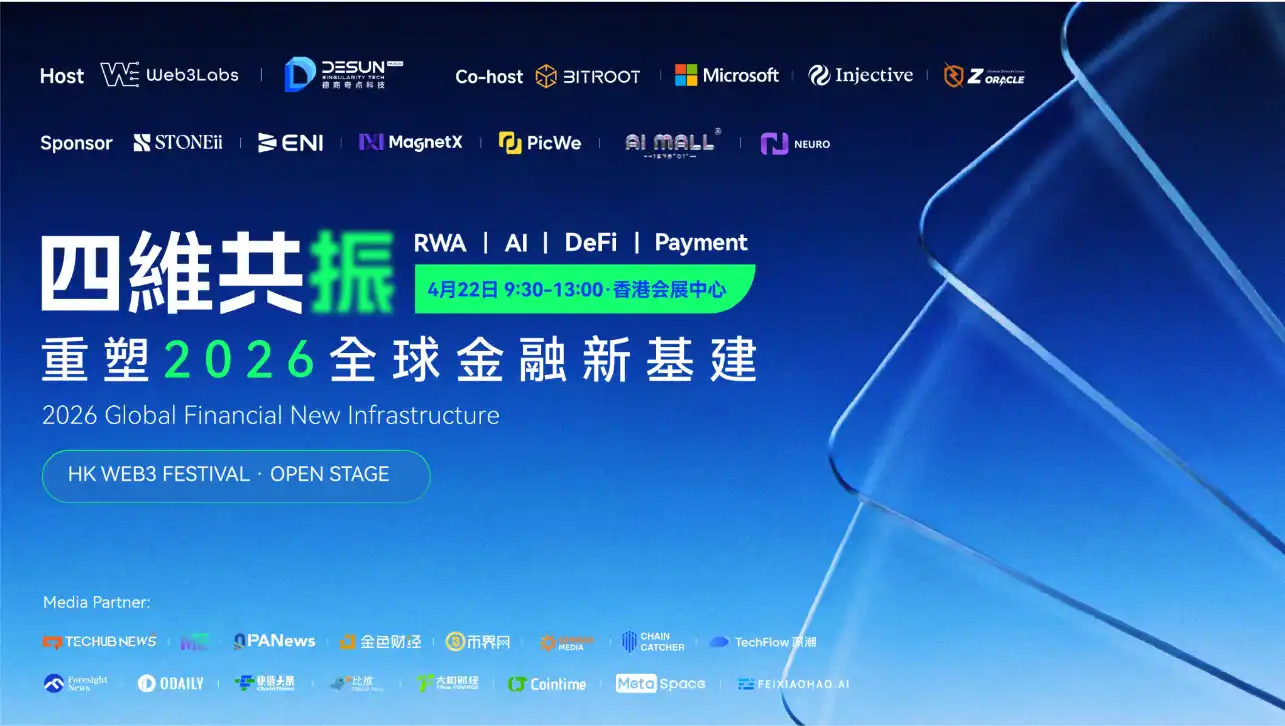
The "Four-Dimensional Resonance: 2026 Global Financial New Infrastructure" forum, a core event of the Hong Kong Web3 Festival, was successfully held at the Hong Kong Convention and Exhibition Centre. Co-hosted by Web3Labs and DeShang Singularity Tech, with joint support from Bitroot, Injective, Microsoft, and Z Oracle, the event gathered policymakers, industry leaders, and investors to explore the integration and innovation of global financial infrastructure, focusing on RWA, AI, DeFi, and compliant payments. Policy speakers, including Hong Kong Legislative Council Member Mr. Wu Jiezhuang, South Korean National Assembly Member Mr. Min Byung-duk, and ACED Chairman Mr. Yun Seok-hun, emphasized the importance of cross-border regulatory collaboration and an open policy environment for fintech innovation. Web3Labs CEO Caspar and DeShang Singularity Tech CEO Chang Shuai highlighted Hong Kong’s role as a financial innovation center and the approaching "singularity moment" for global financial infrastructure. Technical insights were shared by MagnetX, Bitroot, Microsoft, and Injective on topics including AI Agent economies, the evolution of public blockchains, and AI’s transformative role in finance. Key partnerships and initiatives were launched: - GWDC 2026 Korea collaboration between Hong Kong and South Korea. - A strategic agreement between Web3Labs and Microsoft. - The launch of a public anti-fraud alliance by Z Oracle and partners. - The "Injective Rising Star" program to support AI and Web3 projects. Panel discussions delved into AI-driven smart payments, compliant cross-border transactions, and the fusion of RWA and DeFi. Participants agreed that integrating RWA with DeFi is crucial for the next stage of financial infrastructure, enabling a shift from physical to digital finance. The forum underscored Hong Kong’s pivotal role in advancing a globalized and sustainable Asian fintech ecosystem.

marsbit20 мин. назад

Four-Dimensional Resonance: Hong Kong Web3 Carnival Sub-Forum Co-Creates Blueprint for Global Financial New Infrastructure

marsbit20 мин. назад

Торговля

Спот
Фьючерсы
活动图片