Blockchain Association Rejects Proposal To Widen Stablecoin Yield Restrictions

bitcoinistОпубликовано 2025-12-21Обновлено 2025-12-21

Введение

The Blockchain Association, along with over 125 crypto and fintech groups, is urging Senate Banking leaders to oppose efforts to expand a ban on stablecoin yields beyond what is explicitly stated in the GENIUS Act. The law prohibits stablecoin issuers from paying yields directly to holders but allows third-party platforms to offer rewards. The association argues that broadening the ban would harm competition and innovation, favoring larger financial firms. In contrast, banking groups, led by the American Bankers Association, are pushing for the ban to extend to partners and affiliates, warning that stablecoin rewards could circumvent the law and drain trillions from traditional bank deposits. The debate centers on consumer protection, financial stability, and the future competitive landscape of digital payments. Senate Banking staff are reviewing both sides as they consider potential legislative clarifications.

The Blockchain Association led a broad industry push this week, asking Senate Banking leaders to resist efforts that would widen a ban on stablecoin yields beyond what Congress wrote into law.

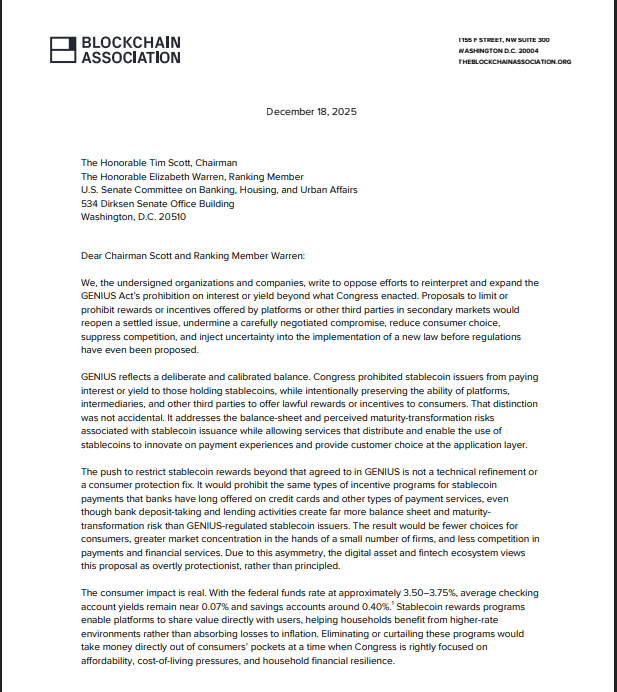
According to the association, the letter was signed by more than 125 crypto and fintech groups and companies and was sent to lawmakers to warn against reinterpreting the new rules in a way that would also bar exchanges and apps from offering rewards tied to stablecoin holdings.

Preserving Platforms’ Ability To Offer Rewards

The coalition’s argument rests on the text of the GENIUS Act, which was signed into law earlier this year by US President Donald Trump and explicitly bars permitted stablecoin issuers from paying interest or yield directly to holders.

Reports have disclosed that the statute nevertheless leaves room for third-party platforms to provide incentives, a distinction industry groups say is intentional and important for competition.

The letter pushes back against attempts to bar crypto platforms from offering yield to customers. Source: The Blockchain Association
Banks Call For Closing A Loophole

Banking groups have pushed back hard. A coalition led by the American Bankers Association and other banking trade groups asked Congress to clarify that the prohibition should extend to partners and affiliates, arguing that third-party rewards could circumvent the law and drain deposits from traditional banks.

According to recent coverage, Treasury analyses cited by bank advocates estimate that stablecoins could, in some scenarios, pull over $6 trillion from bank deposits — a figure that has become central to the banks’ case for tightening the rules.

What Industry Leaders Say

Industry spokespeople say expanding the ban would chill new services that rely on stablecoins and would tilt the market toward larger, incumbent financial firms that already control many payment rails.

BTCUSD currently trading at $88,063. Chart: TradingView

Based on reports, the Blockchain Association and partner groups contend that changing the law’s interpretation now would reopen negotiations the GENIUS Act resolved and would sow regulatory confusion before agencies finish writing implementing rules.

Competition And Consumer Choice At Stake

Supporters of stronger limits say the aim is consumer protection — to stop stablecoin arrangements from becoming de-facto interest accounts that could undermine the banking system and reduce loans to households and businesses.

Other observers point out the issue could also shape which firms win in payments going forward, since restrictions on rewards would affect the commercial incentives of exchanges and fintechs.

Next Steps In Washington

Senate Banking staff are weighing letters from both sides as they consider potential fixes or clarifying language during upcoming hearings.

Regulators who must implement the GENIUS Act have been urged to issue rules that prevent evasion of the ban, and lawmakers may face pressure to either leave the law as written or to craft narrow changes aimed at banks’ concerns.

Featured image from Unsplash, chart from TradingView

Связанные с этим вопросы

QWhat is the main action taken by the Blockchain Association this week?

AThe Blockchain Association led a broad industry push by sending a letter to Senate Banking leaders, asking them to resist efforts to widen a ban on stablecoin yields beyond the text of the GENIUS Act.

QAccording to the coalition's argument, what does the GENIUS Act explicitly prohibit?

AThe GENIUS Act explicitly bars permitted stablecoin issuers from paying interest or yield directly to holders.

QWhy are banking groups, like the American Bankers Association, pushing for a broader interpretation of the ban?

ABanking groups argue that third-party rewards could circumvent the law and drain deposits from traditional banks, with estimates suggesting stablecoins could pull over $6 trillion from bank deposits in some scenarios.

QWhat is the potential market impact if the ban on stablecoin yields is expanded to third parties, according to industry spokespeople?

AIndustry spokespeople say expanding the ban would chill new services that rely on stablecoins and would tilt the market toward larger, incumbent financial firms that already control many payment rails.

QWhat are the next steps for Senate Banking staff regarding this issue?

ASenate Banking staff are weighing letters from both sides as they consider potential fixes or clarifying language during upcoming hearings.

Похожее

Topping GitHub's Trending, the Essential Guide for Claude Code Users

The CLAUDE.md file, trending on GitHub, is a project-level guide for Claude Code designed to dramatically improve its accuracy and efficiency. It addresses key issues like repetitive context explanations, unauthorized code changes, and forgotten decisions across sessions. By placing this plain-text file in a project root, Claude Code reads it automatically at the start of each session. The guide includes rules to eliminate redundant explanations, enforce strict behavioral constraints (e.g., no modifications outside the requested scope without confirmation), and establish a "memory" system using companion files like MEMORY.md and ERRORS.md to log past decisions and failures. It also locks in the project's specific tech stack to prevent inappropriate tool recommendations. Highlighted are four foundational rules from Andrej Karpathy that reportedly increased coding accuracy from 65% to 94%: always ask for clarity first, implement the simplest solution, never touch unrelated code, and explicitly flag uncertainties. The article quantifies significant weekly cost savings for developers and teams by eliminating wasted time on re-explaining context, rolling back unauthorized edits, and re-evaluating previously rejected solutions. The core message is that a small, upfront investment in creating a CLAUDE.md file leads to a more predictable, controlled, and cost-effective AI programming assistant.

marsbit9 мин. назад

Topping GitHub's Trending, the Essential Guide for Claude Code Users

marsbit9 мин. назад

When Computing Power Becomes Commoditized, How Long Until a GPU Futures Market Emerges?

"When Will GPU Futures Arrive? A Framework for Assessing Compute as a Commodity" The article explores the potential for a robust futures market for compute power (GPUs), arguing that such a market is not yet mature but may emerge. It analyzes the landscape using a five-part framework developed for new commodity futures markets. The analysis scores the current state: * **Fragmented Supply (Red)**: Supply is highly concentrated among hyperscale cloud providers (AWS, Azure, GCP, Oracle), limiting the need for price discovery. * **Price Volatility (Green)**: GPU pricing is already highly volatile due to uncertain supply and surging demand. * **Physical Settlement Infrastructure (Green)**: Early infrastructure exists via OTC brokers and price indices (e.g., Ornn, Silicon Data) standardizing contracts. * **Standardized Unit (Red)**: A lack of standardized, tradable units hinders markets; a GPU instance hour varies by region, configuration, and contract terms. * **Lack of Alternatives (Yellow)**: Large players hedge internally via vertical integration, while smaller players bear spot market risk. Overall, the market shows promise (volatility, early infrastructure) but lacks the fragmented supply and standardization needed for large-scale futures trading. Most activity remains OTC. Key open questions and hypotheses: 1. Supply is expected to fragment moderately in 1-2 years, driven by new cloud providers, cheap power locations, and demand from non-frontier labs and AI startups using open-source models. 2. Standardization is most likely to emerge around inference workloads (forecast to be >65% of AI compute demand by 2029), which have simpler, more homogeneous hardware needs than training. Widespread adoption of open-source model weights could accelerate this by democratizing inference and creating demand for optimized, standardized infrastructure. 3. The primary traded unit will likely be the **"chip instance hour"** (akin to electricity, traded regionally), not the physical chip or the downstream AI output (tokens).

marsbit38 мин. назад

When Computing Power Becomes Commoditized, How Long Until a GPU Futures Market Emerges?

marsbit38 мин. назад

When Computing Power Becomes Commoditized, How Long Until a GPU Futures Market?

When Compute is Commoditized: How Far Away is a GPU Futures Market? The article explores the potential emergence of a futures market for computing power ("compute"), akin to markets for commodities like oil or electricity. It uses a five-dimension framework to assess the market's maturity for sustaining robust futures trading. **Current Market Assessment (Scorecard):** * **Supply Fragmentation:** 🔴 **Red.** Supply is highly concentrated, dominated by a few hyperscale cloud providers. * **Price Volatility:** 🟢 **Green.** GPU pricing is already highly volatile. * **Physical Settlement Infrastructure:** 🟢 **Green.** Early infrastructure exists at the OTC/broker level. * **Standardization:** 🔴 **Red.** Compute lacks a standardized, tradable unit (e.g., an H100 hour is not uniform). * **Lack of Substitutes:** 🟡 **Yellow.** Vertically integrated players can hedge internally, while others are forced to be long. **Conclusion:** The overall scorecard suggests a robust futures market is premature. The market has volatility and early settlement infrastructure but lacks the necessary supply fragmentation and standardization for large-scale price discovery. Most activity remains OTC. **Key Unanswered Questions & Hypotheses:** The article posits that the market could evolve in the next 1-2 years: 1. **Supply:** May become *moderately more fragmented* due to new cloud providers, cheaper power locations, and demand from long-tail users (e.g., startups running open-source model inference). 2. **Standardization:** Could emerge from the growing **inference** workload (expected to be >65% of AI compute demand by 2029), which has more homogeneous hardware requirements than custom training workloads. Widespread adoption of **open-source model weights** is seen as a key catalyst for democratizing inference and driving infrastructure standardization. 3. **Traded Unit:** The most viable layer for trading is likely the **"chip-instance-hour"** (powered, usable compute time), traded similarly to electricity in regional contracts with spot/futures overlays. Trading at the upstream "chip" layer is unlikely due to supply concentration, while the downstream "token" layer faces challenges due to lack of uniformity across AI models.

链捕手44 мин. назад

When Computing Power Becomes Commoditized, How Long Until a GPU Futures Market?

链捕手44 мин. назад

Торговля

Спот
Фьючерсы
活动图片