BlackRock, Apollo, Citadel Enter the Market in the Same Week, Investing Real Money in DeFi Governance Tokens

marsbitОпубликовано 2026-03-25Обновлено 2026-03-25

Введение

In February 2026, major financial institutions including BlackRock, Apollo, and Citadel made significant moves into DeFi by directly purchasing governance tokens and integrating their products with decentralized infrastructure. Citadel invested in LayerZero’s ZRO token, BlackRock listed its $2.5B BUIDL fund on UniswapX and acquired UNI tokens, and Apollo committed to acquiring up to 9% of Morpho’s token supply over four years. These actions mark a shift from exploratory partnerships to tangible on-chain engagement, emphasizing economic alignment through token ownership and the use of live, revenue-generating DeFi protocols. The trend reflects growing institutional confidence in public, permissionless DeFi infrastructure, driven by proven scalability and network effects. Regulatory developments, such as the potential passage of the CLARITY Act, could further accelerate this institutional adoption of DeFi.

Author: José Sanchez & Kelvin Koh

Compiled by: Deep Tide TechFlow

Deep Tide Introduction: In February 2026, the way traditional financial institutions entered DeFi underwent a qualitative change: no longer through strategic partnership announcements, but by directly purchasing governance tokens and routing products to decentralized infrastructure.

Within five days, Citadel bought ZRO, BlackRock bought UNI and listed BUIDL on UniswapX, Apollo committed to acquiring 9% of Morpho's token supply over four years. Spartan Group believes this is the true inflection point for the institutionalization of DeFi.

Full Text Below:

Inflection Point for DeFi Institutionalization

February 2026, within just five days, a cluster of landmark institution-crypto collaborations emerged, which we believe marks a qualitative change in how traditional finance participates in on-chain infrastructure.

Citadel Securities announced an investment in LayerZero's ZRO token; BlackRock listed its $2.5 billion BUIDL fund on UniswapX and purchased UNI tokens; Apollo Global Management committed to acquiring up to 9% of Morpho's total governance token supply over four years.

Previously, the NYSE had already announced on January 19th the launch of a tokenized securities platform supporting 24/7 on-chain settlement. The pattern is clear: institutional capital is shifting from exploration to real on-chain execution—buying tokens, acquiring governance rights, routing products to decentralized infrastructure.

This wave of entry differs from previous cycles in three ways.

First, these are direct token purchases that create economic alignment, not advisory arrangements or pilot declarations.

Second, the related products are actively operating with real revenue: BUIDL manages $2.5 billion, Morpho supports over $900 million in active loans for Coinbase, LayerZero has settled over $70 billion in USDT0 cross-chain transfers.

Third, institutions chose public, permissionless protocols, not proprietary closed systems, indicating that the composability and network effects of existing DeFi infrastructure are more valuable than the control offered by custom systems.

The NYSE kicked off this show on January 19th, announcing plans to build a blockchain-based venue supporting 24/7 trading and instant on-chain settlement of tokenized stocks and ETFs, combining its Pillar matching engine with a blockchain post-trade system. Although still subject to regulatory approval and implementation details are relatively limited, this is the highest-level directional signal: the world's most iconic stock exchange is targeting on-chain settlement as core infrastructure.

LayerZero followed on February 10th with Zero, a new L1 designed for institutional-grade financial infrastructure. Citadel Securities made a strategic ZRO token purchase, significant for a firm handling about 35% of US retail stock trading.

DTCC will explore using Zero to expand its tokenization and collateral management capabilities; ICE is evaluating the chain for 24/7 trading infrastructure; Google Cloud joined to explore AI Agent micropayments; ARK Invest holds both equity and token positions, with Cathie Wood joining the advisory board.

Tether also announced a separate strategic investment in LayerZero Labs on the same day. Zero is expected to launch in Fall 2026, with three zones: a general EVM environment, a privacy-focused payments zone, and a dedicated trading zone.

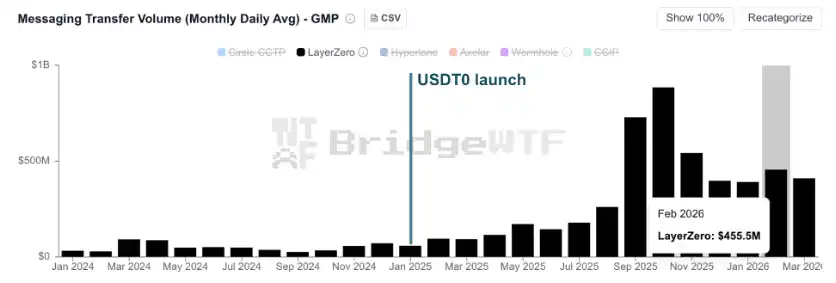
Institutional interest reflects proven throughput capability. USDT0—Tether's omnichain stablecoin built on LayerZero's OFT standard—has facilitated over $70 billion in cross-chain transfers since January 2025.

As shown in the figure below, daily settled value accelerated sharply after USDT0's launch, transforming LayerZero from a messaging layer into critical financial infrastructure.

Figure: USDT0 has facilitated over $70 billion in cross-chain transfers since launch

Source: BridgeWTF

The next day, BlackRock's $2.4 billion BUIDL fund (the largest tokenized US Treasury product) was listed and made tradable on UniswapX, marking the first time a BlackRock product became accessible via decentralized exchange infrastructure.

Securitize handles compliance and whitelisting, while Wintermute, Flowdesk, and Tokka Labs compete for quotes through UniswapX's RFQ framework. BlackRock also disclosed a strategic UNI token purchase (specific terms not yet public), its first DeFi governance token on its balance sheet.

Although BUIDL's access is still limited to qualified purchasers with a minimum of $5 million, Securitize CEO Carlos Domingo stated that the infrastructure is designed to scale to retail products over time.

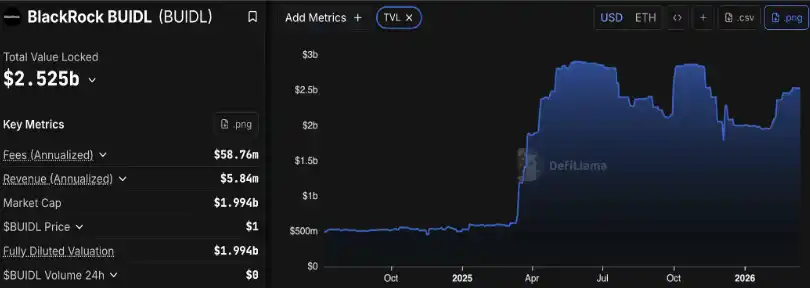
The decision to list on Uniswap reflects BUIDL's evolution from a niche experiment to an institutional-scale product. Since launching in March 2024 with a $40 million size, the fund peaked at nearly $2.9 billion in mid-2025 and currently has a TVL of around $2.5 billion.

Figure: BlackRock's BUIDL fund currently has a TVL of $2.5 billion

Source: Defillama

On February 13th, Apollo Global Management signed a cooperation agreement, committing to acquire up to 90 million MORPHO tokens over 48 months, approximately 9% of the total supply.

In addition to the token acquisition (valued at approximately $110 million at mid-February prices), Apollo will also collaborate to build on-chain lending markets, extending its blockchain footprint—part of its credit strategies are already tokenized via Securitize (ACRED) and Anemoy (ACRDX).

This deal is one of the most significant collaborations to date between an institution and a native DeFi protocol.

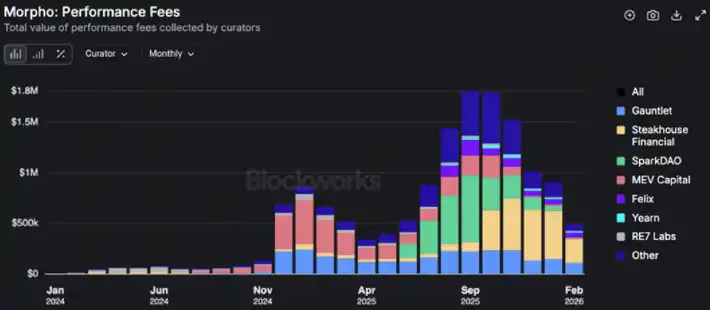
The opportunities for institutions within Morpho extend beyond token ownership. The protocol's architecture allows any entity to become a vault curator, building lending markets with customized risk parameters. Curators can earn performance fees from generated yield and management fees (capped at 5%) from AUM, creating a sustainable revenue model for institutional participants.

Perhaps the most convincing validation of the infrastructure is the CeFi-DeFi "Mohawk" model pioneered by Coinbase: retail users borrow against BTC and ETH collateral through the Coinbase interface, while Morpho acts as the lending engine on the backend, currently supporting over $900 million in active loans and $1.7 billion in collateral.

This proves that institutional-grade DeFi can be abstracted and scaled to operate behind familiar consumer interfaces, with users not needing to interact with the underlying protocol.

For Apollo, the vault curator economics, the validated distribution channel via Coinbase, and the governance influence gained through token accumulation together form a strong positioning in the on-chain credit space.

This convergence validates the design choices of permissionless, composable protocols and suggests sustained demand for governance tokens of infrastructure layer projects.

Key risks remain in execution: regulatory approval for the NYSE platform and Zero is pending, institutional token purchases may test protocol governance, and the gap between announcements and sustained on-chain activity remains significant. Nonetheless, the directional signal is unmistakable.

Figure: Morpho vault curators have generated substantial fee revenue

Source: Blockworks Research

Looking ahead, we expect these partnerships to deepen further once the CLARITY Act is passed. The Act passed the House in July 2025 by a vote of 294 to 134 and is now advancing in the Senate, where the Banking and Agriculture Committees need to reconcile their respective draft versions before a full vote.

The main point of contention is the treatment of stablecoin yield: the banking side is pushing to restrict interest payments on stablecoin balances, while crypto firms argue this would push innovation overseas.

July is widely seen as a key deadline before the August recess; if missed, the next window will be delayed until the fall. Once enacted, the CLARITY Act will provide the US's first comprehensive digital asset regulatory framework, clarify SEC/CFTC jurisdiction, establish a registration path for digital commodity exchanges, and provide legal certainty for tokenized products.

For protocols like Morpho and Uniswap, this will remove the regulatory ambiguity that currently constrains the scope of institutional cooperation. We believe this will unlock a second, broader wave of TradFi-crypto integration.

Связанные с этим вопросы

QWhat significant shift in how traditional financial institutions engage with DeFi occurred in February 2026?

AThe shift was a move from strategic partnership announcements to directly purchasing governance tokens and routing products to decentralized infrastructure, marking a qualitative change in their participation.

QWhich three major institutions made significant moves into DeFi within a five-day period, and what did each do?

ACitadel Securities invested in LayerZero's ZRO token; BlackRock listed its $2.5B BUIDL fund on UniswapX and purchased UNI tokens; Apollo Global Management committed to acquiring up to 9% of Morpho's token supply over four years.

QWhat are the three key differences between this wave of institutional entry into DeFi and previous cycles?

A1. They involve direct token purchases creating economic alignment, not just advisory roles or pilot announcements. 2. The involved products are actively operating with real revenue. 3. Institutions chose public, permissionless protocols over proprietary closed systems, valuing composability and network effects.

QWhat is the significance of the 'Mohawk' model pioneered by Coinbase, as mentioned in the context of Morpho?

AThe 'Mohawk' model is a CeFi-DeFi hybrid where retail users borrow against BTC and ETH through the Coinbase interface, while Morpho acts as the lending engine on the backend. It proves that institutional-grade DeFi can be abstracted and scaled behind a consumer interface.

QWhat potential future development does the article suggest could further deepen these TradFi-DeFi partnerships, and what is a key point of contention surrounding it?

AThe passage of the CLARITY Act is expected to deepen partnerships. A key point of contention is the treatment of stablecoin yield, with banks pushing to restrict interest payments on stablecoin balances, while crypto firms argue this would push innovation overseas.

Похожее

When Doing Cryptocurrency Payment, the First Thing is Licenses, What is the Second?

When launching a crypto payment business, obtaining the necessary licenses is the crucial first step. However, the second, and arguably more critical, step is designing a comprehensive operational framework that forms a coherent business loop. This loop must be clearly understood and executable by all stakeholders: banks, payment partners, exchanges, on-chain analytics providers, regulators, and your internal team. Many projects mistakenly believe a single license permits all operations. Licenses merely grant entry; they don't define how the specific business functions. The real challenge lies in detailing every aspect of the workflow. This involves clarifying the customer base, the flow of fiat and crypto assets, the settlement process, and establishing clear lines of responsibility for risks like AML compliance, sanctions screening, chargebacks, and regulatory inquiries. A robust framework must answer seven core questions: Who are the clients and merchants? Who collects fiat and crypto? Who handles conversion and custody? And who is ultimately accountable for compliance and risk management? Projects often fail not from a lack of licensing, but during due diligence when they cannot convincingly explain these operational details. Therefore, beyond securing licenses, the priority must be constructing a closed-loop system. This system ensures the business model is transparent, risks are managed, responsibilities are delineated, contracts are aligned, and the entire process is comprehensible to partners and regulators. The true competitive edge in crypto payments lies not in acquiring a license quickly, but in integrating licensing, banking, compliance, and operations into a sustainable and executable whole.

marsbit9 мин. назад

When Doing Cryptocurrency Payment, the First Thing is Licenses, What is the Second?

marsbit9 мин. назад

Arthur Hayes Analysis: AI Bubble Nears Burst, Crypto Market Faces Short-Term Pressure

Arthur Hayes argues that the current AI market is a bubble poised to burst, which will exert downward pressure on the crypto market in the near term. The core trigger is rising oil prices due to the US-Iran conflict and a blockade of the Strait of Hormuz. Higher energy costs directly increase the operational expenses of AI data centers, squeezing profit margins for companies like Google, Anthropic, and OpenAI. Hayes predicts that persistent inflation from high oil prices will force Trump, in a bid to win the November election, to turn public sentiment against the AI industry. He may propose regulations and taxes on data centers and AI companies to appeal to voters concerned about costs and job displacement. Such political rhetoric could shatter market confidence. Furthermore, the market is unlikely to healthily absorb the massive concurrent IPOs of SpaceX, Anthropic, and OpenAI, which together seek valuations in the trillions. The combination of soaring energy costs, overwhelming equity supply, and negative political pressure will puncture the AI bubble. Hayes notes that nearly all new USD liquidity since 2022 has flowed into AI, leaving crypto like Bitcoin behind. When the AI bubble bursts, liquidity will contract sharply, pulling down all risk assets, including cryptocurrencies. In response, Hayes's fund, Maelstrom, has sold all AI-related stocks and non-core cryptocurrencies. It maintains core positions in Bitcoin and Ethereum while increasing exposure to energy sector equities, betting on rising oil and gas prices. He expects Bitcoin to bottom after the AI-led market decline, before rallying again with future monetary easing.

Foresight News23 мин. назад

Arthur Hayes Analysis: AI Bubble Nears Burst, Crypto Market Faces Short-Term Pressure

Foresight News23 мин. назад

To C, To B, and the Next Big Thing Called To A

After To C and To B, the Next Wave is To A: Serving AI Agents In a recent quarterly earnings call, Meituan's Wang Xing introduced a new concept: To A (To Agent), signifying that future business services will increasingly target AI Agents as primary clients, not just consumers or merchants. This shift implies that internet giants must now consider how to make their services more appealing for AI Agents to recommend, fundamentally altering traditional distribution logic. This "To A era" is prompting an unusual trend of alliances among major tech companies. Unlike previous competitive battles, firms like Meituan, Tencent, JD.com, Huawei, OPPO, and OpenAI are rapidly forming partnerships. The reason is strategic: as AI Agents become the primary user interface, handling tasks from a single command (e.g., "Book a Japanese restaurant for tomorrow"), the risk for platforms is being bypassed entirely. Companies are positioning themselves within this new value chain. Three primary strategies are emerging: 1. **Super-Entry Points + Service Providers:** Platforms like Tencent's Yuanbao, WeChat, and ChatGPT aim to be the first-stop Agent, integrating various services (food delivery, shopping, travel) from partners like Meituan and JD.com. 2. **Apps as Callable Services:** Companies like Meituan, JD.com, and Uber are ensuring their core services remain accessible and callable by external Agents, shifting from front-end apps to back-end capabilities. 3. **System-Level Agent Entry Points:** Smartphone makers (Huawei, Honor, OPPO) are leveraging their OS-level AI assistants to control the initial user command, redistributing it to relevant service apps. While alliances offer mutual benefit—entry points gain service capabilities, and service providers gain traffic—inherent conflicts of interest exist. A dominant Agent platform could eventually attempt to connect directly with suppliers (restaurants, hotels), bypassing current aggregators like Meituan or Ctrip. Other unresolved challenges include the potential for Agent recommendations to become a new form of paid ranking and unclear accountability for faulty recommendations. The current rush to form alliances is a defensive move by service providers to secure their position before the landscape solidifies. In this To A-driven restructuring, the greatest risk is not losing the race but failing to hear the starting gun.

marsbit32 мин. назад

To C, To B, and the Next Big Thing Called To A

marsbit32 мин. назад

The More Lifelike the Robot, the More Terrifying? Unveiling the 'Uncanny Valley Effect' in the Era of Humanoid Robots

As humanoid robots become increasingly lifelike, they confront a significant psychological barrier known as the "Uncanny Valley Effect," a concept proposed by Japanese roboticist Masahiro Mori in 1970. This phenomenon describes a dip in human comfort and acceptance when robots appear almost, but not perfectly, human. Minor imperfections in facial expressions, eye movements, or skin texture trigger a subconscious sense of unease, as the brain detects something trying, yet failing, to mimic a person. Examples range from the controversial human-like robot Sophia to animated characters in films like *The Polar Express*. The effect poses a key design challenge for robotics companies. Some, like Boston Dynamics, avoid it entirely by creating highly capable but visibly mechanical robots. Others, like Hanson Robotics, push for greater human likeness despite the risk. For consumer robots, especially in homes, most manufacturers opt for stylized or clearly mechanical designs to ensure broader acceptance. While the Uncanny Valley remains a powerful force, its impact may diminish over time through technological advancements that achieve near-perfect realism or through generational familiarity as people grow accustomed to interacting with humanoid machines. Ultimately, navigating this psychological frontier requires as much understanding of human perception as of robotics technology itself.

marsbit32 мин. назад

The More Lifelike the Robot, the More Terrifying? Unveiling the 'Uncanny Valley Effect' in the Era of Humanoid Robots

marsbit32 мин. назад

Торговля

Спот
Фьючерсы
活动图片