Bitwise Submits Second Amended Hyperliquid ETF Filing — Launch Imminent?

bitcoinistОпубликовано 2026-04-12Обновлено 2026-04-12

Введение

Bitwise has filed a second amended application with the SEC for its spot Hyperliquid (HYPE) ETF, adding FalconX, Flowdesk, Nonco, and Wintermute as approved trading counterparties. This update, highlighted by Bloomberg analyst Eric Balchunas, suggests an imminent launch. Bitwise is positioned to be the first to market with a HYPE ETF, ahead of competitors 21Shares and Grayscale. The proposed fund, with ticker BHYP and a 0.67% management fee, plans to generate additional yield through staking. Meanwhile, HYPE's price has surged over 65% year-to-date, trading near $43 amid strong market performance.

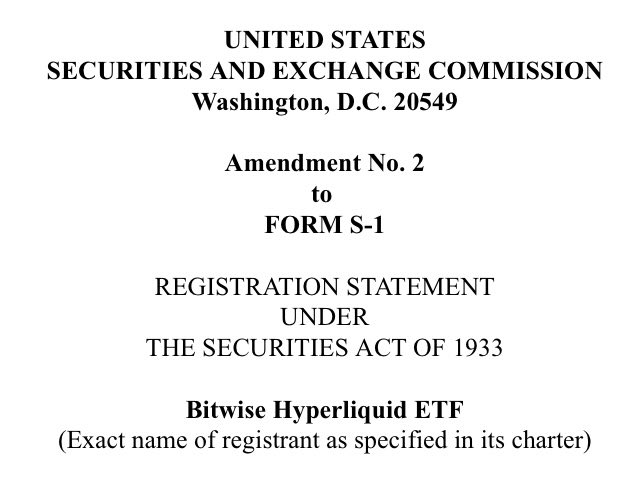
According to the latest report, Bitwise has taken a step closer toward the launch of its proposed spot Hyperliquid (HYPE) exchange-traded fund (ETF) after filing a second amendment with the United States Securities and Exchange Commission.

Bitwise Updates List Of Countertrading Parties In Hyperliquid ETF Filing

On Friday, April 10th, Bitwise submitted its second amendment to its spot Hyperliquid with the SEC, introducing new names to the list of approved trading counterparties ahead of an imminent launch in the US. This latest filing included FalconX, Flowdesk, Nonco, and Wintermute as approved trading counterparties for the asset manager.

Earlier in its first amendment filing in December 2025, Bitwise revealed the fund’s BHYP ticker, an annual management fee of 0.67%, and a proposal to generate additional profit through HYPE staking. Also, the asset management fund had listed three trading counterparties at the time, including A1 (now dropped off), Nonco, and Solios (disclosed as a d/b/a of FalconX).

Source: @EricBalchunas on X

In a post on the social media platform, Bloomberg senior ETF analyst Eric Balchunas highlighted the second amendment filing, saying that this latest update suggests that the fund’s launch might be imminent. Despite competition from two other asset managers, Bitwise looks set to win the race for the first spot ETF linked to Hyperliquid’s native token, HYPE.

21Shares followed with an application of its own to launch a Hyperliquid ETF in October 2025, while Grayscale submitted its own filing in late March 2026. Upon approval (which looks like a matter of when rather than if), Bitwise’s HYPE ETF will debut on the NYSE Arca stock exchange and offer investors exposure to the spot price of Hyperliquid.

HYPE Price Overview

Despite the raging market uncertainty this year, Hyperliquid’s native token HYPE has been one of the best performers so far. In fact, it can be said that the decentralized perpetual futures trading protocol has been one of the major winners from the Middle East tensions, as traders looked to gain market exposure even outside of regular trading hours.

Data from CoinGecko shows that the price of HYPE is up by more than 65% year-to-date and almost 200% in the past full year. As bullish momentum returned to the cryptocurrency market his week, investors have seen the altcoin’s price reclaim the $40 mark, jumping by nearly 20% in the past week.

As of this writing, the price of HYPE sits just beneath $43, reflecting a nearly 3% jump in the past 24 hours.

The price of HYPE on the daily timeframe | Source: HYPEUSDT chart on TradingView

Связанные с этим вопросы

QWhat is the latest step Bitwise has taken towards launching its spot Hyperliquid ETF?

ABitwise has filed a second amended S-1 filing with the SEC, updating its list of approved trading counterparties.

QWhich new trading counterparties were added in Bitwise's second amendment for the HYPE ETF?

AThe new approved trading counterparties added are FalconX, Flowdesk, Nonco, and Wintermute.

QAccording to the article, which analyst suggested that the launch of the Bitwise HYPE ETF is imminent?

ABloomberg senior ETF analyst Eric Balchunas suggested the fund's launch might be imminent after the second amendment was submitted.

QOn which stock exchange is the Bitwise Hyperliquid ETF expected to debut upon approval?

AUpon approval, Bitwise's HYPE ETF is expected to debut on the NYSE Arca stock exchange.

QHow has the price of HYPE performed year-to-date according to CoinGecko data mentioned in the article?

AAccording to CoinGecko data, the price of HYPE is up by more than 65% year-to-date.

Похожее

Why Hasn't the U.S. Seen the Rise of 'Huabei' or 'Jiebei'?

The article explores why the U.S. lacks large-scale consumer credit products like China's "Huabei" and "Jiebei," despite having a developed financial sector. Key reasons include: 1. **Structural Barriers**: A fragmented federal and state regulatory system, reinforced by post-2008 reforms like the Dodd-Frank Act, raises compliance costs and protects traditional banks, stifling fintech innovation. 2. **Credit Card Dominance**: Credit cards, used by 70-80% of adults, form a $1.28 trillion debt market with high APRs (avg. 22.3%). This system cross-subsidizes users who pay in full with those carrying balances, creating a predatory yet entrenched ecosystem. 3. **Data Privacy Laws**: Strict regulations (e.g., FCRA, CCPA) prevent tech giants from leveraging behavioral data for credit scoring, unlike in China where such data fuels fintech models. 4. **Capital Market Disincentives**: Wall Street penalizes tech firms entering finance due to lower valuations associated with heavy regulation and risk, as seen in Apple’s failure with Apple Card. 5. **Banking Oligopoly**: Major banks control consumer lending, leveraging lobbying power and consumer habits to maintain high-cost credit, while alternatives like payday loans (400% APR) or "unbanked" services remain niche or exploitative. Ultimately, regulatory, structural, and corporate interests collectively block the emergence of accessible, low-cost digital lending in the U.S.

Odaily星球日报45 мин. назад

Why Hasn't the U.S. Seen the Rise of 'Huabei' or 'Jiebei'?

Odaily星球日报45 мин. назад

More and More 'Model Supermarkets' Are Opening: ByteDance, Alibaba, and Tencent Compete to Integrate

Chinese tech giants like ByteDance, Alibaba, and Tencent are accelerating the rollout of integrated AI model subscription services—dubbed “model supermarkets”—to provide developers with bundled access to multiple leading domestic large language models (LLMs). ByteDance’s Volcengine recently upgraded its "Coding Plan" by adding newer models like GLM-5.1, Minimax M2.7, and Kimi k2.6, allowing subscribers to use various top models under a single monthly fee starting at ¥40. However, user feedback reveals significant issues, including rapid consumption of usage limits (e.g., hitting caps within hours), frequent server errors (like HTTP 429), and slow response times during peak hours. Complaints about misleading deduction rates—where calls to advanced models consume more quota—are also common. The trend is industry-wide: Alibaba, Tencent, and Baidu have all launched similar multi-model coding plans. While these platforms reduce trial costs for developers, they also expose challenges in balancing affordability with service quality and computational stability. Amid this shift, independent AI companies like Zhipu, MiniMax, and Moonlight Face (Kimi) are developing strategies to avoid becoming mere “pipes” in this ecosystem—focusing on vertical applications, autonomous agents, and long-context models to retain competitiveness. Analysts suggest that, while platform aggregation may pressure model firms in the short term, specialized and vertical AI capabilities will remain differentiated in the long run.

marsbit49 мин. назад

More and More 'Model Supermarkets' Are Opening: ByteDance, Alibaba, and Tencent Compete to Integrate

marsbit49 мин. назад

Торговля

Спот
Фьючерсы
活动图片