Bitwise crypto index fund moves from over-the-counter to NYSE Arca for trading

cointelegraphОпубликовано 2025-12-09Обновлено 2025-12-09

Введение

Bitwise Asset Management's 10 Crypto Index Fund (BITW) is transitioning from the over-the-counter market to NYSE Arca, marking a significant step toward mainstream adoption. The fund, which offers diversified exposure to the top 10 cryptocurrencies like Bitcoin and Ethereum, will now trade as an exchange-traded product on a major regulated securities exchange. This move is expected to reduce investment friction and provide a safer, more accessible entry point for investors hesitant about direct crypto exposure. Bitwise, an early issuer of a spot Bitcoin ETF, has seen growing institutional interest amid regulatory developments and market volatility, including recent large liquidations and subsequent inflows into crypto ETPs.

Bitwise Asset Management’s 10 Crypto Index Fund (BITW) is moving from the over-the-counter market to NYSE Arca, a shift that brings crypto exposure further into mainstream trading infrastructure.

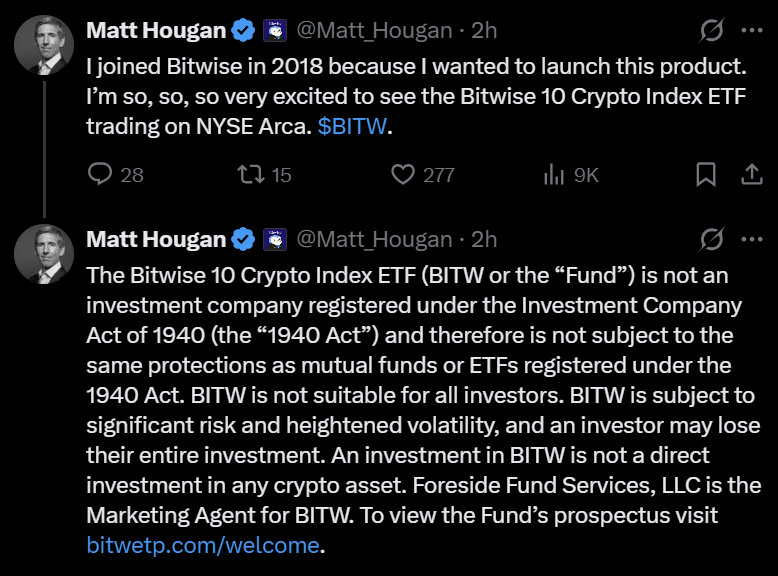
Beginning Tuesday, BITW is officially uplisted to NYSE Arca — one of the New York Stock Exchange’s electronic markets for exchange-traded products — where it will trade as an exchange-traded product, the company announced.

Launched in 2017, BITW offers diversified exposure to the 10 largest cryptocurrencies by market capitalization, including Bitcoin (BTC), Ether (ETH), Solana (SOL) and XRP (XRP). The fund rebalances monthly to reflect changes in the broader crypto market.

Listing on NYSE Arca places a crypto-linked product on a major regulated securities exchange, the same type of venue where traditional exchange-traded funds (ETFs) trade. The move is expected to reduce friction for investors who may be hesitant to navigate crypto exchanges.

“Most investors we meet are convinced crypto is here to stay, but they don't know who the winners will be or how many will succeed," said Bitwise CIO Matt Hougan. “The index approach is a way for people to invest in the thesis without having to predict the future.”

Source: Matt Hougan

Bitwise was among the first issuers to receive approval for a spot Bitcoin ETF in January 2024. Its Bitwise Bitcoin ETF Trust (BITB) was one of the fastest 25 exchange-traded products to reach $1 billion in assets, hitting the milestone roughly a month after launch.

Related: Bitwise files for stablecoin, tokenization ETF with US SEC

Institutional adoption and market volatility

Institutional interest in digital assets has expanded rapidly since the approval of US spot Bitcoin ETFs in early 2024. The arrival of the more crypto-friendly Trump administration has further accelerated adoption through increased regulatory attention, new legislation and a federal mandate to support the industry’s development.

At the same time, institutional investors have been reminded of the sector’s inherent volatility, which remains elevated even as larger and more established participants enter the market.

Crypto markets saw their largest-ever liquidation event on Oct. 10, when roughly $19 billion in positions were wiped out. The resulting turbulence over the following month triggered sharp withdrawals and significant outflows from crypto exchange-traded products.

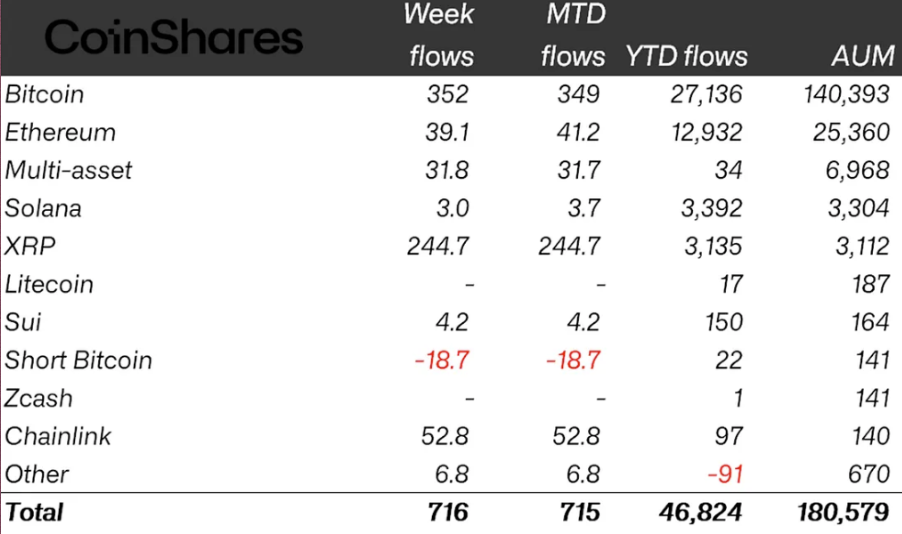
However, inflows have resumed in the last two weeks, with ETP inflows exceeding $1.7 billion over that period, according to CoinShares data.

Inflows into crypto ETPs flip positive for two consecutive weeks. Source: CoinShares


Magazine: Decade after Ethereum ICO: Blockchain forensics end double-spending debate

Похожее

Why Hasn't the U.S. Seen the Rise of 'Huabei' or 'Jiebei'?

The article explores why the U.S. lacks large-scale consumer credit products like China's "Huabei" and "Jiebei," despite having a developed financial sector. Key reasons include: 1. **Structural Barriers**: A fragmented federal and state regulatory system, reinforced by post-2008 reforms like the Dodd-Frank Act, raises compliance costs and protects traditional banks, stifling fintech innovation. 2. **Credit Card Dominance**: Credit cards, used by 70-80% of adults, form a $1.28 trillion debt market with high APRs (avg. 22.3%). This system cross-subsidizes users who pay in full with those carrying balances, creating a predatory yet entrenched ecosystem. 3. **Data Privacy Laws**: Strict regulations (e.g., FCRA, CCPA) prevent tech giants from leveraging behavioral data for credit scoring, unlike in China where such data fuels fintech models. 4. **Capital Market Disincentives**: Wall Street penalizes tech firms entering finance due to lower valuations associated with heavy regulation and risk, as seen in Apple’s failure with Apple Card. 5. **Banking Oligopoly**: Major banks control consumer lending, leveraging lobbying power and consumer habits to maintain high-cost credit, while alternatives like payday loans (400% APR) or "unbanked" services remain niche or exploitative. Ultimately, regulatory, structural, and corporate interests collectively block the emergence of accessible, low-cost digital lending in the U.S.

Odaily星球日报36 мин. назад

Why Hasn't the U.S. Seen the Rise of 'Huabei' or 'Jiebei'?

Odaily星球日报36 мин. назад

More and More 'Model Supermarkets' Are Opening: ByteDance, Alibaba, and Tencent Compete to Integrate

Chinese tech giants like ByteDance, Alibaba, and Tencent are accelerating the rollout of integrated AI model subscription services—dubbed “model supermarkets”—to provide developers with bundled access to multiple leading domestic large language models (LLMs). ByteDance’s Volcengine recently upgraded its "Coding Plan" by adding newer models like GLM-5.1, Minimax M2.7, and Kimi k2.6, allowing subscribers to use various top models under a single monthly fee starting at ¥40. However, user feedback reveals significant issues, including rapid consumption of usage limits (e.g., hitting caps within hours), frequent server errors (like HTTP 429), and slow response times during peak hours. Complaints about misleading deduction rates—where calls to advanced models consume more quota—are also common. The trend is industry-wide: Alibaba, Tencent, and Baidu have all launched similar multi-model coding plans. While these platforms reduce trial costs for developers, they also expose challenges in balancing affordability with service quality and computational stability. Amid this shift, independent AI companies like Zhipu, MiniMax, and Moonlight Face (Kimi) are developing strategies to avoid becoming mere “pipes” in this ecosystem—focusing on vertical applications, autonomous agents, and long-context models to retain competitiveness. Analysts suggest that, while platform aggregation may pressure model firms in the short term, specialized and vertical AI capabilities will remain differentiated in the long run.

marsbit40 мин. назад

More and More 'Model Supermarkets' Are Opening: ByteDance, Alibaba, and Tencent Compete to Integrate

marsbit40 мин. назад

Торговля

Спот
Фьючерсы
活动图片