BitMine enters Ethereum staking race with new MAVAN platform – Details

ambcryptoОпубликовано 2026-03-27Обновлено 2026-03-27

Введение

BitMine Immersion Technologies, the world's largest Ethereum treasury firm, has launched a new ETH staking platform called MAVAN (Made in America Validator Network) with the goal of becoming the leading staking provider. The company has already staked 3.14 million ETH worth over $6.8 billion and holds a total of 4.6 million ETH, representing 3.8% of the total supply. It aims to control 5% of the circulating supply and generate $300 million in annual yield. While staking all its ETH would make it the second-largest platform, surpassing Binance, it would still need an additional 5 million ETH to overtake current leader Lido, which holds nearly 9 million staked ETH. BitMine also plans to expand into other proof-of-stake networks and blockchain infrastructure in the future.

Bitmine Immersion Technologies, the world’s largest Ethereum treasury firm, now aims to replace Lido as the top ETH staking platform. On Wednesday, the firm unveiled its ETH staking platform dubbed MAVAN (an acronym for Made in America Validator Network).

The firm reported that it has already staked 3,142, 643 ETH as of Tuesday, 24 March, translating to over $6.8B worth of staked ETH based on current market prices. In the past week alone, BitMine staked 101.7K ETH, worth $219M.

At the time of writing, BitMine held a total of 4.6 million ETH or 3.8% of the total supply. It aims to control 5% of the circulating supply.

It also bought an additional 50K ETH earlier on Thursday, bringing its weekly buys to over 117K ETH. This meant the remaining unstaked ETH was over 1.5 million ETH. This too will be staked in the coming weeks, the firm said.

BitMine’s aggressive bet on ETH staking

The end goal is to become the top staking platform for institutions with the potential to generate $300M annually at the current 2.83% 7-day BMNR yield. Tom Lee, the chairman of the firm, added,

Because Bitmine is the largest owner of Ethereum in the world, shortly after launch, MAVAN will be the largest Ethereum staking platform in the world.

Highlighting MAVAN and Bitmine’s long-term staking strategy, Lee continued,

We plan to expand across additional proof-of-stake (PoS)networks and critical blockchain infrastructure over time, and through 2026, we’ll grow our efforts in areas such as on-chain vaults, post-quantum client development, and more.

In other words, other PoS chains like SOL, BNB, Tron [TRX], and others could fall in BitMine’s staking orbit.

However, the update could shake up the broader ETH staking ecosystem, which is currently facing stiff competition amid growing appetite for low-risk institutional staking.

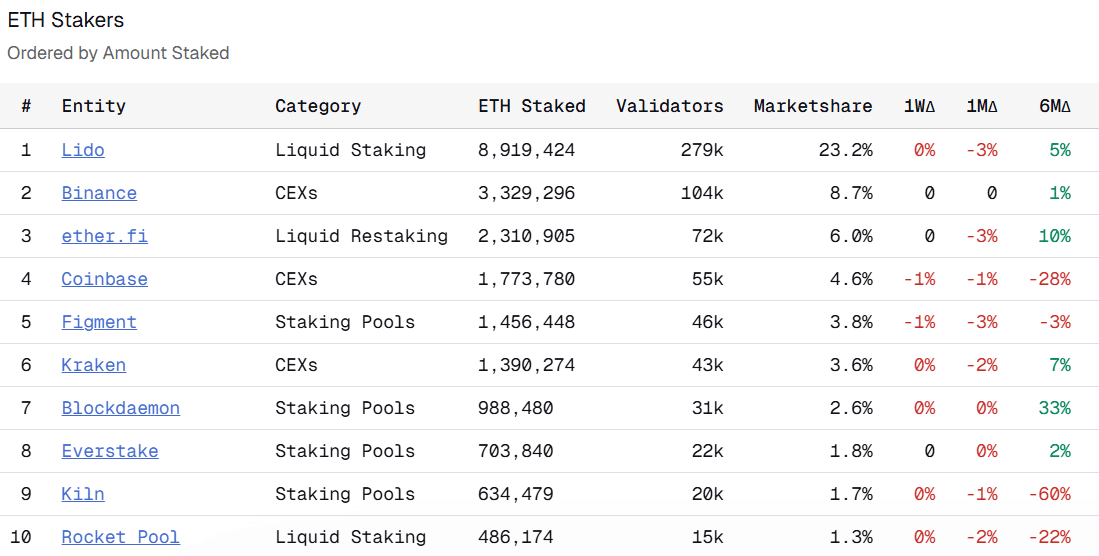
In fact, Lido, the top leader in the segment, confirmed that the ongoing structural shift was partly responsible for its 23% annual revenue fall in 2025. Although its market share also shrank, it was still leading in the segment with nearly 9 million staked ETH.

Alas, with BitMine now eyeing its position, will it defend its top spot? Well, that depends on whether Lido’s staking outflows continue in the next few months.

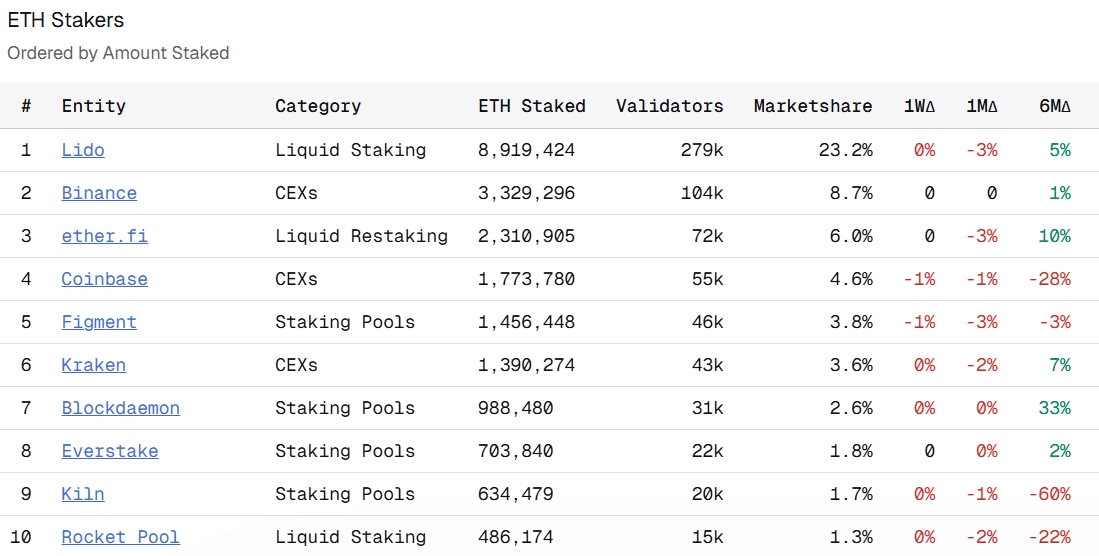
As it stands, even if BitMine stakes its entire 4.6 million ETH stash, that would make it the second-largest staking platform, surpassing Binance. However, it would still need an extra 5 million ETH to dislodge Lido from the top seat.

Source: Dune

Final Summary

  • BitMine unveiled the MAVAN staking platform and plans to stake the whole of its 4.6 million ETH stash to get $300M in annual yield revenue.
  • However, it will need over 5 million ETH to displace Lido as the top staking platform.

Связанные с этим вопросы

QWhat is the name of the new ETH staking platform launched by BitMine and what does the acronym stand for?

AThe new ETH staking platform is called MAVAN, which stands for Made in America Validator Network.

QHow much Ethereum (ETH) has BitMine already staked as of March 24th, and what is its total ETH holding?

AAs of March 24th, BitMine has staked 3,142,643 ETH. The company's total ETH holding is 4.6 million.

QWhat is BitMine's stated end goal for its staking platform in terms of annual revenue and current yield?

ABitMine's end goal is to generate $300 million in annual revenue at the current 2.83% 7-day BMNR yield.

QWho is the current leader in the ETH staking segment and how much ETH do they have staked?

ALido is the current leader in the ETH staking segment with nearly 9 million staked ETH.

QBesides Ethereum, what other types of networks does BitMine plan to expand into, according to Chairman Tom Lee?

AAccording to Tom Lee, BitMine plans to expand across additional proof-of-stake (PoS) networks, such as SOL, BNB, and Tron [TRX], as well as critical blockchain infrastructure.

Похожее

Super-Rich Hoarded Record Cash in February, Stock Market Hit New Highs Four Months Later: Who's Getting Fooled?

In February, the total assets in US money market funds reached a record high of approximately $8.25 trillion, a trend highlighted by high-net-worth individuals increasing their cash holdings. Notably, Warren Buffett's Berkshire Hathaway amassed a $381.7 billion cash pile ahead of his 2025 retirement, while other prominent figures like Peter Thiel sold tech stocks, fueling narratives of wealthy investors seeking safety. However, by June, the trend reversed. Money market fund assets fell to around $7.87 trillion, indicating a flow of capital back into equities. Concurrently, the S&P 500 and Nasdaq reached all-time highs, with the S&P 500 surpassing 7600 points. This market surge occurred despite the earlier defensive moves, highlighting a potential opportunity cost for those who retreated to cash. Analysis shows that since early 2022, the S&P 500's total return significantly outpaced that of prime money market funds. The capital shifted from equities appears to have been partly reallocated into alternative investments like real estate, art, and private credit, especially among ultra-high-net-worth individuals. Meanwhile, major investment banks like Goldman Sachs and Morgan Stanley have raised their year-end targets for the S&P 500, citing AI-driven earnings growth, while also cautioning about risks including market concentration and economic fragility beneath the surface rally.

marsbit10 мин. назад

Super-Rich Hoarded Record Cash in February, Stock Market Hit New Highs Four Months Later: Who's Getting Fooled?

marsbit10 мин. назад

Robot Vacuums Have Been Competing for 20 Years, So Why Are 90% of Chinese Households Still Hesitant?

The article explores why over 90% of Chinese households are still hesitant to adopt robotic vacuum cleaners despite two decades of industry development, identifying a core "trust gap" as the primary barrier. The central issue is not a lack of need, but user concerns about reliability in dynamic, real-world home environments. Common anxieties include the robot dragging pet waste, colliding with transparent objects, tangling in cords, scattering cat litter, getting stuck on thresholds, missing corners under furniture, and requiring high-maintenance bases that develop odors. The industry's past focus on competing on technical specs (suction power, mopping functions) has not adequately addressed these practical usability and trust problems. The piece then examines DJI's entry into the market with its ROMO 2 model as a potential new approach. Leveraging its expertise in spatial perception and obstacle avoidance from drones, DJI's solution emphasizes "less intervention" through three key principles: less manual re-cleaning, less user rescue missions, and less maintenance. Specific ROMO 2 features highlighted include advanced obstacle recognition (handling transparent objects and small items), adaptive leg mechanisms for climbing thresholds (up to 8.5cm), an extendable arm for reaching under furniture, AI for identifying and appropriately handling different mess types (e.g., avoiding scattering dry debris), and a self-cleaning base designed to minimize user upkeep. The article argues the next phase of competition should shift from a "parameter race" to a "trust race." It draws a parallel to the iPhone's simplification of the smartphone, suggesting that focusing on a reliable, low-hassle user experience—where people feel confident leaving their floors to the machine—is what's needed to finally convince the vast majority of观望ing families. The ultimate test for products like the ROMO 2 will be long-term user adoption, retention, and口碑, not just technical specifications.

marsbit11 мин. назад

Robot Vacuums Have Been Competing for 20 Years, So Why Are 90% of Chinese Households Still Hesitant?

marsbit11 мин. назад

The Unclear American Economy: Resilient or Cooling Down?

**U.S. Economic Outlook: Resilient or Cooling Down?** This analysis examines whether the U.S. economy is heading towards a recession. While still growing, the economy shows significant signs of strain. Key data points include Q1 2026 GDP growth of 1.6% and Q1 PCE inflation at 4.5% (annualized), more than double the Fed's target. The labor market remains resilient but is softening, with unemployment at 4.3%. Critical recession indicators present a mixed picture: the yield curve has normalized after a prolonged inversion (historically a late-cycle signal), and the Conference Board's Leading Economic Index has been declining. Current recession probability for 2026 is estimated at 19%, but rises to 41% for 2027, indicating heightened delayed risks. Major pressures are building: a wall of corporate debt refinancing at higher rates, depleted consumer savings, a contracting housing sector, and an energy price shock. The economy exhibits stagflationary characteristics—high inflation alongside slowing growth—which constrains the Federal Reserve's policy options. Historical patterns show recessions are often preceded by Fed tightening and yield curve inversions. If a recession occurs, it is expected to be mild, similar to 2001 rather than 2008. For investors, a defensive portfolio shift toward staples, healthcare, and short-term high-quality bonds may be prudent, while maintaining a long-term, diversified perspective. Key developments to monitor include upcoming GDP, employment, and inflation data, as well as policy signals from the new Fed Chair.

marsbit18 мин. назад

The Unclear American Economy: Resilient or Cooling Down?

marsbit18 мин. назад

The Most Advanced Large Models Are Now Subject to Export Controls Like Enriched Uranium

In an unprecedented move mirroring the control of enriched uranium, the US Commerce Department has imposed an export control ban on Anthropic's advanced AI models, Fable 5 and Mythos 5, forcing their global shutdown. This marks the first time a purely digital entity—a set of neural network weights—has been subjected to such hardware-like strategic export restrictions, based not on physical scarcity but on its concentrated "capability density." The article draws a direct parallel to the historical control of nuclear technology, arguing that just as uranium ore becomes a controlled substance only when enriched to a critical threshold, AI capabilities become subject to regulation when compressed into a single, potent, and easily accessible interface. This "enriched AI" is seen as crossing a threshold where its aggregated power poses a potential threat. The author predicts three major consequences over the next decade. First, capability auditing will become institutionalized, with governments setting compliance checklists and thresholds for model power, triggering automatic export controls. Second, jurisdictional boundaries will blur as US export controls extend their reach globally, governing any user of American AI services regardless of location, forcing non-US entities to reconsider their AI supply chain dependencies. Third, a technological bifurcation will occur, splitting the AI landscape into a restricted, high-risk track of advanced US proprietary models and a more reliable track of open-source or locally developed alternatives, where guaranteed access may outweigh raw performance. The core crisis exposed is the lack of a legal property rights framework for AI "intelligence." While companies invest heavily in integrating these models into their production systems, legally they only purchase a service that can be revoked at any time, leaving them with no recourse for their sunk investments. The conclusion warns of a permanently fractured digital world where the most capable models may not be the most usable, and clear, unassailable ownership of technology will become paramount.

marsbit31 мин. назад

The Most Advanced Large Models Are Now Subject to Export Controls Like Enriched Uranium

marsbit31 мин. назад

Торговля

Спот
Фьючерсы
活动图片