Bitcoin Social Euphoria Hits Yearly High Amid CLARITY Act Buzz

bitcoinistОпубликовано 2026-05-18Обновлено 2026-05-18

Введение

Bitcoin social sentiment has surged to a yearly high following the U.S. Senate Banking Committee's bipartisan approval of the CLARITY Act. Data from Santiment shows a ratio of 1.55 bullish comments for every 1 bearish comment, indicating a "FOMO zone" similar to a peak in late April. Analysts note such high optimism often signals a short-term profit-taking opportunity, contrasting with the better contrarian buy signal seen during recent "FUD zone" pessimism. Despite near-term caution, the CLARITY Act is viewed as a long-term positive, aiming to establish a clearer federal regulatory framework for digital assets by defining roles for the SEC and CFTC. The bill, supported by major crypto firms, now awaits a full Senate vote, with a critical window for passage before the August recess.

The CLARITY Act’s landmark committee approval has sent Bitcoin sentiment soaring to its highest point in months.

Data from Santiment shows that bullish Bitcoin commentary on social media has climbed to one of its greediest readings of the year, with 1.55 bullish comments for every 1.00 bearish comment. The on-chain data, however, indicates that the crowd may be getting ahead of itself.

Bitcoin Sentiment Points To Greed After CLARITY Act Vote

The passage of the Digital Asset Market Clarity Act through the Senate Banking Committee moved both price and crowd psychology simultaneously. The move came after the US Senate Banking Committee advanced the CLARITY Act in a 15-9 bipartisan vote, sending the important market-structure bill to the full Senate.

Interestingly, Santiment’s data shows that Bitcoin social sentiment has moved back into a FOMO zone. On May 15, Santiment’s social sentiment ratio for Bitcoin reached 1.55 bullish comments for every 1.00 bearish comment, placing it within a FOMO Zone.

That reading mirrors a prior peak recorded on April 25, when the ratio reached 1.58 bullish-to-bearish. Any time the ratio of positive to negative commentary on social media crosses this FOMO zone, then it is an ideal temporary profit-taking moment.

This does not mean Bitcoin has to crash because the crowd has turned optimistic. The same Santiment chart shows that the better contrarian setup came on April 18, when the bullish-to-bearish ratio dropped to 0.59. This was deep in the FUD Zone, before Bitcoin mounted a recovery.
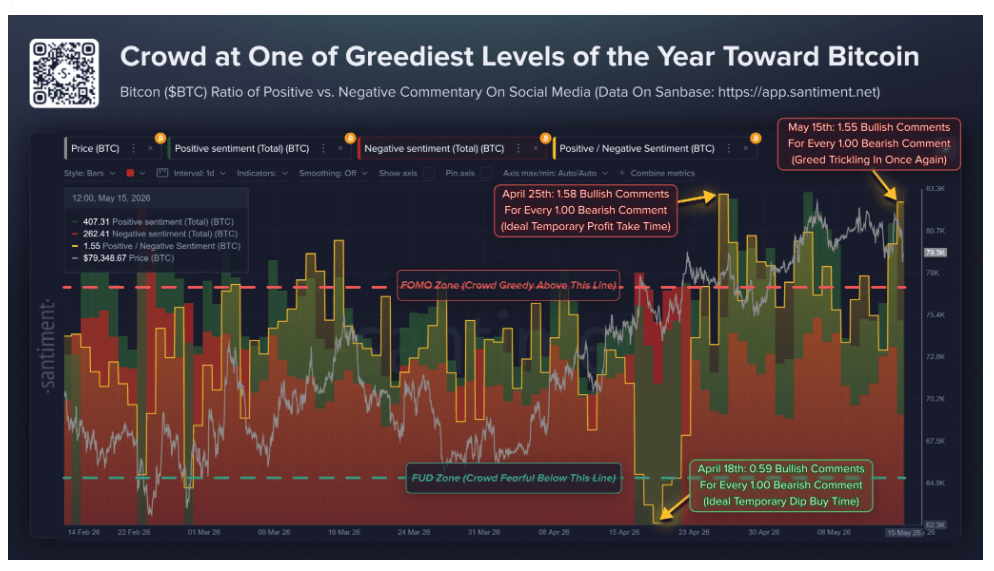
Bitcoin Ratio Of Positive vs. Negative Commentary. Source: @SantimentData On X

CLARITY Act Still Bullish For Bitcoin In The Long Run

The caution around short-term sentiment does not cancel the long-term importance of the CLARITY Act. The bill is designed to create a clearer federal framework for digital assets, including a more defined division of authority between the Securities and Exchange Commission and the Commodity Futures Trading Commission.

BTCUSD currently trading at $78,486. chart: TradingView

The bill was championed by major crypto companies, including Coinbase, Circle, and Ripple, all of which have sought a degree of regulation for the crypto industry. Senior figures linked to these companies also reacted positively on social media after the Senate Banking Committee advanced the legislation.

Coinbase CEO Brian Armstrong, for instance, stated in a post on X: “looking forward to a bipartisan law that cements the US as the world’s crypto capital. Let’s get CLARITY done.”

The bill still needs to be available for a vote from the full Senate, where 60 yes votes will be required. Projections from SoSoValue show a key window between mid-May and early August, with the House recess beginning July 27 and the Senate recess beginning August 10.

If lawmakers fail to complete full Senate consideration and reconciliation before that period, the bill could be pushed deeper into the fall agenda, and the difficulty of passage will rise significantly.
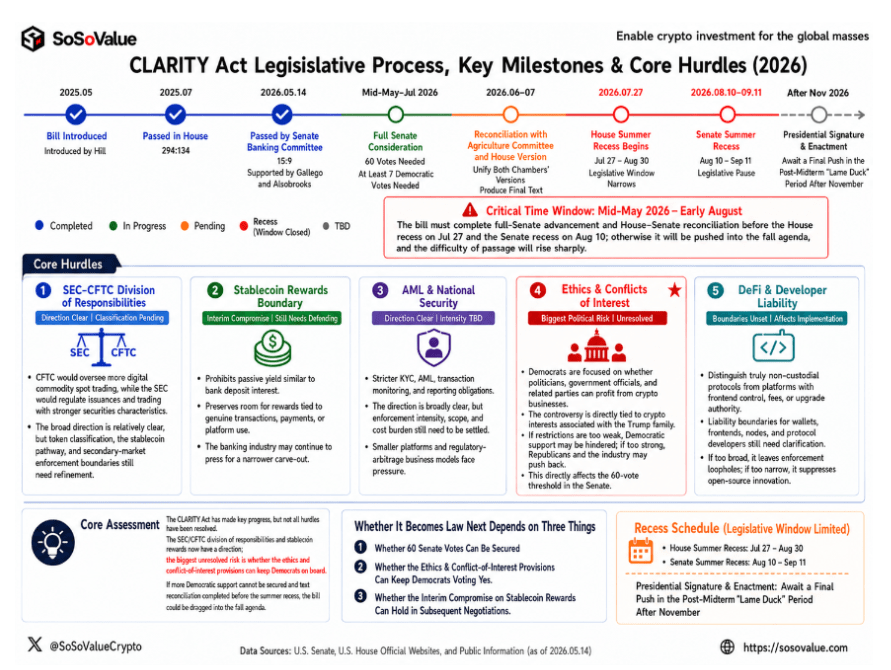
Clarity Act Legislative Process. Source: SoSoValue

Featured image from Unsplash, chart from TradingView

Связанные с этим вопросы

QWhat specific event caused Bitcoin social sentiment to reach a yearly high?

AThe landmark committee approval of the CLARITY Act by the US Senate Banking Committee caused Bitcoin social sentiment to soar to its highest point in months.

QAccording to Santiment's data, what was the ratio of bullish to bearish Bitcoin comments on social media on May 15?

AOn May 15, Santiment's data showed a ratio of 1.55 bullish comments for every 1.00 bearish comment regarding Bitcoin on social media.

QWhat is the main purpose of the CLARITY Act as described in the article?

AThe CLARITY Act is designed to create a clearer federal framework for digital assets, including a more defined division of authority between the Securities and Exchange Commission (SEC) and the Commodity Futures Trading Commission (CFTC).

QWhich major crypto companies are mentioned as champions of the CLARITY Act?

AMajor crypto companies championing the CLARITY Act include Coinbase, Circle, and Ripple.

QWhat are the key legislative deadlines mentioned for the CLARITY Act to be passed by the full Senate?

AProjections show a key window between mid-May and early August, with the House recess beginning July 27 and the Senate recess beginning August 10. If not passed before this period, the bill could be pushed into the fall agenda, making passage significantly more difficult.

Похожее

Fei-Fei Li's Team Clarifies the Concept of 'World Models', Sora Merely a Renderer

"World Models" has become a widely used yet confusing term in AI. To address this, a team led by Fei-Fei Li and World Labs proposed a functional taxonomy based on the Partially Observable Markov Decision Process framework. This taxonomy categorizes systems called "world models" into three distinct projections: Renderers, Simulators, and Planners. Renderers, like OpenAI's Sora and other video generation models, focus on producing photorealistic visual outputs for human perception. They prioritize visual fidelity over physical accuracy. Simulators, such as NVIDIA Omniverse, aim to compute precise future environmental states for computational tasks like engineering analysis or digital twins. Planners, like Vision-Language-Action models, take in observations and goals to output executable actions for robots or agents. The article clarifies that most current "world models," including Sora, are primarily Renderers. They generate convincing visuals but lack the core ability to simulate state transitions based on actions, a key requirement for a true world model in classic reinforcement learning definitions. This conceptual confusion has practical implications, leading to potential misalignment in technology selection, investment, and public understanding of AI capabilities. Clear categorization is crucial. It helps enterprises avoid costly mistakes (e.g., using a renderer for robot training), allows investors to accurately assess markets, and enables researchers to build comparable benchmarks. While future systems may integrate these functions, recognizing current boundaries is essential for honest assessment and progress.

marsbit22 мин. назад

Fei-Fei Li's Team Clarifies the Concept of 'World Models', Sora Merely a Renderer

marsbit22 мин. назад

Bloomberg Uncovered: How Do China's Wealthy Circumvent the Annual $50,000 Limit to Transfer Assets?

**Summary: How Wealthy Chinese Circumvent $50,000 Annual Foreign Exchange Limits** Despite China's strict capital controls, including an annual $50,000 per person foreign exchange quota, an estimated $150 billion in funds still leaves the country annually via various gray and underground channels. This report outlines the evolution of China's "capital wall" and the methods used to bypass it. **The Evolving Capital Controls:** * **Foundation (1994):** The system of "current account convertibility with strict capital account controls" was established. * **Quota Set (2007):** The $50,000 individual annual forex purchase limit was formalized. * **Crackdown Begins (2015-2017):** Following market volatility, enforcement tightened. Banks were required to scrutinize transactions, and channels like using UnionPay cards for Hong Kong insurance premiums or buying overseas property were blocked. * **Digital & Legal Upgrades (2024-2026):** Enhanced algorithms now flag suspicious patterns (e.g., "smurfing"). The Common Reporting Standard (CRS) provides Chinese tax authorities with data on citizens' offshore accounts. Unlicensed cross-border brokers have been targeted. **Five Primary Methods for Moving Capital:** 1. **Underground Banking / "Hawala" (Duiqiao):** The largest-scale method. No money crosses borders. Clients pay RMB to a domestic account; an overseas associate deposits equivalent foreign currency into the client's offshore account. Risks include high fees, account freezes, and legal penalties. 2. **"Smurfing" or "Ant Moving":** Using multiple individuals' $50,000 quotas to pool funds for one offshore recipient. Increasingly detected by anti-money laundering algorithms. 3. **Trade Invoice Manipulation:** Businesses over-invoice imports or under-invoice exports via offshore shell companies, creating a pretext to transfer excess funds abroad under the guise of trade. 4. **Channel Migration:** After a crackdown on internet brokers, funds flow toward more compliant but costly channels like major banks' cross-border wealth management services or Qualified Domestic Institutional Investor (QDII) quotas. 5. **Structural Arrangements:** High-net-worth individuals use complex, high-cost legal structures involving offshore trusts, insurance, and investment migration programs to transfer asset ownership. **Regulatory Response: Focusing on People, Not Just Money** The current strategy extends oversight from enterprises to **individual residents**. Tools like CRS allow retroactive visibility into offshore assets. Cryptocurrencies, once seen as a potential loophole, are now actively monitored and prosecuted as an illegal channel. The underlying driver remains: with significant wealth concentrated among millions of affluent households seeking diversification amid domestic economic shifts, the incentive to move assets offshore persists despite regulatory barriers.

marsbit42 мин. назад

Bloomberg Uncovered: How Do China's Wealthy Circumvent the Annual $50,000 Limit to Transfer Assets?

marsbit42 мин. назад

Торговля

Спот
Фьючерсы
活动图片