Bitcoin Capital Continues to Exit: Why A Negative 7dMA Signals A High-Risk Regime

bitcoinistОпубликовано 2025-12-27Обновлено 2025-12-27

Введение

Bitcoin is struggling to regain market confidence as sentiment deteriorates and apathy dominates trading. Price remains below $90,000, with repeated recovery attempts failing. On-chain data reveals a negative seven-day moving average of net capital flow at approximately -$160 million, indicating more capital is exiting the network through loss-making sales than entering via profits. Despite weak conditions, Bitcoin supply activity remains elevated, with 31.79% of supply moving in the last 180 days. This high activity reflects distribution and stress rather than accumulation, as holders exit positions at unfavorable prices. For the trend to turn positive, net capital flows must recover alongside sustained activity.

Bitcoin is struggling to regain market confidence as sentiment continues to deteriorate and apathy dominates trading behavior. Price remains capped below the $90,000 level, with repeated recovery attempts failing to gain traction. As volatility compresses and participation thins, an increasing number of analysts are warning that the market may face further downside before stability can return. For now, conviction on both sides remains limited, leaving Bitcoin vulnerable to renewed selling pressure.

On-chain data underscores this fragile backdrop. A recent report by Axel Adler examines daily capital inflows and outflows across the Bitcoin network, using a seven-day moving average of net capital flow to assess market health.

This metric captures the balance between realized profits, which represent capital entering the network, and realized losses, which reflect capital being destroyed through loss-making sales. When the net flow turns negative, it signals that participants are selling at a loss more aggressively than they are taking profits.

Currently, the seven-day average stands at approximately negative $160 million, meaning the market has been losing an average of $160 million in capital per day over the past week. The period between December 17 and 24 was marked by sharp volatility, with large outflows interspersed with brief positive days. Although December 25 saw another net inflow, it was not enough to offset prior losses.

Elevated Coin Activity Signals Distribution Under the Surface

On-chain data highlighted by Adler shows that Bitcoin remains unusually active despite weak market conditions. The Bitcoin “% Supply Active (Last 180 Days)” metric tracks the share of total BTC supply that has moved at least once over the past six months.

Currently, that figure stands at 31.79%, slightly above its 30-day average of 31.43% and firmly in the 80th percentile compared with historical data. Activity has also risen sharply on a year-over-year basis, up 14.4%, indicating that coins are changing hands far more frequently than they were a year ago.
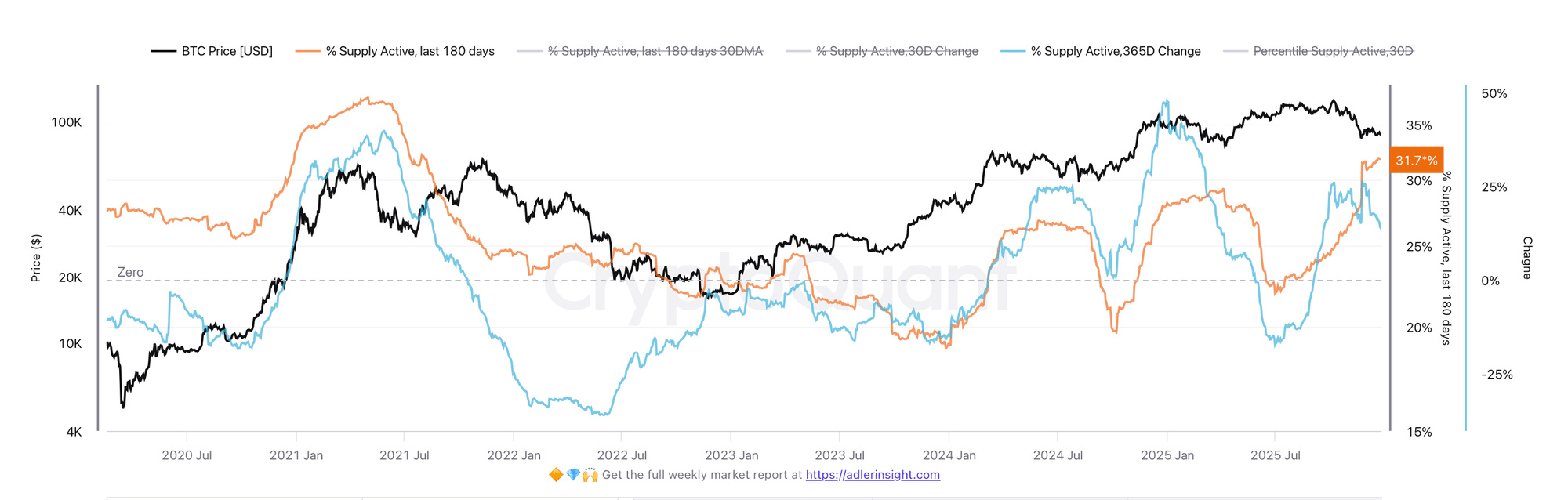
Bitcoin % Supply Active | Source: CryptoQuant

At face value, elevated activity can sometimes signal renewed interest or accumulation. In the current context, however, it carries a more cautionary implication. High supply activity is occurring alongside a negative net capital flow regime, meaning that much of this movement reflects loss-making sales rather than profitable distribution. Coins are not simply rotating between long-term holders; they are being sold under pressure.

This combination challenges the idea that the market is simply apathetic. Instead, it points to active distribution, with holders choosing to exit positions despite unfavorable prices. The distinction is important: apathy implies indecision, while distribution suggests stress.

For this metric to turn constructive, elevated activity would need to persist while net capital flows recover toward zero or positive territory. Only then would increased coin movement begin to reflect accumulation rather than capitulation.


Связанные с этим вопросы

QWhat does a negative 7-day moving average of net capital flow indicate for the Bitcoin market?

AA negative 7-day moving average of net capital flow indicates that participants are selling Bitcoin at a loss more aggressively than they are taking profits, signaling capital destruction and a high-risk regime where the market is losing value.

QWhat is the current value of Bitcoin's 7-day average net capital flow, and what does it represent?

AThe current 7-day average net capital flow is approximately negative $160 million, meaning the Bitcoin market has been losing an average of $160 million in capital per day over the past week.

QHow does the '% Supply Active (Last 180 Days)' metric behave in the current market, and what does it suggest?

AThe '% Supply Active (Last 180 Days)' metric stands at 31.79%, above its 30-day average and in the 80th percentile historically, with a 14.4% year-over-year increase. This elevated activity, combined with negative capital flows, suggests active distribution and loss-making sales rather than accumulation.

QWhat is the difference between market apathy and distribution according to the on-chain analysis?

AMarket apathy implies indecision and lack of trading conviction, while distribution indicates active selling under pressure, with holders exiting positions despite unfavorable prices, reflecting stress and capitulation in the market.

QWhat conditions would need to occur for increased coin movement to signal accumulation rather than capitulation?

AFor increased coin movement to signal accumulation rather than capitulation, elevated supply activity would need to persist alongside a recovery in net capital flows toward zero or positive territory, indicating that coins are being bought for profit rather than sold at a loss.

Похожее

a16z: AI's 'Amnesia', Can Continuous Learning Cure It?

The article "a16z: AI's 'Amnesia' – Can Continual Learning Cure It?" explores the limitations of current large language models (LLMs), which, like the protagonist in the film *Memento*, are trapped in a perpetual present—unable to form new memories after training. While methods like in-context learning (ICL), retrieval-augmented generation (RAG), and external scaffolding (e.g., chat history, prompts) provide temporary solutions, they fail to enable true internalization of new knowledge. The authors argue that compression—the core of learning during training—is halted at deployment, preventing models from generalizing, discovering novel solutions (e.g., mathematical proofs), or handling adversarial scenarios. The piece introduces *continual learning* as a critical research direction to address this, categorizing approaches into three paths: 1. **Context**: Scaling external memory via longer context windows, multi-agent systems, and smarter retrieval. 2. **Modules**: Using pluggable adapters or external memory layers for specialization without full retraining. 3. **Weights**: Enabling parameter updates through sparse training, test-time training, meta-learning, distillation, and reinforcement learning from feedback. Challenges include catastrophic forgetting, safety risks, and auditability, but overcoming these could unlock models that learn iteratively from experience. The conclusion emphasizes that while context-based methods are effective, true breakthroughs require models to compress new information into weights post-deployment, moving from mere retrieval to genuine learning.

marsbit3 ч. назад

a16z: AI's 'Amnesia', Can Continuous Learning Cure It?

marsbit3 ч. назад

Торговля

Спот
Фьючерсы

Популярные статьи

Как купить USDS

Добро пожаловать на HTX.com! Мы сделали приобретение USDS (USDS) простым и удобным. Следуйте нашему пошаговому руководству и отправляйтесь в свое крипто-путешествие.Шаг 1: Создайте аккаунт на HTXИспользуйте свой адрес электронной почты или номер телефона, чтобы зарегистрироваться и бесплатно создать аккаунт на HTX. Пройдите удобную регистрацию и откройте для себя весь функционал.Создать аккаунтШаг 2: Перейдите в Купить криптовалюту и выберите свой способ оплатыКредитная/Дебетовая Карта: Используйте свою карту Visa или Mastercard для мгновенной покупки USDS (USDS).Баланс: Используйте средства с баланса вашего аккаунта HTX для простой торговли.Третьи Лица: Мы добавили популярные способы оплаты, такие как Google Pay и Apple Pay, для повышения удобства.P2P: Торгуйте напрямую с другими пользователями на HTX.Внебиржевая Торговля (OTC): Мы предлагаем индивидуальные услуги и конкурентоспособные обменные курсы для трейдеров.Шаг 3: Хранение USDS (USDS)После приобретения вами USDS (USDS) храните их в своем аккаунте на HTX. В качестве альтернативы вы можете отправить их куда-либо с помощью перевода в блокчейне или использовать для торговли с другими криптовалютами.Шаг 4: Торговля USDS (USDS)С легкостью торгуйте USDS (USDS) на спотовом рынке HTX. Просто зайдите в свой аккаунт, выберите торговую пару, совершайте сделки и следите за ними в режиме реального времени. Мы предлагаем удобный интерфейс как для начинающих, так и для опытных трейдеров.

78 просмотров всегоОпубликовано 2026.04.13Обновлено 2026.04.13

Как купить USDS

Неделя обучения по популярным токенам 12: Крипто-конференция на 25 апреля 2026 года в Mar-a-Lago привлекает внимание, волна мем-монет вновь поднимается

Сообщество с большим нетерпением ожидает крипто-конференцию на 25 апреля 2026 года в Mar-a-Lago, многие рассматривают это как возможность «купить монету = приблизиться к президенту».

932 просмотров всегоОпубликовано 2026.04.14Обновлено 2026.04.14

Неделя обучения по популярным токенам 12: Крипто-конференция на 25 апреля 2026 года в Mar-a-Lago привлекает внимание, волна мем-монет вновь поднимается

Обсуждения

Добро пожаловать в Сообщество HTX. Здесь вы сможете быть в курсе последних новостей о развитии платформы и получить доступ к профессиональной аналитической информации о рынке. Мнения пользователей о цене на A (A) представлены ниже.

活动图片