Binance's "Blind Box Experiment": When Airdrops Enter the Random Era

比推Опубликовано 2026-02-12Обновлено 2026-02-12

Введение

Binance's "Alpha Box" introduces a randomized airdrop model, shifting from predetermined rewards to a blind box mechanism. Users spend a fixed amount of Alpha points to open a box containing a random token from a pool of projects, with the outcome revealed only at the moment of claiming. The cost to participate decreases over time, creating a strategic dilemma: pay a higher cost early or risk missing out by waiting for a lower threshold. This change aims to address declining user participation and balance attracting active engagement with preventing abuse. The randomness is designed to filter out low-effort users, encourage immediate trading activity, and boost short-term liquidity as recipients often quickly sell or swap unexpected tokens. For projects, it offers exposure to a pre-screened audience but reduces their control over distribution timing and branding. Key metrics for success include the speed of reward pool depletion, participant numbers, token price volatility post-distribution, and sustained trading activity. The experiment reflects Binance effort to refine its ecosystem through gamification, using scarcity, uncertainty, and time pressure to transform airdrops from simple giveaways into engaging, strategic events. The long-term viability depends on whether it fosters lasting user engagement or merely drives short-term speculative behavior.

Author: 137Labs

Original Title: Binance's "Blind Box Experiment": When Airdrops Enter the Random Era


Airdrops have entered the blind box era.

Binance Alpha Box replaces certainty with randomness and creates tension through time-based discounts. Is this an advanced attempt at refined operations or a tool for short-term liquidity stimulation? This article interprets the real logic behind this "blind box experiment" based on mechanism evolution, user behavior, and data changes.

Binance's "Blind Box Experiment": When Airdrops Enter the Random Era

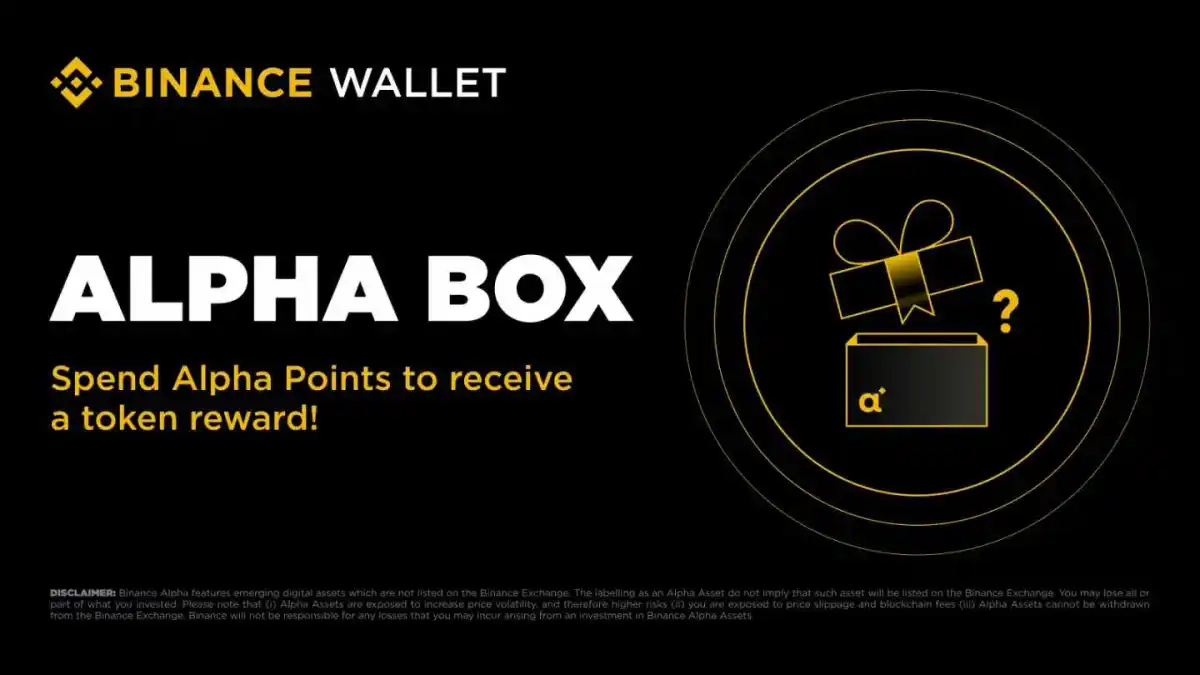
On February 10, 2026, Binance Wallet launched a new airdrop model called Alpha Box. This change is not a simple rule adjustment but a reconstruction of the distribution logic: users no longer know which project's tokens they will receive before claiming the reward; everything is determined by the "draw result." Airdrops have moved from "deterministic allocation" to "random revelation."

This step adds a clear product design and gaming element to what was originally a tool-oriented airdrop activity.
I. Blind Box Mechanism: Handing "Choice" Over to Probability

The core logic of Alpha Box is straightforward:

· The participation threshold is a fixed consumption of Alpha points (base is 15 points);

· Each blind box corresponds to only one project token;

· Which one is obtained is revealed only at the moment of claiming;

· A single event may integrate reward pools from multiple projects.

The official emphasizes that the tokens from different projects are "roughly equivalent in value," but the measurement standard is not fully disclosed—is it based on project valuation or real-time market prices? This ambiguity itself adds to the discussion around the mechanism.

More tension is created by the dynamic discount design: after the event starts, the points required for participation decrease at fixed time intervals until the reward pool is exhausted. This rhythm creates a typical dilemma—

Should one lock in eligibility immediately at a higher cost, or wait for a lower threshold but risk missing out on participation?

This is not just claiming an airdrop; it is more like a strategic choice.

II. Why the Change? The Pressure Behind the Data

Looking back at Alpha's evolution, this is not a random adjustment.

Since Alpha launched at the end of 2024, mechanisms such as point acquisition, consumption rules, trading range restrictions, dual-phase threshold systems, and weighted rewards for new coin trading have been introduced. Within just one year, multiple rounds of optimization have revolved around one core question:

How to balance "attracting activity" and "preventing arbitrage abuse"?

When the number of participants showed a significant decline over several months, simply raising thresholds or increasing consumption was no longer enough to reignite user interest.

Thus, the platform chose to change the game rules itself—transforming deterministic rewards into random distribution.

No longer guaranteeing "I know what I will get," but introducing psychological expectations and gaming emotions.

III. For Users: Participation Enthusiasm or Short-Term Impulse?

Blind box airdrops may influence user behavior in two directions.

First layer: Screening participants.

The fixed point cost itself is a "friction fee." Those willing to consume points to participate often have higher action intentions. This screening helps reduce low-quality point farming behavior, making the participant group more concentrated.

Second layer: Increasing immediate trading activity.

Random rewards often lead to quick liquidation behavior—

When users draw tokens that do not match their preferences, they tend to quickly sell or convert them into mainstream assets. This means that, in the short term, the trading volume and liquidity of related tokens will significantly increase.

This type of capital flow exhibits high intensity and short-cycle characteristics:

· Claiming moment → Price fluctuation → Concentrated selling or conversion → Trading volume amplification.

· From a market perspective, this is more like a "liquidity event" than mere value distribution.

IV. For Project Teams: More Precise, But More Uncontrolled

Traditional airdrops are usually distributed by the project teams themselves, with tokens going directly into users' wallets. The problem is that a large number of recipients immediately sell, resulting in very low retention rates.

In the Alpha blind box model, projects only need to hand over their token pool to the platform for unified distribution.

The advantages are:

· Participants are screened by the point threshold;

· Trading activity is concentrated and released;

· The platform bears the screening and execution costs.

But the costs are also evident:

· Projects lose control over the distribution pace;

· Tokens appear mixed with those of other projects;

· Users do not explicitly come for a specific project when participating.

This is an exchange of "brand exposure" for "control."

V. Liquidity Catalyst or Short-Term Fireworks?

Evaluating the success of such a mechanism requires observing several key metrics:

1. Reward pool depletion speed—Is it emptied quickly?

2. Participant scale—Is there a significant rebound?

3. Token price trend—Does it show rapid volume increase and fluctuation after distribution?

4. Trading activity after the event ends—Does it remain high?

If traffic and trading volume surge only during the event and quickly decline afterward, it is more like a marketing-driven short-term stimulus.

If users remain active after the event, it means the mechanism has successfully changed participation habits.

The real question is not "whether the blind box is fun," but whether it can form a sustainable participation structure.

VI. From Airdrops to Gaming: The Platform's Refined Operation Experiment

Five rule changes reflect the platform's continuous testing of the ecosystem's rhythm.

Alpha Box is not just a simple product innovation but an experiment in user behavior.

It reconstructs the incentive model in three ways:

· Creating a sense of scarcity through point consumption;

· Enhancing psychological expectations with randomness;

· Generating competitive pressure with a time-decreasing mechanism.

This combination turns airdrops from "welfare distribution" into "participation decisions."

The answer may soon become apparent:

After the first blind boxes are opened, will users become more engaged due to the unknown, or will they simply complete an arbitrage during brief fluctuations?

In the crypto market, mechanisms are often more real than narratives.

The emergence of Alpha Box means airdrops have entered a new stage—no longer just reward distribution, but a refined experiment围绕 liquidity and behavioral models.


Twitter:https://twitter.com/BitpushNewsCN

Bitpush TG Discussion Group:https://t.me/BitPushCommunity

Bitpush TG Subscription: https://t.me/bitpush

Original link:https://www.bitpush.news/articles/7611379

Связанные с этим вопросы

QWhat is the core mechanism of Binance's Alpha Box airdrop program?

AThe core mechanism of Binance's Alpha Box is a 'blind box' system where users spend a fixed amount of Alpha points to open a box, but they do not know which specific project's token they will receive until the moment of claiming. The required points to participate also decrease at fixed time intervals, creating a strategic dilemma for users.

QWhat problem was the Alpha Box designed to solve, according to the article?

AThe Alpha Box was designed to address the challenge of declining user participation and to find a new balance between 'attracting active users' and 'preventing arbitrage abuse.' It moves away from deterministic rewards to a random distribution model to reignite user interest and reshape participation habits.

QHow does the article suggest the blind box mechanism affects user behavior?

AThe article suggests the mechanism filters participants by requiring a point cost, attracting more committed users. It also likely increases short-term trading activity, as users who receive tokens not to their preference are inclined to sell or swap them quickly, boosting transaction volume and liquidity in a short, intense cycle.

QWhat are the trade-offs for project teams participating in the Alpha Box airdrop?

AThe trade-offs for project teams are a loss of control over the distribution rhythm and their token being mixed with others in a pool, meaning users aren't specifically seeking their project. In exchange, they benefit from a pre-screened user base and a burst of concentrated trading activity handled by the platform.

QWhat key metrics does the article propose for evaluating the success of the Alpha Box experiment?

AThe key metrics proposed are: the speed at which the reward pool is depleted, the scale of participating users (whether it rebounds significantly), the price movement and trading volume of the tokens post-distribution, and whether trading activity remains high after the event concludes.

Похожее

Arbitrum Pretends to Be the Hacker, 'Steals' Back the Money Lost by KelpDAO

Title: Arbitrum Poses as Hacker to Recover Stolen Funds from KelpDAO Last week, KelpDAO suffered a hack resulting in nearly $300 million in losses, marking the largest DeFi security incident this year. Approximately 30,765 ETH (worth over $70 million) remained on an Arbitrum address controlled by the attacker. In an unprecedented move, Arbitrum’s Security Council utilized its emergency authority to upgrade the Inbox bridge contract, adding a function that allowed them to impersonate the hacker’s address and initiate a transfer without access to its private key. The council’s action, approved by 9 of its 12 members, moved the stolen ETH to a frozen address in a single transaction before reverting the contract to its original state. The operation was coordinated with law enforcement, which attributed the attack to North Korea’s Lazarus Group. Community reactions are divided: some praise the recovery of funds, while others question the centralization of power, as the council can upgrade core contracts without governance votes. However, such emergency mechanisms are common among major L2s. Despite the partial recovery, over $292 million was stolen in total, with more than $100 million in bad debt on Aave and remaining funds scattered across other chains. The incident highlights escalating security challenges in DeFi, with state-sponsored hackers employing advanced tactics and L2s responding with elevated countermeasures.

marsbit9 мин. назад

Arbitrum Pretends to Be the Hacker, 'Steals' Back the Money Lost by KelpDAO

marsbit9 мин. назад

iQiyi Is Too Impatient

The article "iQiyi Is Too Impatient" discusses the controversy surrounding the Chinese streaming platform IQiyi's recent announcement of an "AI Actor Library" during its 2026 World Conference. IQiyi claimed over 100 actors, including well-known names like Zhang Ruoyun and Yu Hewei, had joined the initiative. CEO Gong Yu suggested AI could enable actors to "star in 14 dramas a year instead of 4" and that "live-action filming might become a world cultural heritage." The announcement quickly sparked backlash. Multiple actors named in the list issued urgent statements denying they had signed any AI-related authorization agreements. This forced IQiyi to clarify that inclusion in the library only indicated a willingness to *consider* AI projects, with separate negotiations required for any specific role. The incident, which trended on social media with hashtags like "IQiyi is crazy," is presented as a sign of the company's growing desperation. Facing intense competition from short-video platforms like Douyin and Kuaishou, as well as Bilibili and Xiaohongshu, IQiyi's financial performance has weakened, with revenues declining for two consecutive years. The author argues that IQiyi is "too impatient" to tell a compelling AI story to reassure the market, especially as it pursues a listing on the Hong Kong stock exchange. The piece concludes by outlining three key "AI questions" IQiyi must answer: defining its role as a tool provider versus a content creator, balancing the "coldness" of AI with the human element audiences desire, and properly managing the interests of platforms, actors, and viewers. The core dilemma is that while AI can reduce costs and increase efficiency, it risks creating homogenized, formulaic content and devaluing human performers.

marsbit1 ч. назад

iQiyi Is Too Impatient

marsbit1 ч. назад

Торговля

Спот
Фьючерсы

Популярные статьи

Как купить S

Добро пожаловать на HTX.com! Мы сделали приобретение Sonic (S) простым и удобным. Следуйте нашему пошаговому руководству и отправляйтесь в свое крипто-путешествие.Шаг 1: Создайте аккаунт на HTXИспользуйте свой адрес электронной почты или номер телефона, чтобы зарегистрироваться и бесплатно создать аккаунт на HTX. Пройдите удобную регистрацию и откройте для себя весь функционал.Создать аккаунтШаг 2: Перейдите в Купить криптовалюту и выберите свой способ оплатыКредитная/Дебетовая Карта: Используйте свою карту Visa или Mastercard для мгновенной покупки Sonic (S).Баланс: Используйте средства с баланса вашего аккаунта HTX для простой торговли.Третьи Лица: Мы добавили популярные способы оплаты, такие как Google Pay и Apple Pay, для повышения удобства.P2P: Торгуйте напрямую с другими пользователями на HTX.Внебиржевая Торговля (OTC): Мы предлагаем индивидуальные услуги и конкурентоспособные обменные курсы для трейдеров.Шаг 3: Хранение Sonic (S)После приобретения вами Sonic (S) храните их в своем аккаунте на HTX. В качестве альтернативы вы можете отправить их куда-либо с помощью перевода в блокчейне или использовать для торговли с другими криптовалютами.Шаг 4: Торговля Sonic (S)С легкостью торгуйте Sonic (S) на спотовом рынке HTX. Просто зайдите в свой аккаунт, выберите торговую пару, совершайте сделки и следите за ними в режиме реального времени. Мы предлагаем удобный интерфейс как для начинающих, так и для опытных трейдеров.

1.1k просмотров всегоОпубликовано 2025.01.15Обновлено 2025.03.21

Как купить S

Sonic: Обновления под руководством Андре Кронье – новая звезда Layer-1 на фоне спада рынка

Он решает проблемы масштабируемости, совместимости между блокчейнами и стимулов для разработчиков с помощью технологических инноваций.

2.2k просмотров всегоОпубликовано 2025.04.09Обновлено 2025.04.09

Sonic: Обновления под руководством Андре Кронье – новая звезда Layer-1 на фоне спада рынка

HTX Learn: Пройдите обучение по "Sonic" и разделите 1000 USDT

HTX Learn — ваш проводник в мир перспективных проектов, и мы запускаем специальное мероприятие "Учитесь и Зарабатывайте", посвящённое этим проектам. Наше новое направление .

1.8k просмотров всегоОпубликовано 2025.04.10Обновлено 2025.04.10

HTX Learn: Пройдите обучение по "Sonic" и разделите 1000 USDT

Обсуждения

Добро пожаловать в Сообщество HTX. Здесь вы сможете быть в курсе последних новостей о развитии платформы и получить доступ к профессиональной аналитической информации о рынке. Мнения пользователей о цене на S (S) представлены ниже.

活动图片