Bezos, Schmidt, Powell Jobs: The Three AI Investment Philosophies of Silicon Valley's Old Money

marsbitОпубликовано 2026-05-14Обновлено 2026-05-14

Введение

Jeff Bezos, Eric Schmidt, and Laurene Powell Jobs, three prominent figures from Silicon Valley's "old money," are deploying massive personal fortunes into AI, but with distinctly different investment philosophies reflecting their visions for the future. Eric Schmidt, the former Google CEO, approaches AI as a geopolitical and infrastructural arms race. Through his family office, Hillspire, he invests heavily in defense AI companies, energy infrastructure (like Bolt Data & Energy to power data centers), and space launch capabilities (Relativity Space). For Schmidt, the ultimate AI advantage lies in physical resources—energy, transport, and military application—framing it as a national competition requiring state-level strategy and endurance. Jeff Bezos is building a vertically integrated, full-stack AI empire. His bets span the model layer (via Amazon's massive investment in Anthropic), the application layer (through investments like Perplexity), and now, the physical execution layer. His new venture, Project Prometheus, with $6.2 billion, aims to inject AI into manufacturing, creating a closed loop from AI chips and cloud compute (AWS) to real-world production, potentially for Amazon's own ventures like the Kuiper satellite network. In contrast, Laurene Powell Jobs adopts a more subtle, human-centric approach through her Emerson Collective. Her AI investments focus on specific, positive-impact applications—such as AI for healthcare (Proximie, Atropos Health), education (Cur...

Author: Deep Chao TechFlow

On November 17, 2025, 61-year-old Jeff Bezos once again became the CEO of a company. It was the first time he returned to an operational role since stepping down from Amazon in 2021. The new company is called Project Prometheus, with a startup fund of $6.2 billion, focusing on "Physical AI" and targeting the manufacturing industry.

Seven months earlier, 70-year-old Eric Schmidt took control of a rocket company called Relativity Space and appointed himself as CEO. He didn't explain why he needed to step in at his age, perhaps "every day matters in the AI era" was the default answer.

In June of the same year, Steve Jobs' widow, Laurene Powell Jobs, gave a rare public interview. She sat next to Jony Ive, talking about the prototype she saw at the company io. It was an "AI device" acquired by OpenAI with $6.4 billion in stock, reportedly screenless and shaped like a player hanging around the neck. Her evaluation of the prototype was: "It's an incredible thing to see an idea become reality."

Three people, three different postures. But they are all placing bets at the same casino.

Over the past three years, top moneybags in Silicon Valley have almost all been doing the same thing: pouring money from family offices, venture capital, and charitable foundations into AI. Schmidt, Bezos, and Powell Jobs are just the three most prominent examples. But a closer look at their target lists reveals that this is not the same game; they are betting on three completely different futures.

Schmidt: Treating AI as the Next Cold War

According to data cited by Wikipedia and The AI Insider, Schmidt's family office Hillspire has invested in over 22 AI companies since 2019, totaling more than $5 billion. The list includes Anthropic, SandboxAQ (a quantum+AI company spun off from Alphabet), Inworld AI, Holistic AI, and Altera. These are the targets that "insiders in the industry" would list.

But what truly reveals his underlying approach is another list.

White Stork: A company producing AI drones in Ukraine. Rebellion Defense: Defense AI. Istari: Simulation. Swift Beat: Military software. This is a family office that treats AI as the next generation of military equipment.

Schmidt has served as Chairman of the Defense Innovation Board since 2016 and co-led the National Security Commission on Artificial Intelligence from 2019 to 2021. He is a player who treats AI policy, defense procurement, and energy infrastructure as one and the same. In January 2024, Forbes disclosed that he simultaneously launched White Stork's drone projects in the U.S. and Ukraine, treating the Ukrainian battlefield as a "laboratory for AI weapons."

Then there's infrastructure.

In January 2026, he co-founded a company called Bolt Data & Energy with Texas Pacific Land, serving as its chairman. This company doesn't rent server rooms or buy electricity from the grid; it aims to build its own natural gas power plants in the West Texas wilderness, directly pumping electricity into data centers. The plan is to first reach 1 gigawatt, eventually scaling to 10 gigawatts, equivalent to the electricity consumption of 7 million households. Texas Pacific Land contributed $50 million, plus priority water supply rights. In an email reply to Fortune, Schmidt said: "The biggest bottleneck for AI is not algorithms, it's energy."

In March of the same year, he took control of Relativity Space. This company is developing a reusable rocket called Terran R, aiming to challenge SpaceX's monopoly in medium-to-low orbit launches. By that time, it had $2.9 billion in orders.

Putting these pieces together, the logic becomes clear.

Schmidt doesn't believe in the approach of "investing in a basket of large model companies." He believes the outcome of AI will ultimately depend on three things: computing power (data centers and electricity), transport (rockets, satellites, drones), and policy (defense committees and congressional hearings). He also invests in model companies, and even publicly wrote an article calling for the U.S. to increase open-source investment after DeepSeek emerged, but that's just one piece on his chessboard, not the whole game.

His reaction to DeepSeek is very telling. After DeepSeek's release in early 2025, Schmidt immediately wrote an article in The Washington Post, calling it a "turning point in the global AI race." His prescription wasn't retreat, but escalation, including more open source, more Stargate-style infrastructure, and more sharing of training methods between model labs.

In other words, he sees AI as an endurance race between nations, and he has already positioned himself on the sidelines while also serving as a committee member. At 70, stepping out to become CEO of Relativity might seem like a struggle to outsiders. He explains it himself: Kissinger worked until he was 100, "times of major transformation require responsibility, not withdrawal."

Bezos: The Full-Stack Control Freak

Bezos's approach is completely different from Schmidt's.

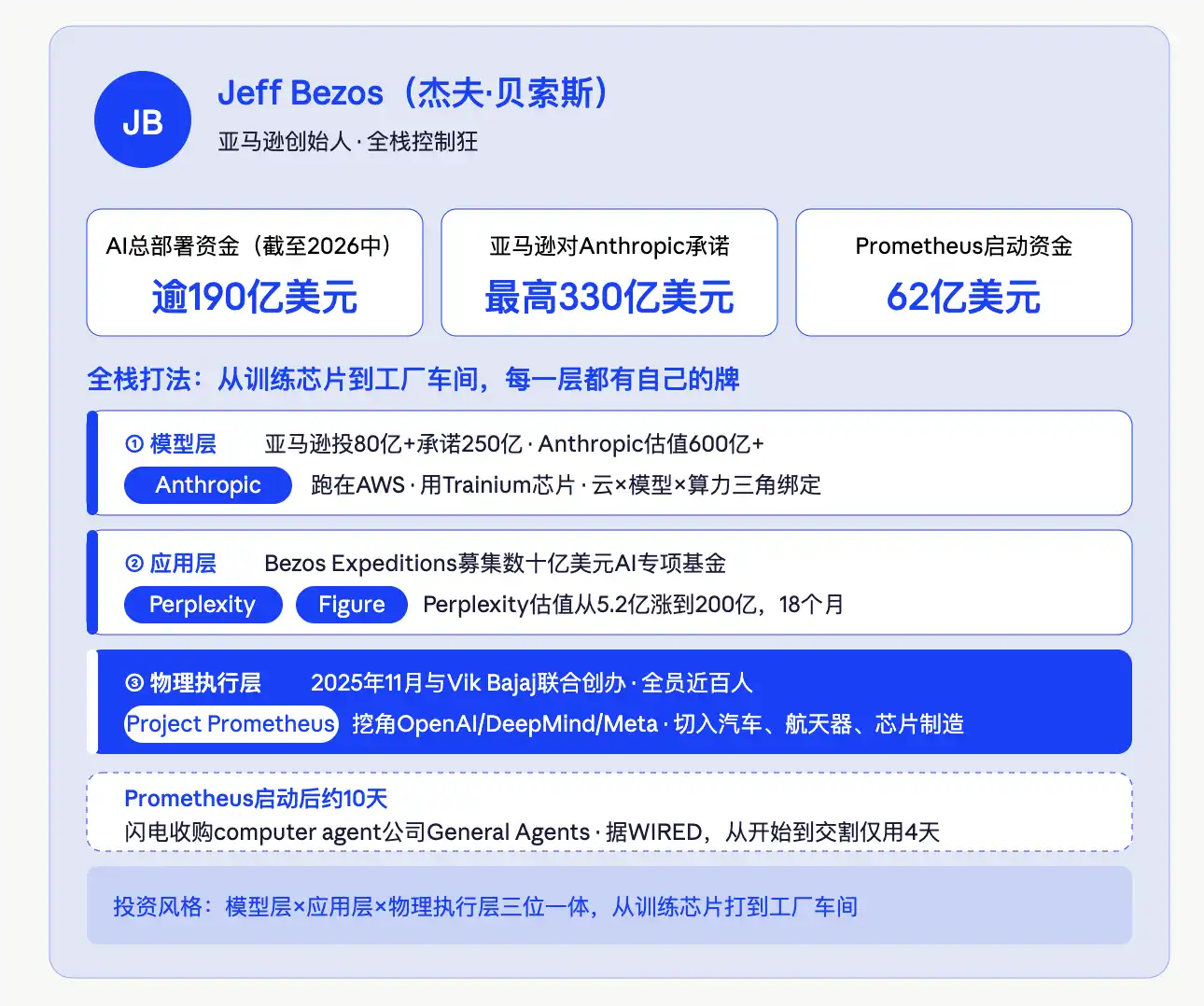
According to data cited by StartupHub from TechCrunch, The Information, and the Bezos Earth Fund, as of mid-2026, Bezos had deployed over $19 billion into AI. This number is still rising.

Breaking it down, it's mainly divided into three parts.

The first part is Anthropic. Amazon started investing in September 2023, eventually reaching $8 billion, and in April 2026, committed to adding up to $25 billion more. Anthropic runs on AWS, using Amazon's Trainium chips. This binds Amazon's cloud infrastructure, Bezos's model-layer bet, and Anthropic's research capacity into a triangle, going far beyond a mere financial investment. When Anthropic's valuation soared above $60 billion, Amazon had already captured the largest external slice of the pie.

The second part is the scattered investments of Bezos Expeditions. Bezos Expeditions is raising a multi-billion dollar AI-specific fund, upgrading "Bezos's personal angel investments" into "institutional investor." Among them, its investment in Perplexity, an AI search company, rose from a $520 million valuation in January 2024 to $20 billion in September 2025.

The third part is Project Prometheus.

In November 2025, Bezos and former Google X executive Vik Bajaj jointly announced the founding of this company, with a startup fund of $6.2 billion, nearly 100 employees. The team was recruited from OpenAI, DeepMind, and Meta. The founding advisor list included Ashish Vaswani and Jakob Uszkoreit, two of the authors of the 2017 paper "Attention Is All You Need." The company's goal is to apply AI to manufacturing, including cars, spacecraft, and chips.

Why manufacturing? Because this neatly meshes with Bezos's other businesses. Amazon has the Kuiper satellite constellation; once manufacturing AI is realized, its first batch of customers will be right in his own backyard.

Musk called Project Prometheus a "copycat" on X.

But structurally, this is not copying.

Bezos holds the model layer through Anthropic, the application layer through Perplexity and Figure, and the computing layer through Amazon. Now, by creating Prometheus, he's integrating AI into manufacturing, taking on the "physical world execution layer" as well. This is a full-stack approach, with his own cards at every layer, from training chips to deployment on the factory floor.

About 10 days after Project Prometheus launched, it quietly acquired a company called General Agents. This company developed "computer agents," AI agents capable of directly operating an entire computer. WIRED later disclosed that this acquisition, from start to closing, took only four days.

Donely's CEO Harsha Abegunasekara commented: "What General Agents truly cracked is speed; Ace runs on your computer almost instantaneously." His company was originally a competitor of General Agents.

From angel investing to forming a specialized fund, to personally taking the CEO role, Bezos only needed 18 months. He is essentially building a system larger than Amazon.

Powell Jobs: The Low-Key Camp

Looking at these three individuals together, Powell Jobs is the one who least resembles an "AI investor."

According to CNBC citing data from the private wealth platform Fintrx, her family office, Emerson Collective, has invested in at least 9 AI-related startups since 2022, participating in funding rounds totaling over $1 billion. This figure is not on the same scale as Schmidt's or Bezos's.

But the interesting part is the list itself.

Proximie: A remote surgical connection platform; Atropos Health: Clinical data AI; Formation Bio: AI drug discovery; Curipod: A Norwegian AI teaching tool; Mistral: The French large model company, Europe's sole contender against OpenAI.

No defense, no data centers, no rockets.

Emerson Collective's website clearly states its investment directions: Education, Energy & Environment, Digital Health, Fintech, Media. AI is just a tool woven into these themes. She holds a majority stake in The Atlantic and is very adept at Columbia-style "soft power" investments.

But the one investment she truly nailed is not on the same line as the ones mentioned above.

After Jony Ive left Apple in 2019, Powell Jobs invested in his design firm LoveFrom through Emerson Collective. Ive later said in a Financial Times interview: "If it weren't for Laurene, LoveFrom wouldn't exist at all." A few years later, Ive founded another hardware company called io, specializing in AI devices, and Powell Jobs invested again. In May 2025, OpenAI acquired io in an all-stock transaction worth $6.4 billion, making Ive a billionaire on paper. Emerson Collective also cashed out.

Another key investment: Emerson Collective was one of the early investors in Mistral AI when this French company was still Europe's last remaining contender in large models.

Putting these together, her AI bets are concentrated in two directions: either "using AI to solve specific human problems" or "reshaping the way humans and machines interact" (io's devices, Ive's design).

VC Sheet described Emerson Collective in an assessment: "An intentionally opaque LLC that houses venture capital, philanthropy, policy advocacy, art, and media ownership under one roof, able to use whichever tool—grants, policy lobbying, or investment—is most effective."

Philosophically, she is closer to the older generation of East Coast family offices: influence is more important than returns, the long term more important than the short term, having the microphone more important than the spotlight.

Three Investment Philosophies

Placing the three lists side by side, you see three sets of judgments about AI's future.

Schmidt is betting on national competition and infrastructure bottlenecks. In his world, AI will ultimately be determined by "who has the most electricity, the fastest rockets, the strongest drones." Models are just the entry ticket; the real moat is in the physical layer. That's why he personally steps in to lead Relativity and Bolt. What he wants is not returns, but control.

Bezos is betting on application diffusion at an industrial revolution scale. He believes AI will eventually permeate every machine tool, every airplane, every satellite like electricity. So he locks down the model layer through Amazon, the manufacturing layer through Prometheus, and embeds into the consumer application layer through Expeditions. He's not betting on whether a specific company will win, but whether this entire "full-stack" structure can win.

Powell Jobs is betting on something else. She's betting that humans will ultimately be unable to tolerate the current human-machine interaction model. She and Ive repeatedly emphasized in the Financial Times interview that "humans deserve better." Her investments in io, LoveFrom, medical AI, and educational AI are based on the same judgment: the biggest market of the next decade will be "fixing the side effects caused by the internet in the last decade."

Three sets of judgments, three different approaches.

Which one is right? No one knows. Schmidt might overestimate the weight of geopolitics in the AI economy. Bezos might underestimate the capital consumption of the "full-stack" heavy-asset model—a typical example is that Prometheus hasn't shipped anything yet, and there's already talk of needing to raise another $10 billion. Powell Jobs faces an even more awkward question: io's devices won't go into mass production until 2027, and OpenAI's own financial model has been repeatedly questioned by the market.

But one thing is certain. When the winners of the last internet generation collectively turn their family funds toward AI, this is no longer a small hype cycle in a certain sector. Bolt has already raised $150 million in startup funds; Anthropic alone is set to receive Amazon's committed $33 billion. Capital flows of this magnitude will shape the industrial geography of the next decade on their own.

As for who will have the last laugh, we'll have to look back in 2030. Until then, the three old-timers are still at the table, and the chips are still being added.

Связанные с этим вопросы

QAccording to the article, what are the three distinct AI investment philosophies of Jeff Bezos, Eric Schmidt, and Laurene Powell Jobs?

AJeff Bezos's philosophy is an 'all-stack control freak' approach, aiming to build a system controlling everything from chips to factory floors through model layers (Anthropic), application layers (Perplexity, Figure), computing power (AWS), and manufacturing (Project Prometheus). Eric Schmidt views AI as the next Cold War, focusing on national competition and physical infrastructure like energy, rockets, drones, and defense policy. Laurene Powell Jobs focuses on human-centered applications, investing in using AI to solve specific human problems or reshape human-machine interaction through hardware and design.

QWhat specific company did Eric Schmidt personally become the CEO of to support his AI investment strategy, and what is its business?

AEric Schmidt became the CEO of Relativity Space, a rocket company developing a reusable rocket called Terran R to challenge SpaceX's monopoly in low-Earth orbit launch services. This is part of his strategy to secure the 'transportation' layer for AI's future.

QHow does Jeff Bezos's Project Prometheus connect to his broader business ecosystem?

AProject Prometheus focuses on applying AI to manufacturing (cars, spacecraft, chips). This aligns with Bezos's other businesses, as its first major clients could be internal. For example, Amazon has the Kuiper satellite constellation, and Project Prometheus's manufacturing AI could directly support its production.

QWhat is Laurene Powell Jobs's significant investment connection to Apple's former design chief Jony Ive?

ALaurene Powell Jobs's Emerson Collective invested in Jony Ive's design firm LoveFrom and later in his AI hardware company io. In 2025, OpenAI acquired io in a $6.4 billion all-stock deal, resulting in a significant financial return for both Ive and Emerson Collective.

QWhat common move have these three Silicon Valley figures made in the past three years regarding AI?

AIn the past three years, these top Silicon Valley figures have directed substantial capital from their family offices, venture capital, and charitable foundations into AI. While their specific strategies differ, they are all heavily betting on AI as a defining technology for the next decade, driving massive capital flows that will shape the future industry landscape.

Похожее

It Took Me a Year to See the Bitter Truth About Agent Payments

After a year building infrastructure for the Agent economy, engaging with major players like Stripe, Visa, and Coinbase, the author shares a sobering analysis of the current state of Agent payments. The core finding is a stark lack of genuine, immediate demand across most envisioned use cases. The article breaks down four key market segments: 1. **Agent-to-Merchant (Consumer Shopping):** For most product categories (e.g., clothing, electronics), conversational AI shopping is a step backwards from visual e-commerce interfaces. While agents excel at understanding needs, they can't replace side-by-side product comparison. Real merchant interest is defensive "Agent Engine Optimization," not driven by current customer demand. Potential exists for high-frequency, low-decision purchases (like food delivery) or navigating complex store UIs, but these require massive B2C distribution channels dominated by giants like Amazon. 2. **Agent-to-API (Developer Services):** Developers already have subscriptions and billing relationships for APIs (compute, data). Prepaid balances solve micro-payment issues for low transaction volumes. A deeper structural problem is that major SaaS vendors' business models rely on enterprise contracts, resisting granular pay-per-call pricing. While protocols like MPP and x402 serve the long tail of niche services, this market is small and developers are historically low-willingness-to-pay. 3. **Agent-to-Agent:** This remains largely theoretical with minimal transaction volume. While it represents a long-term bet on a fundamentally new transaction infrastructure (sub-second, micro-penny to million-dollar, multi-party settlements), it does not constitute a present market. 4. **Agent-to-Finance:** This is the only category with existing, paying demand. Integrating AI into financial workflows (trading, portfolio management) is a natural evolution and enables new capabilities like autonomous rebalancing. However, competition favors established, regulated institutions. The "real problem" is not moving money between agents, but the broader challenge of **coordination**—orchestrating work between agents and humans, verifying outcomes, and settling results. Payment is just one component of settlement, which is itself part of coordination. Companies that solve the coordination layer will subsume payment, not the other way around. While well-funded incumbents build defensively for a long-term future, startups must find where the market is today—which, for the author's team, lies outside these four categories in an area of real, growing, and underserved activity.

marsbit3 мин. назад

It Took Me a Year to See the Bitter Truth About Agent Payments

marsbit3 мин. назад

It Took Me a Year to See the Hard Truth About Agent Payments

**Title: It Took Me a Year to See the Hard Truth About Agent Payments** Over the past year, I've worked on infrastructure for the Agent economy, engaging with major players like Stripe, Visa, Coinbase, and numerous startups. The findings reveal a stark reality: genuine, widespread demand for Agent-based payments does not yet exist. **Key Observations:** * **Agent-to-Merchant (Shopping):** The user experience for AI shopping often falls short, especially for visual product discovery. While AI excels at understanding needs, conversational interfaces can't yet replace browsing and comparing multiple products visually. Current merchant interest is largely defensive ("Agent Engine Optimization") for a future that hasn't arrived. High-frequency, low-friction purchases (like food delivery) are potential fits, but lack open APIs and face high AI inference costs. Simpler, more affordable, or cross-language interactions for complex UIs are a niche opportunity but require massive consumer distribution to scale. * **Agent-to-API (Developer Tools):** Developer payment needs for APIs (computing, data, models) are already met through subscriptions and prepaid credits. The core challenge is not payment friction but supplier economics: most large SaaS providers prefer enterprise contracts over micropayments for API calls. Protocols like MPP and x402 suit the long-tail of smaller services but cater to a developer market historically reluctant to pay for these tools. Major infrastructure needs at the top of the stack are already being addressed. * **Agent-to-Agent (Machine Commerce):** This is a long-term vision with almost no current transaction volume. While a future with high-speed, high-frequency, multi-party machine-to-machine transactions would require novel infrastructure, it remains theoretical. The market is not here yet. * **Agent-to-Finance:** This is the only category with clear, present demand. Financial professionals and DeFi users already pay for tools, and AI augmentation is a natural evolution. Autonomous AI agents can enable entirely new financial strategies. However, competition is fierce from established, regulated incumbents who can more easily layer AI onto their existing products. **The Core Insight:** Companies, especially giants with long time horizons, are building defensively for a potential future of mass machine commerce. For them, early investment is a low-cost hedge. For startups, the current market reality is different. The primary challenge isn't just moving money between agents (payments). The larger, unsolved problem is **orchestration** – coordinating work between agents and humans, verifying outcomes, and then settling. Payment is just a part of settlement, which is just a part of orchestration. Companies that solve the orchestration problem will subsume payments, not the other way around. After a year of building, we see the real, growing, and underserved market opportunity lies in this broader domain of orchestration.

链捕手26 мин. назад

It Took Me a Year to See the Hard Truth About Agent Payments

链捕手26 мин. назад

Claude Opus 4.8 Finds a $4.5 Billion Bug: The AI Era is Mass-Producing Hackers

A researcher discovered a critical "infinite mint" vulnerability in the Zcash cryptocurrency's Orchard protocol using Claude Opus 4.8, leading to a swift fix but also a 50% market drop, erasing billions in value. This incident highlights a new era where powerful, accessible AI models are dramatically lowering the barrier to finding software vulnerabilities. Previously, the security community feared specialized models like Claude Mythos Preview, capable of finding decades-old zero-day exploits. The Zcash case, however, involved a publicly available, general-purpose model. This shift makes advanced security auditing—and attack capabilities—accessible to far more people, not just experts. The mass democratization of vulnerability discovery brings a dual challenge: a flood of low-quality, AI-generated false reports that overwhelm maintainers, and the real, rapid uncovering of deep, dangerous bugs. Open-source projects, often understaffed and unfunded, are particularly vulnerable to this "attention DDoS." The article cites examples like curl shutting down its bug bounty program due to the unsustainable workload. Our perceived digital safety has often been luck, relying on the high cost and effort required to find deeply hidden flaws in complex systems, as seen with historical vulnerabilities like Heartbleed or Baron Samedit. AI changes this cost structure, effectively "mass-producing flashlights" to illuminate every corner of our codebase. While large companies operate extensive security chains involving external white-hat hackers and massive defensive operations, the global cybersecurity workforce faces a severe shortage, especially of experienced personnel capable of analyzing complex threats and coordinating fixes. The core dilemma emerges: AI makes *finding* bugs cheap and scalable, but *fixing* them remains a slow, expensive, and human-intensive process. The article concludes that AI won't destroy the internet but acts as a bright light, revealing that our digital existence is not inherently secure but is precariously maintained by ongoing human effort. The true cost in the AI era may not be discovery, but whether there will be enough people left willing and able to do the hard work of repair.

marsbit59 мин. назад

Claude Opus 4.8 Finds a $4.5 Billion Bug: The AI Era is Mass-Producing Hackers

marsbit59 мин. назад

Codex Goal Mode Usage Guide: How to Make AI Continuously Pursue a Specific Objective

"Codex Goal Mode: How to Make AI Work Continuously Toward a Specific Goal" OpenAI's Codex "goal mode" (/goal) transforms the AI from a reactive code assistant into a proactive execution agent capable of working autonomously for hours or even days to achieve a defined objective. To maximize its effectiveness, follow these key principles: 1. **Define Clear, Verifiable Exit Criteria:** The goal prompt should be a concise, measurable success condition, not a lengthy specification. Use quantifiable metrics like "reduce build time by 30%" or "achieve 100% test parity." 2. **Provide Initial Guidance and Tools:** Direct Codex toward likely problem areas and specify available tools (e.g., browsers, testing environments) to prevent it from exploring unproductive paths. 3. **Enable Progress Measurement:** Equip Codex with ways to track advancement, such as creating comparison tools for visual tasks or evaluation sets, ensuring it can gauge its own progress. 4. **Use a Realistic Execution Environment:** For tasks like performance optimization, provide access to environments that closely mimic production (e.g., similar configs, databases) to yield valid results. 5. **Be Cautious with Visual Goals:** Avoid vague "pixel-perfect" instructions. Instead, supplement visual references with functional checklists or design system specifications to prevent Codex from obsessing over minor details. 6. **Implement Progress Tracking:** For long-running tasks, have Codex commit code to draft PRs, update progress documents, or send Slack updates to maintain visibility into its work. 7. **Review and Consolidate Results:** Once the goal is met, instruct Codex to review its work, clean up ineffective experimental code, and reflect on what strategies succeeded or failed. Ultimately, using goal mode shifts the developer's role from writing prompts to managing a persistent engineering agent—defining objectives, establishing metrics, configuring environments, and conducting final reviews.

marsbit2 ч. назад

Codex Goal Mode Usage Guide: How to Make AI Continuously Pursue a Specific Objective

marsbit2 ч. назад

Торговля

Спот
Фьючерсы

Популярные статьи

Как купить S

Добро пожаловать на HTX.com! Мы сделали приобретение Sonic (S) простым и удобным. Следуйте нашему пошаговому руководству и отправляйтесь в свое крипто-путешествие.Шаг 1: Создайте аккаунт на HTXИспользуйте свой адрес электронной почты или номер телефона, чтобы зарегистрироваться и бесплатно создать аккаунт на HTX. Пройдите удобную регистрацию и откройте для себя весь функционал.Создать аккаунтШаг 2: Перейдите в Купить криптовалюту и выберите свой способ оплатыКредитная/Дебетовая Карта: Используйте свою карту Visa или Mastercard для мгновенной покупки Sonic (S).Баланс: Используйте средства с баланса вашего аккаунта HTX для простой торговли.Третьи Лица: Мы добавили популярные способы оплаты, такие как Google Pay и Apple Pay, для повышения удобства.P2P: Торгуйте напрямую с другими пользователями на HTX.Внебиржевая Торговля (OTC): Мы предлагаем индивидуальные услуги и конкурентоспособные обменные курсы для трейдеров.Шаг 3: Хранение Sonic (S)После приобретения вами Sonic (S) храните их в своем аккаунте на HTX. В качестве альтернативы вы можете отправить их куда-либо с помощью перевода в блокчейне или использовать для торговли с другими криптовалютами.Шаг 4: Торговля Sonic (S)С легкостью торгуйте Sonic (S) на спотовом рынке HTX. Просто зайдите в свой аккаунт, выберите торговую пару, совершайте сделки и следите за ними в режиме реального времени. Мы предлагаем удобный интерфейс как для начинающих, так и для опытных трейдеров.

1.4k просмотров всегоОпубликовано 2025.01.15Обновлено 2026.06.02

Как купить S

Sonic: Обновления под руководством Андре Кронье – новая звезда Layer-1 на фоне спада рынка

Он решает проблемы масштабируемости, совместимости между блокчейнами и стимулов для разработчиков с помощью технологических инноваций.

2.3k просмотров всегоОпубликовано 2025.04.09Обновлено 2025.04.09

Sonic: Обновления под руководством Андре Кронье – новая звезда Layer-1 на фоне спада рынка

HTX Learn: Пройдите обучение по "Sonic" и разделите 1000 USDT

HTX Learn — ваш проводник в мир перспективных проектов, и мы запускаем специальное мероприятие "Учитесь и Зарабатывайте", посвящённое этим проектам. Наше новое направление .

1.8k просмотров всегоОпубликовано 2025.04.10Обновлено 2025.04.10

HTX Learn: Пройдите обучение по "Sonic" и разделите 1000 USDT

Обсуждения

Добро пожаловать в Сообщество HTX. Здесь вы сможете быть в курсе последних новостей о развитии платформы и получить доступ к профессиональной аналитической информации о рынке. Мнения пользователей о цене на S (S) представлены ниже.

活动图片