Beyond Capitulation: Why Bitcoin’s Short-Term Holders Refuse To Blink Amid Iran Escalation

bitcoinistОпубликовано 2026-03-03Обновлено 2026-03-03

Введение

Bitcoin is under pressure as Middle East tensions increase market uncertainty, but a key behavioral shift is emerging. Short-term holders (STHs), who typically amplify volatility by sending coins to exchanges during losses, are not panicking as expected. During a capitulation event in early February, STHs transferred 89,000 BTC at a loss in 24 hours. Since then, loss-driven inflows have declined steadily. Even amid recent Iran-related geopolitical escalation—a classic risk-off trigger—there was no significant spike in STH realized-loss transfers. This suggests that forced selling phase may be exhausting, indicating seller fatigue and potential market stabilization. The key signal ahead is whether STHs continue to restrain from selling, pointing to base-building, or if a new loss-transfer spike renews downside risk.

Bitcoin is facing renewed pressure as geopolitical tensions in the Middle East reshape the macro backdrop and weigh on risk assets. Rather than responding to isolated headlines, the market is reacting to a broader shift in uncertainty, liquidity expectations, and cross-asset positioning. Price remains fragile, with rallies struggling to gain traction as participants reassess exposure in an increasingly volatile environment.

A recent CryptoQuant report sheds light on a critical behavioral shift through the Short-Term Holder (STH) P&L to Exchanges metric — a tool designed to track how the most reactive cohort is positioning. These investors, often responsible for amplifying short-term volatility, tend to transfer coins to exchanges when under stress, particularly during loss realization events.
Bitcoin Short-Term Holder P&L to Exchanges Sum 24H | Source: CryptoQuant

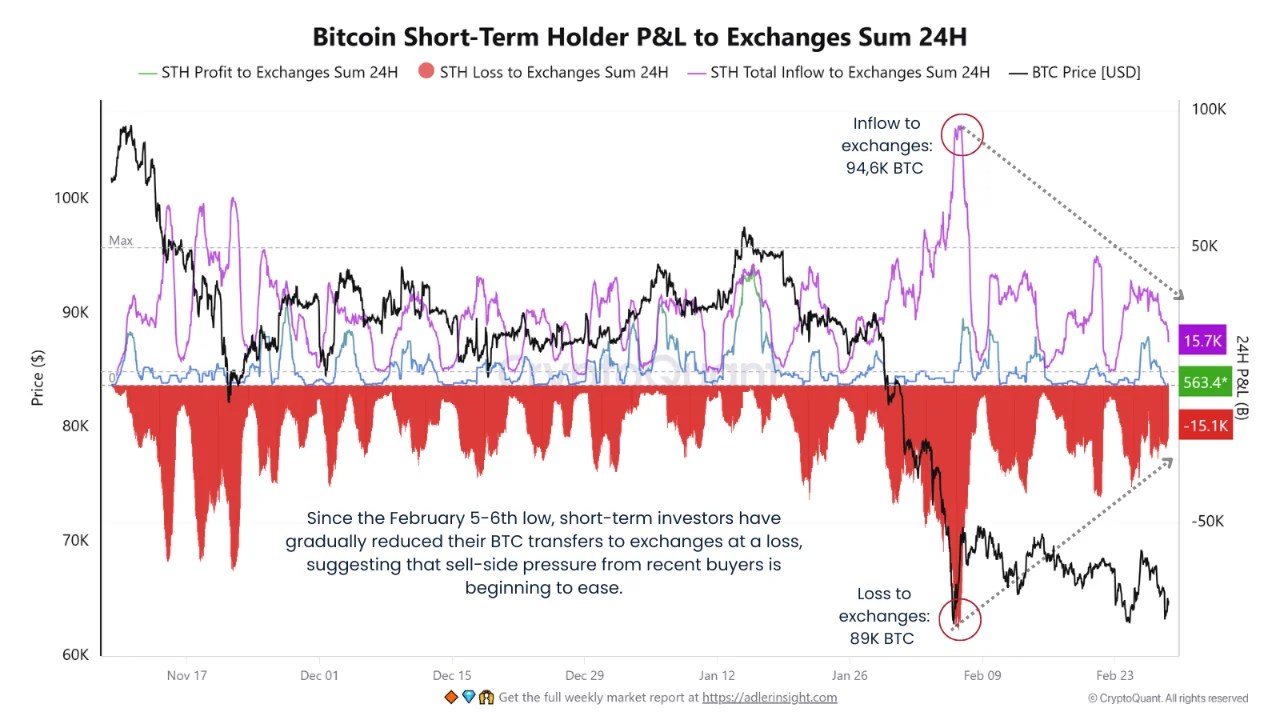
During the February 5–6 capitulation episode, STHs sent approximately 89,000 BTC to exchanges at a loss within a single 24-hour window — a clear signal of panic-driven distribution. However, the dynamics have since evolved. Following that event, loss-driven inflows have steadily declined.

This suggests that immediate sell-side pressure from recent buyers is diminishing. The data indicate that acute panic has subsided. What remains is not aggressive accumulation, but a gradual transition from forced liquidation to relative exhaustion — a subtle yet important structural development.

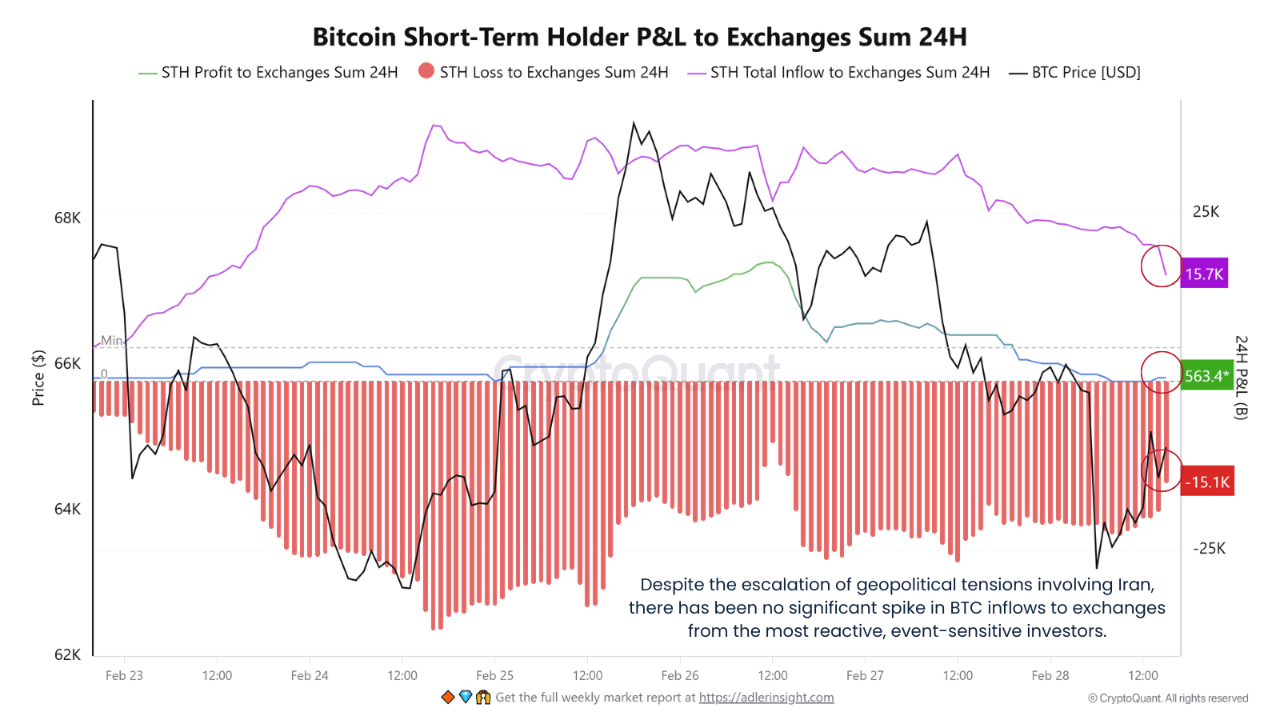
The granular view of the Short-Term Holder P&L to Exchanges metric adds nuance to the broader picture. Even amid the recent geopolitical escalation involving Iran — an event class that has historically triggered reactive risk-off flows — exchange inflows from short-term holders did not materially expand. As Bitcoin probed the $63,000–$64,000 zone, there was no corresponding spike in realized-loss transfers. For a cohort typically hypersensitive to volatility, this restraint is notable.
Bitcoin Short-Term Holder Loss to Exchange | Source: CryptoQuant

This behavior suggests a shift from reflexive panic to conditional holding. In prior stress episodes, similar price shocks produced visible surges in exchange-bound coins as weak hands rushed to de-risk. The absence of that pattern now implies that a meaningful portion of forced selling may already have occurred during the early-February capitulation phase.

Markets tend to stabilize only after marginal sellers are exhausted. The progressive decline in loss-driven transfers supports the thesis that liquidation pressure is being absorbed rather than re-accelerating.

Going forward, the signal to monitor is persistence. If short-term holder inflows remain muted, it would reinforce the case for seller fatigue and base-building conditions. Conversely, a renewed spike in realized-loss transfers would indicate that capitulation is incomplete, reopening the path for further downside volatility.


Связанные с этим вопросы

QWhat does the Short-Term Holder (STH) P&L to Exchanges metric track?

AIt tracks how the most reactive cohort of investors, the short-term holders, are positioning by monitoring their transfer of coins to exchanges, particularly during stress and loss realization events.

QHow many BTC did short-term holders send to exchanges at a loss during the February 5-6 capitulation episode?

AShort-term holders sent approximately 89,000 BTC to exchanges at a loss within a single 24-hour window during that period.

QWhat does the decline in loss-driven inflows from short-term holders suggest about market behavior?

AIt suggests that immediate sell-side pressure from recent buyers is diminishing, acute panic has subsided, and the market is transitioning from forced liquidation to relative exhaustion.

QHow did short-term holders react to the recent geopolitical escalation involving Iran, according to the data?

ADespite the escalation, exchange inflows from short-term holders did not materially expand, and there was no spike in realized-loss transfers, indicating notable restraint.

QWhat future signal should be monitored to assess market stability of Bitcoin, as per the article?

AThe persistence of muted short-term holder inflows should be monitored, as it would indicate seller fatigue and base-building conditions, while a renewed spike would suggest incomplete capitulation and potential further downside volatility.

Похожее

Торговля

Спот
Фьючерсы

Популярные статьи

Как купить S

Добро пожаловать на HTX.com! Мы сделали приобретение Sonic (S) простым и удобным. Следуйте нашему пошаговому руководству и отправляйтесь в свое крипто-путешествие.Шаг 1: Создайте аккаунт на HTXИспользуйте свой адрес электронной почты или номер телефона, чтобы зарегистрироваться и бесплатно создать аккаунт на HTX. Пройдите удобную регистрацию и откройте для себя весь функционал.Создать аккаунтШаг 2: Перейдите в Купить криптовалюту и выберите свой способ оплатыКредитная/Дебетовая Карта: Используйте свою карту Visa или Mastercard для мгновенной покупки Sonic (S).Баланс: Используйте средства с баланса вашего аккаунта HTX для простой торговли.Третьи Лица: Мы добавили популярные способы оплаты, такие как Google Pay и Apple Pay, для повышения удобства.P2P: Торгуйте напрямую с другими пользователями на HTX.Внебиржевая Торговля (OTC): Мы предлагаем индивидуальные услуги и конкурентоспособные обменные курсы для трейдеров.Шаг 3: Хранение Sonic (S)После приобретения вами Sonic (S) храните их в своем аккаунте на HTX. В качестве альтернативы вы можете отправить их куда-либо с помощью перевода в блокчейне или использовать для торговли с другими криптовалютами.Шаг 4: Торговля Sonic (S)С легкостью торгуйте Sonic (S) на спотовом рынке HTX. Просто зайдите в свой аккаунт, выберите торговую пару, совершайте сделки и следите за ними в режиме реального времени. Мы предлагаем удобный интерфейс как для начинающих, так и для опытных трейдеров.

1.1k просмотров всегоОпубликовано 2025.01.15Обновлено 2025.03.21

Как купить S

Sonic: Обновления под руководством Андре Кронье – новая звезда Layer-1 на фоне спада рынка

Он решает проблемы масштабируемости, совместимости между блокчейнами и стимулов для разработчиков с помощью технологических инноваций.

2.2k просмотров всегоОпубликовано 2025.04.09Обновлено 2025.04.09

Sonic: Обновления под руководством Андре Кронье – новая звезда Layer-1 на фоне спада рынка

HTX Learn: Пройдите обучение по "Sonic" и разделите 1000 USDT

HTX Learn — ваш проводник в мир перспективных проектов, и мы запускаем специальное мероприятие "Учитесь и Зарабатывайте", посвящённое этим проектам. Наше новое направление .

1.7k просмотров всегоОпубликовано 2025.04.10Обновлено 2025.04.10

HTX Learn: Пройдите обучение по "Sonic" и разделите 1000 USDT

Обсуждения

Добро пожаловать в Сообщество HTX. Здесь вы сможете быть в курсе последних новостей о развитии платформы и получить доступ к профессиональной аналитической информации о рынке. Мнения пользователей о цене на S (S) представлены ниже.

活动图片