Behind the Rejection of the $17M CRV Grant: Founder's Proposal Power Weakened, Convex and Yearn Become Key Players

marsbitОпубликовано 2025-12-25Обновлено 2025-12-25

Введение

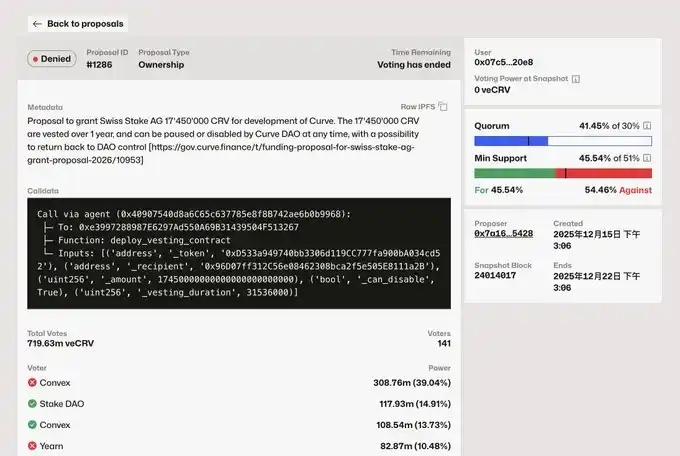
A proposal to grant 17 million CRV tokens (worth approximately $1.7 million) to Swiss Stake AG, a long-time core development team, was rejected in a Curve Finance governance vote. Major veCRV holders, including Convex and Yearn, voted against it, wielding enough voting power to determine the outcome. The rejection reflects two key shifts in DAO governance: First, communities are demanding greater accountability, transparency, and measurable results for treasury grants, moving beyond unconditional funding. Second, large veCRV holders, motivated by self-interest, are resistant to proposals that dilute their token value without clear, foreseeable benefits to them. The incident highlights the evolving power dynamics within Curve's governance. The veToken model, which ties voting rights to long-term locked capital, inherently concentrates power among large, capital-rich entities like Convex and Yearn. As users delegate their tokens to these protocols for yield and liquidity, governance is increasingly shifting from founders and communities to a form of "governance capitalism" dominated by major stakeholders.

A few days ago, a funding proposal on Curve was rejected, which involved allocating 17M $CRV to the development team (Swiss Stake AG) for development expenses. Both Convex and Yearn voted against it, and their voting power was sufficient to influence the final outcome.

Since the Aave governance issue began to gain attention, governance has started to be scrutinized by the market, and the habit of approving funding requests without question is being broken. This Curve proposal highlights two key points:

1. Some voices in the community are not opposed to funding AG, but they want clarity on how previous funds were used, how future funds will be utilized, whether the approach is sustainable, and whether it has generated returns for the project. At the same time, this overly simplistic grant model lacks accountability once funds are disbursed. In the future, the DAO needs to establish a Treasury, ensure transparency in income and expenditures, or add governance constraints.

2. The major veCRV holders do not want to dilute their value. This is a clear conflict of interest. If the projects supported by CRV grants cannot foreseeably benefit veCRV holders, they are unlikely to gain support. Of course, Convex and Yearn also have their own agendas and influence, but that’s a separate issue.

This proposal was initiated by Curve founder Mich. AG is one of the teams that has been maintaining the core codebase since 2020. The roadmap presented by AG for this funding includes advancing llamalend, supporting PT and LP, as well as expanding the on-chain foreign exchange market and crvUSD. These seem like worthwhile initiatives, but whether they justify a 17M $CRV grant is another calculation. Particularly, Curve’s governance differs significantly from Aave’s, with power distributed among several teams with distinct stances.

Comparing ve with conventional governance models:

First, the conclusion: most conventional governance models, by design, have little to no advantage. Of course, if a DAO is mature enough, traditional structures can function well, but unfortunately, no crypto project has reached that level of maturity yet, as even market-consensus leaders like Aave have encountered issues.

If we focus solely on model design, ve has some advanced aspects. Firstly, it generates cash flow and is backed by liquidity control rights. When there is external demand for liquidity, this power is subject to bribes. So even if you don’t want to lock your tokens long-term, you can delegate them to proxy projects like Convex/Yearn to earn yields.

Thus, ve is a model where voting rights are tied to cash flow. Its future evolution will likely follow the path of “governance capitalism.” Vetoken binds voting rights with “long-term locking,” essentially筛选 those with large capital, ability to bear liquidity loss, and capacity for long-term博弈. Over time, this means governance will shift from ordinary users to “capital groups.”

At the same time, due to the presence of proxy layers like Convex/Yearn, many ordinary users, even loyal ones, who want to retain liquidity and flexibility while earning yields, will gradually choose to delegate their governance to these projects.

This vote also offers some insight: in the future, Mich may not be the key player in Curve’s governance; instead, power lies with these major token holders. When Aave faced governance issues, some proposed the idea of “delegated governance/elite governance,” which is quite similar to Curve’s current structure. As for whether this is good or bad, only time will tell.
Связанные с этим вопросы

QWhy was the proposal to grant 17M $CRV to the development team Swiss Stake AG rejected by the Curve community?

AThe proposal was rejected primarily because major veCRV holders, such as Convex and Yearn, voted against it. They were concerned about the dilution of their token value and the lack of transparency and accountability regarding the use of funds. The community also demanded clearer details on past fund usage, future plans, and measurable benefits to the project before approving such a grant.

QWhat are the key concerns raised by the Curve community regarding grant proposals like this one?

AThe community emphasized the need for transparency in treasury management, including clear reporting on how funds are used and how they generate value for the project. They also called for sustainable and constrained grant models rather than unconditional funding, ensuring that grants align with the long-term interests of veCRV holders and the ecosystem.

QHow does Curve's ve token model differ from traditional governance models in crypto?

ACurve's ve (vote-escrowed) model binds voting rights to long-term token lockups, creating a system where governance power is coupled with financial incentives like yield and bribes. This contrasts with traditional governance models, which often lack built-in economic alignment. The ve model tends to concentrate governance influence among large, long-term capital providers rather than ordinary users.

QWhat role do Convex and Yearn play in Curve's governance structure?

AConvex and Yearn act as major vote aggregators in Curve's governance by accumulating veCRV tokens from users who delegate to them. They wield significant voting power, often enough to sway governance outcomes, as seen in the rejection of the 17M $CRV grant proposal. Their influence highlights the shift toward 'governance capitalism,' where large capital entities dominate decision-making.

QWhat does the rejection of this proposal indicate about the future of Curve's governance?

AThe rejection signals that Curve's governance is increasingly dominated by large veCRV holders and proxy platforms like Convex and Yearn, rather than individual founders or small stakeholders. This reflects a broader trend toward capital-driven governance, where decisions are made based on economic incentives and long-term value preservation for major stakeholders.

Похожее

AI Giants Enter the Dark Forest

In the AI industry's "dark forest," major players like Anthropic, OpenAI, and DeepSeek are strategically withholding their most advanced models to avoid becoming targets in a high-stakes competitive landscape. Anthropic released Claude Opus 4.7 but admitted it underperforms compared to their unreleased model Mythos, citing safety concerns. They delayed addressing user complaints about performance regression until OpenAI’s GPT-5.5 launch, highlighting a tactic of controlled disclosure aligned with competitors’ moves. OpenAI’s GPT-5.5, though a full retrain since GPT-4.5, was seen as incremental rather than revolutionary. Leaks revealed internal models like Glacier and Heisenberg, indicating significant unreleased capabilities. OpenAI acknowledges a "capability overhang," where real model power exceeds what users experience, often due to infrastructure-driven throttling. DeepSeek launched V4 Preview, a cost-efficient model, but its full potential (V4 Pro Max) awaits Huawei’s Ascend 950 super-nodes量产 in late 2026. Their strategy focuses on affordability and scalability, aiming to democratize AI access globally, a move noted even by NVIDIA’s CEO as a disruptive threat. Together, these actions reflect a broader trend: leading AI labs are deliberately pacing releases, hiding strengths, and aligning disclosures with competitive dynamics—each avoiding the risk of exposure in a forest where first movers become targets.

marsbit1 ч. назад

AI Giants Enter the Dark Forest

marsbit1 ч. назад

Торговля

Спот
Фьючерсы

Популярные статьи

Как купить S

Добро пожаловать на HTX.com! Мы сделали приобретение Sonic (S) простым и удобным. Следуйте нашему пошаговому руководству и отправляйтесь в свое крипто-путешествие.Шаг 1: Создайте аккаунт на HTXИспользуйте свой адрес электронной почты или номер телефона, чтобы зарегистрироваться и бесплатно создать аккаунт на HTX. Пройдите удобную регистрацию и откройте для себя весь функционал.Создать аккаунтШаг 2: Перейдите в Купить криптовалюту и выберите свой способ оплатыКредитная/Дебетовая Карта: Используйте свою карту Visa или Mastercard для мгновенной покупки Sonic (S).Баланс: Используйте средства с баланса вашего аккаунта HTX для простой торговли.Третьи Лица: Мы добавили популярные способы оплаты, такие как Google Pay и Apple Pay, для повышения удобства.P2P: Торгуйте напрямую с другими пользователями на HTX.Внебиржевая Торговля (OTC): Мы предлагаем индивидуальные услуги и конкурентоспособные обменные курсы для трейдеров.Шаг 3: Хранение Sonic (S)После приобретения вами Sonic (S) храните их в своем аккаунте на HTX. В качестве альтернативы вы можете отправить их куда-либо с помощью перевода в блокчейне или использовать для торговли с другими криптовалютами.Шаг 4: Торговля Sonic (S)С легкостью торгуйте Sonic (S) на спотовом рынке HTX. Просто зайдите в свой аккаунт, выберите торговую пару, совершайте сделки и следите за ними в режиме реального времени. Мы предлагаем удобный интерфейс как для начинающих, так и для опытных трейдеров.

1.2k просмотров всегоОпубликовано 2025.01.15Обновлено 2025.03.21

Как купить S

Sonic: Обновления под руководством Андре Кронье – новая звезда Layer-1 на фоне спада рынка

Он решает проблемы масштабируемости, совместимости между блокчейнами и стимулов для разработчиков с помощью технологических инноваций.

2.2k просмотров всегоОпубликовано 2025.04.09Обновлено 2025.04.09

Sonic: Обновления под руководством Андре Кронье – новая звезда Layer-1 на фоне спада рынка

HTX Learn: Пройдите обучение по "Sonic" и разделите 1000 USDT

HTX Learn — ваш проводник в мир перспективных проектов, и мы запускаем специальное мероприятие "Учитесь и Зарабатывайте", посвящённое этим проектам. Наше новое направление .

1.8k просмотров всегоОпубликовано 2025.04.10Обновлено 2025.04.10

HTX Learn: Пройдите обучение по "Sonic" и разделите 1000 USDT

Обсуждения

Добро пожаловать в Сообщество HTX. Здесь вы сможете быть в курсе последних новостей о развитии платформы и получить доступ к профессиональной аналитической информации о рынке. Мнения пользователей о цене на S (S) представлены ниже.

活动图片