Base Official Selection: 12 Promising Projects Chosen from 1,175 Applications

marsbitОпубликовано 2026-04-10Обновлено 2026-04-10

Введение

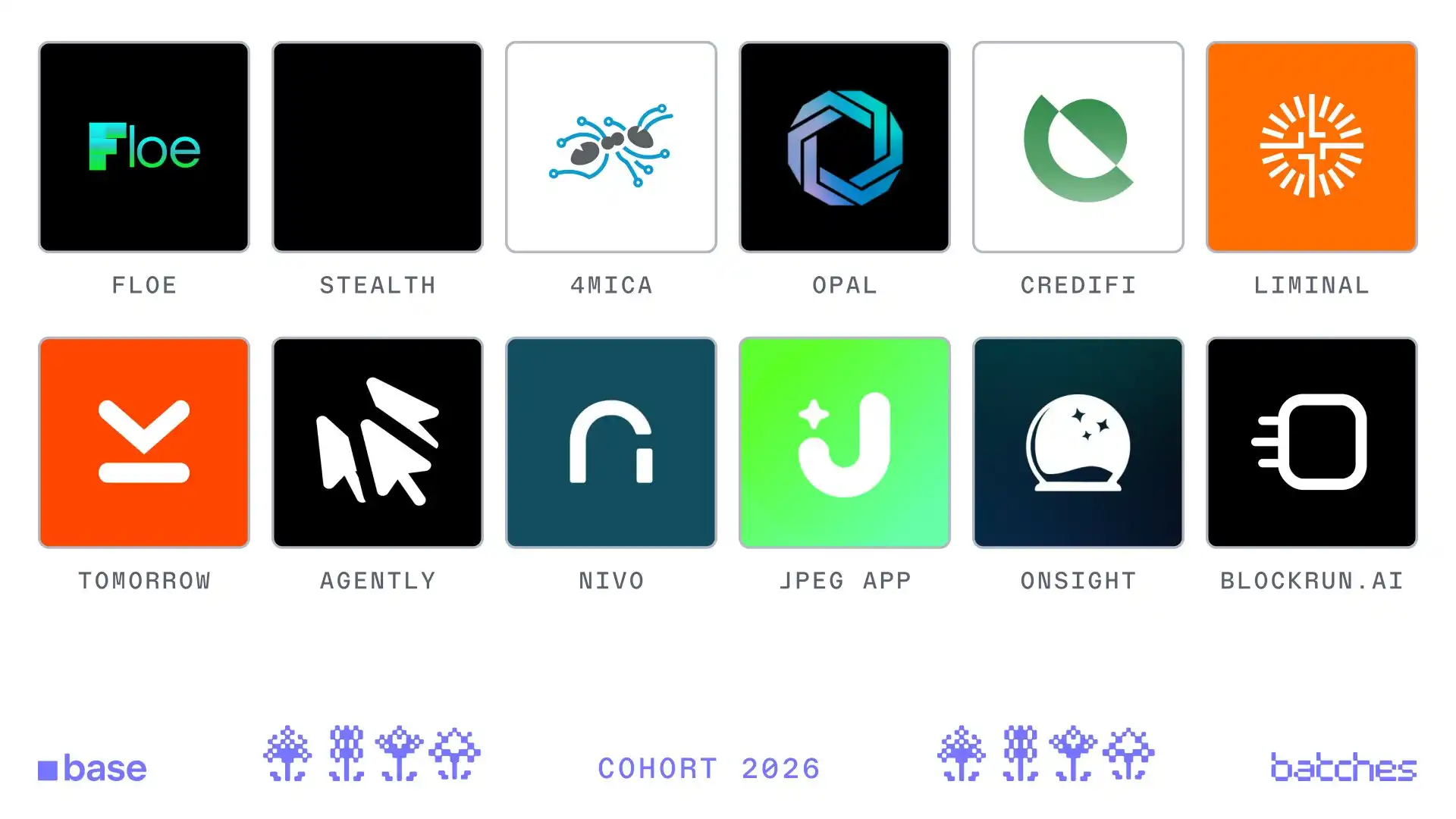
Base has officially selected 12 standout projects from 1,175 applications for its accelerator program, signaling a strategic focus on high-potential on-chain ecosystems over independent unified stacks outside the OP Superchain. The chosen projects span key sectors including DeFi, prediction markets, AI agents, and payments. Highlights include: BlockRunAI (AI agent infrastructure with x402 pay-per-use payments), a stealth prediction market with novel leverage primitives, 0x4Mica (micropayment clearing for AI agents), Opal DEX (privacy-focused perpetual DEX), TradeOnsight (gamified social prediction platform), Credifi (uncollateralized lending via zkTLS), Tomorrow Loans (creator economy lending), AgentlyHQ (AI agent coordination layer), Nivo Finance (FX hedging for SMEs), JPEGapp (image-based prediction market), Floe Labs (AI agent credit infrastructure), and Liminal (AI-native neobank). Base is positioning itself as a major hub for on-chain innovation this cycle.

Author: yyy

Base has just announced the 12 ecosystem projects selected for its official accelerator program, which I believe sends an important strategic signal:

@base prioritizes the development of on-chain potential ecosystems over building a unified stack independent of the OP Superchain.

These 12 projects were chosen from 1,175 applications to the @base official accelerator program, covering promising sectors such as DeFi, prediction markets, AI Agents, and payments. They are truly one-in-a-hundred selections, with higher credibility than previous batches.

Here is the information on these 12 projects:

1/ @BlockRunAI

Sub-sector: AI Agent Infrastructure / x402 Payments

Provides routing for LLM, tools, and data access for AI Agents, with pay-per-request via the x402 protocol.

2/ (Stealth Project)

Sub-sector: Prediction Markets

Develops a new leverage primitive for prediction markets to enhance trading capital efficiency.

3/ @0x4Mica

Sub-sector: AI Agent Micropayments / Clearing Infrastructure

Provides clearing infrastructure for high-frequency micro-transactions of AI Agents, supporting collateralization and batch settlements.

4/ @opal_dex

Sub-sector: DeFi / Privacy Perpetual DEX

A privacy-protected perpetual contract DEX supporting cryptocurrency and RWA trading, with sealed matching and "dealer" privacy.

5/ @TradeOnsight

Sub-sector: Prediction Markets / Social Gamification

A gamified social prediction market platform that combines social chat with betting experiences.

6/ @credifi

Sub-sector: DeFi / Uncollateralized Lending

An uncollateralized lending protocol based on zkTLS and on-chain credit scoring, lowering the barrier to DeFi lending.

7/ @tomorrowloans

Sub-sector: DeFi / Creator Economy Lending

A collateralized stablecoin lending platform for creators based on verifiable revenue (e.g., Google AdSense).

8/ @AgentlyHQ

Sub-sector: AI Agent Coordination / Transaction Routing

A coordination and transaction routing layer for AI Agents, enabling multiple agents to collaborate on complex tasks and on-chain payments.

9/ @nivo_finance

Sub-sector: DeFi / Foreign Exchange Hedging

An on-chain foreign exchange hedging and forward locking protocol for SMEs and cross-border businesses to manage exchange rate risks.

10/ @jpegapp

Sub-sector: Prediction Markets / Opinion Markets

An opinion market based on photo content where users bet on images, and the highest bet wins.

11/ @FloeLabs

Sub-sector: AI Agent Credit / DeFi

Provides credit lines and credit infrastructure for AI Agents and institutions, supporting payment scenarios like x402.

12/ @liminalcash

Sub-sector: Neobank / AI-Native Banking

An AI-native, self-custodial digital bank integrating self-custody wallets, payments, and smart financial management features.

Base is highly likely to become one of the main battlegrounds for on-chain ecosystem innovation in this crypto cycle. Wait for the wind to come.

Связанные с этим вопросы

QWhat is the main strategic signal released by Base according to the article?

ABase prioritizes the layout of on-chain potential ecosystems over building a unified stack independently from the OP Superchain.

QHow many projects applied to Base's official accelerator program, and how many were selected?

AThere were 1175 applications, and 12 projects were selected.

QWhich project provides a new leverage primitive for prediction markets to improve capital efficiency?

AThe stealth project (unnamed) in the prediction market segment.

QWhat is the core function of the project @0x4Mica?

AIt provides clearing infrastructure for high-frequency micro-transactions of AI Agents, supporting collateralization and batch settlements.

QWhat type of financial service does @liminalcash aim to provide?

AIt aims to be an AI-native, self-custodial digital bank that integrates self-custody wallets, payments, and intelligent financial management features.

Похожее

Arthur Hayes Analysis: AI Bubble Nears Burst, Crypto Market Faces Short-Term Pressure

Arthur Hayes argues that the current AI market is a bubble poised to burst, which will exert downward pressure on the crypto market in the near term. The core trigger is rising oil prices due to the US-Iran conflict and a blockade of the Strait of Hormuz. Higher energy costs directly increase the operational expenses of AI data centers, squeezing profit margins for companies like Google, Anthropic, and OpenAI. Hayes predicts that persistent inflation from high oil prices will force Trump, in a bid to win the November election, to turn public sentiment against the AI industry. He may propose regulations and taxes on data centers and AI companies to appeal to voters concerned about costs and job displacement. Such political rhetoric could shatter market confidence. Furthermore, the market is unlikely to healthily absorb the massive concurrent IPOs of SpaceX, Anthropic, and OpenAI, which together seek valuations in the trillions. The combination of soaring energy costs, overwhelming equity supply, and negative political pressure will puncture the AI bubble. Hayes notes that nearly all new USD liquidity since 2022 has flowed into AI, leaving crypto like Bitcoin behind. When the AI bubble bursts, liquidity will contract sharply, pulling down all risk assets, including cryptocurrencies. In response, Hayes's fund, Maelstrom, has sold all AI-related stocks and non-core cryptocurrencies. It maintains core positions in Bitcoin and Ethereum while increasing exposure to energy sector equities, betting on rising oil and gas prices. He expects Bitcoin to bottom after the AI-led market decline, before rallying again with future monetary easing.

Foresight News3 мин. назад

Arthur Hayes Analysis: AI Bubble Nears Burst, Crypto Market Faces Short-Term Pressure

Foresight News3 мин. назад

To C, To B, and the Next Big Thing Called To A

After To C and To B, the Next Wave is To A: Serving AI Agents In a recent quarterly earnings call, Meituan's Wang Xing introduced a new concept: To A (To Agent), signifying that future business services will increasingly target AI Agents as primary clients, not just consumers or merchants. This shift implies that internet giants must now consider how to make their services more appealing for AI Agents to recommend, fundamentally altering traditional distribution logic. This "To A era" is prompting an unusual trend of alliances among major tech companies. Unlike previous competitive battles, firms like Meituan, Tencent, JD.com, Huawei, OPPO, and OpenAI are rapidly forming partnerships. The reason is strategic: as AI Agents become the primary user interface, handling tasks from a single command (e.g., "Book a Japanese restaurant for tomorrow"), the risk for platforms is being bypassed entirely. Companies are positioning themselves within this new value chain. Three primary strategies are emerging: 1. **Super-Entry Points + Service Providers:** Platforms like Tencent's Yuanbao, WeChat, and ChatGPT aim to be the first-stop Agent, integrating various services (food delivery, shopping, travel) from partners like Meituan and JD.com. 2. **Apps as Callable Services:** Companies like Meituan, JD.com, and Uber are ensuring their core services remain accessible and callable by external Agents, shifting from front-end apps to back-end capabilities. 3. **System-Level Agent Entry Points:** Smartphone makers (Huawei, Honor, OPPO) are leveraging their OS-level AI assistants to control the initial user command, redistributing it to relevant service apps. While alliances offer mutual benefit—entry points gain service capabilities, and service providers gain traffic—inherent conflicts of interest exist. A dominant Agent platform could eventually attempt to connect directly with suppliers (restaurants, hotels), bypassing current aggregators like Meituan or Ctrip. Other unresolved challenges include the potential for Agent recommendations to become a new form of paid ranking and unclear accountability for faulty recommendations. The current rush to form alliances is a defensive move by service providers to secure their position before the landscape solidifies. In this To A-driven restructuring, the greatest risk is not losing the race but failing to hear the starting gun.

marsbit12 мин. назад

To C, To B, and the Next Big Thing Called To A

marsbit12 мин. назад

The More Lifelike the Robot, the More Terrifying? Unveiling the 'Uncanny Valley Effect' in the Era of Humanoid Robots

As humanoid robots become increasingly lifelike, they confront a significant psychological barrier known as the "Uncanny Valley Effect," a concept proposed by Japanese roboticist Masahiro Mori in 1970. This phenomenon describes a dip in human comfort and acceptance when robots appear almost, but not perfectly, human. Minor imperfections in facial expressions, eye movements, or skin texture trigger a subconscious sense of unease, as the brain detects something trying, yet failing, to mimic a person. Examples range from the controversial human-like robot Sophia to animated characters in films like *The Polar Express*. The effect poses a key design challenge for robotics companies. Some, like Boston Dynamics, avoid it entirely by creating highly capable but visibly mechanical robots. Others, like Hanson Robotics, push for greater human likeness despite the risk. For consumer robots, especially in homes, most manufacturers opt for stylized or clearly mechanical designs to ensure broader acceptance. While the Uncanny Valley remains a powerful force, its impact may diminish over time through technological advancements that achieve near-perfect realism or through generational familiarity as people grow accustomed to interacting with humanoid machines. Ultimately, navigating this psychological frontier requires as much understanding of human perception as of robotics technology itself.

marsbit12 мин. назад

The More Lifelike the Robot, the More Terrifying? Unveiling the 'Uncanny Valley Effect' in the Era of Humanoid Robots

marsbit12 мин. назад

Торговля

Спот
Фьючерсы
活动图片