Bank of Korea Interprets the AI Semiconductor Cycle: The Most Dangerous Signal Lies in Financing

marsbitОпубликовано 2026-04-13Обновлено 2026-04-13

Введение

The Bank of Korea (BoK) released a report examining the sustainability of the current AI-driven semiconductor supercycle, concluding that the expansion is likely to continue until at least the first half of 2026. The report highlights three key differences from past cycles: unprecedented demand growth (driven by HBM and AI accelerators), severely constrained supply (due to complex HBM production and conservative industry expansion), and a significantly larger and longer supply-demand gap. Five critical factors will determine the cycle's longevity: 1. The profitability of AI investments, as market focus shifts from market share capture to earnings. 2. The ability of major tech firms to secure financing, with internal cash flows already insufficient to cover massive CAPEX, leading to increased corporate debt issuance and risky vendor financing structures reminiscent of the telecom bubble. 3. Uncertain impact of AI model efficiency improvements, which could either reduce per-unit demand or increase total consumption. 4. Expansion speed of major memory manufacturers, with significant new capacity from SK Hynix, Micron, and Samsung only expected from late 2027. 5. Ramping production from Chinese manufacturers, whose DRAM market share is projected to grow rapidly, pressuring prices. The report warns that financing fragility—evidenced by rising CDS spreads, off-balance-sheet SPV financing, and redemption halts in private credit funds—is the most critical risk. While the cycle rem...

Compiled by: Macro_Lin

Recently, I read a special report released by the Bank of Korea (BoK) titled "Examination of the Sustainability of the Global Semiconductor Boom." This report is quite unique.

South Korea is a major global exporter of memory chips. The financial reports of Samsung and SK Hynix are, to some extent, the national economic reports for the BoK. When this central bank itself steps in to seriously discuss how far this AI-driven semiconductor super cycle can actually go, the attitude itself is noteworthy. Sell-side research reports have their biases, bearish reports carry emotion; BoK's document is permeated with the restrained tone characteristic of a central bank, with a much higher density of argumentation than emotional charge.

Core View

The Bank of Korea judges that the amplitude and duration of the supply-demand imbalance in this memory cycle significantly exceed those of the past three cycles, and expansion is certain to continue at least until the first half of 2026. However, starting in 2027, five variables will jointly determine the timing of the reversal, with two of the most concerning signals already emerging.

I. How This Round Differs from the Past Three

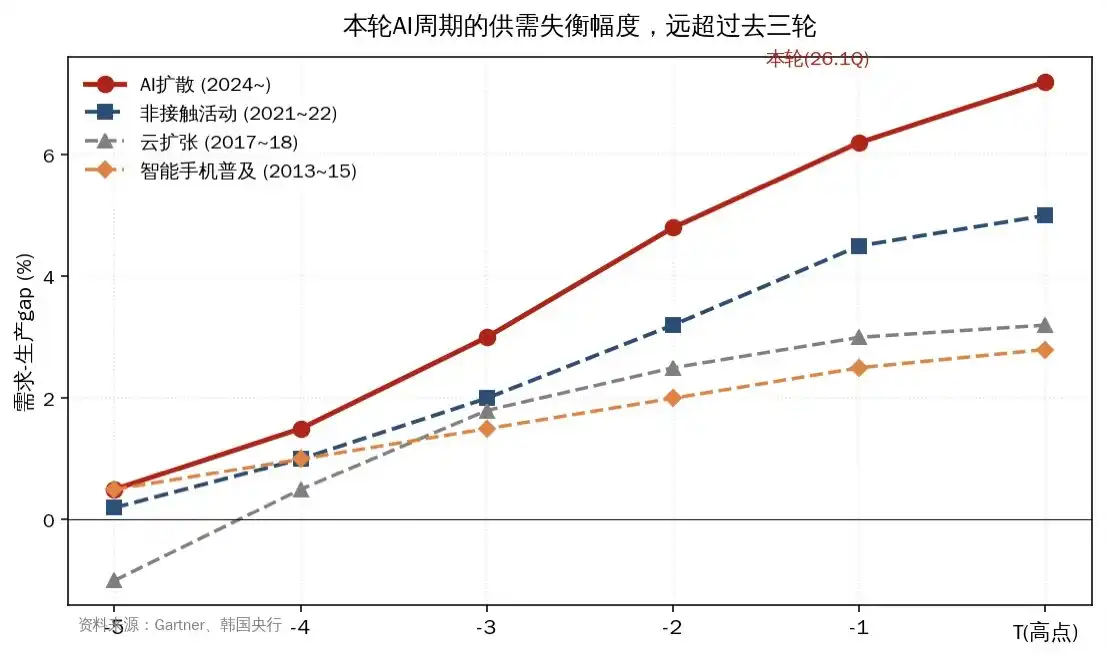
BoK divides the semiconductor cycles since 2010 into four rounds: smartphone普及 (2013-2015), cloud expansion (2017-2018), pandemic non-contact demand (2020-2021), and the current round of AI diffusion (2024-present).

The script for the past three rounds was the same. New technology pulls up demand, supply lags behind to catch up, concentrated release of expanded production leads supply to surpass demand, inventory accumulates, prices fall, and the cycle reverses. Post-2017, this reversal point highly coincided with the inflection point in CAPEX of large US tech companies.

This round differs in three aspects.

First, demand growth is the fastest in history. HBM is exploding with the loading volume of AI accelerators, and general-purpose DRAM is also being driven up by inference needs. It's a synchronous expansion across all categories.

Second, supply elasticity is the worst in history. HBM processes are difficult with long expansion cycles. Memory manufacturers, having experienced the bloodbath of 2022-2023, are conservative in expansion. General-purpose DRAM production lines are being switched to HBM, further exacerbating the tightness of general-purpose products.

Third is the result. BoK created a crucial chart plotting the demand-production gap of the four cycles on the same coordinates. The imbalance amplitude and duration of this round significantly exceed those of the past three. Inventory levels at both the DRAM manufacturing and demand ends are declining, with no signs of accumulation.

Figure 1: Comparison of Demand-Production Gaps in Past Semiconductor Cycles, Current AI Cycle Amplitude Significantly Exceeds History

II. The Five Variables Determining How Far the Cycle Can Go

BoK provides a clear five-factor framework: three on the demand side, two on the supply side. I'll explain them in order of importance.

1. Timing of Profitability Verification for AI Investments. Currently, OpenAI, Anthropic, etc., are operating at a loss. What supports their valuations and investments is the market's expectation of future dominance. BoK's judgment is subtle: starting next year, the market's focus will shift from grabbing territory to whether it can make money. Coupled with risks like data center power bottlenecks, accelerated GPU depreciation, and insufficient utilization, it's difficult for CAPEX growth to maintain its current pace.

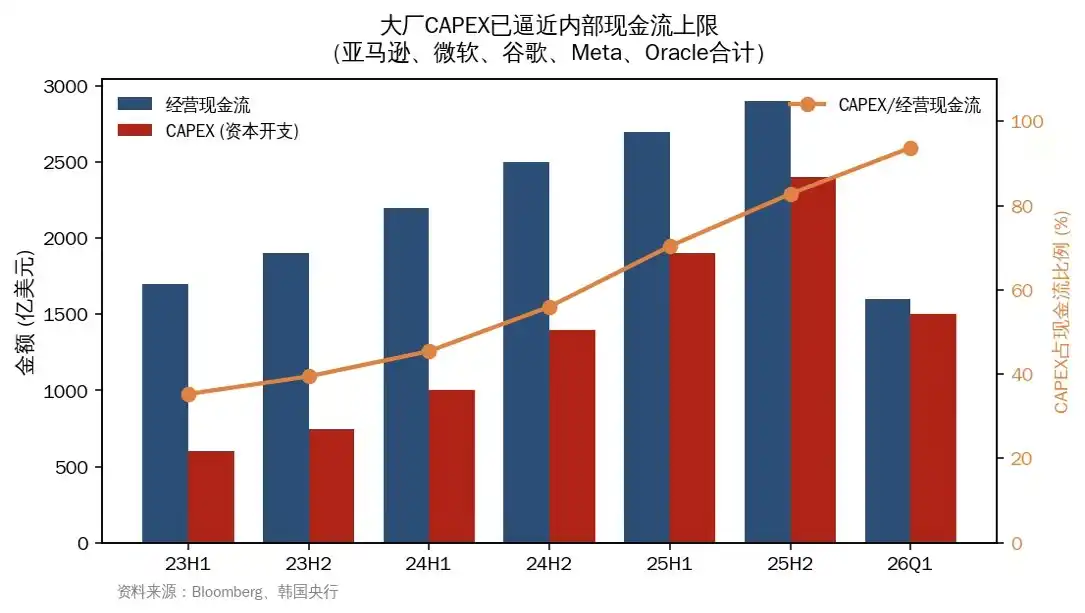
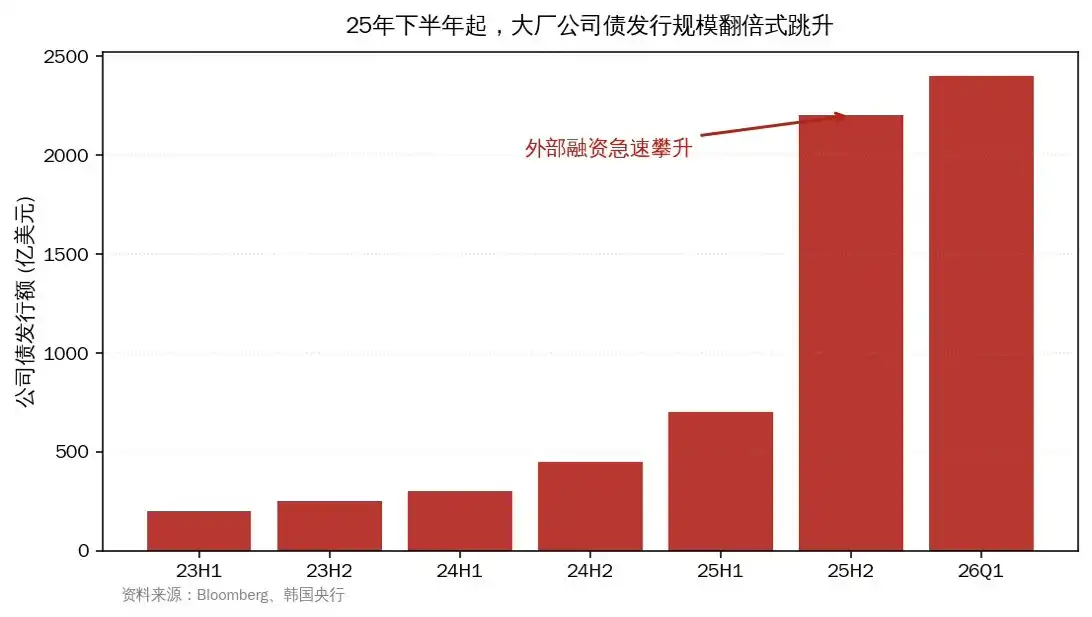
2. Whether Large Companies Can Continuously Raise Funds. This section is the most informative part of the entire report. BoK explicitly compares the present to the telecom bubble of the late 1990s and points out a worsening fact: the internal cash flow of large companies can no longer support CAPEX of this magnitude. Starting in the second half of last year, large companies reduced buybacks and significantly issued corporate bonds; the CDS spreads of some companies have already widened.

Figure 2: Large Companies' Operating Cash Flow Can No Longer Cover CAPEX, Ratio Soared from 25% to Nearly 100%

Figure 3: Corporate Bond Issuance Volume Jumped in H2 2025, External Financing Becomes Main Supplement

Even more alarming is the financing behavior itself. Neocloud companies (e.g., CoreWeave) are much smaller than large firms but must continuously procure GPUs and build AI data centers. Nvidia provides them with credit support to boost sales of its own GPUs. This structure is highly similar to the vendor financing provided by Cisco and Lucent to nascent telecom companies back then.

Another layer is off-balance-sheet financing. Meta's Hyperion data center, through SPVs and private credit, has $29.5 billion in liabilities not on Meta's balance sheet. Oracle's Stargate ($66 billion), xAI's Colossus ($20 billion) use similar structures. BoK mentions a detail: in February-March 2026, institutions like Blue Owl, BlackRock, Morgan Stanley, and Cliffwater suspended redemptions for some private credit funds due to AI disruption concerns. This is a crack.

3. Progress in AI Model Efficiency. After DeepSeek, memory-saving technologies like quantization compression, MoE, Mamba, Nvidia's CMX, Google's TurboQuant are rapidly emerging. BoK frankly admits the bidirectional impact is uncertain. Efficiency gains could either reduce unit demand or, due to Jevons Paradox, increase total demand. This factor is marked with a bidirectional arrow in BoK's overall assessment table, the only one among the five without a definitive direction.

4. Expansion Speed of Major Memory Manufacturers. This year, Samsung's P4 and SK Hynix's M15X have exhausted existing cleanroom space but it's still insufficient. The real supply release window is in the second half of 2027. SK Hynix's Yongin, Micron's new fab in 2027H2, Samsung's P5 in 2028. These are hard constraints on the supply side that can be calendared.

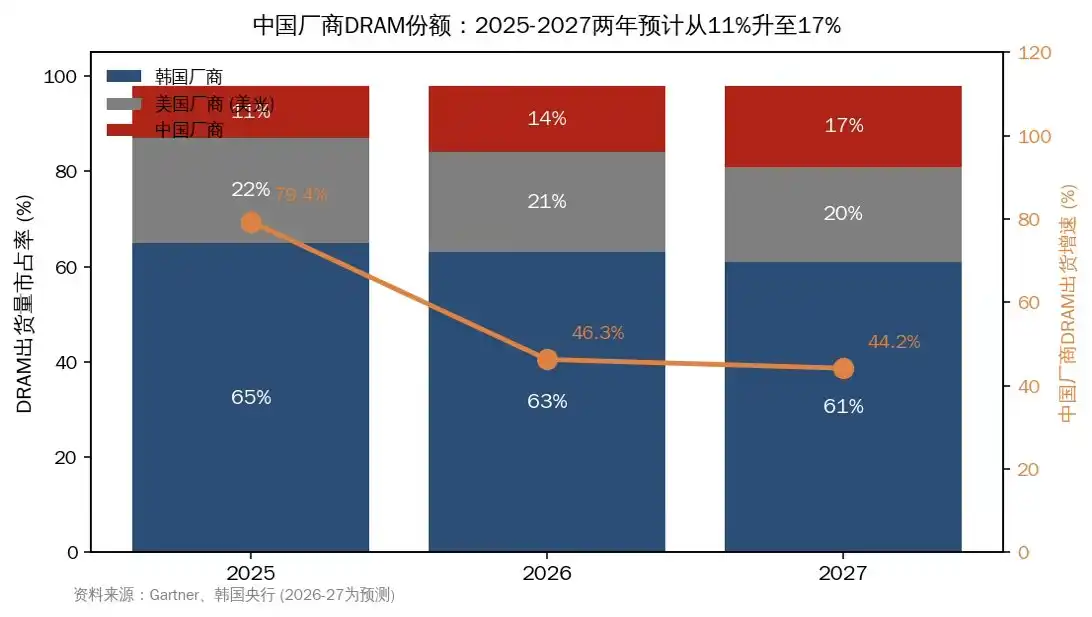
5. Catch-up Speed of Chinese Manufacturers. BoK assesses the technology gap between China and South Korea is about 4 years, for both HBM and general-purpose DRAM. So the high-end landscape remains stable short-term. But one number is noteworthy: the DRAM shipment share of Chinese manufacturers may rise from 10.5% in 2025 to 17% in 2027, with a growth rate over the next two years more than 3 times that of major memory makers. This share will pressure general-purpose DRAM prices, accelerating the timing of imbalance relief.

Figure 4: Chinese Manufacturers' DRAM Share Rises from 11% to 17%, Shipment Growth Far Exceeds Major Memory Makers

III. Regarding the Middle East War, BoK's Judgment is Calmer Than Expected

Currently, there are no signs of data center construction delays or memory supply slowdowns. The AI investment cycle is led by US companies, with 74% of data centers under construction in the Americas. The correlation between the global economy and semiconductors has significantly weakened in recent years.

But BoK lists several potential transmission channels. Rising oil prices increase data center operating costs, tightening financial conditions increase large companies' financing difficulties, supply disruptions of Middle Eastern raw materials and equipment (bromine, helium), and if Taiwan's energy issues affect system chip production, it would drag down memory. The most direct backlash is on the consumer side: Gartner already predicts that due to memory price increases, PC shipments will fall 10.4% YoY and smartphones 8.4% in 2026.

IV. Piecing Together the Timeline

BoK concludes with a color-coded matrix visualizing the impact strength of each of the five factors for the years 2026, 2027, and 2028. I translate the implications of this chart into a narrative timeline.

2026: The pattern of demand dominance and supply constraints continues. This is the most certain year.

2027: Contradictions begin to accumulate. Large company financing pressure rises, Chinese expansion accelerates, new fabs are not yet operational but vulnerabilities in financing end are exposed.

2028: Concentrated release from Samsung's P5, SK Hynix's Yongin, Micron's new fab. Risks on the supply side significantly amplify.

An Extension

The truly interesting part of this report is its narrative style. A central bank whose national foundation is memory did not cheerlead for its domestic industry. It spent significant篇幅 arguing the fragility of the financing structure, the bidirectional uncertainty of technological efficiency, and the微妙 inflection point in 2027 on the timeline. This restraint is an attitude in itself.

Its comparison to the telecom bubble is the part I reread several times. The script back then was: strong initial demand叠加competitive expansion,再叠加a technological innovation that arrived faster than expected (WDM - Wavelength Division Multiplexing), ultimately pushing the industry into rapid oversupply. Today's AI industry has all three conditions present, the difference is just that the critical technology equivalent to WDM hasn't appeared yet.

When domestic investors focus on the memory industry chain, their attention habitually falls on supply-side matters like HBM yield rates, CXMT progress. BoK's report pulls the focus back to the other side: the real variable in this cycle lies on the demand side, more precisely, hidden in the financing sustainability of the AI industry. Signals like Neocloud's vendor financing, off-balance-sheet leverage of SPVs, redemption halts in private credit funds—these deserve closer scrutiny than any expansion timetable.

At least until the first half of 2026, the story continues. The script thereafter depends on how the five variables above play out.

Связанные с этим вопросы

QAccording to the Bank of Korea (BoK), what is the main reason this AI-driven semiconductor super cycle is different from the previous three cycles?

AThe BoK identifies three key differences: 1) The fastest demand growth in history, driven by HBM and general DRAM for AI; 2) The worst supply elasticity in history due to HBM's complexity and conservative post-2022 expansion; 3) The resulting supply-demand gap is significantly larger and longer-lasting than in past cycles.

QWhat are the two most critical warning signals for the cycle's sustainability that the BoK report highlights in the financing sector?

AThe two critical warning signals are: 1) Major tech companies' internal cash flow can no longer cover their massive CAPEX, forcing them to reduce buybacks and issue corporate debt. 2) The rise of vendor financing for Neocloud companies (e.g., by Nvidia) and the use of off-balance-sheet SPV financing (e.g., by Meta and Oracle), which resembles the structure of the telecom bubble. Additionally, some private credit funds have halted redemptions due to AI disruption concerns.

QHow does the BoK assess the potential impact of Chinese semiconductor manufacturers on the global market?

AThe BoK estimates a technical gap of about 4 years between Chinese and Korean manufacturers for both HBM and general DRAM. However, it notes that the shipment share of Chinese DRAM is projected to rise from 10.5% in 2025 to 17% in 2027, with a growth rate more than three times that of major manufacturers. This expansion is expected to put downward pressure on general DRAM prices and accelerate the timeline for the supply-demand imbalance to ease.

QWhat is the BoK's projected timeline for the semiconductor cycle based on its five-factor framework?

AThe BoK's projected timeline is: 2026: The expansion continues as demand outweighs constrained supply. 2027: Contradictions begin to accumulate with rising financing pressure for big tech and accelerated Chinese expansion, while new fabs are not yet online. 2028: Significant supply-side risks emerge as major new fabs from Samsung, SK Hynix, and Micron begin concentrated production.

QWhy does the BoK draw a comparison between the current AI investment cycle and the telecom bubble of the late 1990s?

AThe BoK draws the comparison due to structural similarities: strong initial demand, competitive expansion, and the potential for a rapid technological innovation to trigger oversupply. Specifically, it highlights the parallel between vendor financing provided to new cloud companies today (like Nvidia's support for CoreWeave) and the vendor financing provided by companies like Cisco and Lucent to new telecom firms during the bubble. The report suggests that today's AI industry has all the conditions present that existed before the telecom bubble, except for the specific critical technology (like WDM) that ultimately caused the crash.

Похожее

U.S. Government Bans Foreign Nationals from Using Fable 5, Anthropic Issues Rebuttal

U.S. Government Bans Foreign Access to Fable 5, Anthropic Issues Rebuttal On June 12th, the U.S. government ordered AI company Anthropic to immediately suspend all foreign access—including foreign nationals within the U.S. and Anthropic's own foreign employees—to its newly released Fable 5 and Mythos 5 AI models, citing national security concerns. This forced Anthropic to temporarily disable access to both models for all users globally, as it cannot technically differentiate user nationality at scale. The models, released just three days prior, represent Anthropic's highest public capability tier. Fable 5 is the first publicly available model from the advanced "Mythos" family, while Mythos 5 is a less-restricted version for approved cybersecurity and critical infrastructure partners. The government's directive was reportedly triggered by claims from another company that it could "jailbreak" Mythos 5, raising alarm within the Trump administration. Anthropic, in a detailed public statement, strongly challenged this rationale. The company argues the demonstrated "jailbreak" is a narrow, non-generalized technique that merely involves identifying minor, known software vulnerabilities—a capability common to other publicly available models like OpenAI's GPT-5.5 and routinely used by cybersecurity defenders. Anthropic stated it has complied with the order but disagrees with the government's standard, warning that applying it industry-wide would halt all new frontier model deployments. The company criticized the lack of a transparent, fact-based legal process and expressed confidence the situation stems from a misunderstanding. It is working to restore access and will release more technical details within 24 hours. Other Anthropic models remain unaffected.

链捕手14 мин. назад

U.S. Government Bans Foreign Nationals from Using Fable 5, Anthropic Issues Rebuttal

链捕手14 мин. назад

The Revelation from the Raydium Theft Incident: New DeFi Vulnerabilities Lurking in Forgotten Old Contracts

**Raydium Exploit Reveals DeFi's Hidden Risk: Forgotten "Zombie" Contracts** A recent attack on Raydium's deprecated V3 AMM pools resulted in a loss of approximately $1.34 million. The hacker exploited pools that were no longer supported by Raydium's current UI or SDK but remained fully functional and accessible on-chain. This incident highlights a critical, often overlooked category of risk in DeFi: inactive or legacy smart contracts that projects fail to properly decommission. Since March 2025, there have been at least 8 publicly reported attacks targeting such abandoned contracts, with total losses around $10.8 million. Including older pools and deprecated features, the count rises to 10 incidents with roughly $22.5 million in losses. These "zombie contracts" represent a lifecycle management failure rather than a code vulnerability, yet they are typically misclassified under general "code bug" categories in security reports, masking the true scale of the problem. The root cause is that projects often merely document a contract as "deprecated" without taking essential technical steps to secure it: withdrawing remaining assets, disabling external call functions, and implementing ongoing monitoring. These forgotten, under-monitored components become prime targets for attackers. To address this, the industry needs to recognize "zombie contracts" as a distinct risk category and establish standardized decommissioning protocols. Essential steps should include: 1) a formal retirement announcement, 2) removal of all front-end integrations, 3) withdrawal of locked assets, 4) disabling key contract functions, 5) ongoing security monitoring, 6) clear user communication, and 7) a post-mortem analysis. The value of a DeFi project lies not only in its current TVL but also in the security of its historical codebase, which has now become a new attack surface.

Foresight News2 ч. назад

The Revelation from the Raydium Theft Incident: New DeFi Vulnerabilities Lurking in Forgotten Old Contracts

Foresight News2 ч. назад

Robots Begin to 'Consume Data': The Hidden Production Chain from Indian Data Factories to Billion-Dollar Humanoid Robots

Robots have started to 'consume data,' driving the formation of a new industrial supply chain focused on producing training data for embodied AI. Unlike large language models, which are trained on vast internet text corpora, embodied AI models face a 'data desert' in the physical world. This has created a massive demand for first-person perspective video data (Ego Data), captured by workers wearing cameras in places like Indian garment factories. Companies like Neocambrian AI are establishing 'data factories' where workers perform standardized tasks (e.g., sorting clothes, kitchen organization) to generate thousands of hours of video. Research, such as NVIDIA's EgoScale, demonstrates that scaling this human demonstration data predictably improves robot performance, particularly for dexterous manipulation. This has validated a training path combining large-scale human data for pre-training with smaller amounts of robot-specific data for fine-tuning. The value of different data types varies significantly, forming a 'data pyramid.' The base consists of low-cost, large-scale internet and Ego Data. Higher layers include more expensive motion-capture data (e.g., from data gloves), simulation/synthetic data, and the most costly and scarce layer: real robot teleoperation data. This demand has spawned a layered ecosystem of data suppliers: low-cost data factories, motion capture and alignment specialists, robot-native teleoperation service providers, simulation data companies, and platforms aiming for data standardization. Robot companies themselves are adopting a 'layered procurement' strategy: outsourcing generic Ego Data while building in-house capabilities for robot-specific adaptation data and the critical deployment/failure data generated in real-world applications. The industry is shifting focus from hardware and basic mobility to the data pipelines required for general-purpose capability. While parallels exist to data labeling companies like Scale AI in the LLM boom, the physical complexity of robot data—involving action success ambiguity and sim-to-real gaps—requires more integrated solutions for data collection, annotation, and a continuous feedback loop. The race is on to build the data engines that will teach robots to operate reliably in the unstructured real world.

marsbit4 ч. назад

Robots Begin to 'Consume Data': The Hidden Production Chain from Indian Data Factories to Billion-Dollar Humanoid Robots

marsbit4 ч. назад

Торговля

Спот
Фьючерсы

Популярные статьи

Что такое $BANK

Банк ИИ: Революционный шаг в будущее банковского дела Введение В эпоху, отмеченную быстрыми темпами технологического прогресса, Банк ИИ находится на пересечении искусственного интеллекта (ИИ) и банковских услуг. Этот инновационный проект стремится переопределить финансовый ландшафт, повышая операционную эффективность, меры безопасности и качество обслуживания клиентов с помощью ИИ. Приступая к этому изучению Банка ИИ, мы углубимся в то, что включает в себя проект, его операционную динамику, его исторический контекст и значительные вехи. Что такое Банк ИИ? В своей основе Банк ИИ представляет собой преобразовательную инициативу, направленную на интеграцию искусственного интеллекта в различные банковские операции. Этот проект использует возможности ИИ для автоматизации процессов, улучшения протоколов управления рисками иEnhancing взаимодействия с клиентами через персонализированные услуги. Основные цели Банка ИИ включают: Автоматизация банковских функций: Используя технологии ИИ, Банк ИИ стремится автоматизировать рутинные задачи, снижая нагрузку на человеческие ресурсы и повышая эффективность. Улучшение управления рисками: Проект использует алгоритмы ИИ для прогнозирования и выявления рисков, тем самым укрепляя меры безопасности против мошенничества и других угроз. Персонализация банковских услуг: Банк ИИ сосредоточен на предложении индивидуально подобранных финансовых продуктов и услуг, анализируя данные и поведение клиентов. Улучшение клиентского опыта: Внедрение решений на базе ИИ, таких как чат-боты и виртуальные помощники, направлено на предоставление пользователям более человеческого взаимодействия, революционизируя способ, которым клиенты взаимодействуют с банками. С этими целями Банк ИИ позиционирует себя как ключевого игрока в сделании банковских услуг более эффективными, безопасными и ориентированными на пользователей. Кто создатель Банка ИИ? Детали, касающиеся создателя Банка ИИ, остаются неизвестными. Таким образом, ни одно конкретное лицо или организация не были идентифицированы в доступной информации. Анонимность, окружающая начало проекта, поднимает вопросы, но не умаляет его амбициозного видения и целей. Кто инвесторы Банка ИИ? Подобно создателю проекта, конкретная информация о инвесторах или поддерживающих организациях Банка ИИ не была раскрыта. Без этой информации трудно описать финансовую поддержку и институциональную поддержку, которая может продвигать проект вперед. Тем не менее, важность наличия прочной инвестиционной базы является ключевой для поддержания развития в такой инновационной сфере. Как работает Банк ИИ? Банк ИИ работает на нескольких инновационных фронтах, сосредотачиваясь на уникальных факторах, которые отличают его от традиционных банковских рамок. Ниже приведены ключевые операционные особенности: Автоматизация: Применяя алгоритмы машинного обучения, Банк ИИ автоматизирует различные ручные процессы внутри банков. Это приводит к снижению операционных затрат и позволяет работникам перераспределять свои усилия на более стратегические деятельности. Совершенное управление рисками: Интеграция ИИ в практики управления рисками обеспечивает банки инструментами для точного прогнозирования потенциальных угроз, таких как мошенничество, обеспечивая безопасность информации и активов клиентов. Индивидуализированные финансовые рекомендации: Путем непрерывного обучения на основе взаимодействия с клиентами, системы ИИ развивают тонкое понимание потребностей пользователей, позволяя им предлагать персонализированные советы по финансовым решениям. Улучшенные взаимодействия с клиентами: Используя чат-боты и виртуальных помощников на базе ИИ, Банк ИИ обеспечивает более увлекательный клиентский опыт, позволяя пользователям быстро получать ответы на свои запросы, тем самым сокращая время ожидания и повышая уровень удовлетворенности. Все вместе эти операционные особенности позиционируют Банк ИИ как пионера в банковском секторе, устанавливающего новые эталоны для предоставления услуг и операционного совершенства. Хронология Банка ИИ Понимание траектории Банка ИИ требует взгляда на его исторический контекст. Ниже представлена хронология, подчеркивающая важные вехи и события: Начало 2010-х: Концепция интеграции ИИ в банковские услуги начала привлекать внимание, когда банковские учреждения осознали потенциальные преимущества. 2018: Произошел заметный рост внедрения технологий ИИ, когда банки начали использовать инструменты ИИ, такие как чат-боты, для базового обслуживания клиентов и системы управления рисками для улучшения безопасности. 2023: Сложность ИИ продолжала развиваться, при этом генеративный ИИ был представлен для выполнения более сложных задач, таких как обработка документов и анализ инвестиций в реальном времени. Этот год стал значительным шагом вперед в возможностях, которые ИИ-технологии предоставили банкам. 2024-Настоящее состояние: На данный момент Банк ИИ находится на восходящей траектории, с продолжающимися исследованиями и разработками, которые расширяют возможности в банковских операциях. Продолжение изучения приложений ИИ намекает на захватывающие события, которые еще предстоят. Ключевые моменты о Банке ИИ Интеграция ИИ в банковское дело: Банк ИИ сосредоточен на принятии искусственного интеллекта для оптимизации банковских процессов и улучшения пользовательского опыта. Автоматизация и фокус на управлении рисками: Проект сильно акцентирует внимание на этих областях, стремясь сместить бремя рутинных задач, одновременно усиливая системы безопасности с помощью предсказательной аналитики. Персонализированные банковские решения: Используя данные клиентов, Банк ИИ предоставляет индивидуально подобранные банковские услуги, которые учитывают потребности отдельных пользователей. Обязанность по развитию: Банк ИИ остается приверженным постоянным исследовательским и развивающим усилиям, обеспечивая свою адаптируемость и постоянную актуальность по мере того, как технологии продолжают развиваться. Заключение В заключение, Банк ИИ является важным шагом вперед в банковской индустрии, использующим искусственный интеллект для изменения операционных парадигм, повышения безопасности и повышения удовлетворенности клиентов. Несмотря на пробелы в информации о создателе и инвесторах, четкие цели и функциональные механизмы Банка ИИ обеспечивают прочную основу для его постоянной эволюции. Поскольку технологии ИИ продолжают развиваться и сливаться с банковским сектором, Банк ИИ хорошо позиционирован, чтобы существенно повлиять на будущее финансовых услуг, улучшая наш подход к пониманию и взаимодействию с банковским делом.

148 просмотров всегоОпубликовано 2024.04.06Обновлено 2024.12.03

Что такое $BANK

Как купить BANK

Добро пожаловать на HTX.com! Мы сделали приобретение Lorenzo Protocol (BANK) простым и удобным. Следуйте нашему пошаговому руководству и отправляйтесь в свое крипто-путешествие.Шаг 1: Создайте аккаунт на HTXИспользуйте свой адрес электронной почты или номер телефона, чтобы зарегистрироваться и бесплатно создать аккаунт на HTX. Пройдите удобную регистрацию и откройте для себя весь функционал.Создать аккаунтШаг 2: Перейдите в Купить криптовалюту и выберите свой способ оплатыКредитная/Дебетовая Карта: Используйте свою карту Visa или Mastercard для мгновенной покупки Lorenzo Protocol (BANK).Баланс: Используйте средства с баланса вашего аккаунта HTX для простой торговли.Третьи Лица: Мы добавили популярные способы оплаты, такие как Google Pay и Apple Pay, для повышения удобства.P2P: Торгуйте напрямую с другими пользователями на HTX.Внебиржевая Торговля (OTC): Мы предлагаем индивидуальные услуги и конкурентоспособные обменные курсы для трейдеров.Шаг 3: Хранение Lorenzo Protocol (BANK)После приобретения вами Lorenzo Protocol (BANK) храните их в своем аккаунте на HTX. В качестве альтернативы вы можете отправить их куда-либо с помощью перевода в блокчейне или использовать для торговли с другими криптовалютами.Шаг 4: Торговля Lorenzo Protocol (BANK)С легкостью торгуйте Lorenzo Protocol (BANK) на спотовом рынке HTX. Просто зайдите в свой аккаунт, выберите торговую пару, совершайте сделки и следите за ними в режиме реального времени. Мы предлагаем удобный интерфейс как для начинающих, так и для опытных трейдеров.

1.0k просмотров всегоОпубликовано 2025.05.09Обновлено 2026.06.02

Как купить BANK

Обсуждения

Добро пожаловать в Сообщество HTX. Здесь вы сможете быть в курсе последних новостей о развитии платформы и получить доступ к профессиональной аналитической информации о рынке. Мнения пользователей о цене на BANK (BANK) представлены ниже.

活动图片