Assessing community sentiment after David Sacks’s 130-day term as crypto czar ends

ambcryptoОпубликовано 2026-03-28Обновлено 2026-03-28

Введение

David Sacks has concluded his 130-day term as AI and crypto czar for former President Donald Trump. His performance has received mixed reviews from the crypto community. A key achievement was helping pass the GENIUS Act, a stablecoin legislation bill. However, broader goals, such as establishing a U.S. strategic Bitcoin reserve (SBR), remain unfulfilled, drawing criticism from some community members who view this as a failure. Sacks is transitioning to a new role as co-chair of the President’s Council of Advisers on Science and Technology (PCAST), where he will advise on a wider range of tech issues. Despite his departure, advocacy for crypto policy continues within the administration.

David Sacks’s role as AI and crypto czar for President Donald Trump has ended after his 130-day term expired this month. However, his scorecard and ratings across the crypto community have been mixed.

On Thursday, the venture capitalist told Bloomberg that he will be joining the President’s Council of Advisers on Science and Technology (PCAST) as co-chair.

I think moving forward as co-chair of PCAST, I can now make recommendations on not just AI but an expanded range of technology topics.

Mixed views on David Sacks’s scorecard

As crypto czar, Sacks helped push the GENIUS Act, a stablecoin legislation bill, into law last year. This was also done in collaboration with Bo Hines, who was Trump’s chief crypto advisor at that time.

However, after Bo Hines resigned and joined Tether, Patrick Witt, the current White House crypto chief advisor, stepped up to coordinate the broader crypto market structure bill – The CLARITY Act.

In 2024, the sector had a key policy agenda it was pushing. This included an overhaul of the regulatory authorities (SEC and CFTC), the establishment of a U.S strategic Bitcoin reserve (SBR), and the adoption of clear rules via the GENIUS Act and the CLARITY Act.

As it stands, most of the agenda has been met with the CLARITY Act still in progress. However, the U.S SBR has been muted and hasn’t received much attention lately. Unfortunately, some sections of the community are using it as the main scorecard for Sacks.

According to one user, for instance, both Bo Hines and David Sacks failed to audit the current BTC stack held by the U.S government and the way forward to establishing the related reserve.
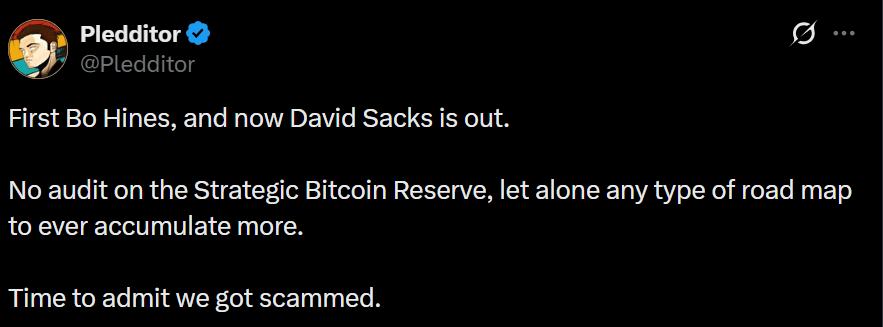
Source: X

For her part though, Jacquelyn Melinek, Founder of Token Relations, dismissed the framing as “misleading.” She added,

This is misleading. David Sacks didn’t choose to be ‘out,’ it’s just his term finished. There are other people still at the WH advocating for digital assets and policy. Breathe.

Meanwhile, the chance for a U.S SBR before 2027 was below 30% on the predictions site Polymarket.


Final Summary

  • David Sacks’s AI and crypto czar term has expired as he steps up to the President’s tech council.
  • However, his crypto scorecard elicited mixed reactions despite helping fast-track the GENIUS Act – A stablecoin law.


Связанные с этим вопросы

QWhat was David Sacks' role and for how long did he serve?

ADavid Sacks served as AI and crypto czar for President Donald Trump for a 130-day term.

QWhat is David Sacks' new position after his term as crypto czar ended?

AHe will be joining the President’s Council of Advisers on Science and Technology (PCAST) as co-chair.

QWhat was a key legislative achievement credited to David Sacks during his term?

AHe helped push the GENIUS Act, a stablecoin legislation bill, into law.

QAccording to the article, what is the main point of criticism some in the community have against Sacks?

ASome criticize him for failing to audit the U.S. government's Bitcoin holdings and establish a U.S. strategic Bitcoin reserve (SBR).

QHow did Jacquelyn Melinek respond to the criticism of David Sacks' departure?

AShe dismissed the framing as 'misleading,' stating his term simply finished and that there are other people still advocating for digital assets policy at the White House.

Похожее

How Many Tokens Away Is Yang Zhilin from the 'Moon Chasing the Light'?

The article explores the intense competition between two leading Chinese AI companies, DeepSeek and Kimi (Moon Dark Side), and the mounting pressure on Yang Zhilin, the founder of Kimi. While DeepSeek re-emerged after 15 months of silence with its powerful V4 model—boasting 1.6 trillion parameters and low-cost, long-context capabilities—Kimi has been focusing on long-context processing and multi-agent systems with its K2.6 model. Yang faces a threefold challenge: technological rivalry, commercialization pressure, and investor expectations. Despite Kimi’s high valuation (reaching $18 billion), its revenue heavily relies on a single product with low paid conversion rates, while DeepSeek’s strategic silence and open-source influence have strengthened its market position and valuation prospects, now targeting over $20 billion. Both companies reflect broader trends in China’s AI ecosystem: Kimi aims for global influence through open-source contributions and agent-based advancements, while DeepSeek prioritizes foundational innovation and hardware independence, notably shifting to Huawei’s chips. Their competition is seen as vital for China’s AI progress, with the gap between top Chinese and U.S. models narrowing to just 2.7% on the Elo rating scale. Ultimately, the article argues that this rivalry, though anxiety-inducing for leaders like Zhilin, is essential for driving innovation and solidifying China’s role in the global AI landscape.

marsbit4 ч. назад

How Many Tokens Away Is Yang Zhilin from the 'Moon Chasing the Light'?

marsbit4 ч. назад

TechFlow Intelligence Bureau: ChatGPT Helps Amateur Mathematician Crack 60-Year-Old Problem, CFTC Sues New York Regulator Over Coinbase and Gemini

An amateur mathematician, with the assistance of ChatGPT, has solved a combinatorial mathematics puzzle originally proposed by Hungarian mathematician Paul Erdős in the 1960s. This marks another milestone in AI-aided mathematical research, demonstrating the evolving capabilities of large language models in formal reasoning. In other AI developments, OpenAI introduced a new privacy filter tool for enterprise API usage, automatically screening sensitive data. Meanwhile, the Qwen3.6-27B model achieved 100 tokens per second on a single RTX 5090 GPU using quantization, significantly lowering the cost barrier for local AI deployment. In crypto and Web3, the U.S. CFTC sued New York’s financial regulator, challenging its oversight of Coinbase and Gemini—a first-of-its-kind federal-state regulatory clash. Following a vulnerability, KelpDAO and major DeFi protocols established a recovery fund. Tether froze $344 million in assets linked to Iran’s central bank upon U.S. Treasury request, highlighting the centralized control risks in stablecoins. Separately, Litecoin underwent a 3-hour chain reorganization to undo a privacy-layer exploit. In the U.S., former President Trump invoked the Defense Production Act to address power grid bottlenecks affecting AI data centers and dismissed the entire National Science Board, raising concerns over research independence. A retail trader gained 250% on a $600k Intel options bet amid AI-related speculation. Xiaomi announced its first performance electric vehicle, targeting rivals like Tesla. Meanwhile, iPhone users reported devices automatically reinstalling a hidden app daily, suspected to be MDM-related. A Chinese securities report noted that A-share institutional crowding has reached its second-longest streak since 2007, signaling high valuations and potential style rotation. The day’s developments reflect a dual narrative: AI is enabling unprecedented individual breakthroughs, while centralized power structures—whether governmental or corporate—are becoming more assertive, underscoring that decentralization is as much a political-economic challenge as a technical one.

marsbit4 ч. назад

TechFlow Intelligence Bureau: ChatGPT Helps Amateur Mathematician Crack 60-Year-Old Problem, CFTC Sues New York Regulator Over Coinbase and Gemini

marsbit4 ч. назад

Торговля

Спот
Фьючерсы

Популярные статьи

Неделя обучения по популярным токенам (2): 2026 может стать годом приложений реального времени, сектор AI продолжает оставаться в тренде

2025 год — год институциональных инвесторов, в будущем он будет доминировать в приложениях реального времени.

1.8k просмотров всегоОпубликовано 2025.12.16Обновлено 2025.12.16

Неделя обучения по популярным токенам (2): 2026 может стать годом приложений реального времени, сектор AI продолжает оставаться в тренде

Обсуждения

Добро пожаловать в Сообщество HTX. Здесь вы сможете быть в курсе последних новостей о развитии платформы и получить доступ к профессиональной аналитической информации о рынке. Мнения пользователей о цене на AI (AI) представлены ниже.

活动图片