Argentina court orders nationwide block of Polymarket over gambling

cointelegraphОпубликовано 2026-03-17Обновлено 2026-03-17

Введение

An Argentine court has ordered a nationwide block of the crypto-based prediction market platform Polymarket, citing unauthorized gambling operations. The ruling, issued by a Buenos Aires court on March 11, instructed the national communications regulator ENACOM to restrict access to the platform and its variants across the country. The investigation was initiated following a complaint by the Buenos Aires City Lottery (LOTBA), which raised concerns over insufficient identity and age verification, potentially allowing minors to gamble. The court also directed Apple and Google to remove Polymarket’s mobile apps in Argentina. This action follows earlier scrutiny of the platform, particularly regarding its inflation prediction markets, which closely mirrored official data and sparked insider trading concerns. Similar restrictions have been implemented in other countries, including Colombia in Latin America.

A court in Argentina has ordered a nationwide block of major crypto-based prediction market platform Polymarket over unauthorized gambling.

Argentina’s national communications and media regulator, Ente Nacional de Comunicaciones (ENACOM), received a court order to block access to Polymarket website and its variants across the country, according to a ruling dated March 11.

The order was issued by the Buenos Aires Court of First Instance in Criminal, Contravention and Minor Offenses No. 31, which is investigating Polymarket under Argentina’s Criminal Code for allegedly offering gambling services without authorization.

The judge asked ENACOM to carry out the measure either directly or through internet service providers (ISPs) and to promptly inform the court or the specialized gambling prosecutor’s office if technical or other obstacles prevent full compliance.

Buenos Aires regulator initiated the case

According to local media reports, the case was brought by the Buenos Aires City Lottery (LOTBA), the state-owned company that regulates gambling activities in the city.

After receiving a complaint from LOTBA about Polymarket’s alleged operation without authorization, prosecutor Juan Rozas, in charge of the City’s Specialized Gaming Prosecutor’s Office (FEJA), opened the investigation that led to the court order.

Authorities argued that Polymarket allowed users to place bets without sufficient identity and age verification, raising concerns that minors could access the platform.

“In practice, this meant that anyone — including children and adolescents — could access and start betting without any control,” the authorities reportedly said.

Inflation bets deepen scrutiny

In addition to instructing ENACOM to block access to Polymarket, the court reportedly ordered Google and Apple to remove and restrict the platform’s mobile applications on Android and iOS throughout Argentina, including for existing users.

Social media reports indicate users are discussing workarounds such as VPNs, while observers note that the order comes from a Buenos Aires city court rather than the national government.

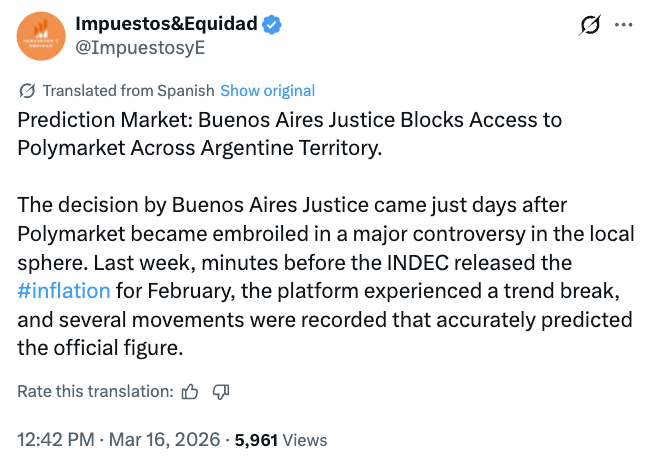
Source: ImpuestosyE (translated by Grok)

The action adds to earlier Polymarket’s scrutiny after its inflation-related prediction markets closely mirrored official data from Argentina’s statistics agency, reigniting controversy over potential insider trading, according to local reports.

Polymarket did not immediately respond to a request for comment from Cointelegraph.

Related: CFTC chair backs blockchain-based prediction markets as ‘truth machines’

Argentina’s action is the latest example of moves against prediction markets globally, with countries including the Netherlands, Hungary, Portugal and Ukraine taking similar steps to restrict access.

In Latin America, Colombia was among the first to take action, with its gambling regulator reportedly warning about Polymarket’s unauthorized operations in September 2025.

Magazine: How crypto laws changed in 2025 — and how they’ll change in 2026

Связанные с этим вопросы

QWhy did the Argentina court order a nationwide block of Polymarket?

AThe court ordered the block because Polymarket was allegedly offering unauthorized gambling services, violating Argentina's Criminal Code.

QWhich regulatory body in Argentina is responsible for implementing the block on Polymarket?

AEnte Nacional de Comunicaciones (ENACOM), the national communications and media regulator, is responsible for implementing the block.

QWhat concerns did authorities raise about Polymarket's operations that led to the investigation?

AAuthorities were concerned that Polymarket allowed users to bet without proper identity and age verification, potentially enabling minors to access the platform.

QBesides blocking the website, what additional actions did the court order against Polymarket?

AThe court also ordered Google and Apple to remove and restrict Polymarket's mobile applications on Android and iOS throughout Argentina.

QWhich other countries have taken similar actions to restrict prediction markets like Polymarket?

ACountries including the Netherlands, Hungary, Portugal, Ukraine, and Colombia have taken similar steps to restrict access to such prediction markets.

Похожее

The AI Agent Era Accelerates Its Arrival: Questflow Defines a New Paradigm of Financial Intelligence with On-Chain AI Brokerage

The AI Agent era is accelerating, with the CB Insights AI 100 list highlighting global investment confidence. The focus has shifted from whether AI works to its speed of deployment and ability to manage complex workflows, with autonomous AI Agents driving this transformation. At the forefront is Questflow, a Singapore-based startup redefining financial intelligence through its on-chain AI brokerage. Unlike tools that merely provide data dashboards, Questflow deploys AI Agents that proactively scan markets, form judgments, and execute trades via a conversational interface—operating 24/7 without requiring manual confirmation for each decision. This embodies the new AI paradigm of agents capable of executing multi-step workflows autonomously. Questflow's mission is to democratize institutional-grade trading intelligence. Historically reserved for the ultra-wealthy, this capability is now accessible starting from just $1 through Questflow's "AI Clone + Copy Trade" model. The platform charges only a 1% execution fee, aligning its incentives directly with users and eliminating traditional management or performance fees. The timing is opportune, aligning with key trends identified by CB Insights: the scalable deployment of AI Agents, accelerated AI adoption in financial services, and the maturation of on-chain infrastructure. With robust liquidity on platforms like Hyperliquid and Polymarket, alongside advancements in AI reasoning and non-custodial wallet security, Questflow is positioned to merge the roles of broker, fund, and exchange into a single, accessible platform for millions.

链捕手44 мин. назад

The AI Agent Era Accelerates Its Arrival: Questflow Defines a New Paradigm of Financial Intelligence with On-Chain AI Brokerage

链捕手44 мин. назад

Why Pricing Social Interactions is Doomed to Fail?

Titled "Why Putting a Price on Social Interaction Is Doomed to Fail," this article critiques attempts to monetize social networks directly through SocialFi models, arguing their inevitable failure stems from a fundamental misunderstanding of media dynamics. Using Marshall McLuhan's theory of "hot" and "cold" media, the author posits that social networks are inherently "cold" media. Their value isn't contained in individual posts but is co-created through user participation, interpretation, and fragmented, ongoing interaction (e.g., replies, shares). This ambiguity and need for user involvement are core to their function. The article asserts that SocialFi projects like Friend.tech failed because introducing real-time, tradable financial pricing (a definitive "hot" signal) into this "cold" environment doesn't add a layer—it replaces the medium's essence. The unambiguous price signal overshadows and nullifies the nuanced, participatory social signal. Users become traders, not participants, and when speculative profits vanish, the underlying social ecosystem—never genuinely cultivated—collapses entirely. This principle extends beyond crypto. The author argues platforms like Twitter have gradually "heated up" through metrics (likes, retweets counts, algorithmically defined value), shifting users from participants to performers and eroding organic engagement. The solution isn't to abandon capital but to manage its entry point. Successful models like Substack, Patreon, or Bandcamp allow capital to "condense" at specific, isolated nodes (e.g., subscriptions, one-time payments) without permeating and "heating" every social interaction. They preserve the core "cold," participatory medium while enabling monetization at designated boundaries. The NFT boom and bust serves as a stark parallel: the ancient "cold" medium of collecting (valued for story, community, gradual accumulation) was rapidly destroyed by platforms that introduced real-time floor prices, rarity scores, and trading dashboards, transforming collectors into speculators and vaporizing cultural value when prices fell. The core lesson: "Liquidity equals heat." Injecting high liquidity and definitive pricing into a "cold" participatory medium doesn't optimize it; it fundamentally alters and destroys its value-creating mechanism. The future lies not in pricing every social gesture but in finding precise, non-invasive points for capital to condense without overheating the entire ecosystem.

marsbit52 мин. назад

Why Pricing Social Interactions is Doomed to Fail?

marsbit52 мин. назад

Торговля

Спот
Фьючерсы
活动图片