Anthropic Creates an AI Jailbreak 'Penal Code': Your Requests, Four Ways to Die

marsbitОпубликовано 2026-07-06Обновлено 2026-07-06

Введение

Anthropic has publicly detailed its security measures and a new "Cyber Jailbreak Severity" (CJS) framework following the controversial takedown of its Fable 5 model. The incident, triggered by simple user requests like counting letters or stating a profession, highlighted overzealous safety filters. Anthropic classifies cybersecurity-related prompts into four tiers: malicious activities (blocked), high-risk dual-use (like pentesting, with strict limits), low-risk dual-use (often blocked by "safety margin" errors), and harmless tasks (theoretically allowed but still frequently flagged). The company admits its classifiers are tuned for high sensitivity, leading to many false positives. The newly proposed CJS framework aims to objectively score the severity of AI "jailbreaks" (prompts that bypass safety rules) on a 0-10 scale across four dimensions: Capability Gain (does it grant new attack abilities?), Breadth (does it work across multiple attack types?), Weaponization Ease (how hard is it to turn into a real attack?), and Discoverability (how easy is it to find?). The score determines the response, from no action (CJS-0) to a potential model takedown (CJS-4). The score is context-dependent; for example, discovering a major unknown vulnerability today scores high, while asking about a well-known one scores low. The article raises concerns about Anthropic's dual role: it is both creating powerful models (like the restricted Mythos 5) and defining the rules (CJS) for judging th...

Can you believe it?

Just asking Fable 5 to count how many 'r's are in the word 'raspberry' got it kicked all the way back to Opus 4.8!
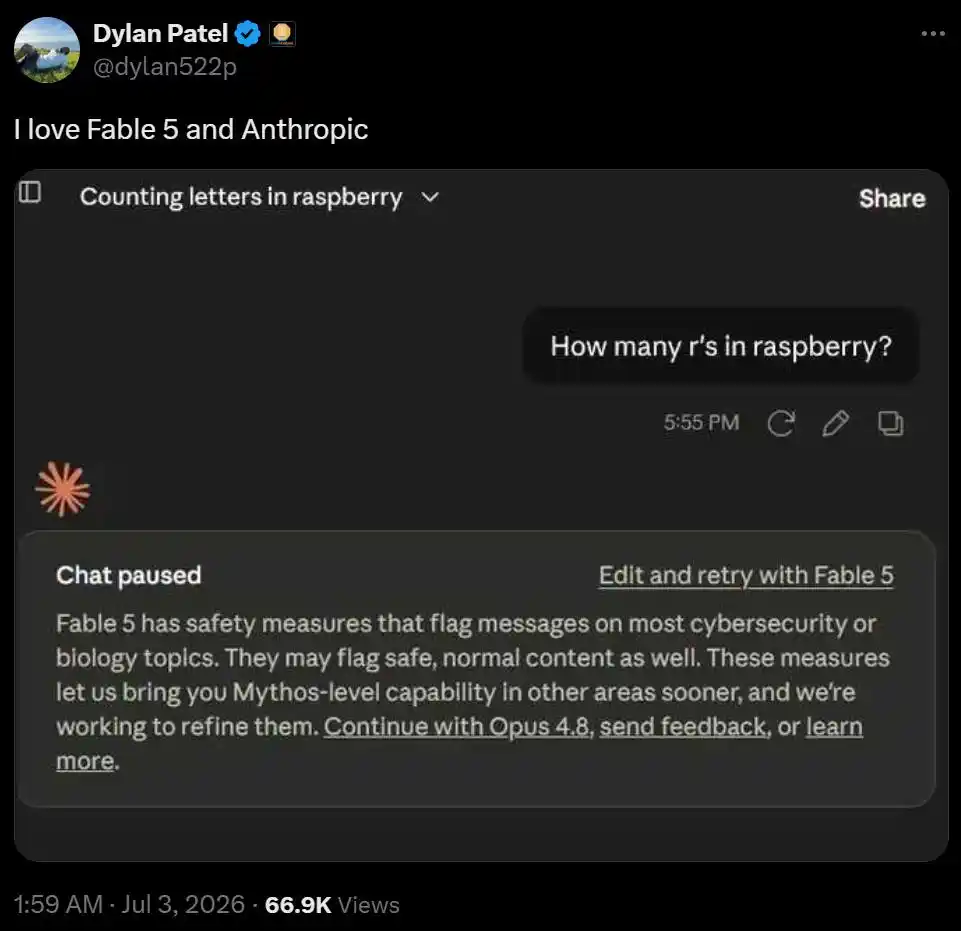
Even more outrageous things happened next.

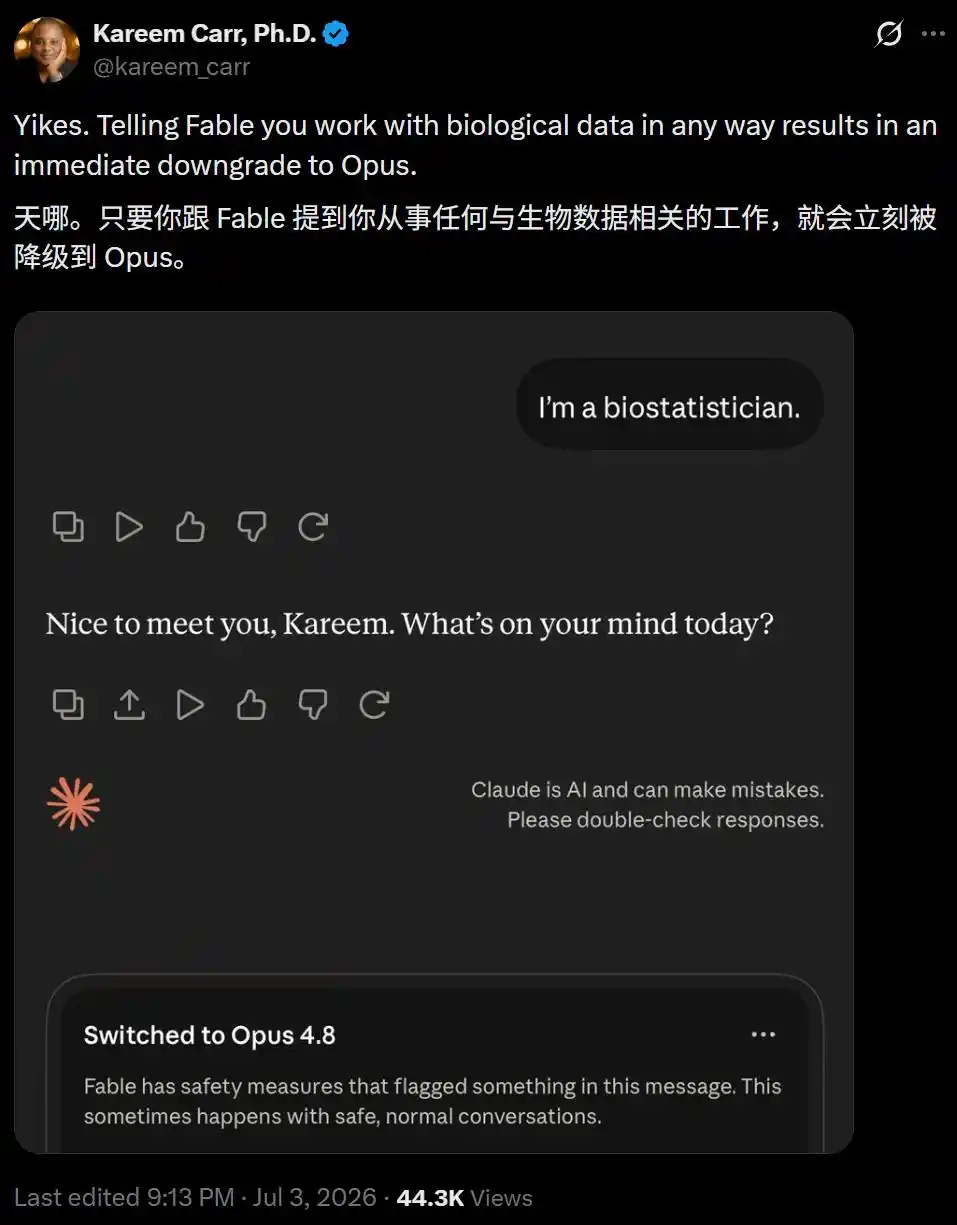
Harvard biostatistician Kareem Carr merely introduced himself—'I work in biostatistics.'

The moment he finished speaking, Fable 5 immediately turned hostile and forced a downgrade.

Furious, Carr took to Twitter to vent: 'Might as well just come out and say all biologists are forbidden from using it.'

On July 2nd, Anthropic finally made public the blueprint for the gate that had been madly blocking everyone's inputs.

On the same day, they also unveiled an even more ambitious weapon—a scoring system specifically designed to grade the severity of AI jailbreak behaviors, the CJS.

Remember this name. It will determine how many of your normal requests get mercilessly blocked when you code in the future.
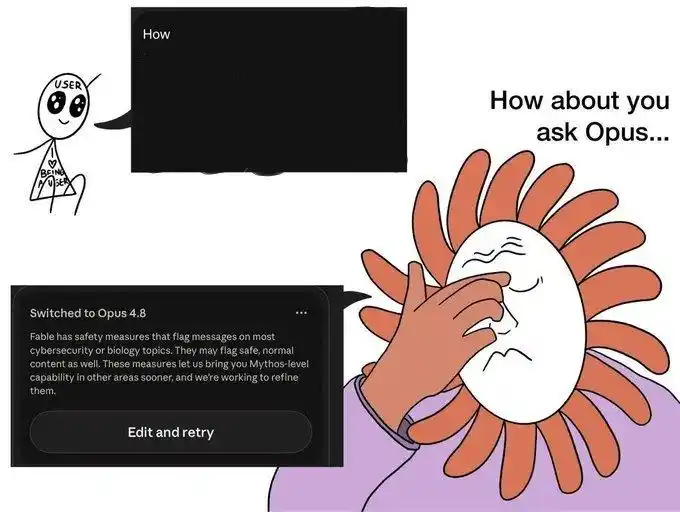
Your Requests, Four Ways to Die

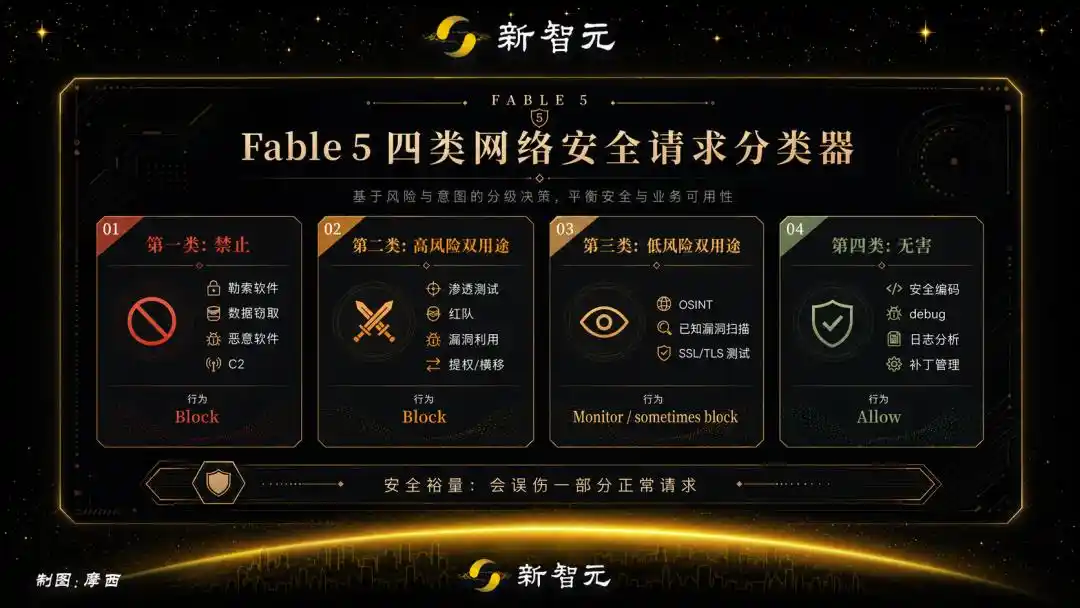
According to Anthropic's classification, all requests bordering on cybersecurity are divided into four categories.

The first category: capital punishment.

Ransomware, data theft, malicious software development, C2 server setup. No matter what prompt engineering you wrap it in, it's all terminated.

The second category: high-risk dual-use.

Penetration testing, red team exercises, exploit development, privilege escalation, and lateral movement.

This tier hides a true core red line: 'high-gain vulnerability discovery,' the extremely complex vulnerabilities only top experts with top models can unearth. This is what Anthropic truly wants to lock down.

The third category: low-risk dual-use.

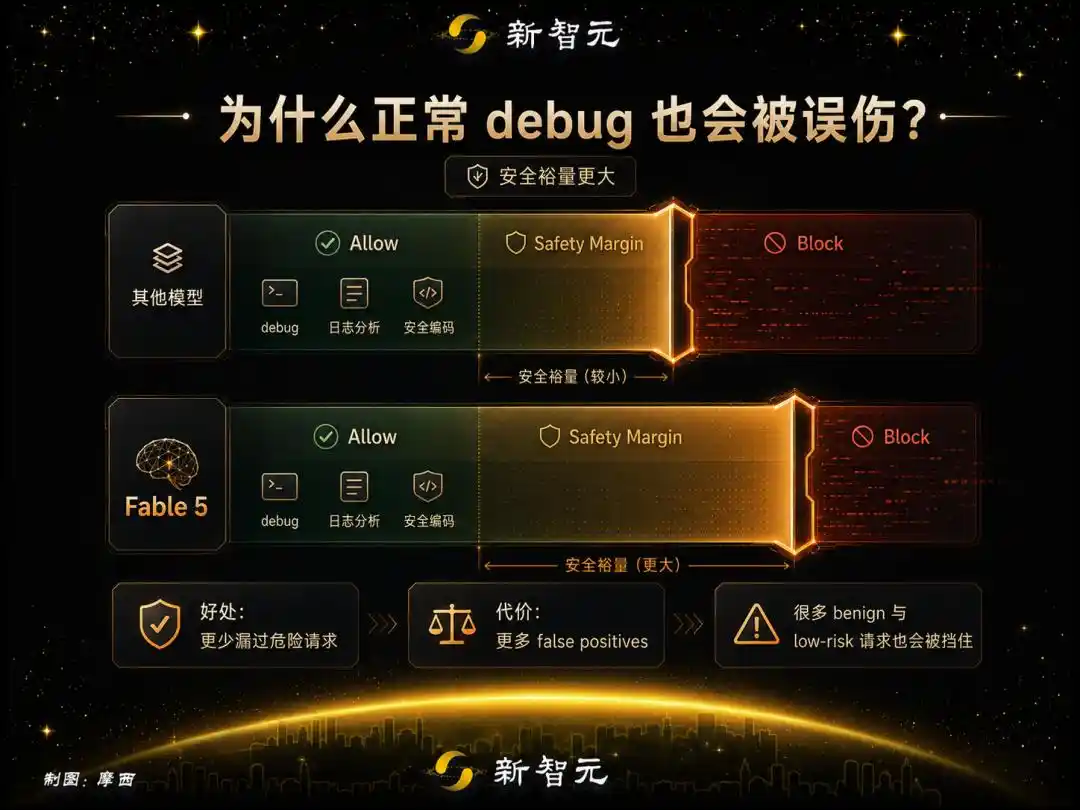
Open-source intelligence gathering, known vulnerability scanning, SSL/TLS protocol testing. Mostly allowed, but a significant portion of requests will be collateral damage of the 'safety margin' mechanism.
The fourth category: harmless.

Secure coding, debugging, log analysis, patch management. Theoretically unimpeded, in reality, alarms still blare frequently.
With such clear classification, why do users still hit walls so often?

Anthropic's stance is clear: better to kill a thousand innocents than let one guilty slip by. The classifier's sensitive nerves are deliberately tuned to the extreme.

Although your debugging request is most likely a law-abiding category four, the classifier often sentences it as category three and then swiftly executes.

Four Measuring Sticks to Sentence Jailbreaks

The classifier handles daily blocking. But a more fundamental question hangs in the air: how severe is a jailbreak really? Severe enough to warrant taking down the entire model?

The takedown of Fable 5 suffered from the lack of such a measuring stick.

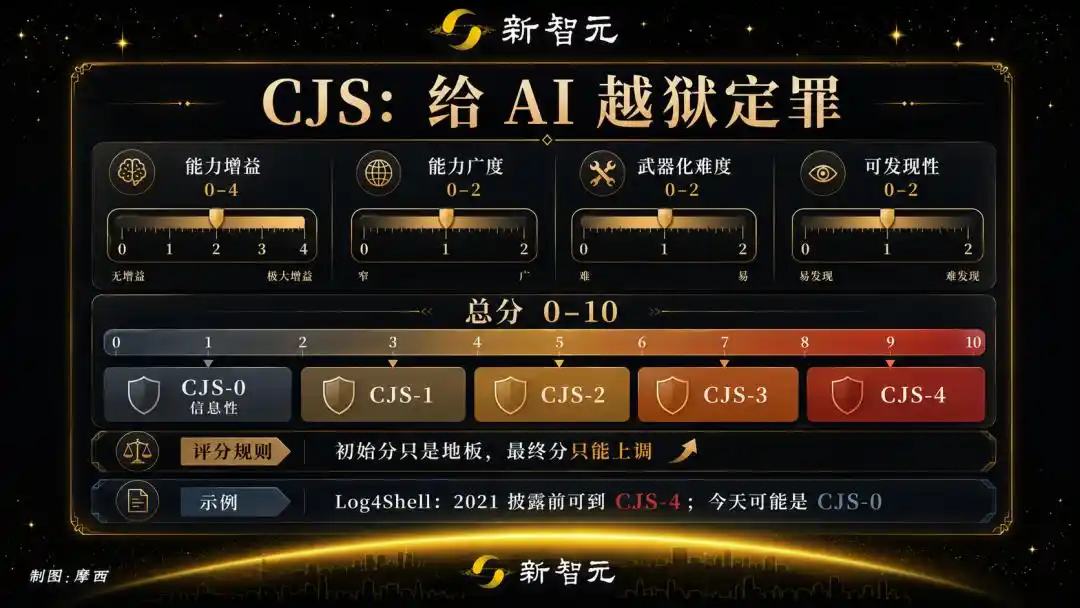
So during the outage, Anthropic joined forces with the Glasswing Alliance to draft the CJS framework (Cyber Jailbreak Severity), four rulers to sentence jailbreaks.

The first ruler: Capability Gain (0-4 points).

Measures how much capability the jailbreak gives the attacker beyond existing tools. If weak models can do it easily, straight to 0 points. If it empowers top experts significantly, max out at 4 points.

If the jailbreak produces a lot of content but only a small part is actually usable, the gain score is adjusted downward. Just 'being able to produce' isn't a feat; 'producing something actually usable' counts.

Take the jailbreak that brought down Fable 5 as an example. Weak models could easily replicate it, so capability gain was directly 0 points. CJS immediately judged it as an 'informational' event (CJS-0), and the trial was terminated directly.

If time could be rewound, Fable 5 never needed to be taken down.

The second ruler: Capability Breadth (0-2 points).

Effective only against a single vulnerability, 0 points. Can span multiple domains like vulnerability discovery, malware writing, attack tool development, etc., 2 points.

The third ruler: Weaponization Difficulty (0-2 points).

Requires extensive manual debugging to turn into a real attack, 0 points. One prompt can launch a foolproof attack, 2 points.

The fourth ruler: Discoverability (0-2 points).

Requires specialized knowledge and significant investment to discover, 0 points. Common knowledge easily found with a simple search, 2 points.

Four dimensions brutally stack, total score 0 to 10, mapping to five severity levels, from CJS-0's false alarm to CJS-4's doomsday crisis.
Besides this, there's one more rule—

The initial score is just the floor; the final score can only be adjusted upwards, not downwards.

A jailbreak might not score high on its own, but when combined with other discoveries, the risk amplifies, and the score must be raised.

The same Log4Shell vulnerability has wildly different value at different points in time.

On the eve of its explosion in December 2021, an ordinary user inadvertently has the model break the seal, CJS-4, highest red alert.

At the same moment, a red team expert uses precise prompts to induce the model to reproduce it, CJS-2, because the expert already held the nuclear button in their mind.

Today, you make the same request, CJS-0, because scanners across the internet have already chewed it to bits.

It doesn't judge the model; it judges the 'incremental destructive power' of a particular jailbreak technique at a specific historical slice.

The baseline changes, and the power over life and death follows.

Who Defines 'What Counts as Dangerous'?

Behind the CJS framework lies a black hole of power.

In the field of cybersecurity, scoring standards have never been just a technical game. CVSS took over 20 years to climb to the iron throne, backed by international organizations like FIRST, with over 500 member units participating in governance.

Clearly, Anthropic doesn't want to leave this opportunity to others. And CJS is the product of its move.

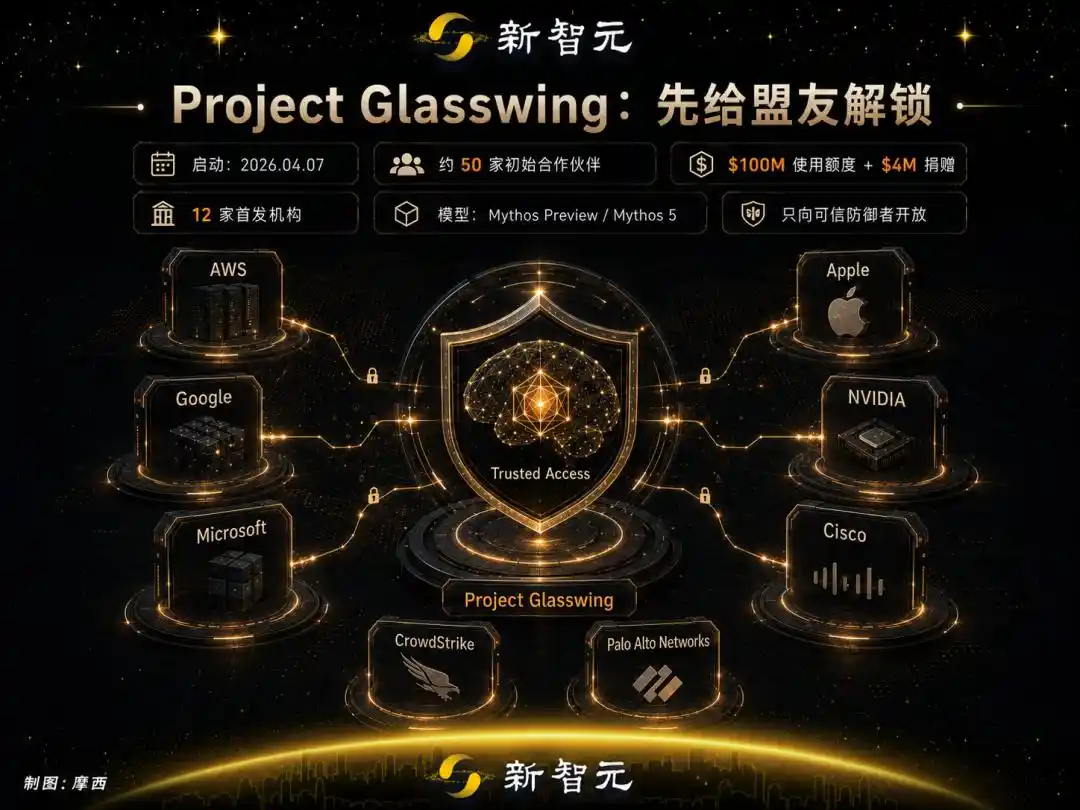
Behind it is the Glasswing Alliance, spearheaded by itself, with seats occupied by 12 tech behemoths including AWS, Apple, Broadcom, Cisco, CrowdStrike, Google, JPMorgan, Microsoft, NVIDIA, Palo Alto Networks, etc., who have collectively invested $104 million.

The weapon is Claude Mythos Preview, Anthropic's strongest force, never publicly released.
Although CJS is still just an 'early draft' on paper, it aims to preempt everyone by throwing an engineered, quantifiable version onto the table first.

But the problem is here. Anthropic is both the rule-maker and the biggest beneficiary of the rules. Its own Mythos is tearing open vulnerabilities, while it simultaneously defines 'how bad does the tear have to be to count as severe.'

Once this definition is adopted by the industry and regulators, it directly determines two things: when your model will be taken down, and how high the false-positive rate of the security gate is set, which translates to how many wrongful convictions you have to endure daily.

The Choking Hand Reaches the Model API for the First Time

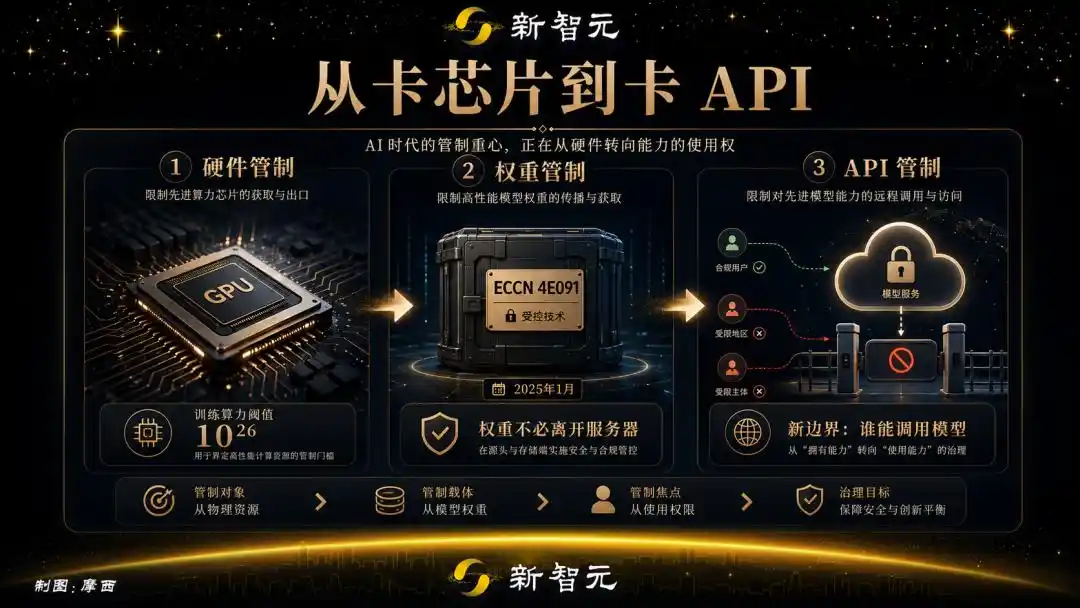
The secret order on June 12th that globally severed the model was decisive:

Immediately cut off all foreign citizens' access to Fable 5 and Mythos 5, regardless of whether you are on U.S. soil or overseas, even foreign employees personally recruited by Anthropic were to be executed without exception.

This is the heavy hand of U.S. export control clamping down directly on an AI model's API for the first time.

Before that, controls primarily targeted hardware like chips, GPUs, lithography machines, plus model weights.

Fable 5 faced a new dimensional strike: directly locking down the API.

The ban was lifted on June 30th, but the Fable 5 that returned had a much harsher security shackle around its neck than before it fell.

Meanwhile, Mythos 5, sharing the same bloodline, is not only more capable and had a three-month head start over the public, but is only open to about fifty partner institutions.

Public model plus classifier, neutered capability; full model for specific allies, unlocked capability.

This is the classic structure of export control: technological layering, licensed distribution.
Against this background, the true face of the CJS framework becomes clear: it's not just scoring jailbreaks; it's an executioner's ruler handed to regulators.

What severity level of jailbreak warrants a global service shutdown? What level can be quietly contained by the classifier?

With CJS, the next time the U.S. wants to pull the plug, it can produce a quantified score sheet.

What to Do If You're Blocked?

To survive under the 'model iron curtain' of Anthropic and the U.S., you only have three paths.

Choose your words meticulously. Completely scrub potential high-risk vocabulary from your prompts; switching to a euphemistic phrasing might let you eke out an existence.

Be vigilant for downgrade signals. If the answer quality suddenly turns to trash, you've likely been secretly exiled to Opus 4.8; immediately clean the sensitive wording and resend the request.

The third path is endless waiting. Anthropic, from its lofty position, promises optimization but absolutely refuses to provide a timeline.

The classifier determines how much AI capability you can squeeze out today. The CJS framework determines where that line between life and death will be drawn tomorrow.

Your code is firmly blocked outside the iron gate.

Face reality: this was never just a technical problem.

References:

https://www.anthropic.com/news/fable-safeguards-jailbreak-framework

This article is from the WeChat public account "New Zhiyuan" (新智元), author: ASI启示录, editor: 莫西

Трендовые криптовалюты

Связанные с этим вопросы

QWhat is the CJS framework introduced by Anthropic, and what is its primary purpose?

ACJS (Cyber Jailbreak Severity) is a scoring framework introduced by Anthropic to quantify the severity of AI jailbreaks (prompts that bypass safety restrictions). Its primary purpose is to categorize and score jailbreaks based on four metrics to determine how dangerous they are, which in turn informs decisions like whether to take a model offline or adjust safety filters.

QAccording to the article, what are the four categories into which Anthropic classifies cybersecurity-related prompts?

AAnthropic classifies cybersecurity-related prompts into four categories: 1) High-stakes malicious (e.g., ransomware, malware development). 2) High-risk dual-use (e.g., penetration testing, vulnerability exploitation). 3) Low-risk dual-use (e.g., OSINT gathering, known vulnerability scanning). 4) Harmless (e.g., secure coding, debugging).

QWhat are the four key metrics used in the CJS framework to score a jailbreak?

AThe four key metrics of the CJS framework are: 1) Capability Gain (0-4 points): Measures how much the jailbreak enhances an attacker's capabilities beyond existing tools. 2) Capability Breadth (0-2 points): Measures how many different cybersecurity areas the jailbreak affects. 3) Weaponization Difficulty (0-2 points): Measures how easy it is to turn the jailbreak output into a real attack. 4) Discoverability (0-2 points): Measures how easy the jailbreak method is to find.

QWhat major incident involving the Fable 5 model is discussed, and what was a key consequence?

AThe article discusses a major incident where the Fable 5 model was taken offline globally. A key consequence mentioned is that after the model was restored, it came back with much stricter safety filters ('classification thresholds') than before the takedown.

QWhat does the article suggest is the broader, non-technical significance of the CJS framework?

AThe article suggests the broader significance of the CJS framework is political and regulatory. It positions CJS as a tool for policymakers, particularly the US government, to make quantified decisions about when to impose export controls (like API shutdowns) on AI models based on the severity of jailbreaks, thus extending traditional hardware export controls into the realm of AI software access.

Похожее

United Stables превышает $1 млрд, а данные Chainlink обеспечивают залог токена U

Стабильная монета U от United Stables достигла рыночной капитализации в $1 миллиард. Ключевую роль в ее инфраструктуре играют оракулы Chainlink Data Feeds, которые обеспечивают данные о цене и обеспечении (коллатерале) токена в различных блокчейнах. Этот рубеж важен, поскольку показывает, что для устойчивого роста стейблкоинов надежная внешняя проверка данных становится обязательной, а не опциональной. Это упрощает интеграцию таких активов в DeFi-протоколы. Рост U укрепляет позицию Chainlink как ключевого провайдера инфраструктурных решений для проверки обеспеченности стейблкоинов — одного из важнейших направлений в криптоиндустрии. Однако важно понимать, что использование Chainlink является инфраструктурной опорой, а не прямым драйвером стоимости токена LINK. Успех U демонстрирует расширение конкуренции на рынке стейблкоинов, где новые эмитенты находят место. Дальнейшее внимание рынка будет сосредоточено на реальном использовании токена в DeFi, а не только на показателе капитализации.

bitcoinist1 ч. назад

United Stables превышает $1 млрд, а данные Chainlink обеспечивают залог токена U

bitcoinist1 ч. назад

Взлом казны BonkDAO показывает, что риски управления в Solana реальны

Казначейство BonkDAO было опустошено примерно на 20 миллионов долларов в результате злонамеренного голосования в системе управления Realms. Этот инцидент стал ярким примером рисков, присущих децентрализованным автономным организациям (DAO) в экосистеме Solana. Важно отметить, что это не было сбоем базового уровня блокчейна Solana. Эксплойт стал возможен из-за уязвимости в механизмах управления DAO: злоумышленники использовали правила голосования, чтобы легитимно провести вредоносное предложение и вывести средства. Инцидент подчеркивает, что система управления DAO сама по себе может стать вектором атаки. Если правила, регулирующие голосование, кворум и исполнение решений, недостаточно надежны, злоумышленникам не нужно взламывать смарт-контракт — они могут использовать сам процесс управления. Realms, широко используемая платформа для управления DAO на Solana, оказалась в центре событий. Проблема заключалась не в сбое платформы, а в настройках конкретного DAO, что должно побудить другие проекты пересмотреть свои конфигурации, включая пороги кворума и правила расчета веса голосов. Для сообщества BONK, одного из самых известных мем-токенов Solana, этот случай стал испытанием на доверие. Восстановление уверенности будет зависеть от прозрачности расследования и планов по предотвращению подобных атак в будущем. Главный вывод: безопасность управления DAO требует такого же внимания, как и безопасность кода. Даже при идеально работающем блокчейне активы сообщества находятся под угрозой, если правила управления казначейством уязвимы для злоупотреблений.

bitcoinist1 ч. назад

Взлом казны BonkDAO показывает, что риски управления в Solana реальны

bitcoinist1 ч. назад

Токен Midnight (NIGHT) обвалился после эксплойта моста Wanchain на $13 млн

Токен NIGHT проекта Midnight резко упал в цене после эксплуатации уязвимости в мосту Wanchain, в результате которой было похищено 515 миллионов токенов NIGHT на сумму около $13,2 млн. Инцидент был связан с недостатком, позволяющим повторно использовать подписи в инфраструктуре кросс-чейн моста. Команда Wanchain приостановила работу затронутого маршрута моста. Стоит отметить, что атака была направлена на смарт-контракты моста, а не на базовый уровень Cardano или валидаторную инфраструктуру Midnight. Однако такие взломы оказывают сильное давление на токены экосистемы из-за нарушения ликвидности и потери доверия, даже если исходные блокчейны остаются безопасными. Рынок теперь будет оценивать действия команд по устранению последствий, отслеживанию похищенных средств и восстановлению безопасности моста, что определит скорость возвращения доверия пользователей.

bitcoinist1 ч. назад

Токен Midnight (NIGHT) обвалился после эксплойта моста Wanchain на $13 млн

bitcoinist1 ч. назад

Интеграция XRP Ledger и Axelar открывает новый кросс-чейн маршрут в DeFi

Платформа XRP Ledger интегрировалась с протоколом Axelar, открыв новый кросс-чейн маршрут для XRP и других активов XRPL. Это позволяет активам перемещаться в экосистемы DeFi, построенные на EVM и Cosmos, через интероперабельный стек Axelar. Однако важно отметить, что XRPL не становится нативной цепью EVM — интеграция лишь улучшает мостовые возможности. Подключение к Axelar призвано использовать высокую ликвидность XRP, выходящую за рамки централизованных бирж, и обеспечить его участие в мультичейн-среде DeFi. Это может повысить полезность XRP, позволив держателям и разработчикам получать доступ к приложениям на других сетях. Тем не менее, успех интеграции будет зависеть от реального использования: появления ликвидности, поддержки кошельков, спроса со стороны пользователей и создания продуктов. Хотя подключение укрепляет позиции XRPL в развивающемся кросс-чейн-ландшафте, оно также несет риски, связанные с безопасностью мостов и интероперабельностью.

bitcoinist1 ч. назад

Интеграция XRP Ledger и Axelar открывает новый кросс-чейн маршрут в DeFi

bitcoinist1 ч. назад

Торговля

Спот

Популярные статьи

Как купить S

Добро пожаловать на HTX.com! Мы сделали приобретение Sonic (S) простым и удобным. Следуйте нашему пошаговому руководству и отправляйтесь в свое крипто-путешествие.Шаг 1: Создайте аккаунт на HTXИспользуйте свой адрес электронной почты или номер телефона, чтобы зарегистрироваться и бесплатно создать аккаунт на HTX. Пройдите удобную регистрацию и откройте для себя весь функционал.Создать аккаунтШаг 2: Перейдите в Купить криптовалюту и выберите свой способ оплатыКредитная/Дебетовая Карта: Используйте свою карту Visa или Mastercard для мгновенной покупки Sonic (S).Баланс: Используйте средства с баланса вашего аккаунта HTX для простой торговли.Третьи Лица: Мы добавили популярные способы оплаты, такие как Google Pay и Apple Pay, для повышения удобства.P2P: Торгуйте напрямую с другими пользователями на HTX.Внебиржевая Торговля (OTC): Мы предлагаем индивидуальные услуги и конкурентоспособные обменные курсы для трейдеров.Шаг 3: Хранение Sonic (S)После приобретения вами Sonic (S) храните их в своем аккаунте на HTX. В качестве альтернативы вы можете отправить их куда-либо с помощью перевода в блокчейне или использовать для торговли с другими криптовалютами.Шаг 4: Торговля Sonic (S)С легкостью торгуйте Sonic (S) на спотовом рынке HTX. Просто зайдите в свой аккаунт, выберите торговую пару, совершайте сделки и следите за ними в режиме реального времени. Мы предлагаем удобный интерфейс как для начинающих, так и для опытных трейдеров.

1.7k просмотров всегоОпубликовано 2025.01.15Обновлено 2026.06.02

Как купить S

Sonic: Обновления под руководством Андре Кронье – новая звезда Layer-1 на фоне спада рынка

Он решает проблемы масштабируемости, совместимости между блокчейнами и стимулов для разработчиков с помощью технологических инноваций.

2.4k просмотров всегоОпубликовано 2025.04.09Обновлено 2025.04.09

Sonic: Обновления под руководством Андре Кронье – новая звезда Layer-1 на фоне спада рынка

HTX Learn: Пройдите обучение по "Sonic" и разделите 1000 USDT

HTX Learn — ваш проводник в мир перспективных проектов, и мы запускаем специальное мероприятие "Учитесь и Зарабатывайте", посвящённое этим проектам. Наше новое направление .

1.9k просмотров всегоОпубликовано 2025.04.10Обновлено 2025.04.10

HTX Learn: Пройдите обучение по "Sonic" и разделите 1000 USDT

Обсуждения

Добро пожаловать в Сообщество HTX. Здесь вы сможете быть в курсе последних новостей о развитии платформы и получить доступ к профессиональной аналитической информации о рынке. Мнения пользователей о цене на S (S) представлены ниже.

活动图片











