Analyzing if AAVE could target $92 after breaking KEY support

ambcryptoОпубликовано 2026-03-29Обновлено 2026-03-29

Введение

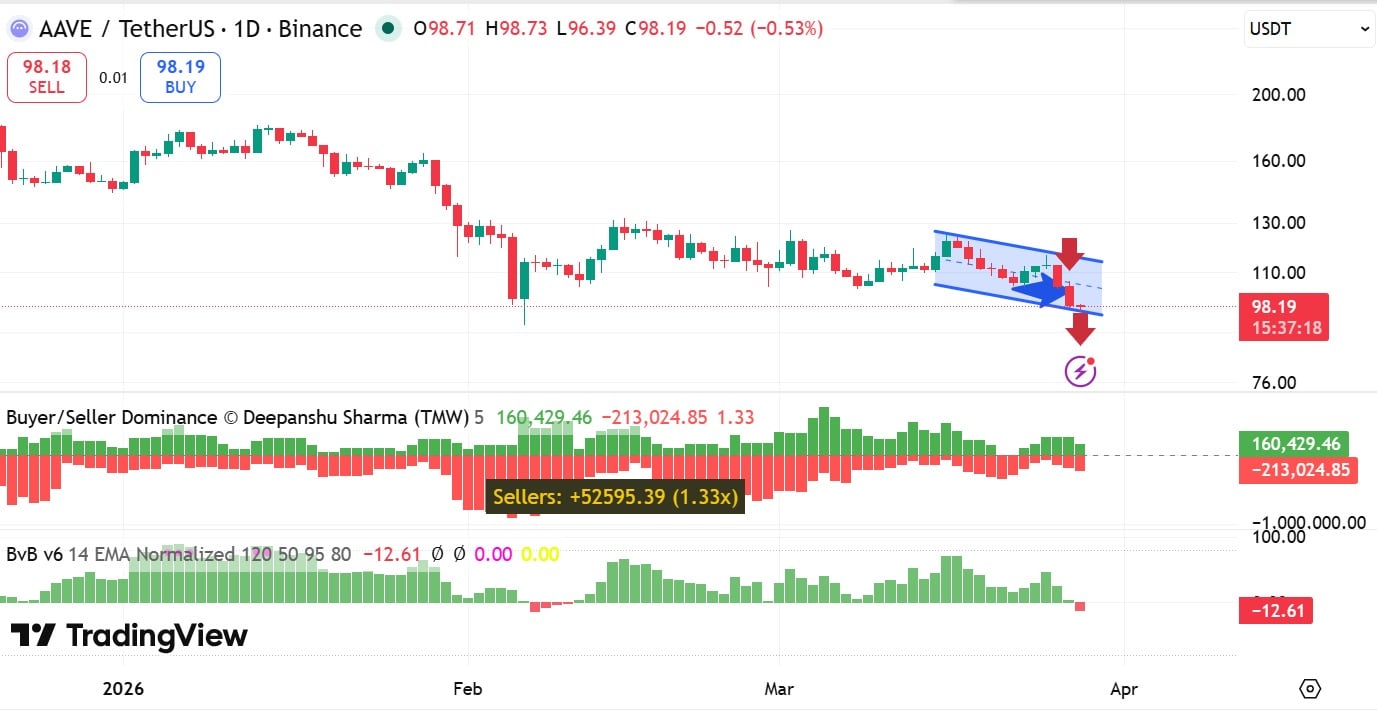
AAVE breached the $100 support level amid a broader market decline, falling to a three-week low of $96 and trading at $97 at press time, down 7.7% daily. The market cap dropped by over $200 million. The altcoin fell below its short-term moving averages, reflecting strong bearish pressure. Market participants turned bearish, with the Bulls vs. Bears indicator turning negative after over a month of positivity. Exchange data showed a net inflow of tokens, indicating selling dominance, and the Exchange Supply Ratio hit a monthly high of 0.137. The RSI dropped to 34, nearing oversold conditions, suggesting continued seller control. If bearish momentum persists, AAVE could decline toward $92. A rebound would require reclaiming $100 and key moving averages at $107 and $110; otherwise, the downtrend may continue.

Aave [AAVE] breached the $100 support level amid a broader market slip and fell to a three-week low of $96. In fact, at press time, AAVE traded at $97, down 7.7% on the daily charts, while the market cap fell by over $200 million.

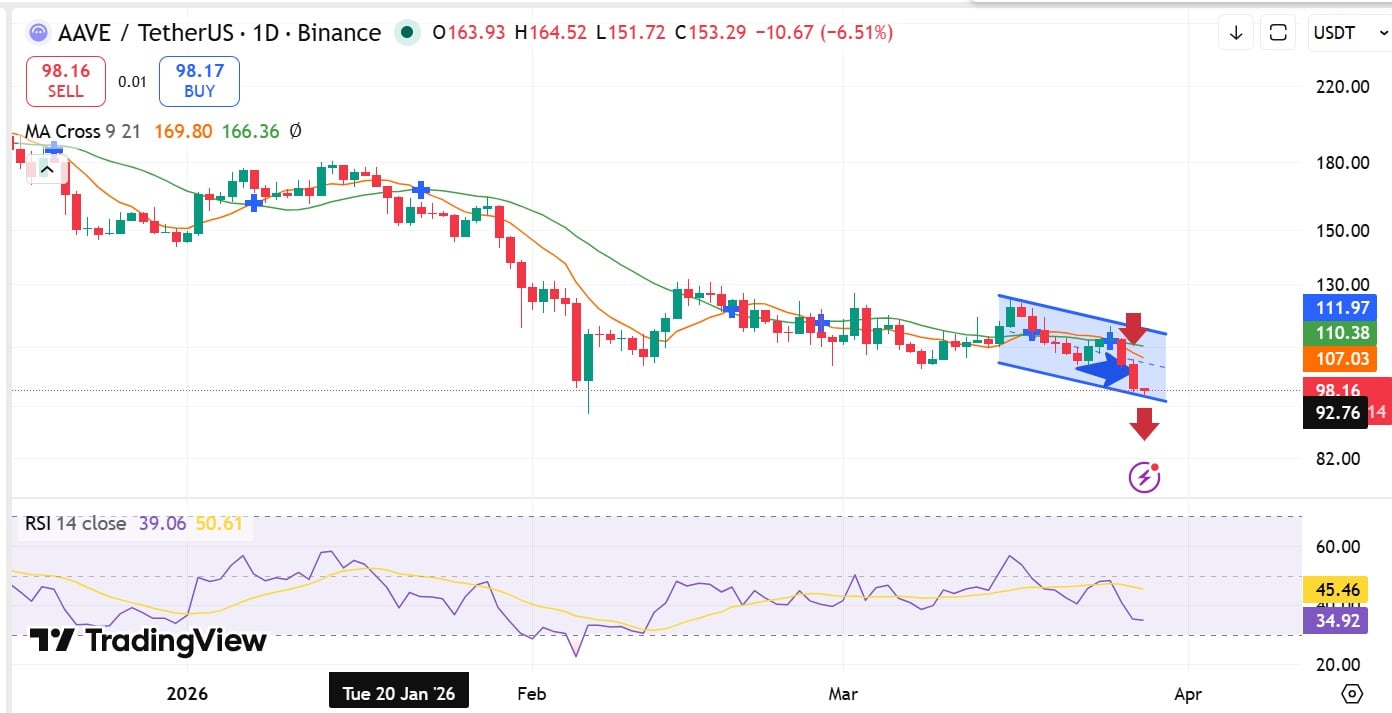
In doing so, the altcoin fell below its short-term Moving Averages (MA), the 9- and 21-day MAs, reflecting strong downside pressure.

AAVE drops below $100

As the crypto market retraced, AAVE market participants turned bearish and began exiting the market aggressively, thereby strengthening downside momentum.

In fact, the Bulls vs. Bears indicator turned negative after being positive for more than a month. When this metric turns negative, it suggests that sellers have dominated the market and displaced buyers.

Source: TradingView

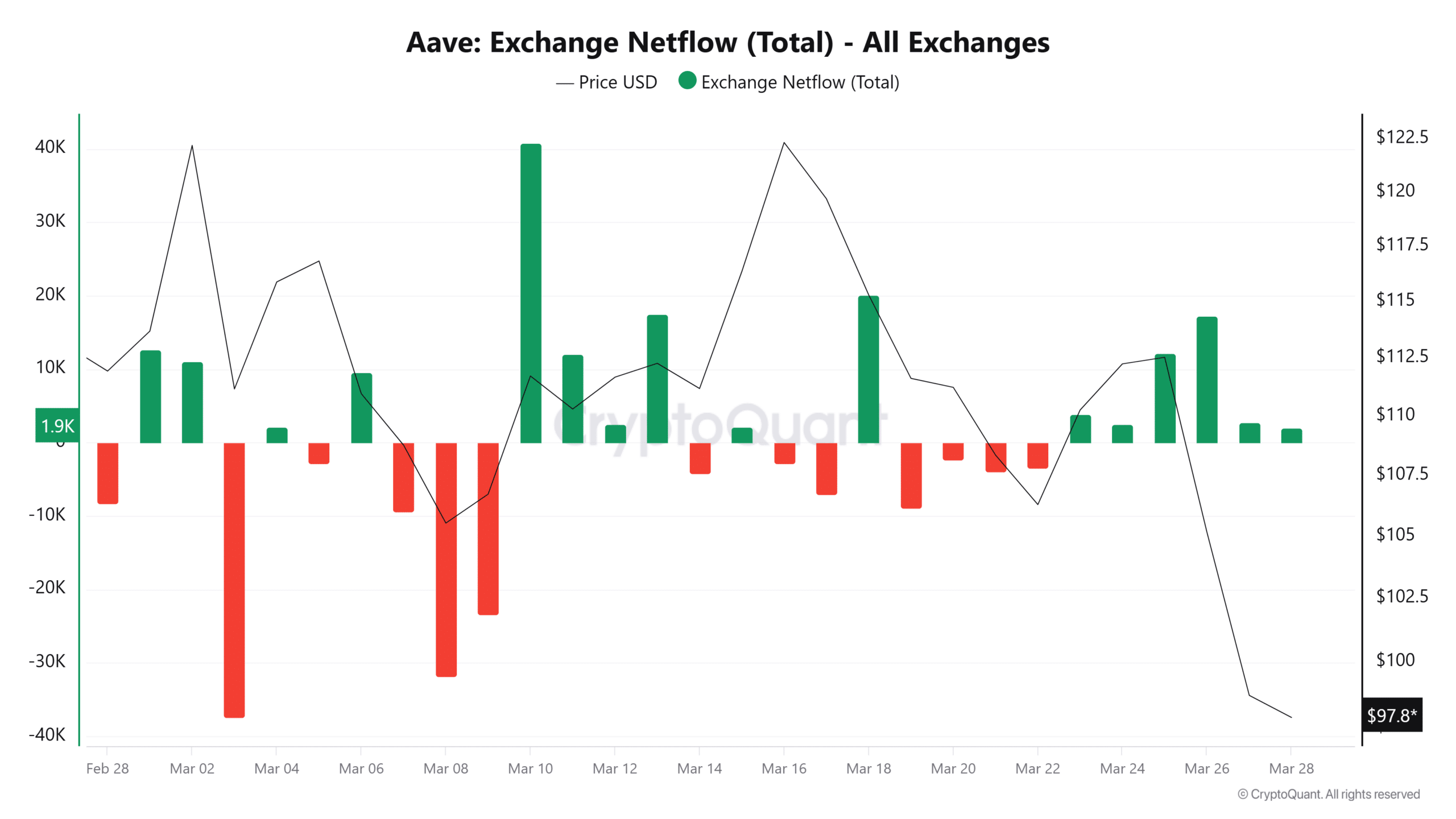
Furthermore, exchange activities echoed this seller dominance. According to CryptoQuant data, 79k AAVE tokens flowed into exchanges, compared to 74k flowing out.

Source: CryptoQuant

Thus, the altcoin’s Netflow extended its hold within the positive zone for the sixth day, suggesting that sellers have had a strong dominance over the market.

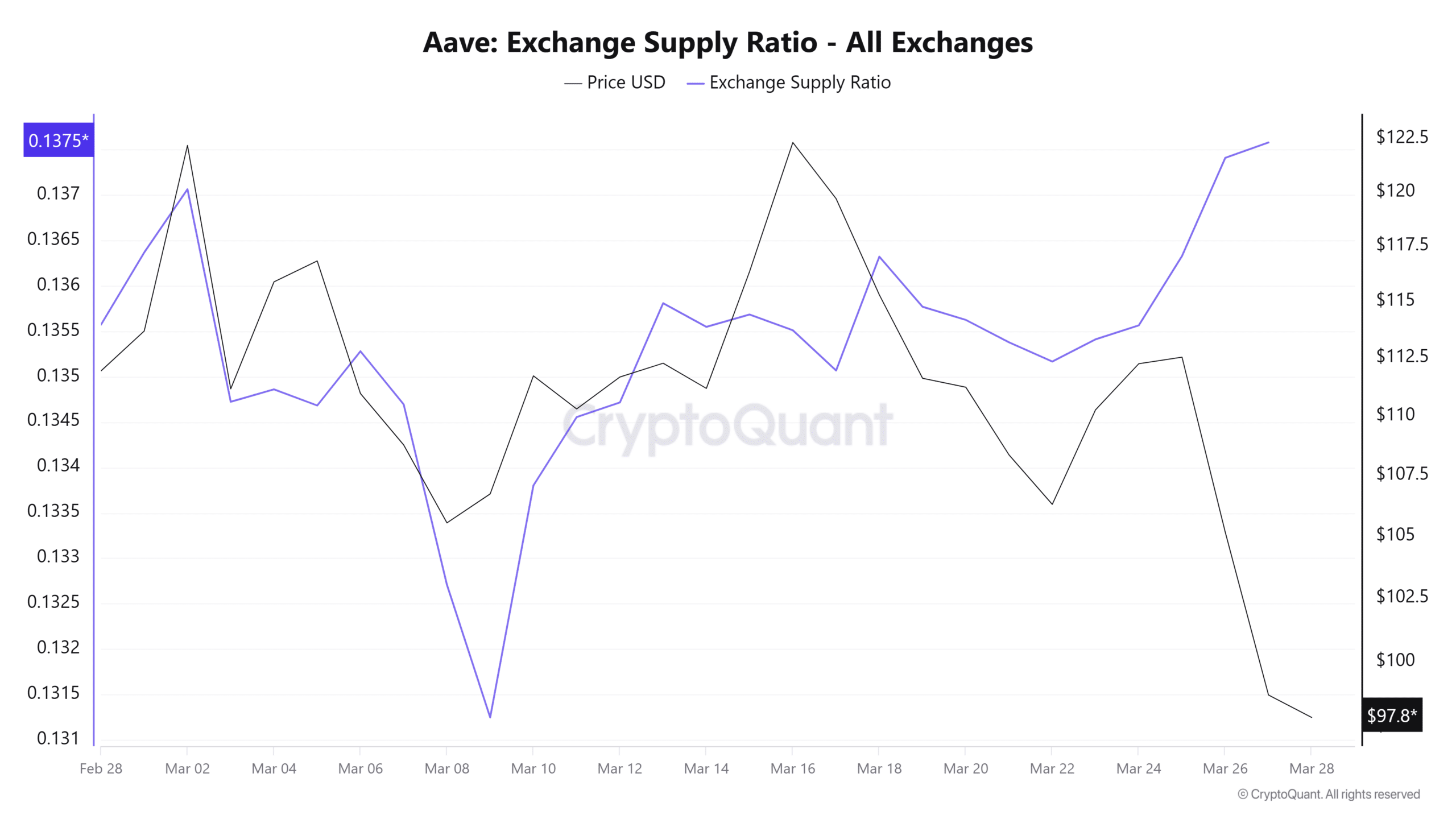
As a result, the altcoin’s Exchange Supply Ratio jumped to a monthly high of 0.137 as of writing, indicating increased selling activity. Often, such a jump in ESR reduces scarcity, thus increasing the supply available for immediate sale.

Source: CryptoQuant

Such a setup on exchanges has preceded strong downward momentum for the asset, leading to lower prices.

What momentum indicators suggest

AAVE has experienced strong downward momentum and breached a key support level, with sellers significantly outpacing buyers. Since then, the altcoin’s Relative Strength Index (RSI) dropped deeper into bearish territory, falling to 34 at press time.

With RSI nearing oversold territory, this suggests sellers’ control of the market, while buyers have largely stepped back. Traditionally, such market conditions have strengthened downward momentum, typically resulting in lower prices.

Source: TradingView

Therefore, if sellers continue to overrun the market with little resistance, AAVE is likely to slide towards $92 before attempting another leg up.

However, if the market cools down and bulls reclaim $100, the altcoin could set the ground for a rebound. But for a significant trend reversal, bulls need to flip $100 and reclaim the 9- and 21-day MAs at $107 and $110, respectively.

Failure to do so will see the altcoin enter an extended bearish streak, with a likelihood of staying below $100.


Final Summary

  • Aave dropped 7.7%, breaching $100 and dropping to a three-week low of $96.
  • AAVE faced intense selling pressure, with bears outpacing bulls, strengthening downside risk.

Связанные с этим вопросы

QWhat key support level did AAVE breach, and what was its price at the time of writing?

AAAVE breached the $100 support level and was trading at $97 at the time of writing.

QWhat does the Bulls vs. Bears indicator turning negative suggest about the AAVE market?

AIt suggests that sellers have dominated the market and displaced buyers, indicating strong bearish sentiment.

QAccording to the data, how did the Netflow and Exchange Supply Ratio (ESR) metrics reflect selling pressure?

AThe Netflow was positive for the sixth day, and the Exchange Supply Ratio jumped to a monthly high of 0.137, both indicating increased selling activity and dominance by sellers.

QWhat does the RSI value of 34 at press time imply for AAVE's price momentum?

AAn RSI of 34 suggests that the market is nearing oversold territory, with sellers in control and strong downward momentum, which could lead to lower prices.

QWhat are the two potential price scenarios for AAVE mentioned in the article?

AIf sellers continue to dominate, AAVE could slide towards $92. If bulls reclaim $100, it could set the stage for a rebound, but a significant reversal requires flipping $100 and reclaiming the 9- and 21-day MAs at $107 and $110.

Похожее

Why Hasn't the U.S. Seen the Rise of 'Huabei' or 'Jiebei'?

The article explores why the U.S. lacks large-scale consumer credit products like China's "Huabei" and "Jiebei," despite having a developed financial sector. Key reasons include: 1. **Structural Barriers**: A fragmented federal and state regulatory system, reinforced by post-2008 reforms like the Dodd-Frank Act, raises compliance costs and protects traditional banks, stifling fintech innovation. 2. **Credit Card Dominance**: Credit cards, used by 70-80% of adults, form a $1.28 trillion debt market with high APRs (avg. 22.3%). This system cross-subsidizes users who pay in full with those carrying balances, creating a predatory yet entrenched ecosystem. 3. **Data Privacy Laws**: Strict regulations (e.g., FCRA, CCPA) prevent tech giants from leveraging behavioral data for credit scoring, unlike in China where such data fuels fintech models. 4. **Capital Market Disincentives**: Wall Street penalizes tech firms entering finance due to lower valuations associated with heavy regulation and risk, as seen in Apple’s failure with Apple Card. 5. **Banking Oligopoly**: Major banks control consumer lending, leveraging lobbying power and consumer habits to maintain high-cost credit, while alternatives like payday loans (400% APR) or "unbanked" services remain niche or exploitative. Ultimately, regulatory, structural, and corporate interests collectively block the emergence of accessible, low-cost digital lending in the U.S.

Odaily星球日报41 мин. назад

Why Hasn't the U.S. Seen the Rise of 'Huabei' or 'Jiebei'?

Odaily星球日报41 мин. назад

More and More 'Model Supermarkets' Are Opening: ByteDance, Alibaba, and Tencent Compete to Integrate

Chinese tech giants like ByteDance, Alibaba, and Tencent are accelerating the rollout of integrated AI model subscription services—dubbed “model supermarkets”—to provide developers with bundled access to multiple leading domestic large language models (LLMs). ByteDance’s Volcengine recently upgraded its "Coding Plan" by adding newer models like GLM-5.1, Minimax M2.7, and Kimi k2.6, allowing subscribers to use various top models under a single monthly fee starting at ¥40. However, user feedback reveals significant issues, including rapid consumption of usage limits (e.g., hitting caps within hours), frequent server errors (like HTTP 429), and slow response times during peak hours. Complaints about misleading deduction rates—where calls to advanced models consume more quota—are also common. The trend is industry-wide: Alibaba, Tencent, and Baidu have all launched similar multi-model coding plans. While these platforms reduce trial costs for developers, they also expose challenges in balancing affordability with service quality and computational stability. Amid this shift, independent AI companies like Zhipu, MiniMax, and Moonlight Face (Kimi) are developing strategies to avoid becoming mere “pipes” in this ecosystem—focusing on vertical applications, autonomous agents, and long-context models to retain competitiveness. Analysts suggest that, while platform aggregation may pressure model firms in the short term, specialized and vertical AI capabilities will remain differentiated in the long run.

marsbit45 мин. назад

More and More 'Model Supermarkets' Are Opening: ByteDance, Alibaba, and Tencent Compete to Integrate

marsbit45 мин. назад

Торговля

Спот
Фьючерсы
活动图片