Amplify ETFs for stablecoins, tokenization go live for trading

cointelegraphОпубликовано 2025-12-24Обновлено 2025-12-24

Введение

Amplify has launched two new exchange-traded funds: the Amplify Stablecoin Technology ETF (STBQ) and the Amplify Tokenization Technology ETF (TKNQ), both now trading on NYSE Arca. These ETFs track indexes of companies involved in stablecoin and tokenization infrastructure, including major players like Visa, Circle, Mastercard, PayPal, BlackRock, and JPMorgan. The launch comes amid growing regulatory clarity in the U.S. and Europe, with laws like the GENIUS Act and MiCA positioning stablecoins as compliant digital finance tools. Tokenization and stablecoins have gained significant traction this year as institutions explore digitizing traditional financial services.

Digital asset manager Amplify has launched two exchange-traded funds tracking blockchain projects across stablecoins and tokenization.

The company said on Tuesday that its Amplify Stablecoin Technology ETF (STBQ) and Amplify Tokenization Technology ETF (TKNQ) both went live on the NYSE Arca exchange.

Both funds track a diversified index of companies working on products or infrastructure, along with projects that generate revenue from tokenization and stablecoins.

“These new ETFs expand Amplify’s lineup at a time when the infrastructure behind stablecoins and the growth of tokenization are shaping the next phase of digital finance,” the company said.
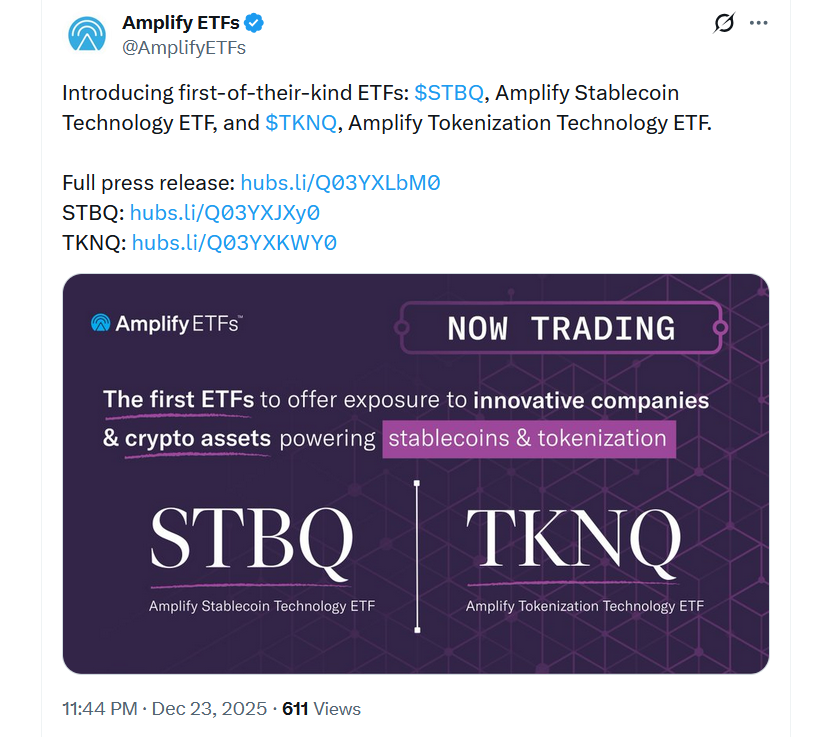
Source: Amplify ETFs

Stablecoins and tokenization have been among the most popular themes in crypto this year, with the US passing laws that have given institutions confidence to launch stablecoins, and regulators opening dialogue on how they should treat assets such as tokenized stocks.

Amplify said its stablecoin-focused ETF tracks shares of companies “generating significant revenue from payments technology, digital asset infrastructure, and trading platforms.”

It holds shares in companies working on stablecoins such as Visa, Circle, Mastercard and PayPal, alongside crypto ETFs from Grayscale, iShares and Bitwise.

The firm pointed to regulatory developments in the US and EU, noting that the “GENIUS Act in the US and MiCA in Europe are positioning stablecoins as the compliant backbone of digital finance.”

Related: Clarity Act delays led to $952M in crypto fund outflows: CoinShares

Meanwhile, the tokenization fund includes exposure to BlackRock, JPMorgan, Figure Technology Solution, Citigroup and the Nasdaq, which all have made tokenization plays over the past few years as they seek opportunities to digitize traditional financial services.

Crypto and blockchain ETFs stormed onto the market in 2025 after the US Securities and Exchange Commission under chair Paul Atkins loosened requirements for crypto ETFs.

Magazine: Big questions: Would Bitcoin survive a 10-year power outage?

Связанные с этим вопросы

QWhat are the names of the two new ETFs launched by Amplify and on which exchange did they go live?

AThe two new ETFs are the Amplify Stablecoin Technology ETF (STBQ) and the Amplify Tokenization Technology ETF (TKNQ). They both went live on the NYSE Arca exchange.

QWhat is the primary focus of the Amplify Stablecoin Technology ETF (STBQ)?

AThe Amplify Stablecoin Technology ETF (STBQ) tracks shares of companies generating significant revenue from payments technology, digital asset infrastructure, and trading platforms related to stablecoins.

QWhich major companies are included in the stablecoin-focused ETF's holdings?

AThe stablecoin-focused ETF holds shares in companies such as Visa, Circle, Mastercard, PayPal, as well as crypto ETFs from Grayscale, iShares, and Bitwise.

QWhat regulatory developments does Amplify cite as supporting the growth of stablecoins?

AAmplify points to the GENIUS Act in the US and the Markets in Crypto-Assets (MiCA) regulation in Europe, which are positioning stablecoins as the compliant backbone of digital finance.

QWhich types of companies does the Amplify Tokenization Technology ETF (TKNQ) provide exposure to?

AThe tokenization fund provides exposure to companies like BlackRock, JPMorgan, Figure Technology Solution, Citigroup, and Nasdaq, which are involved in tokenizing traditional financial services.

Похожее

The Value Distribution of Stablecoins

**Summary: The Value Distribution of Stablecoins** The article argues that stablecoins are evolving from mere trading tools into broader channels for dollar access. It divides the stablecoin ecosystem into four layers to analyze how value is distributed: 1. **Issuance Layer:** Mints stablecoins, holds reserve assets, and captures the spread between reserve yield and user costs (e.g., Tether, Circle). This layer currently earns the largest profit margin. 2. **Infrastructure Layer:** Connects stablecoins to the traditional financial system, handling fiat on/off-ramps, banking integration, compliance (KYC/AML), and asset management (e.g., Bridge, BVNK). This is the "unglamorous" but critical work, building the essential bridges between crypto and real-world finance. 3. **Acquiring/Distribution Layer:** Integrates stablecoins into merchant systems, manages payment flows, and provides enterprise financial software (e.g., Stripe, Coinbase). They act as the access point for businesses. 4. **Application Layer:** The end-users and businesses that ultimately use stablecoins for payments, settlements, or as a store of value. They benefit from convenience but have little pricing power. The core thesis is that while the issuance layer currently dominates profits, the often-overlooked **infrastructure layer holds significant long-term potential**. The real challenge and barrier to mass adoption is not the on-chain transfer of stablecoins (which is simple), but the complex "last mile" integration into existing business workflows, banking systems, and regulatory frameworks across different countries. Companies in this layer are currently in a "land grab" phase, investing heavily to build networks, secure bank partnerships, and establish compliance pathways. While their position is currently pressured by the profitable issuers above and distribution platforms below, the article suggests that if stablecoins become a default financial rail for businesses, the infrastructure providers who have done the hard work of integration will ultimately gain strong pricing power and become entrenched, essential players.

marsbit5 ч. назад

The Value Distribution of Stablecoins

marsbit5 ч. назад

The Value Distribution of Stablecoins

The Value Distribution of Stablecoins The article argues that stablecoins are evolving from a mere trading tool into a broad "dollar channel." It analyzes the industry's value chain through four layers: 1. **Issuance Layer (e.g., Tether, Circle):** The top layer that mints stablecoins, holds reserve assets, and captures the thickest interest rate spread. 2. **Infrastructure Layer (e.g., Bridge, BVNK):** Connects stablecoins to the traditional financial system, handling critical but complex "dirty work" like fiat on/off-ramps, banking integration, compliance (KYC/AML), and cross-border settlement. 3. **Acquiring/Distribution Layer (e.g., Stripe, Coinbase):** Embeds stablecoins into merchant systems, manages payment flows, and integrates with enterprise software. 4. **Application Layer:** End-users and businesses that ultimately use stablecoins for payments, settlement, or storing value. The author posits that while the issuance layer currently captures the most profit, the most overlooked and potentially critical layer is infrastructure. The core challenge for stablecoin adoption isn't the on-chain transfer (which is simple), but bridging the gap between blockchain and the real-world financial system. This involves solving practical problems for businesses: fiat conversion, reconciliation, tax handling, and user onboarding. Infrastructure companies are currently in a difficult "land-grab" phase—building networks, securing banking relationships, and achieving compliance country-by-country. They face pressure from both the profitable issuance layer above and distribution platforms below. However, the author suggests this layer is building a crucial moat. Once stablecoins become a default business rail, the infrastructure players who have done the hard work of integration may gain significant, durable value and pricing power.

链捕手5 ч. назад

The Value Distribution of Stablecoins

链捕手5 ч. назад

Торговля

Спот
Фьючерсы
活动图片




