All about why blockchain firms will now become part of U.S Treasury’s cybersecurity program

ambcryptoОпубликовано 2026-04-10Обновлено 2026-04-10

Введение

The U.S. Department of the Treasury has launched a new initiative through its Office of Cybersecurity and Critical Infrastructure Protection (OCCIP) to include blockchain and crypto firms in a cybersecurity program. This move aims to share timely cyber threat intelligence to help these firms prevent and respond to attacks. The announcement comes amid ongoing security challenges in the crypto industry, highlighted by incidents like the 2026 Drift Protocol attack, which resulted in approximately $285 million in losses and was linked to state-backed cyber operations. The article underscores that security vulnerabilities remain a critical systemic risk in crypto, capable of triggering prolonged market downturns, as seen during the 2022 crash following the collapse of FTX. By providing early warnings and fostering coordinated risk management, the Treasury’s program seeks to strengthen institutional confidence and reduce the likelihood of future large-scale market disruptions.

When we talk about “risk” in crypto, the real and often underestimated risk lies in security.

Over the years, the crypto industry has expanded rapidly, bringing institutional participation, new products, and large-scale adoption. And yet, the underlying investment risk has not fully disappeared. The reason is simple – Security vulnerabilities continue to exist across smart contracts, bridges, wallets, and exchanges.

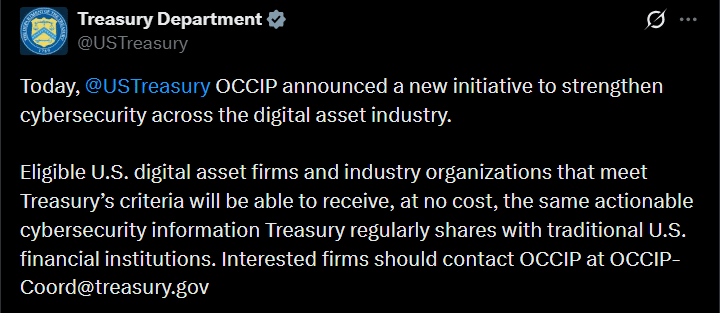
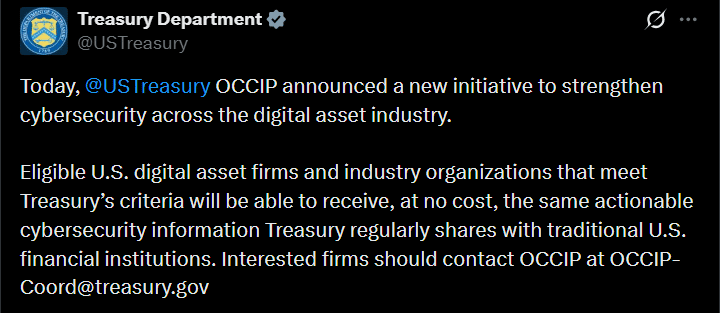
Seen in this light, the latest move by the U.S Treasury becomes relevant. Notably, the U.S Department of the Treasury has launched a new cybersecurity initiative. Through its Office of Cybersecurity and Critical Infrastructure Protection (OCCIP), the program will share timely cyber threat information with eligible crypto and blockchain firms to help them prevent and respond to attacks.

Source: X

Interestingly, the timing of this initiative feels almost deliberate.

Just four months into 2026, the crypto market has already faced another reminder of its security gaps. The recent Drift Protocol attack exposed vulnerabilities within the platform’s trading mechanisms, resulting in losses estimated at around $285 million. In fact, early investigations have linked the activity to DPRK-style operations, suggesting a level of planning typically associated with state-backed cyber groups.

Against this backdrop, the U.S Treasury’s decision to roll out a cybersecurity program for digital asset firms carries significant importance. The key question now is – Will stronger government-backed cybersecurity coordination help strengthen institutional confidence in crypto assets?

OCCIP’s significance viewed through crypto’s 2022 crash

The impact of security lapses goes far beyond a temporary wave of FUD in the market.

In some cases, the consequences are long-lasting. The collapse of FTX in 2022 serves as a clear example. What initially appeared to be a single exchange failure quickly evolved into a security crisis for the entire industry. Billions of dollars were lost, and major lending firms faced significant liquidity stress.

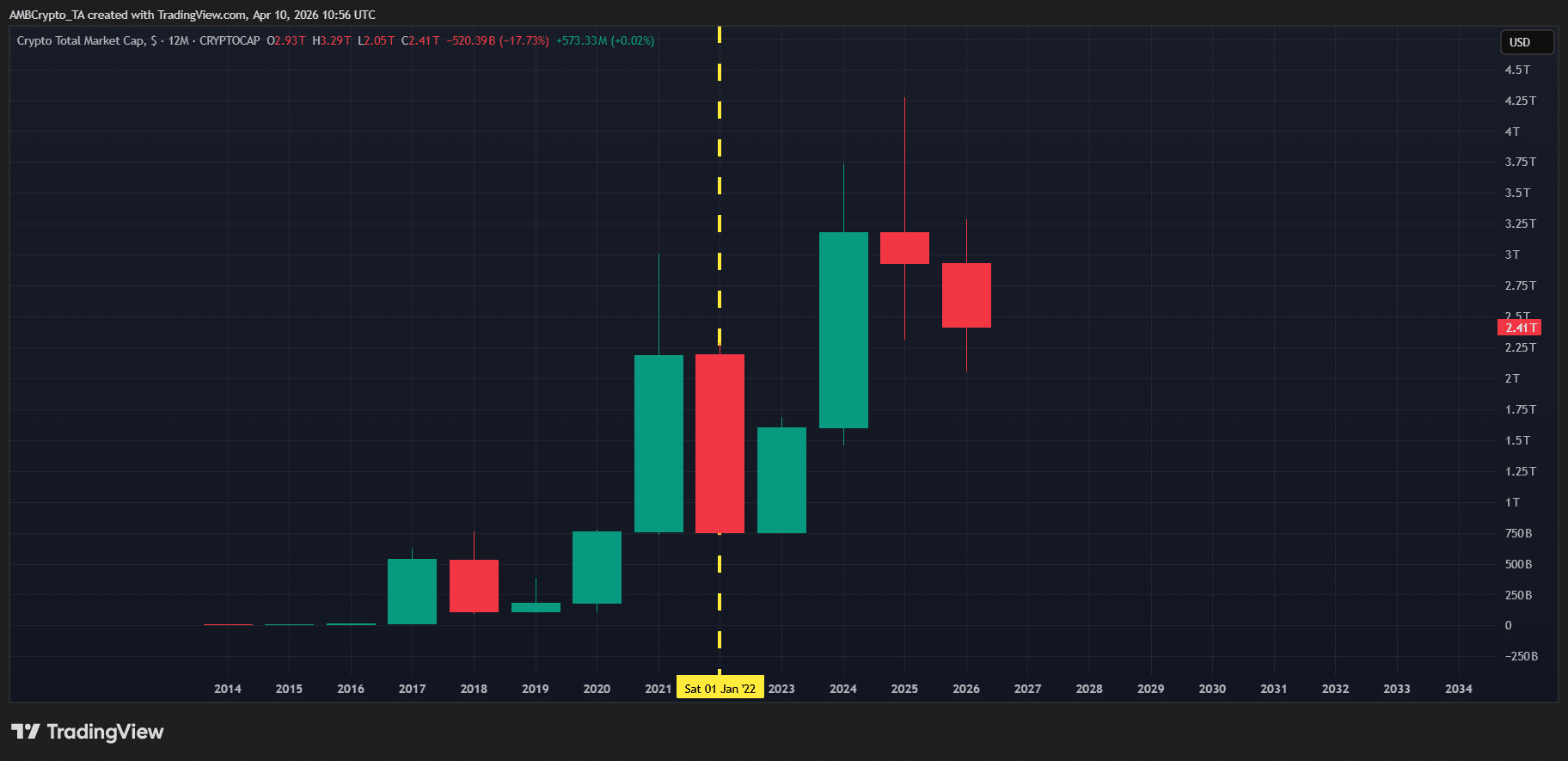
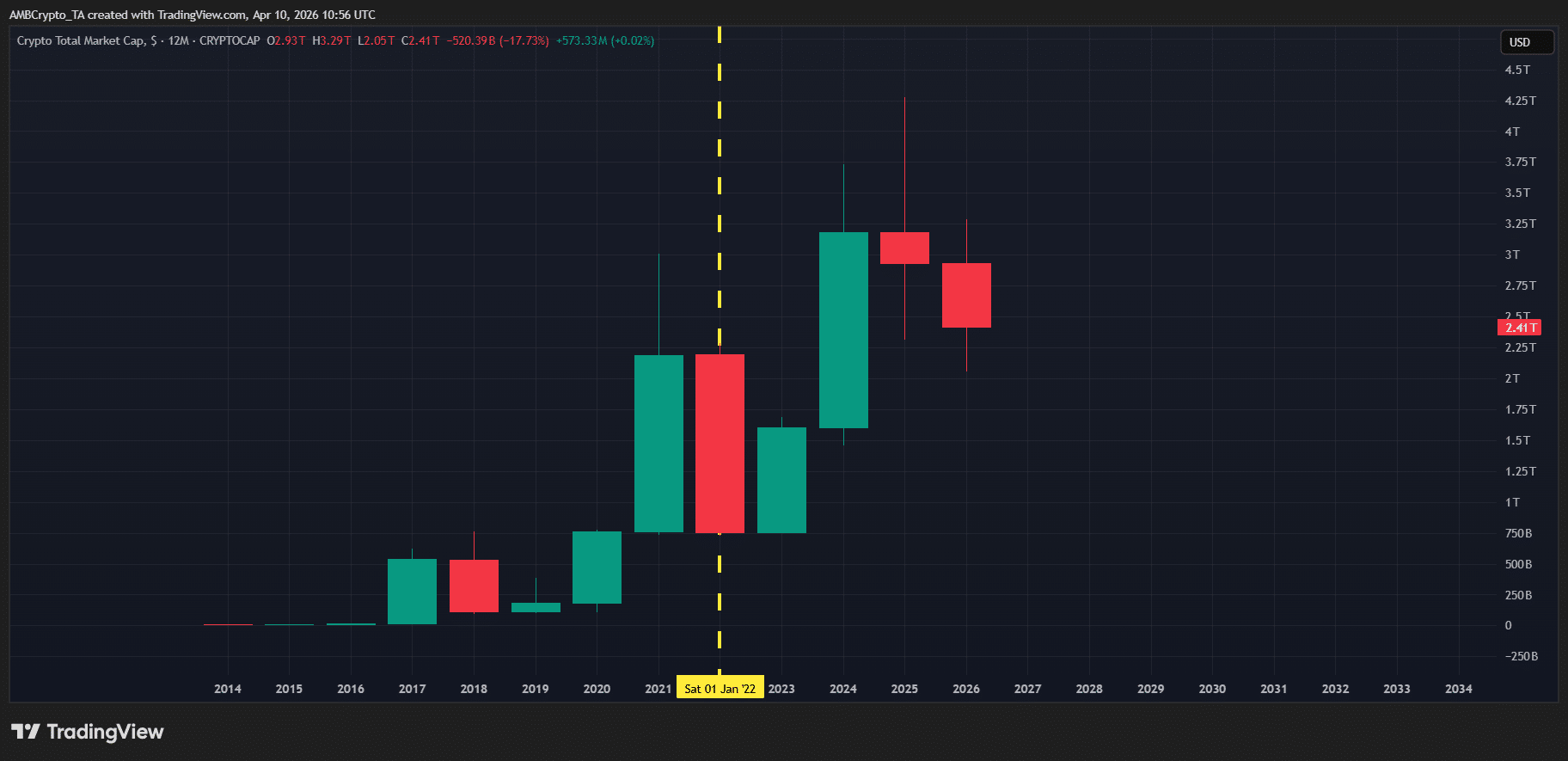
From a technical standpoint, the impact was equally severe. The crypto market ended 2022 down roughly 66%, a period still considered one of the harshest bear markets in crypto history. Recovery was slow rather than immediate.

Throughout 2023, the market managed to regain only 50% of the losses as investors remained cautious.

In fact, it wasn’t until the 2024 cycle that broader momentum returned.

Source: TradingView (TOTAL/USDT)

In essence, the impact of major security failures in crypto extends well beyond price correction.

Instead, they reshape market cycles, delay institutional adoption, and reinforce the industry’s need for stronger security infrastructure and coordinated risk management. Fast forward to now, this is exactly where the U.S Treasury’s OCCIP program starts to become relevant.

From a broader perspective, risks around digital assets have not disappeared. Instead, they are evolving. Alongside protocol exploits and exchange breaches, newer concerns like quantum computing threats are beginning to enter the discussion, keeping long-term security risks on the radar and raising concerns about another 2022-style market shock.

However, the shift now seems to be towards prevention rather than reaction. With OCCIP, digital asset firms will gain access to early warning signals, allowing them to strengthen defenses before vulnerabilities escalate. In turn, this will help keep institutional confidence intact, lowering the chances of another market shock.


Final Summary

  • Security is crypto’s real systemic risk, with repeated exploits showing how security failures can trigger long-term market downturns.
  • By giving digital asset firms access to cyber intelligence, the U.S Treasury’s move could reduce the risk of another shock.

Связанные с этим вопросы

QWhat is the main focus of the U.S. Treasury's new cybersecurity initiative for blockchain firms?

AThe U.S. Treasury's new cybersecurity initiative, through its Office of Cybersecurity and Critical Infrastructure Protection (OCCIP), aims to share timely cyber threat information with eligible crypto and blockchain firms to help them prevent and respond to attacks.

QHow did the 2022 FTX collapse demonstrate the long-lasting impact of security failures in crypto?

AThe FTX collapse in 2022 evolved from a single exchange failure into an industry-wide security crisis, resulting in billions of dollars lost, significant liquidity stress for major lending firms, and a prolonged market downturn with the crypto market ending the year down roughly 66%.

QWhat recent security incident in 2026 highlighted ongoing vulnerabilities, according to the article?

AThe recent Drift Protocol attack in early 2026 exposed vulnerabilities in the platform's trading mechanisms, resulting in estimated losses of around $285 million, with investigations linking the activity to DPRK-style operations.

QHow does the OCCIP program aim to change the approach to cybersecurity risks for digital asset firms?

AThe OCCIP program shifts the approach from reaction to prevention by providing digital asset firms with early warning signals and cyber intelligence, allowing them to strengthen defenses before vulnerabilities escalate and reduce the risk of market shocks.

QWhat broader risks beyond protocol exploits and exchange breaches are mentioned as emerging concerns?

ANewer concerns like quantum computing threats are beginning to enter the discussion, keeping long-term security risks on the radar and raising concerns about potential future market shocks.

Похожее

Funding Weekly Report | 14 Public Funding Events, Kalshi Completes $10B New Funding Round at $220B Valuation Led by Coatue Management

Weekly Funding Roundup: 14 Deals and $10.49B+ in Total Funding, Led by Kalshi's $1B Round Last week (5.4-5.10) saw 14 notable funding events in the global blockchain ecosystem, raising over $10.49 billion in total. Key highlights include Kalshi, a prediction market platform, securing a $1 billion round led by Coatue Management, reaching a $22 billion valuation. The platform now boasts ~2 million MAUs and $178B in annualized trading volume. In DeFi, regulated on-chain reinsurer OnRe raised $5 million in Series A funding, and Bitcoin-backed credit protocol Saturn Credit completed a $2 million seed round. For Infrastructure & Tools, OpenTrade raised $17 million to expand its stablecoin yield infrastructure, and RWA platform Balcony secured $12.7 million to deploy its property settlement service in the US. Centralized Finance saw one deal: AI-driven trading platform Stockcoin.ai completed a seed round led by Amber Group. In the prediction market sector alongside Kalshi, AI-powered platform Elastics raised $2 million. Other notable deals include SC Ventures' strategic investment in crypto market maker GSR and Centrifuge securing a "seven-figure" investment from Coinbase to become a core RWA partner for Base. On the investor side, Haun Ventures raised a new $1 billion fund targeting crypto and AI, and Multi Investment raised ~$616 million to focus on blockchain and Web3 investments.

marsbit2 мин. назад

Funding Weekly Report | 14 Public Funding Events, Kalshi Completes $10B New Funding Round at $220B Valuation Led by Coatue Management

marsbit2 мин. назад

This Week's Key Events Preview | U.S. to Release April CPI Data; U.S. Senate Banking Committee to Review "Digital Asset Market Structure Act of 2025"

Weekly News Preview: Key events for May 12-16 include major economic and crypto industry developments. On Tuesday, May 12, the U.S. will release its April CPI data. Additionally, the gaming blockchain Ronin will begin a 10-hour migration to an Ethereum Layer 2, built on OP Stack with EigenDA for data availability. This aims to leverage Ethereum's security and settle RON's annual inflation below 1%. Base's first independent network upgrade, "Base Azul," is scheduled for mainnet activation on Wednesday, May 13, focusing on security, performance, and developer experience enhancements. Thursday, May 14, sees the U.S. Senate Banking Committee voting on the "Digital Asset Market Structure Act of 2025." In other news, Solana DeFi protocol Carrot will shut down, setting a final withdrawal deadline due to impacts from the Drift exploit. The Moscow Exchange will launch futures trading for Solana, Ripple, and Tron indices (RUB-settled) for qualified investors. Multiple service closures are scheduled for Friday, May 15. Dmail Network will begin winding down due to unsustainable infrastructure costs and failed commercialization. Users must export data before this date. Separately, the Cosmos-based lending blockchain UX Chain will fully shut down. Finally, on Saturday, May 16, gaming infrastructure provider Lattice will wind down operations, with its Redstone Layer 2 network ceasing. Users are urged to withdraw assets, especially from contracts like Uniswap pools, before the shutdown.

链捕手1 ч. назад

This Week's Key Events Preview | U.S. to Release April CPI Data; U.S. Senate Banking Committee to Review "Digital Asset Market Structure Act of 2025"

链捕手1 ч. назад

Торговля

Спот
Фьючерсы
活动图片