All about Revolut moving $1.2B on Polygon and if that makes it faster than SWIFT

ambcryptoОпубликовано 2026-03-28Обновлено 2026-03-28

Введение

Digital banking giant Revolut has processed over $1.2 billion in stablecoin transfers on the Polygon network, demonstrating blockchain's growing role in mainstream finance. These transactions settled in seconds with total fees under $700, showcasing significant cost and efficiency advantages over traditional systems like SWIFT, which can take days and involve high intermediary fees. Polygon's low transaction costs—up to 426x cheaper than Ethereum—make it an attractive infrastructure for institutional payments. This milestone signals a structural shift toward blockchain-based settlements, with stablecoins enabling near-instant, low-cost, and transparent cross-border transactions.

Across the Internet and socials, there has been a heated debate between traditional finance and blockchain. However, as it stands, most investors and institutions are now accepting blockchain as an equal competitor.

Just recently, digital banking giant Revolut crossed a major milestone, processing over $1.2 billion in stablecoin transfers on the Polygon network. The figure reflects real user activity, not test flows, while highlighting how blockchain rails are quietly entering mainstream finance.

In fact, according to Polygon’s official report, these transactions settled in seconds and cost fractions of a cent, making them significantly cheaper than legacy systems.

Why are institutions choosing Polygon?

The economics behind this shift are hard to ignore. Revolut reportedly processed the entire $1.2 billion volume for less than $700 in total fees, demonstrating the scale advantage of blockchain-based settlements.

Polygon consistently offers the lowest transaction costs among major chains – Up to 426x cheaper than Ethereum and 4x cheaper than Solana in many cases.

For institutions moving large capital, this difference compounds quickly. What would cost millions in traditional infrastructure can now be executed almost instantly at near-zero cost.

Traditional cross-border transfers still lag behind

Despite decades of innovation, traditional cross-border systems remain slow and expensive. Payments routed through correspondent banking networks like SWIFT can take 1–5 business days and involve multiple intermediaries.

Fees are another major drawback. Global remittance costs average around 6.49%, with banks often charging over 14% in some corridors.

On the contrary, Polygon-based transfers eliminate intermediaries, settle in seconds, and offer 1:1 stablecoin conversions with no hidden FX spreads.

A structural shift, not a trend

Revolut’s $1.2 billion milestone is more than a headline. In fact, it’s a proof point. Institutions are no longer experimenting with blockchain; they’re deploying it at scale.

As stablecoin infrastructure matures, networks like Polygon are positioning themselves as the back end for global money movement – Faster, cheaper and increasingly invisible to the end user.

Polygon’s network token is benefiting from network adoption

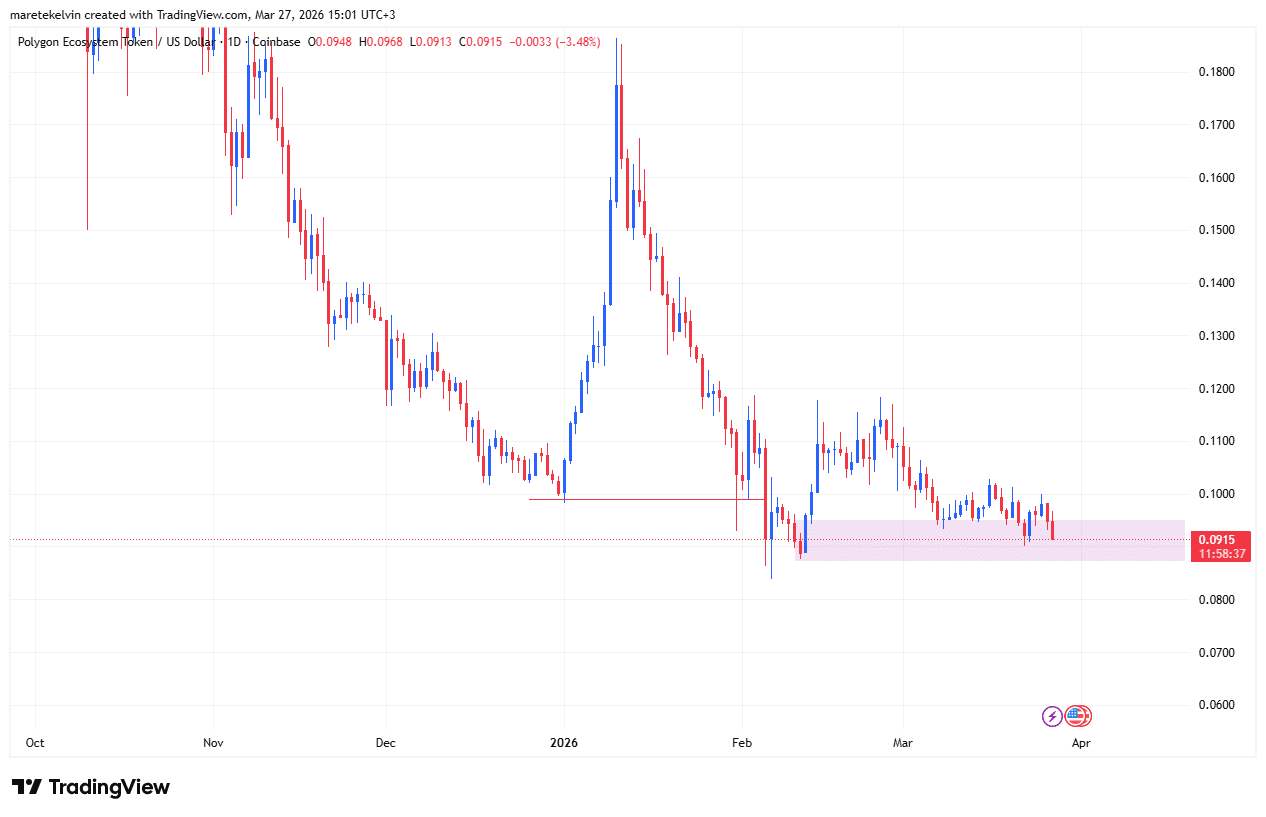
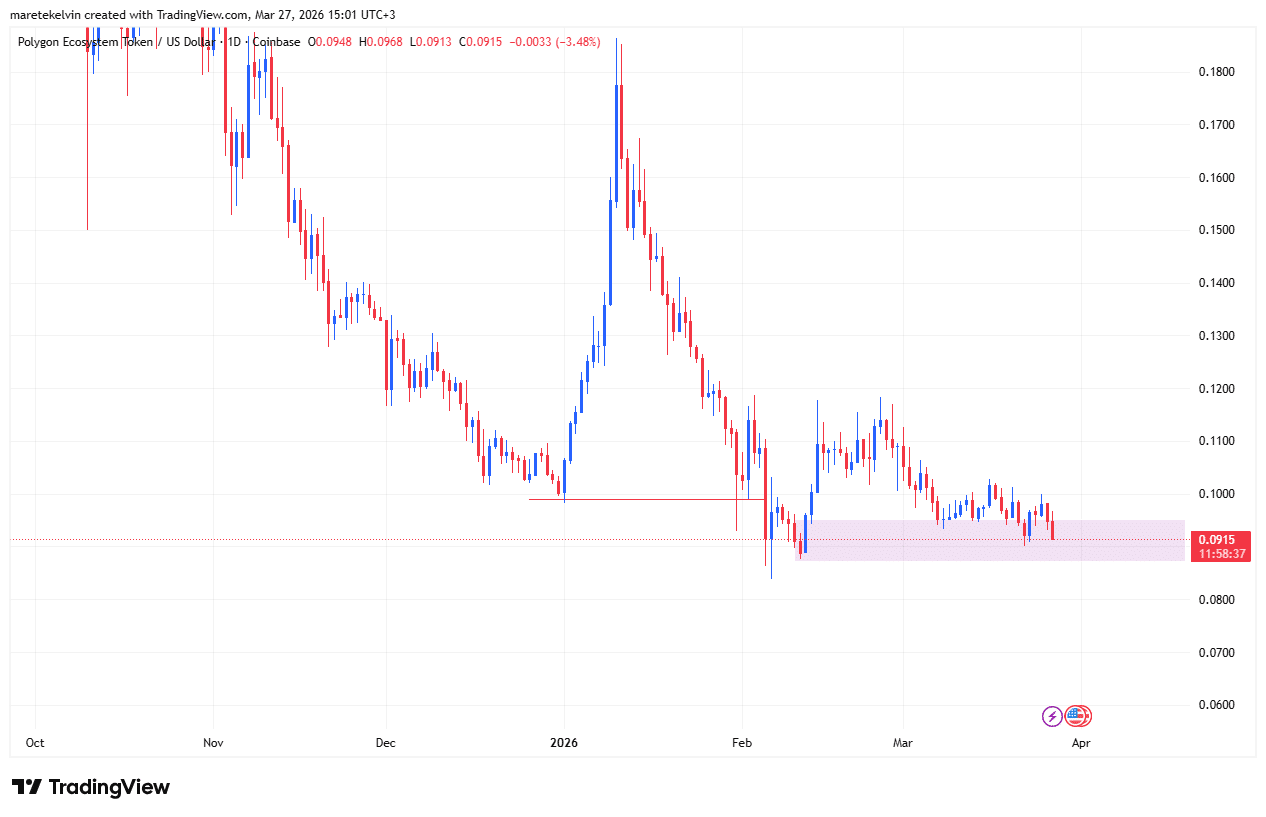
On the daily chart, POL seemed to be gaining some traction at press time. This, despite the fact that the token’s prices have been consolidating over the last few weeks.

If the network keeps recording these significant gains, the altcoin’s prices could usher in a potential breakout as long as the demand zone at around $0.095 holds.

Source: TradingView

Final Summary

  • Blockchain rails like Polygon are proving significantly cheaper and faster than traditional cross-border systems at institutional scale.
  • Revolut’s $1.2B volume signals a structural shift towards stablecoin-powered global payments, rather than a temporary trend.

Связанные с этим вопросы

QWhat major milestone did Revolut achieve on the Polygon network?

ARevolut processed over $1.2 billion in stablecoin transfers on the Polygon network, reflecting real user activity.

QHow do transaction costs on Polygon compare to traditional systems like SWIFT?

APolygon transactions cost fractions of a cent, significantly cheaper than traditional systems. For example, Revolut processed $1.2 billion for less than $700 in total fees, while traditional cross-border transfers average around 6.49% in fees.

QWhat are the advantages of using Polygon for cross-border transfers compared to traditional banking networks?

APolygon-based transfers settle in seconds, eliminate intermediaries, offer 1:1 stablecoin conversions with no hidden FX spreads, and are much cheaper than traditional systems like SWIFT, which can take 1-5 business days and involve multiple intermediaries.

QWhat does Revolut's $1.2 billion volume on Polygon indicate about institutional adoption of blockchain?

AIt signals a structural shift towards stablecoin-powered global payments, showing that institutions are no longer just experimenting with blockchain but are deploying it at scale for faster and cheaper transactions.

QHow has Polygon's network token (POL) been performing according to the article?

AAt the time of writing, POL was gaining some traction despite consolidating over the previous weeks. If network adoption continues, the token's price could potentially break out as long as the demand zone around $0.095 holds.

Похожее

Humanity Loses $31 Million in Attack, Token Price Plummets 90% Due to a Single Private Key

On June 9th, the digital identity project Humanity Protocol suffered a major security breach resulting in over $31 million in losses. According to on-chain analyst Specter, hundreds of wallets holding the project's H token were drained. The attack was confirmed by founder Terence Kwok to be caused by the compromise of a foundation member's private key. As a precaution, users are advised to avoid interacting with Humanity's cross-chain bridge or liquidity pools. The incident caused the H token price to crash over 90%, from around $0.70 to a low of $0.052, wiping its market cap from $2 billion to approximately $35.7 million. The attacker allegedly minted 100 million new H tokens and is selling them for BNB. This breach adds to existing controversies surrounding Humanity Protocol. Founded in 2024, it aimed to verify human users via palm-print biometrics and zero-knowledge proofs. However, a leaked conversation in 2025 revealed that only about 1 million of its 9 million claimed Human IDs had completed biometric verification, suggesting 88% might be bots. Furthermore, the project has faced allegations of being a repackaged product from a Chinese access control vendor, raising privacy and authenticity concerns. Founder Terence Kwok's previous venture, Tink Labs, a hotel smartphone startup that raised $170 million, failed and entered bankruptcy in 2020 after burning through its funding. The current attack highlights the persistent critical issue of private key management in crypto. Unlike smart contract exploits, a private key compromise bypasses all on-chain security mechanisms. With no user compensation plan announced yet, this $31 million breach may be a final blow to the project's credibility, already weakened by previous controversies and a heavily depreciated token.

marsbit11 мин. назад

Humanity Loses $31 Million in Attack, Token Price Plummets 90% Due to a Single Private Key

marsbit11 мин. назад

MicroStrategy Will Not Die in This Downturn: Reflexivity, STRC Anchoring Back to Par, and the Self-Rescue Logic of "Sell Stock, Not Bitcoin"

This article analyzes the recent sharp decline in Bitcoin and MicroStrategy (MSTR), framing it as a targeted "reflexivity" attack. The trigger was MSTR using its cash reserves to buy back convertible notes, raising market concerns about a liquidity crisis. The playbook follows George Soros's principle: market expectations can shape reality. Fears that MSTR might be forced to sell BTC caused panic selling, lowering BTC's price and worsening MSTR's financial ratios, thus reinforcing the negative narrative. The author argues that MSTR's Structured Convertible (STRC), while falling in price, is a floating-rate security that will eventually return to par value (100). The price drop reflects the market demanding a higher yield due to perceived risk, but as a floating-rate instrument, its coupon can adjust, naturally pulling the price back to par over time. This is crucial for MSTR's continued ability to raise funds. The core thesis is that MSTR's best move to counter the attack is to **issue new equity (sell shares)**, not sell its Bitcoin holdings. While selling BTC would solve the immediate cash crunch, it would destroy the company's core investment thesis and premium. It would dilute the BTC per share, likely erase the market premium over its net asset value (mNAV > 1), and worsen its debt-to-asset ratio. Issuing shares while mNAV is high (e.g., 1.25x) allows MSTR to raise cash for reserves without harming shareholder value or the "perpetual accumulation" narrative. It improves the debt ratio and reassures STRC holders, breaking the negative reflexivity cycle. In conclusion, while MSTR could survive this episode even by selling BTC, doing so would fundamentally alter its investment proposition and weaken it for future cycles. The optimal, value-preserving strategy is to sell equity to rebuild reserves and maintain the long-term growth flywheel.

marsbit11 мин. назад

MicroStrategy Will Not Die in This Downturn: Reflexivity, STRC Anchoring Back to Par, and the Self-Rescue Logic of "Sell Stock, Not Bitcoin"

marsbit11 мин. назад

Humanity Loses $31 Million, a Private Key Causes Token Price to Plunge 90%

On June 9th, the digital identity project Humanity Protocol suffered a major security breach resulting in over $31 million stolen from hundreds of wallets holding its H token. The attack was caused by the compromise of a private key belonging to a foundation member, leading the team to advise users against interacting with its bridge or liquidity pools. Following the incident, the price of the H token plummeted by over 90%, from around $0.70 to a low of $0.052, wiping out a significant portion of its market capitalization. The attacker allegedly minted 100 million new H tokens and began selling them for BNB. Humanity Protocol, founded in 2024, aimed to verify human users through palm-print biometrics and zero-knowledge proofs on Polygon CDK. Despite raising $50 million across two funding rounds and achieving a unicorn valuation, the project faced prior controversies. Shortly after its June 2025 token launch, reports emerged that only about 1 million of its 9 million registered IDs had completed biometric verification, suggesting 88% might be bots. Furthermore, allegations surfaced that the project might be a rebranded "shell" of a Chinese access control company, raising concerns about data privacy and authenticity. The project's founder, Terence Kwok, has a controversial business history. His previous venture, Tink Labs, burned through $170 million in funding before collapsing in 2020. The breach highlights the persistent critical risk of private key management in crypto. With no user compensation plan detailed in the initial response, the incident deals a severe blow to trust in a project already struggling with credibility issues.

Foresight News33 мин. назад

Humanity Loses $31 Million, a Private Key Causes Token Price to Plunge 90%

Foresight News33 мин. назад

How to Conduct Deep Research Using Claude's Dynamic Workflows

The article "How to Use Claude's Dynamic Workflows for Deep Research" discusses overcoming the pitfalls of technical research, where both humans and AI can get overwhelmed by information, leading to vague conclusions. It introduces Claude Code's new "Dynamic Workflows" feature, which automatically designs and executes task-specific workflows before starting a task, unlike simpler "planning modes." This approach incorporates validation, result convergence, and adversarial verification from the outset. The core of Dynamic Workflows is six predefined scheduling patterns that address how to decompose tasks and synthesize results: 1. **Classify-and-Act (Routing):** An agent classifies the task and routes it to the most suitable specialist agent for execution. It's precise and efficient but struggles with ambiguous tasks. 2. **Fan-out & Merge:** The task is split into parallel, independent subtasks whose results are later merged. It's fast and isolates contexts but is more expensive and challenging to synthesize. 3. **Adversarial Verification:** Multiple "challenger" agents critique a worker agent's conclusion, requiring majority approval. This counters confirmation bias and self-assessment errors but relies on verifiable facts. 4. **Generate & Filter:** Multiple agents generate many candidate solutions, which are then filtered against a rubric to output only the best. It fosters diversity but depends heavily on the filter's quality. 5. **Tournament:** Multiple agents compete on the same task, with pairwise comparisons eliminating contestants over rounds to select the best. This offers stable relative judgment but is complex. 6. **Loop:** An agent iteratively attempts a task, learning from errors and adjusting until a stop condition is met. It handles tasks with unknown scope but risks infinite loops without proper design. The author compares their own custom deep-research system, which involved multi-agent analysis and deduplication but lacked goal-oriented convergence, to Claude's built-in workflow. The official workflow adds critical layers: initial problem decomposition, credibility assessment of sources, cross-agent voting to delete weak conclusions (not just averaging), and output tightly focused on the user's original goals and actionable recommendations. This structurally addresses common AI issues like goal drift, premature stopping, context pollution, and output bias. In summary, Dynamic Workflows represent a shift from smarter single conversations to a structured research process, compressing what used to require many dialogues into 3-4 interactions, albeit at higher token cost. The author notes remaining challenges for their specific domain (blockchain research): the need for fact-based verification over official documentation, depth in truly novel interdisciplinary thinking, the practical validation of proposed solutions, and tailoring information density to the audience.

marsbit43 мин. назад

How to Conduct Deep Research Using Claude's Dynamic Workflows

marsbit43 мин. назад

When LPs Teach Me Investment with Doubao: A Self-Narrative of a Private Equity GP Switching Careers

When LPs Use Doubao to Teach Investing: A Transition Story of a Private Equity GP AI is making life increasingly difficult for small private equity fund managers, as a former GP of an offshore dollar fund reveals. The fund, managing tens of millions in US stocks, outperformed the Nasdaq but struggled with fundraising. Its traditional Cayman SPC/BVI structure failed to attract major Asian LPs, who now prefer Hong Kong LPF or Singapore VCC frameworks. The rise of AI-powered quantitative strategies has further squeezed the space for funds like his, which relied on subjective, discretionary investing. AI tools have leveled the information playing field, empowering LPs—often high-net-worth individuals, entrepreneurs, or family offices—to analyze investments themselves using chatbots like Doubao. This has eroded trust in GPs' expertise, leading to more frequent challenges over investment decisions and even withdrawals, especially during market rallies when retail investors sometimes outperform funds. Friction arises not necessarily from AI's capabilities but from how LPs use it. Many rely on conversational AI for validation rather than rigorous analysis, sometimes receiving misleading or hallucinated advice. While AI democratizes research, effective investing still requires discerning real insight from plausible-sounding output. Ultimately, AI is unlikely to fully replace GPs. Asset management remains a trust-based service. However, the industry must adapt. The future may see "human私募" (private equity) learning from AI and focusing more on providing value beyond pure analysis—perhaps by mastering the emotional intelligence and trust-building that machines cannot replicate.

Odaily星球日报1 ч. назад

When LPs Teach Me Investment with Doubao: A Self-Narrative of a Private Equity GP Switching Careers

Odaily星球日报1 ч. назад

Торговля

Спот
Фьючерсы
活动图片