AI Within the Range of Artillery

marsbitОпубликовано 2026-03-03Обновлено 2026-03-03

Введение

"AI in the Range of Cannons" discusses the vulnerability of AI infrastructure in the context of modern warfare, triggered by a real-world incident. On March 1, an Iranian missile struck an Amazon data center in the UAE, causing a fire, power outage, and disruption of about 60 cloud services. This led to a global outage of Claude, a major AI service running on Amazon's cloud. Although officially attributed to surging user demand, the incident is linked to a U.S.-Israel airstrike on Iran that used Claude for intelligence analysis, despite a recent U.S. ban on Anthropic (Claude's developer) for refusing unrestricted military use. The article highlights that this marks the first physical destruction of a commercial data center in war, emphasizing that AI, though virtual, relies on physical infrastructure located in geopolitically unstable regions like the Middle East. Silicon Valley has heavily invested in AI infrastructure in the Gulf due to cheap electricity, wealthy sovereign funds, and data localization laws, with projects from Amazon, Microsoft, and OpenAI. However, security frameworks like the Pax Silica agreement focus on chip controls and political alignment, ignoring physical security risks. The piece raises critical questions: When data centers serve both civilian and military purposes, are they legitimate targets? International law lacks clarity. The incident shifts focus from AI replacing jobs to its fragility—over 1,300 large data centers worldwide are protecte...

Author: David, Deep Tide TechFlow

On March 1, Iranian missiles and drones struck the Gulf region, with one landing on an Amazon data center in the UAE.

The data center caught fire, lost power, and approximately 60 cloud services were interrupted.

Claude, one of the world's most widely used AIs, runs on Amazon's cloud. On the same day, Claude experienced a global outage.

Anthropic's official statement was that a surge in users overwhelmed the servers.

As of the time of writing, complaints about Claude's service being unavailable are still circulating on social media; the well-known prediction market Polymarket has already launched a prediction topic: "How many more times will Claude be down in March?".
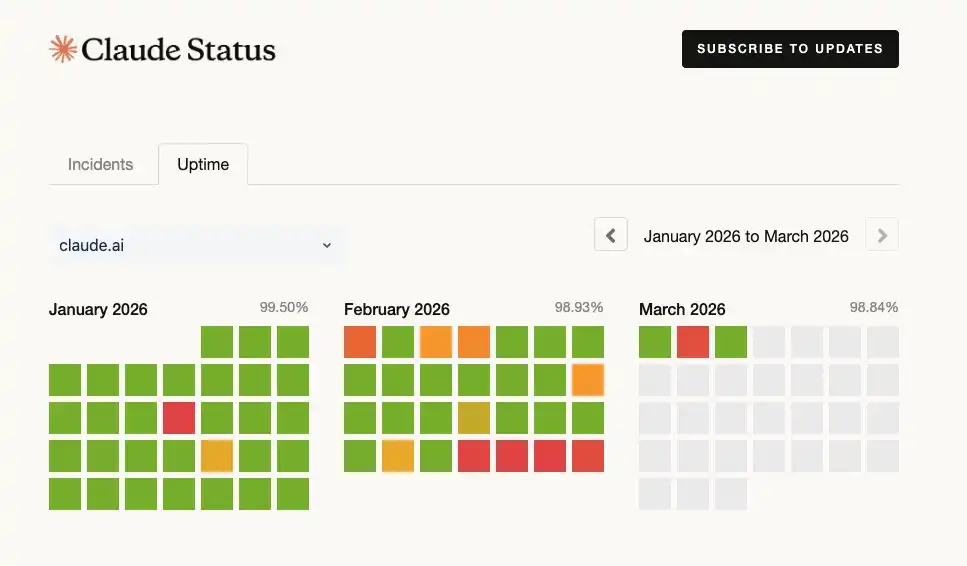
If it is ultimately confirmed that Iran was responsible, this would be the first time in human history:

A commercial data center was physically destroyed in war.

But why would a civilian data center be bombed?

Rewind two days. On February 28, the US and Israel jointly launched an airstrike on Iran, killing Supreme Leader Khamenei and a number of senior officials.

A significant portion of the intelligence analysis, target identification, and battlefield simulation for this airstrike was done with the help of Claude. Through cooperation between the military and data analytics company Palantir, Claude had long been integrated into the US military's intelligence system.

Ironically, just hours before the airstrike, Trump ordered a comprehensive ban on Anthropic because Anthropic refused to hand over its AI to the Pentagon without restrictions. But despite the ban, the war had to be fought.

Publicly, it was said that it would take at least six months to remove Claude from the military system.

So before the ink on the ban was dry, the US military took Claude to bomb Iran. Then Iran retaliated, and a missile landed on the data center running Claude AI.
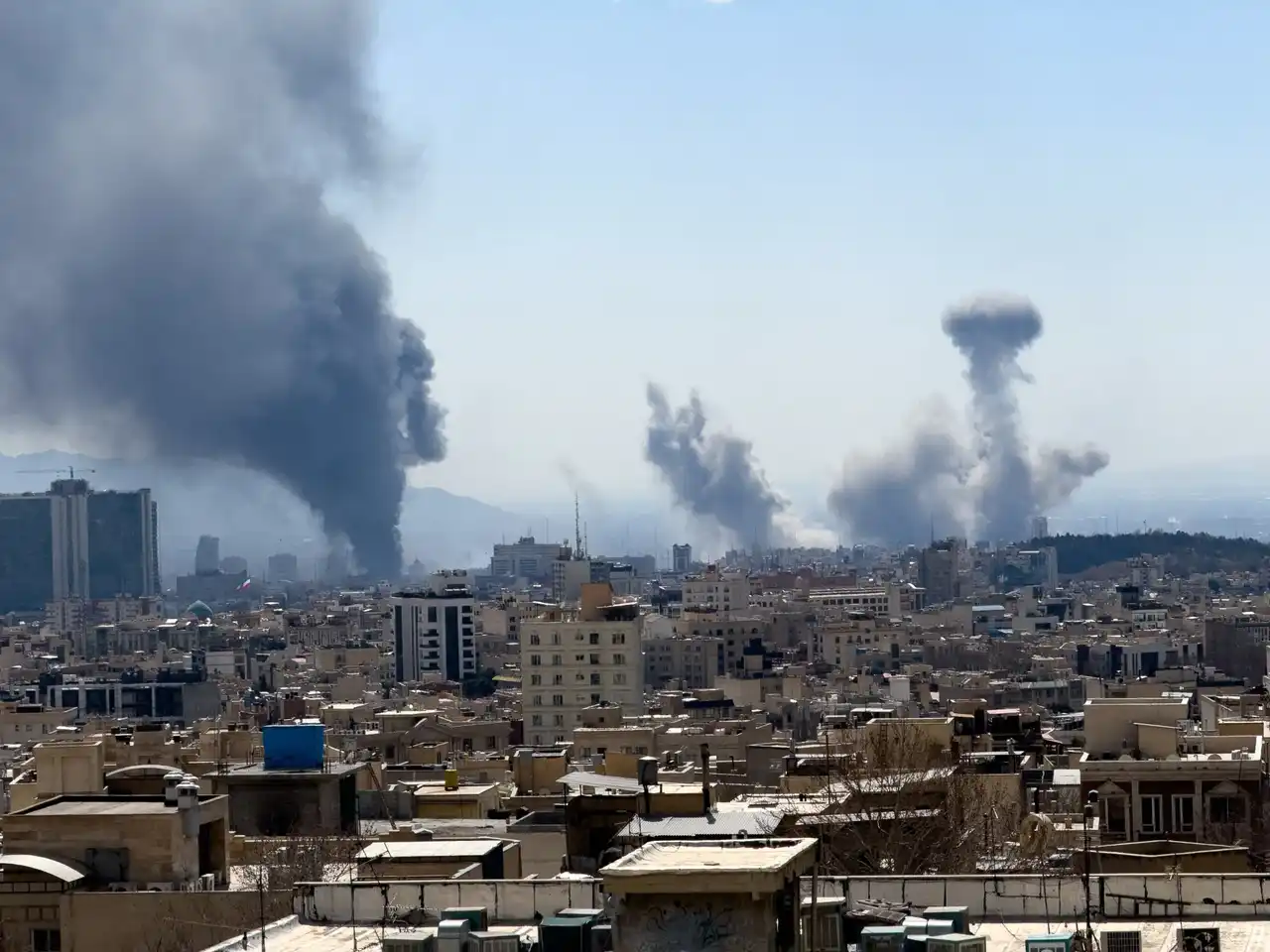
Image source: Bloomberg

The data center was most likely not targeted, merely caught in the crossfire. But regardless of whether the missile was aimed at the data center or not, one thing is certain:

Truth is within the range of the cannon, and AI is within the range of artillery. This applies to both the side firing the artillery and the side being shelled.

The Great AI Infrastructure, Built on the Middle East Powder Keg

Over the past three years, Silicon Valley has moved half of the AI industry to the Middle East Gulf.

The reason is simple. The UAE and Saudi Arabia have the world's wealthiest sovereign wealth funds, cheap electricity, and one regulation:

If you want to serve my customers, the data must be stored in my territory.

So Amazon opened data centers in the UAE and Bahrain each, and invested $5.3 billion in Saudi Arabia to build another; Microsoft has nodes in the UAE and Qatar, and its Saudi facility is also ready.

OpenAI, in collaboration with Nvidia and SoftBank, is building a $30 billion+ AI park in the UAE, touted as the largest computing base outside the US mainland.

In January this year, the US just signed an agreement with the UAE and Qatar called "Pax Silica". Translated, it means "Silicon Peace", which sounds beautiful.

The core content of the agreement is to control the flow of chips, ensuring that advanced chips do not fall into Chinese hands.

In exchange, the UAE obtained a license to import hundreds of thousands of Nvidia's most advanced processors annually. Abu Dhabi's G42 cut ties with Huawei, Saudi AI companies promised not to buy Huawei equipment...

The entire Gulf's AI infrastructure, from chips to data centers to models, has comprehensively leaned towards the US.

These agreements considered everything, from chip export controls, data sovereignty, investment reciprocity, to technology leakage risks.

But none considered that someone would use a missile to bomb a data center.

An international security scholar at Qatar University said something quite fitting after seeing the Amazon data center fire:

"These security frameworks were designed for supply chain control and political alignment; physical security was never on the agenda."

Cloud computing has been telling a story for ten years about elasticity, redundancy, and decentralization. But data centers are buildings with addresses, with walls, roofs, and coordinates. No matter how advanced your chips are, if the data center is bombed, it's bombed.

"Cloud" is a metaphor; data centers are not.

AI seems virtual, running in code, floating in the cloud. But code runs on chips, chips are installed in data centers, and data centers are built on Earth.

Who Protects AI?

This Amazon data center can be said to have been affected, or optimistically, collateral damage.

But what about next time?

In the context of escalating global geopolitical conflicts, if your data center is running AI models that help an opponent with target identification, the opponent has every reason to treat your data center as a military facility to strike.

International law has no answer to this question either.

Existing laws of war have provisions for "dual-use facilities," but those clauses were written for factories and bridges; no one thought about data centers.

Is a data center that helps banks process transactions during the day and runs intelligence analysis for the military at night considered civilian or military?

In peacetime, data center选址 considers latency, electricity prices, policy incentives... When war comes, none of this matters. What matters is how far your data center is from the nearest military base.

So, this bombing has started to shift everyone's attention.

Previously, everyone was discussing the same anxiety: will AI replace my job? But no one discussed another question:

Before AI replaces you, how vulnerable is it itself?

A regional conflict paralyzed the Middle East node of the world's largest cloud service provider for a full day; and this was just one data center.

There are now nearly 1,300 hyperscale data centers worldwide, with another 770 under construction. These centers are consuming more and more electricity, water, and money, and承载着越来越多的事物——your deposits, your medical records, your food delivery orders, even a country's military intelligence...

But the方案 for protecting these data centers, to this day, is probably still fire suppression systems and backup generators.

When AI becomes a country's infrastructure, its security is no longer the responsibility of a single company. Who protects AI? Cloud providers? The US Pentagon? Or the UAE's air defense system?

This question was theoretical three days ago. Not anymore.

AI is within the range of artillery. Actually, it's not just AI. In this era, what isn't within the range of artillery?


Связанные с этим вопросы

QWhat was the significance of the missile strike on Amazon's data center in the UAE on March 1st?

AIt was potentially the first time in history that a commercial data center was physically destroyed in a war, marking a new reality where digital infrastructure is vulnerable to physical conflict.

QWhy was the Claude AI service disrupted globally on the same day?

AThe official reason from Anthropic was a surge in users overwhelming its servers, but the disruption coincided with the missile strike on the Amazon data center in the UAE, where Claude's servers were hosted, suggesting a possible connection.

QWhat geopolitical agreement, signed in January, is mentioned as a reason for the concentration of AI infrastructure in the Middle East?

AThe 'Pax Silica' (Silicon Peace) agreement, where the U.S. secured commitments from the UAE and Qatar to control chip flows and prevent advanced chips from reaching China, in exchange for access to advanced Nvidia processors.

QAccording to the article, what critical consideration was missing from the security frameworks and agreements governing AI infrastructure in the region?

APhysical security. The frameworks were designed for supply chain control and political alignment, but they completely overlooked the risk of physical attacks, such as a missile strike on a data center.

QWhat new question does the article suggest we should be asking about AI, beyond the fear of it taking our jobs?

AHow vulnerable is AI itself? The incident demonstrates that the global AI infrastructure is fragile and can be disrupted by regional conflicts, raising the question of who is responsible for protecting it.

Похожее

How Many Tokens Away Is Yang Zhilin from the 'Moon Chasing the Light'?

The article explores the intense competition between two leading Chinese AI companies, DeepSeek and Kimi (Moon Dark Side), and the mounting pressure on Yang Zhilin, the founder of Kimi. While DeepSeek re-emerged after 15 months of silence with its powerful V4 model—boasting 1.6 trillion parameters and low-cost, long-context capabilities—Kimi has been focusing on long-context processing and multi-agent systems with its K2.6 model. Yang faces a threefold challenge: technological rivalry, commercialization pressure, and investor expectations. Despite Kimi’s high valuation (reaching $18 billion), its revenue heavily relies on a single product with low paid conversion rates, while DeepSeek’s strategic silence and open-source influence have strengthened its market position and valuation prospects, now targeting over $20 billion. Both companies reflect broader trends in China’s AI ecosystem: Kimi aims for global influence through open-source contributions and agent-based advancements, while DeepSeek prioritizes foundational innovation and hardware independence, notably shifting to Huawei’s chips. Their competition is seen as vital for China’s AI progress, with the gap between top Chinese and U.S. models narrowing to just 2.7% on the Elo rating scale. Ultimately, the article argues that this rivalry, though anxiety-inducing for leaders like Zhilin, is essential for driving innovation and solidifying China’s role in the global AI landscape.

marsbit6 ч. назад

How Many Tokens Away Is Yang Zhilin from the 'Moon Chasing the Light'?

marsbit6 ч. назад

TechFlow Intelligence Bureau: ChatGPT Helps Amateur Mathematician Crack 60-Year-Old Problem, CFTC Sues New York Regulator Over Coinbase and Gemini

An amateur mathematician, with the assistance of ChatGPT, has solved a combinatorial mathematics puzzle originally proposed by Hungarian mathematician Paul Erdős in the 1960s. This marks another milestone in AI-aided mathematical research, demonstrating the evolving capabilities of large language models in formal reasoning. In other AI developments, OpenAI introduced a new privacy filter tool for enterprise API usage, automatically screening sensitive data. Meanwhile, the Qwen3.6-27B model achieved 100 tokens per second on a single RTX 5090 GPU using quantization, significantly lowering the cost barrier for local AI deployment. In crypto and Web3, the U.S. CFTC sued New York’s financial regulator, challenging its oversight of Coinbase and Gemini—a first-of-its-kind federal-state regulatory clash. Following a vulnerability, KelpDAO and major DeFi protocols established a recovery fund. Tether froze $344 million in assets linked to Iran’s central bank upon U.S. Treasury request, highlighting the centralized control risks in stablecoins. Separately, Litecoin underwent a 3-hour chain reorganization to undo a privacy-layer exploit. In the U.S., former President Trump invoked the Defense Production Act to address power grid bottlenecks affecting AI data centers and dismissed the entire National Science Board, raising concerns over research independence. A retail trader gained 250% on a $600k Intel options bet amid AI-related speculation. Xiaomi announced its first performance electric vehicle, targeting rivals like Tesla. Meanwhile, iPhone users reported devices automatically reinstalling a hidden app daily, suspected to be MDM-related. A Chinese securities report noted that A-share institutional crowding has reached its second-longest streak since 2007, signaling high valuations and potential style rotation. The day’s developments reflect a dual narrative: AI is enabling unprecedented individual breakthroughs, while centralized power structures—whether governmental or corporate—are becoming more assertive, underscoring that decentralization is as much a political-economic challenge as a technical one.

marsbit6 ч. назад

TechFlow Intelligence Bureau: ChatGPT Helps Amateur Mathematician Crack 60-Year-Old Problem, CFTC Sues New York Regulator Over Coinbase and Gemini

marsbit6 ч. назад

Торговля

Спот
Фьючерсы

Популярные статьи

Неделя обучения по популярным токенам (2): 2026 может стать годом приложений реального времени, сектор AI продолжает оставаться в тренде

2025 год — год институциональных инвесторов, в будущем он будет доминировать в приложениях реального времени.

1.8k просмотров всегоОпубликовано 2025.12.16Обновлено 2025.12.16

Неделя обучения по популярным токенам (2): 2026 может стать годом приложений реального времени, сектор AI продолжает оставаться в тренде

Обсуждения

Добро пожаловать в Сообщество HTX. Здесь вы сможете быть в курсе последних новостей о развитии платформы и получить доступ к профессиональной аналитической информации о рынке. Мнения пользователей о цене на AI (AI) представлены ниже.

活动图片