AI Read '1984' and Decided to Ban It

marsbitОпубликовано 2026-03-27Обновлено 2026-03-27

Введение

A UK secondary school in Manchester used AI to review its library, resulting in a list of 193 books recommended for removal—including George Orwell’s *1984*—due to themes like torture, violence, and sexual coercion. The librarian who resisted the AI’s recommendations was forced to resign after the school reported her for violating child safety procedures. The school later admitted the decisions were AI-generated but deemed them “broadly accurate.” In the same week, Wikipedia voted to ban the use of AI for generating or rewriting content, citing concerns over factual accuracy, the risk of AI “poisoning” its own training data, and the inability of human editors to verify AI-generated content at scale. Meanwhile, OpenAI indefinitely delayed the release of an “adult mode” for ChatGPT, which would have allowed age-verified users to engage in erotic conversations. Internal advisors warned of risks including unhealthy emotional dependency and minors bypassing verification. These events highlight a growing tension: AI can produce content faster than humans can evaluate it, leading institutions to adopt quick—often poorly considered—solutions. The lack of coherent global standards and the widening gap between AI output and human oversight raise urgent questions about who should control what AI decides—and who is accountable when it gets it wrong.

Author: Curry, Deep Tide TechFlow

Last week, a secondary school in Manchester, UK, used AI to review its library.

AI generated a list of 193 books to be removed, each with a reason. George Orwell's "1984" was prominently included, with the reason being "contains themes of torture, violence, and sexual coercion."

"1984" depicts a world where the government monitors everything, rewrites history, and decides what citizens can and cannot see. Now, AI has done the same for a school, and it may not even understand what it is saying.

The school librarian found it unreasonable and refused to fully implement the recommendations given by AI.

The school then launched an internal investigation against her on the grounds of "child safety," accusing her of introducing inappropriate books to the library and reported her to the local government. She took sick leave due to pressure and eventually resigned.

Absurdly, the local government's investigation concluded that she had indeed violated child safety procedures, and the complaint was upheld.

Caroline Roche, chair of the UK School Library Association, said this conclusion means she can no longer work in any school.

The person who resisted AI's judgment lost her job, while those who signed off on AI's judgment faced no consequences.

Subsequently, the school admitted in internal documents that all classifications and reasons were generated by AI, stating: "Although the classification was generated by AI, we believe it is generally accurate."

A school handed over the judgment of "what books are suitable for students" to AI. AI returned an answer it did not understand, and a human administrator stamped it without even looking closely.

After this incident was exposed by the UK free speech organization Index on Censorship, the issues raised extended far beyond a school's bookshelf:

When AI starts deciding for humans what content is appropriate and what is dangerous, who judges whether AI's judgment is correct?

Wikipedia Closes Its Doors to AI

In the same week, another institution answered this question with action.

While the school let AI decide what people can read, the world's largest online encyclopedia, Wikipedia, made the opposite choice: not letting AI decide what the encyclopedia writes.

In the same week, English Wikipedia formally passed a new policy prohibiting the use of large language models to generate or rewrite entry content. The vote was 44 in favor and 2 against.

The direct cause was an AI account called TomWikiAssist. In early March this year, this account autonomously created and edited multiple entries on Wikipedia, which were urgently addressed after being discovered by the community.

It takes AI only a few seconds to write an entry, but volunteers spend hours verifying the facts, sources, and wording of an AI-generated entry for accuracy.
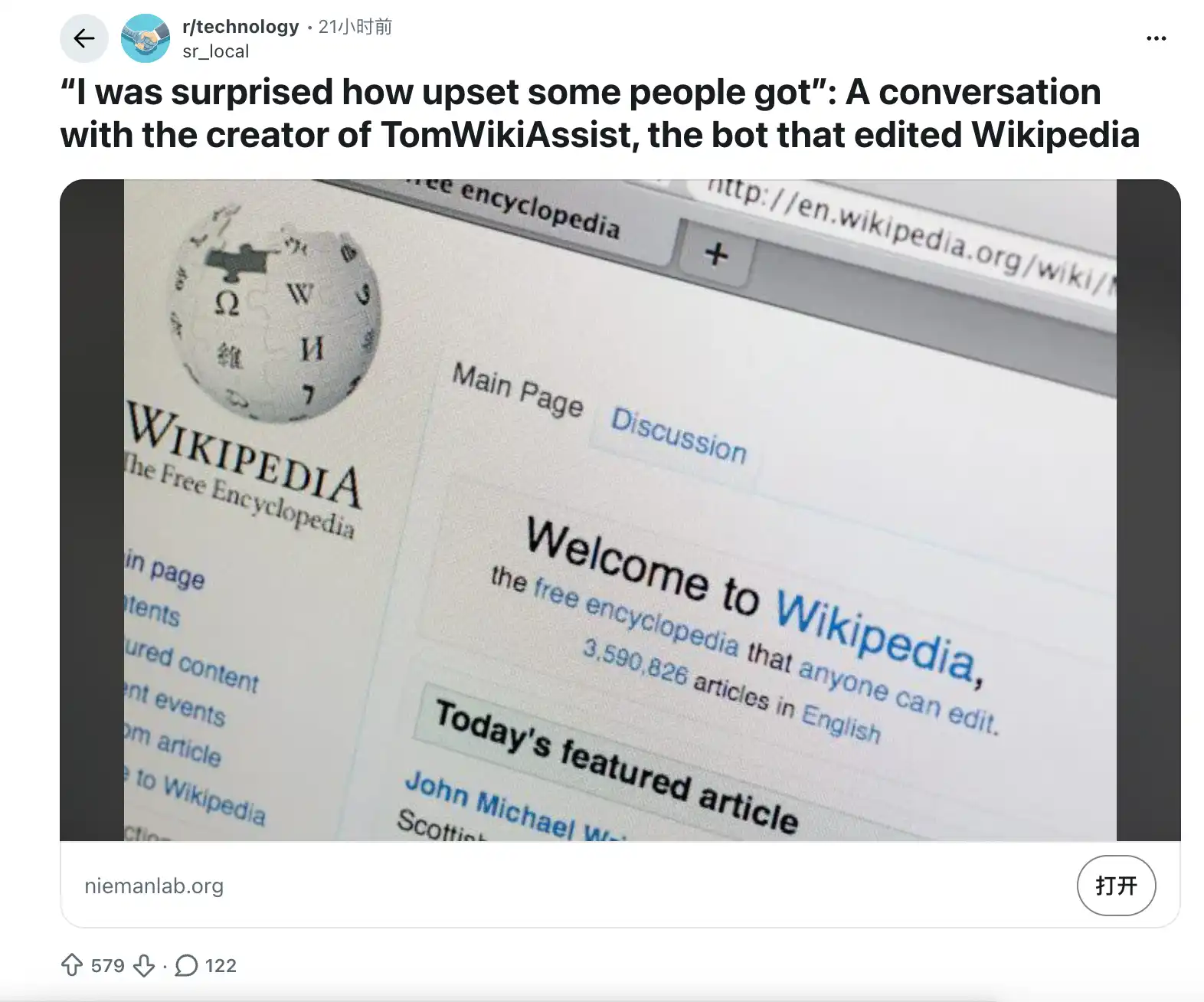
The Wikipedia editing community has only so many people. If AI can mass-produce content indefinitely, human editors simply cannot review it all.

This is not even the most troublesome part. Wikipedia is one of the most important training data sources for global AI models. AI learns knowledge from Wikipedia and then uses what it has learned to write new Wikipedia entries, which are then ingested by the next generation of AI models for further training.

Once AI-generated misinformation mixes in, it will continuously amplified in this cycle, becoming a matryoshka doll-style AI poisoning:

AI pollutes training data, and training data pollutes AI.

However, Wikipedia's policy also leaves two openings for AI: editors can use AI to polish their own writing or use AI to assist with translation. But the policy specifically warns that AI may "go beyond your request, change the meaning of the text, and make it inconsistent with the cited sources."

Human writers make mistakes, and Wikipedia has relied on community collaboration to correct them for over twenty years. AI makes mistakes differently; it fabricates things that look more real than the truth and can be produced in bulk.

A school trusted AI's judgment and lost a librarian. Wikipedia chose not to trust and simply closed the door.

But what if even the creators of AI are starting to lose faith?

The Creators of AI Are Themselves Afraid

While external institutions are closing doors to AI, AI companies are also pulling back.

In the same week, OpenAI indefinitely shelved ChatGPT's "adult mode." This feature was originally planned for release last December, allowing age-verified adult users to engage in erotic conversations with ChatGPT.

CEO Sam Altman personally announced it last October, stating the goal was to "treat adult users like adults."

After being postponed three times, it was directly canceled.

According to the British "Financial Times," OpenAI's internal health advisory committee unanimously opposed this feature. The advisors' concerns were specific: users would develop unhealthy emotional dependencies on AI, and minors would inevitably find ways to bypass age verification.

One advisor put it more directly: without significant improvements, this thing could become a "sexy suicide coach."

The error rate of the age verification system exceeds 10%. Based on ChatGPT's weekly active user base of 800 million, 10% means tens of millions of people could be misclassified.

Adult mode is not the only product cut this month. AI video tool Sora and ChatGPT's built-in instant checkout feature were also taken offline around the same time. Altman said the company is focusing on its core business and cutting "side tasks."

But OpenAI is simultaneously preparing for an IPO.

A company sprinting towards an上市,密集 cutting functions that may cause controversy, this move might more accurately be called risk aversion than focus.

Five months ago, Altman was still saying to treat users like adults. Five months later, he found that his own company still hasn't figured out what AI can let users touch and what it cannot.

Even the creators of AI themselves have no answer. So who should draw this line?

The Uncatchable Speed Gap

Put these three things together, and it's easy to draw a core conclusion:

The speed at which AI produces content and the speed at which humans review content are no longer on the same scale.

The choice of that school in Manchester is easy to understand in this context. How long would it take for a librarian to read all 193 books and make a judgment? Let AI run through them: a few minutes.

The principal chose the few-minute solution. Do you really think he trusted AI's judgment? I think it's more because he didn't want to spend the time.

This is an economic problem. The cost of generation approaches zero, while the cost of review is entirely borne by humans.

Therefore, every institution affected by AI is forced to respond in the most粗暴 way: Wikipedia直接禁止, OpenAI直接砍产品线. None of the solutions are the result of careful consideration; they are all stopgap measures implemented before there's time to think clearly.

"Block it first and talk later" is becoming the norm.

AI capabilities iterate every few months, while discussions about what content AI can touch don't even have a decent international framework. Each institution only manages the line in its own yard. The lines contradict each other, and no one coordinates them.

AI's speed is still accelerating. The number of reviewers won't increase. This scissors gap will only widen until one day something far more serious than banning "1984" happens.

By then, drawing lines might be too late.

Связанные с этим вопросы

QWhy was George Orwell's book '1984' banned by the AI in the Manchester school case?

AThe AI recommended banning '1984' due to its 'themes of torture, violence, and sexual coercion.'

QWhat was the consequence for the librarian who resisted the AI's book removal suggestions?

AThe librarian was subjected to an internal investigation, pressured into taking sick leave, and ultimately resigned. She was also reported to local authorities and deemed to have violated child safety procedures, effectively ending her career in schools.

QWhat action did Wikipedia take regarding AI-generated content, and why?

AWikipedia officially banned the use of large language models to generate or rewrite article content. This decision was made because AI can produce content rapidly, making it difficult for human volunteers to verify facts and sources, and it risks creating a feedback loop where AI pollutes its own training data.

QWhy did OpenAI decide to cancel its planned 'adult mode' for ChatGPT?

AOpenAI canceled the 'adult mode' due to concerns from its internal health advisory board, which warned about users developing unhealthy emotional dependencies on the AI and the risk of minors bypassing age verification. The error rate of the age verification system was also a significant factor.

QWhat is the core issue highlighted by the three events in the article regarding AI and content moderation?

AThe core issue is the significant speed disparity between AI's ability to generate content and humanity's capacity to审核 it. This creates a situation where institutions are forced to make hasty, often poorly considered decisions—such as outright bans or canceling features—because they lack the resources or time to properly evaluate AI's output, and there is no comprehensive international framework to guide these decisions.

Похожее

Stratosphere, Pudgy Penguins и Streamex провели VIP-ужин Founders Table во время ETHConf 2026 и NYC Tech Week

Нью-Йорк, 18 июня 2026 года, Chainwire. Стратосфера, Pudgy Penguins и Streamex провели закрытый VIP-ужин Founders Table в Нью-Йорке в рамках ETHConf 2026 и NYC Tech Week. Мероприятие собрало лидеров из сфер цифровых активов, технологий, ИИ, традиционных финансов и институционального капитала. Ужин состоялся 9 июня для отобранного круга основателей, операторов, фондов, топ-менеджеров и институциональных лидеров. Формат Founders Table предусматривает приватную атмосферу без формальной программы, чтобы способствовать естественному общению. Среди гостей были представители Citi, BitMine, BitGo, Mirae Asset Securities USA, Experian, Pyth Network и других компаний. Stratosphere предоставила сеть контактов, Pudgy Penguins — сильный потребительский бренд в цифровых активах, а Streamex — экспертизу в области токенизированных товарных рынков, таких как золото. Основатель Stratosphere Хассан Шейх отметил оптимизм относительно следующей фазы развития цифровых активов, особенно токенизации товаров. Серия ужинов Founders Table будет продолжена на других крупных конференциях, объединяя основателей, капитал и институции.

TheNewsCrypto1 ч. назад

Stratosphere, Pudgy Penguins и Streamex провели VIP-ужин Founders Table во время ETHConf 2026 и NYC Tech Week

TheNewsCrypto1 ч. назад

Панель ставок на Polymarket заработала благодаря коду, но Polymarket — не лучшее место для «арбитража»

В статье рассказывается о создании пользовательской панели мониторинга для платформы прогнозирования Polymarket, которая помогла автору достичь 30% доходности за несколько недель при стартовом капитале в $1600. Однако автор подчеркивает, что основная цель статьи — не продвижение Polymarket как источника легкой прибыли, а предупреждение о рисках и структурных ловушках этой платформы. Ключевые выводы автора: 1. **Polymarket — не место для арбитража.** Это рынок, где высока зависимость от интерпретации правил и информационного преимущества. Даже при высокой уверенности в исходе события всегда существует риск полной потери инвестиции в случае ошибки. 2. **Управление рисками и диверсификация важнее поиска «верных ставок».** * Автор внедрил систему классификации ставок по уровням уверенности (T1, T2, T3) с строгими лимитами на размер позиции для каждого уровня. * Важна **истинная диверсификация** по некоррелирующим темам (например, Восточная Азия, Ближний Восток, криптовалюты), а не просто участие во множестве рынков с общей базовой переменной. * Высокая вероятность успеха (например, 95%) не оправдывает крупную позицию, так как даже малая вероятность провала означает потерю 100% вложенных средств. 3. **Математическое ожидание и хвостовые риски.** Необходимо оценивать не только потенциальную доходность, но и разницу между личной оценкой вероятности и рыночной ценой, а также влияние потери всей позиции на общий портфель. 4. **Polymarket как тренировочный полигон.** Автор рассматривает платформу скорее как инструмент для тренировки аналитического мышления и дисциплины в условиях неопределенности, чем как источник стабильного дохода. В заключение, автор отмечает, что ценность созданной панели заключается не в подсчете прибыли, а в наложении строгих рамок управления капиталом и рисками на интуитивные решения, превращая разрозненные ставки в систематизированный процесс.

marsbit2 ч. назад

Панель ставок на Polymarket заработала благодаря коду, но Polymarket — не лучшее место для «арбитража»

marsbit2 ч. назад

Разбор роста Notion: от приложения для заметок до 100 миллионов пользователей — как Notion построил тройную маховик роста на основе продукта, шаблонов и сообщества

Notion — это уникальный пример роста SaaS-компании, который основан не на одной функции или агрессивном маркетинге, а на взаимосвязанной системе из трех «маховиков роста»: продукта, шаблонов и сообщества. Изначально Notion начинал как сложный инструмент для создания пользовательских рабочих пространств, но после перезапуска команда сосредоточилась на модульности и простоте. Это позволило превратить его в гибкую платформу, где пользователи могут комбинировать блоки для различных задач — от ведения заметок до управления проектами. Первый маховик — Product-Led Growth (PLG). Свободный план позволил быстро привлечь студентов, создателей и стартапы. Продукт обладает встроенными вирусными механиками: страницы и шаблоны легко делиться, а необходимость сотрудничества естественным образом приводит к приглашению новых пользователей. Второй маховик — экономика шаблонов. Высокая гибкость Notion может отпугнуть новичков. Шаблоны решают эту проблему, превращая абстрактные возможности в готовые решения для конкретных сценариев (планирование, учёба, управление контентом). Пользователи и создатели генерируют тысячи шаблонов, что расширяет экосистему, улучшает SEO и создаёт сообщество заинтересованных создателей. Третий маховик — сообщество. Пользователи делятся своими рабочими процессами, обучают других и формируют идентичность вокруг философии «лучших способов работы». Программа Ambassador помогает локализовать контент и проводить мероприятия по всему миру, превращая пользователей в активных евангелистов. Notion успешно перешёл от индивидуальных пользователей к корпоративному рынку благодаря стратегии «снизу вверх»: сотрудники сначала используют его неформально, а затем компании официально внедряют его для команд. В эпоху ИИ Notion интегрирует возможности искусственного интеллекта непосредственно в рабочие процессы (написание, суммирование, управление знаниями), что повышает ценность платформы и открывает новые сценарии использования. Секрет устойчивого роста Notion заключается не в отдельных функциях, а в целостной экосистеме, где продукт, пользовательский контент и сообщество взаимно усиливают друг друга, создавая значительные барьеры для конкурентов.

marsbit4 ч. назад

Разбор роста Notion: от приложения для заметок до 100 миллионов пользователей — как Notion построил тройную маховик роста на основе продукта, шаблонов и сообщества

marsbit4 ч. назад

Руководство по тестированию AI-карты WeChat: Наступила ли эпоха AI Shopping?

**Автор:** Alan | Команда Biteye **Дата:** 17 июня **Что это?** WeChat Pay представил «AI Special Card» — специальную карту для оплаты через ИИ-агентов, начиная с WorkBuddy. Это не отдельная карта, а изолированный «кошелёк» внутри WeChat Pay. Пользователи пополняют его с основного баланса, и платежи агентов списываются оттуда, а не с основных средств. **Как работает?** 1. Агент (например, WorkBuddy) инициирует платёж. 2. Пользователь сканирует QR-код для подтверждения в приложении WeChat. 3. Средства списываются с баланса AI-карты. 4. Основной счёт WeChat Pay не затрагивается. **Текущие возможности:** Платежи за цифровой контент, API, инструменты, подписки (хотя на практике найти такие сценарии сложно). **Тест: Заказ Bubble Tea через WorkBuddy (Неудача)** * WorkBuddy не может заказать напрямую, требуется вызов стороннего навыка (Skill), например, «Meituan Life Assistant». * Процесс требует авторизации в Meituan, что расходует много внутренних баллов WorkBuddy. * Агент успешно сгенерировал ссылку на оплату через AI Special Card, и платёж прошёл. * **Но:** Была куплена не та позиция (неправильный купон Meituan), а не конкретный напиток. **Вывод:** Проблема не в платежах, а в исполнении задачи агентом. AI Special Card решает только вопрос безопасного списания средств, но не гарантирует, что агент правильно поймёт запрос, выберет товар и выполнит заказ. Платёж остаётся под полным контролем пользователя. **Рекомендации:** Можно опробовать с небольшой суммой для цифровых услуг, но всегда проверяйте детали покупки перед подтверждением платежа.

marsbit4 ч. назад

Руководство по тестированию AI-карты WeChat: Наступила ли эпоха AI Shopping?

marsbit4 ч. назад

На 10 миллиардов долларов: Qualcomm покупает компанию легендарного инженера Jim Keller

По сообщениям, компания Qualcomm ведет переговоры о приобретении стартапа Tenstorrent, занимающегося разработкой ИИ-чипов, за 8-10 миллиардов долларов. Эта сделка может стать крупнейшим приобретением в области ИИ-чипов за последние годы. Tenstorrent, возглавляемый легендарным проектировщиком Джимом Келлером, известен своими разработками в области ускорителей ИИ и процессоров на архитектуре RISC-V. Для Qualcomm, чьи доходы сильно зависят от рынка смартфонов, эта покупка стала бы стратегическим шагом для диверсификации бизнеса, особенно в таких сферах, как центры обработки данных и облачные вычисления. Ключевым преимуществом Tenstorrent является его «анти-Nvidia» подход: компания использует более доступные компоненты, такие как GDDR6 и SRAM, вместо дорогой памяти HBM, а также стандартный Ethernet для соединения ускорителей. Это позволяет создавать высокопроизводительные вычислительные платформы по значительно более низкой цене. Кроме того, технология высокопроизводительных RISC-V CPU от Tenstorrent может предложить Qualcomm альтернативу архитектуре Arm, снизив зависимость от лицензионных соглашений. Разработки стартапа для автомобильного рынка (например, проект Alexandria) также хорошо сочетаются со стратегией Qualcomm в области автомобильных решений. Однако сделка вызывает вопросы из-за высокой оценки стартапа, рисков интеграции технологий и необходимости сохранения ключевой команды Tenstorrent. Аналитики предполагают, что оплата может быть частично привязана к будущим коммерческим успехам компании.

marsbit5 ч. назад

На 10 миллиардов долларов: Qualcomm покупает компанию легендарного инженера Jim Keller

marsbit5 ч. назад

Торговля

Спот
Фьючерсы
活动图片





