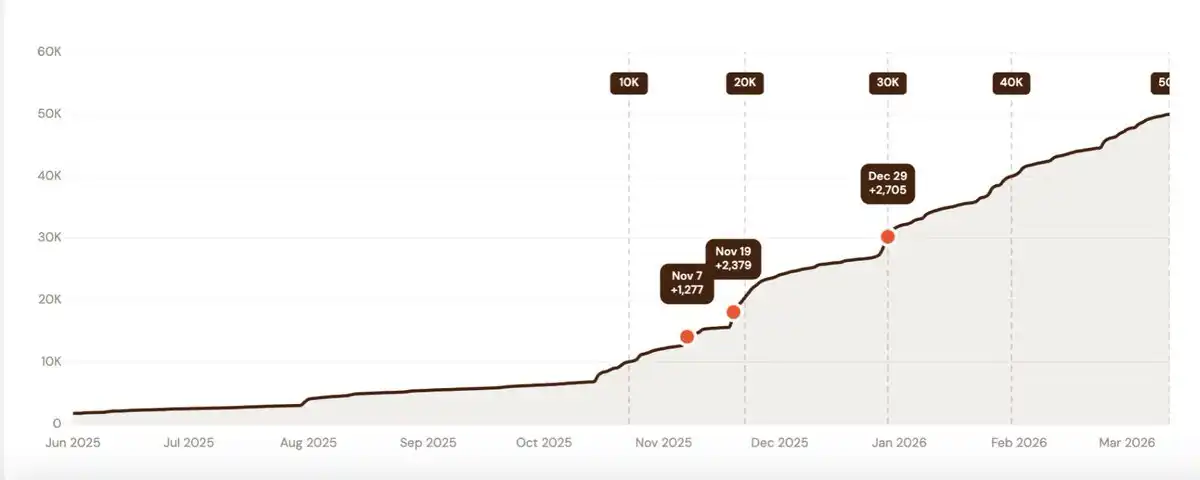
AI Influencer Zhang Zala's Secret to Gaining 50,000 Followers: Algorithm as Network, Beware of AI Alienation...

marsbitОпубликовано 2026-03-24Обновлено 2026-03-24

Введение

AI influencer Zhang Zala shares strategies for growing to 50k followers on X (formerly Twitter), emphasizing treating the platform as a "party" rather than a "stage." Key tactics include: curating the algorithm feed to prioritize high-quality AI and tech discussions; engaging authentically in replies without AI-generated responses; posting consistently (3+ times daily) through public learning, product feedback, and demo sharing; and avoiding AI-assisted writing until developing a unique voice. Underlying factors include her pre-existing Silicon Valley AI network and prior follower base from Chinese social platform Xiaohongshu. Authenticity and providing value are central to sustainable growth.

Author: zarazhangrui

Compiled by: XinGPT

Editor's Note: Before coming to X, Zhang Zala was already a famous AI blogger on Xiaohongshu, positioning herself with her Harvard undergraduate background and Silicon Valley AI company experience, known for creating vibe coding and product-related content.

The following is the full translated text: "

Most people fail to grow on X because they have the wrong mental model. They see X as a stage, thinking they need to step onto it and deliver a speech to an audience.

The correct mental model is: X is a party. When you walk into a party, you don't go to a corner and talk to yourself. You find a group of people already gathered, listen to what they are talking about, and then join their conversation.

This mental model is the foundation of all my growth strategies:

1. Curate Your Feed

Think of this step as "figuring out which parties to attend and which crowd you want to hang out with." If your feed is full of junk content and clickbait, you won't have inspiration to post, and you'll end up participating in the wrong conversations.

Before I started posting regularly, I spent about two weeks deliberately curating my X algorithm. Specifically, whenever I saw clickbait or topics I didn't care about, I clicked the three dots in the top right -> "Not interested." Whenever I saw deep, valuable content, I engaged with it by liking, retweeting, replying, or bookmarking. Over time, the algorithm learns to push more high-quality content to you. My X feed is now full of content about AI, new product launches, and various in-depth discussions—all things I genuinely want to engage with, both inspiring and educational.

2. Reply Sincerely

Do not use AI bots to batch reply for you. Let me say it again, do not use AI bots to batch reply for you.

Replying just for the sake of replying is meaningless. When I see replies under my posts that are clearly AI-generated and just parroting what I said, I actually feel offended. It feels extremely perfunctory, insincere, and lazy.

Going back to the party analogy, replying is like leaning into a circle of people and participating in their existing conversation. You have to say something truly interesting so that people notice you and welcome you into their circle.

Suppose you are A, and you want to interact with B by replying under B's post—and B has many more followers than you. When you interact with sincerity and quality, B will respond to you—by liking your reply, replying to your reply, or following you back. This tells the algorithm: "These two people like each other, let me push more of A's content to B." Then the next time you say something on your own timeline, it's more likely to appear on B's timeline, and B might retweet it. This is how you grow.

3. Post Consistently, Make It a Reflex

This is the most important rule. If you don't follow this rule, nothing else matters. My goal for myself is to post 3 times a day.

This isn't about time management. Extremely busy founders, CEOs, and investors post 5 to 10 times a day. It's about lowering the barrier enough to make it a reflex. It needs to become a natural extension of what you already do every day. Don't overthink it.

What are those reflexes? Here are a few habits that have really helped me maintain consistent output:

1. Learn in Public

I often watch video podcasts and read newsletters about AI and startups. Whenever I see something that resonates, I take a screenshot and post that quote on X. Importantly, I make sure to @ the person who said it. This is both a friendly gesture of respect to the original creator and gets that person to notice you. They might retweet (people love hearing good things about themselves) or follow you. If you learn something new, share that knowledge with the world. I use X as a public notebook.

2. Give Public Feedback

As part of my work, I try out a lot of new AI products. Whenever I come across a product or feature that impresses me, I write a public post of praise or feedback on X, and make sure to @ their official account and the founder. Startup founders—especially early-stage ones—absolutely love product feedback. In my experience, if you share in-depth feedback as a user, 90% of the time the founder will reply to you, retweet you, or DM you.

3. Build in Public

This year I started playing with vibe coding, and many of my most popular posts are product demos I made with vibe coding. People on X absolutely love product demos. Developer relations leads at all the major AI labs are actively watching what people build with their technology (I had two projects retweeted and recommended by the official Google AI Developer X account). Use tools like Screen Studio to record your screen and yourself simultaneously, making 1 to 2 minute demo videos. It doesn't need to be polished. Especially when new models are released, quickly build something with it and share it, even if it's just a rough prototype.

Don't start by promoting your product or company. For all these habits, I am providing value to the community without expecting anything in return. People need to see you first as a sincere, value-providing individual before they will care about anything you might want to say or sell in the future.

4. Don't Use AI for Writing Until You've Developed Your Own Taste and Voice

Using AI to write isn't inherently bad. The danger is using AI to write before you've developed a taste for what good content is. If the AI produces garbage, you won't even realize it's garbage.

X values authenticity above all else. Rough edges beat polish. It's not about perfect grammar or fancy words. Write how you speak in real life.

Read a lot to figure out what good content looks like. Post a lot to know what your own voice sounds like. Only after that, use AI to assist your writing, but ensure the output genuinely sounds like you.

The ultimate goal is not growth on X itself, but growing while still being your authentic self."

A Few Growth Secrets Zhang Zala Didn't Tell You:

1. X's algorithm places very high weight on social relationships, and Zhang Zala's top AI network accumulated in Silicon Valley and her previous experience at major platforms gave her a very good mutual-follow network.

For example, her followers include very prominent AI corporate accounts like Tencent AI, Minimax, Kimi, and many AI entrepreneurs and big names. X's algorithm is essentially a monetization of network relationships. (So asking big names for mutual follows really works, and a big platform is also an advantage!)

2. Before she started operating on X, she was already a major AI influencer on Xiaohongshu, accumulating a batch of seed fans. When she started on X, she naturally had a group of already-followed fans as seed users.

Связанные с этим вопросы

QWhat is the core mindset shift needed to grow on X according to the article?

AThe core mindset shift is to view X not as a stage for delivering monologues but as a party where you join existing conversations. This involves listening to what groups are already discussing and contributing meaningfully to their dialogue.

QWhat are the three key habits mentioned for maintaining consistent posting on X?

AThe three key habits are: 1. Public Learning - sharing insights from content and crediting the original creator; 2. Public Feedback - providing detailed praise or feedback on AI products and tagging founders; 3. Public Building - creating and sharing product demos, especially using new AI technologies.

QWhy does the article advise against using AI for replies initially?

AUsing AI for replies before developing your own voice and taste can lead to generic, insincere responses that offend others. Authenticity is highly valued on X, and AI-generated replies often lack the genuine engagement needed to build meaningful connections.

QHow does the algorithm on X help in growing your audience when interacting with others?

AWhen you interact sincerely with someone (e.g., by providing valuable replies), the algorithm notices the mutual engagement. It may then promote your posts to that person's followers, increasing your visibility and potential for growth through likes, replies, or retweets.

QWhat underlying advantages did Zhang Zala have that contributed to her growth on X?

AZhang Zala had pre-existing advantages including a strong network of AI professionals and top AI companies from her Silicon Valley background, as well as a seed audience from her prior presence as an AI influencer on Xiaohongshu, which helped amplify her initial reach on X.

Похожее

OpenAI Post-Training Engineer Weng Jiayi Proposes a New Paradigm Hypothesis for Agentic AI

OpenAI engineer Weng Jiayi's "Heuristic Learning" experiments propose a new paradigm for Agentic AI, suggesting that intelligent agents can improve not just by training neural networks, but also by autonomously writing and refining code based on environmental feedback. In the experiment, a coding agent (powered by Codex) was tasked with developing and maintaining a programmatic strategy for the Atari game Breakout. Starting from a basic prompt, the agent iteratively wrote code, ran the game, analyzed logs and video replays to identify failures, and then modified the code. Through this engineering loop of "code-run-debug-update," it evolved a pure Python heuristic strategy that achieved a perfect score of 864 in Breakout and performed competitively with deep reinforcement learning (RL) algorithms in MuJoCo control tasks like Ant and HalfCheetah. This approach, termed Heuristic Learning (HL), contrasts with Deep RL. In HL, experience is captured in readable, modifiable code, tests, logs, and configurations—a software system—rather than being encoded solely into opaque neural network weights. This offers potential advantages in explainability, auditability for safety-critical applications, easier integration of regression tests to combat catastrophic forgetting, and more efficient sample use in early learning stages, as demonstrated in broader tests on 57 Atari games. However, the blog acknowledges clear limitations. Programmatic strategies struggle with tasks requiring long-horizon planning or complex perception (e.g., Montezuma's Revenge), areas where neural networks excel. The future vision is a hybrid architecture: specialized neural networks for fast perception (System 1), HL systems for rules, safety, and local recovery (also System 1), and LLM agents providing high-level feedback and learning from the HL system's data (System 2). The core proposition is that in the era of capable coding agents, a significant portion of an AI's learned experience could be maintained as an auditable, evolving software system.

marsbit27 мин. назад

OpenAI Post-Training Engineer Weng Jiayi Proposes a New Paradigm Hypothesis for Agentic AI

marsbit27 мин. назад

Your Claude Will Dream Tonight, Don't Disturb It

This article explores the recent phenomenon of AI companies increasingly using anthropomorphic language—like "thinking," "memory," "hallucination," and now "dreaming"—to describe machine learning processes. Focusing on Anthropic's newly announced "Dreaming" feature for its Claude Agent platform, the piece explains that this function is essentially an automated, offline batch processing of an agent's operational logs. It analyzes past task sessions to identify patterns, optimize future actions, and consolidate learnings into a persistent memory system, akin to a form of reinforcement learning and self-correction. The article draws parallels to similar features in other AI agent systems like Hermes Agent and OpenClaw, which also implement mechanisms for reviewing historical data, extracting reusable "skills," and strengthening long-term memory. It notes a key difference from human dreaming: these AI "dreams" still consume computational resources and user tokens. Further context is provided by discussing the technical challenges of managing AI "memory" or context, highlighting the computational expense of large context windows and innovations like Subquadratic's new model claiming drastically longer contexts. The core critique argues that this strategic use of human-centric vocabulary does more than market products; it subtly reshapes user perception. By framing algorithms with terms associated with consciousness, companies blur the line between tool and autonomous entity. This linguistic shift can influence user expectations, tolerance for errors, and even perceptions of responsibility when systems fail, potentially diverting scrutiny from the companies and engineers behind the technology. The article concludes by speculating that terms like "daydreaming" for predictive task simulation might be next, continuing this trend of embedding the idea of an "inner life" into computational processes.

marsbit29 мин. назад

Your Claude Will Dream Tonight, Don't Disturb It

marsbit29 мин. назад

Торговля

Спот
Фьючерсы

Популярные статьи

Как купить S

Добро пожаловать на HTX.com! Мы сделали приобретение Sonic (S) простым и удобным. Следуйте нашему пошаговому руководству и отправляйтесь в свое крипто-путешествие.Шаг 1: Создайте аккаунт на HTXИспользуйте свой адрес электронной почты или номер телефона, чтобы зарегистрироваться и бесплатно создать аккаунт на HTX. Пройдите удобную регистрацию и откройте для себя весь функционал.Создать аккаунтШаг 2: Перейдите в Купить криптовалюту и выберите свой способ оплатыКредитная/Дебетовая Карта: Используйте свою карту Visa или Mastercard для мгновенной покупки Sonic (S).Баланс: Используйте средства с баланса вашего аккаунта HTX для простой торговли.Третьи Лица: Мы добавили популярные способы оплаты, такие как Google Pay и Apple Pay, для повышения удобства.P2P: Торгуйте напрямую с другими пользователями на HTX.Внебиржевая Торговля (OTC): Мы предлагаем индивидуальные услуги и конкурентоспособные обменные курсы для трейдеров.Шаг 3: Хранение Sonic (S)После приобретения вами Sonic (S) храните их в своем аккаунте на HTX. В качестве альтернативы вы можете отправить их куда-либо с помощью перевода в блокчейне или использовать для торговли с другими криптовалютами.Шаг 4: Торговля Sonic (S)С легкостью торгуйте Sonic (S) на спотовом рынке HTX. Просто зайдите в свой аккаунт, выберите торговую пару, совершайте сделки и следите за ними в режиме реального времени. Мы предлагаем удобный интерфейс как для начинающих, так и для опытных трейдеров.

1.3k просмотров всегоОпубликовано 2025.01.15Обновлено 2025.03.21

Как купить S

Sonic: Обновления под руководством Андре Кронье – новая звезда Layer-1 на фоне спада рынка

Он решает проблемы масштабируемости, совместимости между блокчейнами и стимулов для разработчиков с помощью технологических инноваций.

2.2k просмотров всегоОпубликовано 2025.04.09Обновлено 2025.04.09

Sonic: Обновления под руководством Андре Кронье – новая звезда Layer-1 на фоне спада рынка

HTX Learn: Пройдите обучение по "Sonic" и разделите 1000 USDT

HTX Learn — ваш проводник в мир перспективных проектов, и мы запускаем специальное мероприятие "Учитесь и Зарабатывайте", посвящённое этим проектам. Наше новое направление .

1.8k просмотров всегоОпубликовано 2025.04.10Обновлено 2025.04.10

HTX Learn: Пройдите обучение по "Sonic" и разделите 1000 USDT

Обсуждения

Добро пожаловать в Сообщество HTX. Здесь вы сможете быть в курсе последних новостей о развитии платформы и получить доступ к профессиональной аналитической информации о рынке. Мнения пользователей о цене на S (S) представлены ниже.

活动图片















