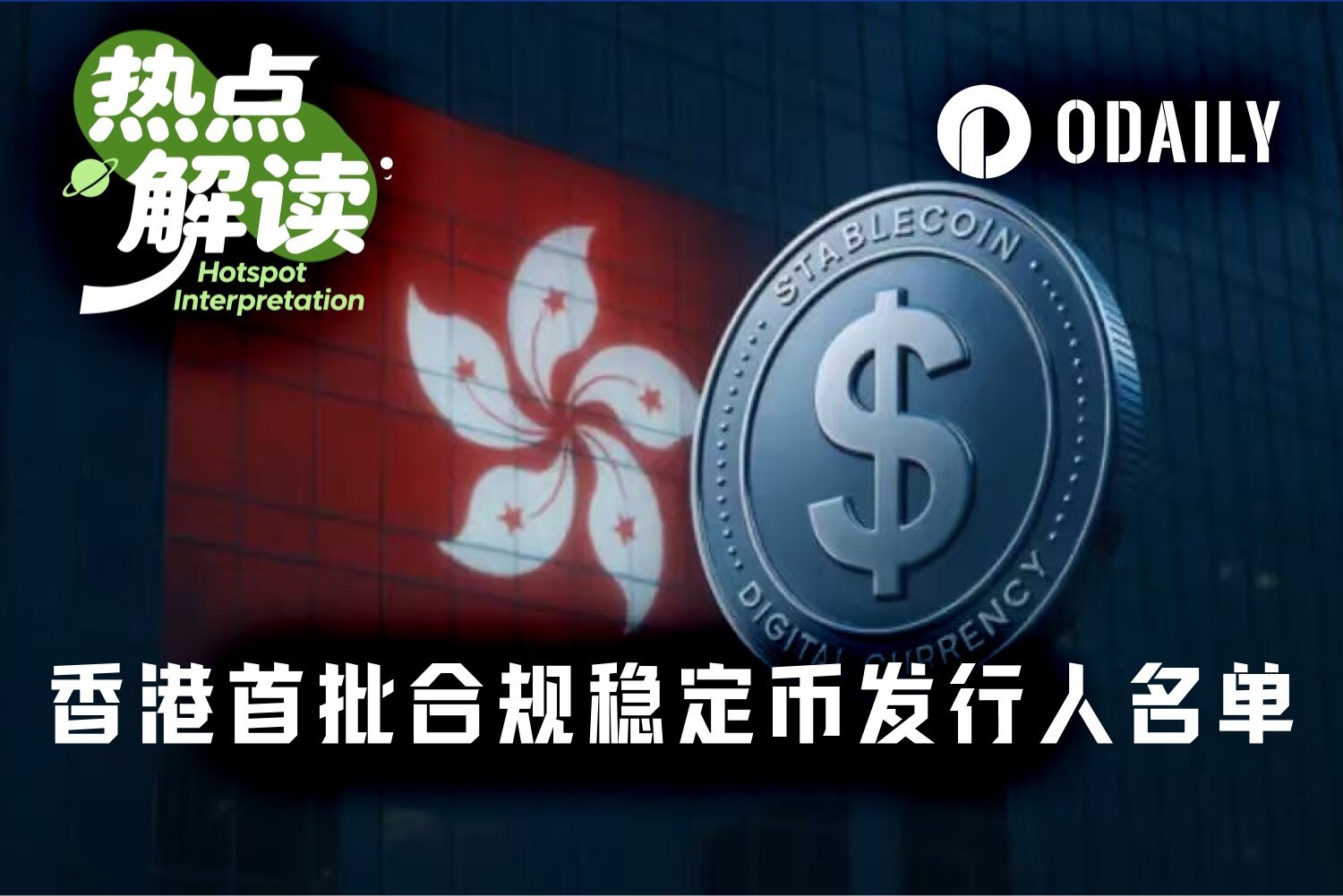
After Two Years and 36 Applicants Narrowed to 2! Hong Kong's First Batch of Stablecoin Licenses Issued, HSBC and Standard Chartered Successfully Break Through

Odaily星球日报Опубликовано 2026-04-10Обновлено 2026-04-10

Введение

Hong Kong has issued its first batch of stablecoin licenses to two institutions after a two-year regulatory process. The Hong Kong Monetary Authority (HKMA) granted approval to HSBC and AnchorFin Tech Limited, a joint venture involving Standard Chartered Bank, HKT, and Animoca Brands. The licensed entities are expected to launch regulated stablecoins by mid-to-late this year. The move marks a major milestone in Hong Kong’s digital asset development, following the introduction of a sandbox arrangement in March 2024 and the formal enactment of the Stablecoin Ordinance in August 2025. Initially, over 70 companies showed interest in applying, but only 36 eventually submitted applications. The HKMA emphasized a cautious and quality-focused approach to licensing. This development is seen as a key step in strengthening Hong Kong’s position as an international digital asset hub. It is expected to promote the use of compliant stablecoins in areas such as cross-border payments, tokenized securities, and decentralized finance (DeFi), while ensuring user protection and risk management. The issuance of the first licenses is viewed not as an endpoint, but as the beginning of a broader expansion of Hong Kong’s stablecoin ecosystem.

Original | Odaily Planet Daily (@OdailyChina)

Author | Golem (@web3_golem)

Hong Kong's first batch of stablecoin licenses has finally been issued.

At 5 PM on April 10th, the Hong Kong Monetary Authority (HKMA) announced that the first batch of stablecoin issuer licenses were granted to two institutions: HSBC Bank and Anchor FinTech Company Limited (a joint venture established by Standard Chartered Bank (Hong Kong) Limited, Hong Kong Telecom (HKT), and ANX Group). It also stated that, according to the current business plans of the two institutions, regulated stablecoins in Hong Kong will be launched successively from the middle to the second half of this year.

Mr. Eddie Yue, Chief Executive of the HKMA, said: "The issuance of the stablecoin issuer licenses is an important milestone in the development of digital assets in Hong Kong. The regulatory regime provides an orderly operating environment, allowing stablecoin issuers to apply innovative technology while properly safeguarding user rights and managing related risks, enabling the healthy, responsible, and sustainable development of Hong Kong's stablecoin ecosystem. I look forward to the issuers launching their businesses as planned, actively exploring development opportunities while managing risks well, promoting the application of compliant stablecoins, addressing pain points in financial and economic activities, creating value for the public and enterprises, and driving the healthy development of Hong Kong's digital assets."

Previous news indicated that the HKMA had completed the final review of the first batch of applications in mid-March 2026. The HKMA received a total of 36 applications.

After Two Years, Hong Kong's Compliant Stablecoins Finally Land

The issuance of Hong Kong's first batch of stablecoin licenses marks a new phase in the implementation of Hong Kong's stablecoin regulatory system. However, the market waited a full two years for this compliant stablecoin license to materialize, making it an achievement reached after a precise博弈 (game/balancing act) between financial innovation and regulatory safety in Hong Kong.

Rewind two years to March 2024, when the Hong Kong Monetary Authority (HKMA) officially launched the "Stablecoin Issuer Sandbox Arrangement." This was a crucial starting point for Hong Kong's stablecoin regulation moving towards practical implementation. The market saw the Hong Kong regulator's open attitude towards crypto finance, which attracted applications from multiple institutions, including traditional financial giants and native Web3 enterprises, to participate in the sandbox experiment.

In July of the same year, after four months of review, the HKMA announced the sandbox participants. Five institutions, including JD CoinChain Technology (Hong Kong) Limited, RD InnoTech Limited, Standard Chartered Bank (Hong Kong) Limited, ANX Group Limited, and Hong Kong Telecom (HKT) Limited, obtained participation qualifications. Market expectations were ignited because this indicated that Hong Kong's stablecoin regulation had entered the stage of specific institutional testing and regulatory磨合 (breaking-in/磨合), and Hong Kong was not far from bringing stablecoins into the formal regulatory framework.

Hong Kong's stablecoin sandbox experiment lasted for one year. On August 1, 2025, Hong Kong's "Stablecoin Ordinance" came into effect, and the stablecoin issuer regulatory system was officially implemented. This was a key node in the development of Hong Kong's virtual assets, marking the entry of Hong Kong's stablecoins into the era of licensed regulation.

The second half of 2025 also coincided with the peak of narratives intersecting crypto and traditional finance, such as RWA, stock tokenization, and listed company crypto treasuries. After the Hong Kong "Stablecoin Ordinance" took effect, the market expected Hong Kong's crypto finance to enter a great navigation era. Therefore, when the HKMA opened the first round of stablecoin issuer license applications, it was reported that over 70 companies intended to apply for Hong Kong stablecoin licenses, including financial institutions, Web2 internet companies, and blockchain enterprises.

But just as the situation was heating up, Hong Kong's stablecoin and RWA businesses faced a regulatory cool-down. In September 2025, market rumors emerged that companies involved in stablecoin and RWA businesses in Hong Kong were "warned" to keep a low profile in their business and statements related to stablecoins and RWA. Simultaneously, the participation of Chinese-funded enterprises in Hong Kong's stablecoin business was strictly controlled. According to a Caixin report at the time, because Hong Kong's stablecoin business was still in its infancy, excessive participation by Chinese-funded entities might bring risks, so it was necessary to isolate the risks first.

This temporary incident directly led to a sharp decrease in the number of enterprises applying for Hong Kong stablecoin licenses. Not only did Chinese-funded banks and state-owned enterprises withdraw, but Web2 internet companies also suspended their stablecoin issuance plans. In October 2025, informed sources revealed that Ant Group, affiliated with Alibaba, and JD.com had suspended their related plans to issue stablecoins in Hong Kong. Ultimately, the HKMA received only 36 stablecoin license applications from institutions, and the market calmed down accordingly.

In early February this year, Mr. Eddie Yue, Chief Executive of the HKMA, stated that they aimed to issue Hong Kong's first batch of stablecoin issuer licenses by March this year. He emphasized: "The number of licenses issued in the first batch will certainly be small, with the goal being稳妥 (prudence/safety first)."

Back to the present, it has been over 8 months since the Hong Kong "Stablecoin Ordinance" came into effect. The issuance of Hong Kong's first batch of stablecoin licenses finally landed today. Over these two years, the market has been hyped, capital has been hot, concepts have been speculated on, and regulation has also been controlled. After going through countless hardships, the path for Hong Kong's compliant stablecoins has finally been fully traversed from "sandbox testing — legislative landing — application review — official licensing".

The Great Era of Hong Kong Stablecoins is Coming

Undoubtedly, the issuance of Hong Kong's first batch of stablecoin licenses is another important milestone on its way to becoming an "International Digital Asset Financial Center".

For Hong Kong, this licensing means that stablecoin regulation is no longer just at the institutional level. With the actual launch of stablecoin businesses by licensed institutions, such as cross-border payments, digital securities, and DeFi fields, Hong Kong's digital financial market will gain more vitality and grasp more discourse power in the future world digital financial system, seizing the strategic high ground of "digital currency sovereignty".

Looking more specifically at the market level, after the first batch of licenses are issued, the Hong Kong crypto market has the opportunity to regain some vitality. In the past, many people thought of forums, summits, and expectations when mentioning Hong Kong stablecoins—it was lively, but always half a step away from real business. Now, the first batch of licensed enterprises can finally legally conduct stablecoin businesses, practically exploring the potential of the Hong Kong market in areas such as cross-border payments, institutional settlements, and on-chain finance.

Of course, the issuance of the first batch of licenses does not mean the overall market situation is settled. Although first movers will have a leading advantage, it doesn't mean latecomers cannot catch up. Only when the second and third batches of licenses are issued in the future will the market truly enter the stage of competing on scenarios, execution capabilities, and products and services.

Therefore, the first batch of licenses is not the climax of the Hong Kong stablecoin story; on the contrary, it is just the beginning. The great era of Hong Kong stablecoins is about to begin.

Связанные с этим вопросы

QWhich two institutions were granted the first stablecoin issuer licenses in Hong Kong?

AHSBC and AnchorX Financial Technology Limited (a joint venture between Standard Chartered Bank Hong Kong, HKT, and Ant Group).

QWhen did the Hong Kong Monetary Authority (HKMA) announce the issuance of the first stablecoin licenses?

AAt 5 p.m. on April 10th.

QHow many applications did the HKMA receive for the stablecoin issuer license?

AThe HKMA received 36 applications.

QWhat was the name of the regulatory sandbox arrangement launched by the HKMA in March 2024 for stablecoin issuers?

AThe 'stablecoin issuer sandbox arrangement'.

QWhen did Hong Kong's 'Stablecoin Ordinance' officially come into effect?

AThe 'Stablecoin Ordinance' officially came into effect on August 1, 2025.

Похожее

The Largest IPO in History Is Approaching, Surpassing SpaceX, 28 Years of AI Self-Iteration, Countdown to Intelligence Explosion

"Anthropic Nears Trillion-Dollar IPO, Fueled by Explosive Growth and 2028 'Intelligence Explosion' Warning Anthropic is considering a deal valuing the AI company near $1 trillion, potentially leading to one of the largest IPOs ever and surpassing SpaceX. Its revenue has skyrocketed, with Annual Recurring Revenue (ARR) reaching $45 billion in May 2026—a 500% increase in just five months. This vertical growth curve is attributed to its key products, Claude Code and Cowork, dominating AI coding and enterprise collaboration. Beyond commercial success, co-founder Jack Clark issued a pivotal warning in an interview: there is a greater than 50% chance that by the end of 2028, AI systems will achieve recursive self-improvement—the ability to autonomously build a 'better version' of themselves, initiating an 'intelligence explosion.' This prophecy underpins the company's astronomical valuation, as the market prices in the potential for transformative and disruptive AI. Further signaling its ambition, Anthropic formed a $1.5 billion joint venture with Goldman Sachs and Blackstone, aiming to disrupt traditional consulting firms like McKinsey by deploying Claude AI for complex strategic work. This move tests AI's capacity to replace high-level cognitive labor, a precursor to its predicted autonomous evolution. The narrative presents a dual future: unprecedented economic opportunity alongside significant risks like economic restructuring and security threats. Anthropic's meteoric rise and Clark's 2028 prediction frame the coming years as a countdown to a potential technological singularity."

marsbit5 мин. назад

The Largest IPO in History Is Approaching, Surpassing SpaceX, 28 Years of AI Self-Iteration, Countdown to Intelligence Explosion

marsbit5 мин. назад

Has Hook Summer Really Arrived? sato, Lo0p, FLOOD Ignite the New Narrative of Uniswap v4

"Hook Summer" Arrives? Sato, Lo0p, FLOOD Ignite Uniswap v4 Narrative Amidst a slight market recovery, attention within the Ethereum ecosystem has shifted to Meme coins built on Uniswap v4's Hook protocol. Following ASTEROID, tokens like sato, sat1, Lo0p, and FLOOD have become market focal points, with market caps ranging from millions to tens of millions, bringing concentrated liquidity to a narrative-dry market. Uniswap v4 Hooks are "plugin smart contracts" that allow developers to inject custom logic at key points in a liquidity pool's lifecycle (initialization, adding/removing liquidity, swaps, etc.), making the AMM programmable. Recent representative projects include: * **sato**: Market cap peaked over $38M; uses a v4 curve mechanism for minting/burning, locking ETH as reserve. * **sat1**: Market cap briefly exceeded $10M, positioning as an "optimized sato," but later declined significantly. * **Lo0p**: Market cap neared $6.6M; a "lending AMM protocol" allowing users to borrow ETH against deposited LO0P tokens without immediate selling pressure. * **FLOOD**: Market cap approached $6M; channels trading reserves into Aave v3 to generate yield, which is retained in the pool. The emergence of these Hook-based tokens could drive long-term growth for the Uniswap ecosystem by attracting users and liquidity to v4 pools. Combined with Uniswap's activated fee switch (partially used to burn UNI), the long-term outlook for UNI appears positive. However, short-term UNI price appreciation is not directly guaranteed. Factors include the sustainability and lifecycle of these new tokens, their price volatility, overall market conditions, and regulatory pressures. Currently, Uniswap v4's TVL ($595M) lags behind v3 and v2, indicating Hook adoption still requires time to mature. In summary, the Hook ecosystem serves as "long-term nourishment" for UNI, but acts more as a "catalyst" than a direct "booster" in the short term. Note: These are early-stage experimental tokens and may carry unknown risks.

marsbit30 мин. назад

Has Hook Summer Really Arrived? sato, Lo0p, FLOOD Ignite the New Narrative of Uniswap v4

marsbit30 мин. назад

Has Hook Summer Truly Arrived? sato, Lo0p, FLOOD Ignite the New Uniswap v4 Narrative

With the broader market showing signs of recovery, a new wave of interest has emerged around Ethereum-based meme coins. Following ASTEROID, tokens like sato, sat1, Lo0p, and FLOOD, built upon the Uniswap v4 Hook protocol, are capturing market attention. Their market capitalizations range from millions to tens of millions of dollars, injecting much-needed focused liquidity into a market lacking narratives. This article explores whether this trend signifies an incoming "Hook Summer" and its potential impact on UNI's price. Hooks are essentially plug-in smart contracts for Uniswap v4 liquidity pools, allowing developers to inject custom logic at key points in a pool's lifecycle (like initialization, adding/removing liquidity, swaps). This transforms the AMM into programmable building blocks. Key highlighted projects include: * **sato**: Peaked over $38M market cap. It utilizes a v4 curve for minting/burning; buying locks ETH as reserve to mint new tokens, while selling redeems ETH from the reserve and burns tokens. * **sat1**: Market cap briefly exceeded $10M, promoted as an "optimized sato," but later declined significantly. * **Lo0p**: Reached nearly $6.6M. It's a lending AMM protocol where buying LO0P tokens locks them as collateral, allowing users to borrow ETH from the pool reserve at 40% LTV, aiming to improve capital efficiency for idle ETH in LPs. * **FLOOD**: Peaked near $6M. Its mechanism directs asset reserves from buys into Aave v3 to generate yield, with fees and interest retained in the pool to potentially influence the token's price long-term. In the long term, the development of the Hook ecosystem can attract users and liquidity to Uniswap v4, benefiting UNI's fundamentals—especially combined with the recent activation of the protocol fee switch, where a portion of fees is used to burn UNI. However, in the short term, these Hook-based tokens are unlikely to directly drive significant UNI price appreciation. Their impact is moderated by factors like token sustainability, price volatility, and broader market and regulatory conditions. Currently, Uniswap v4's TVL ($595M) still trails behind v2 and v3, indicating adoption and growth will take time. The article concludes that while the Hook ecosystem provides long-term "nourishment" for UNI, its short-term role is more of a "catalyst" than a "booster." Readers are cautioned that these are early-stage experimental tokens and may carry unknown risks.

Odaily星球日报42 мин. назад

Has Hook Summer Truly Arrived? sato, Lo0p, FLOOD Ignite the New Uniswap v4 Narrative

Odaily星球日报42 мин. назад

Торговля

Спот
Фьючерсы
活动图片