Advancing MM 1: Market Maker Inventory Quoting System

深潮Опубликовано 2025-12-28Обновлено 2025-12-28

Введение

"Attack of the MM 1: Market Maker Inventory Quoting System" by Dave explores why altcoin prices often move against retail traders immediately after their purchases, debunking the myth of intentional manipulation by "market manipulators." The article explains that this phenomenon is not due to malicious intent but is a result of automated market maker (MM) systems using the Avellaneda-Stoikov model for inventory-based pricing and protection against toxic order flow. When retail traders execute large buy orders, MMs sell, leading to a short inventory exposure. To mitigate risk, MMs adjust their strategies in two ways: 1. **Quote Skew**: They lower prices to attract sellers and discourage further buys, aiming to replenish inventory and protect their short position. 2. **Spread Widening**: They widen bid-ask spreads to reduce transaction probability and earn more spread profit to offset potential losses. The core mechanism involves the "Reservation Price," calculated as Mid Price − γ⋅q (where q is inventory and γ is risk aversion). Large retail orders disrupt inventory balance, causing MMs to adjust prices dynamically. Retail traders often face this due to their concentrated, unconcealed, and unhedged orders, especially in low-liquidity altcoins where their trades significantly impact pricing. The article concludes with a practical tip: instead of executing large orders at once, retail traders can break them into smaller, staggered orders to exploit MM pricing adjustments,...

Author: Dave

Have you ever experienced a situation where, after buying some altcoins, the price keeps moving in the opposite direction in a short time, as if the "market manipulators" are targeting you? Why does this happen? Is it really a conspiracy by the manipulators?

This post will introduce the market maker's quoting system and unveil the mystery behind the "manipulator" conspiracy. The conclusion is: prices often move against us not due to subjective manipulation, but rather due to Inventory-based pricing quote skew under the Avellaneda–Stoikov model and the protective mechanism for handling toxic flow. How exactly? Once upon a time...

First, let's understand the concept of inventory. As we all know, market makers are not directional investors. Under strict hedging, spot price changes should not affect the total P&L. At this point, holding inventory is a "passive" behavior. Changes in inventory lead to an expansion of positions, and the more positions you hold, the greater your risk exposure to adverse price movements. At this time, retail traders' buy and sell orders cause changes, and market makers react to the risks brought by these inventory changes.

In a nutshell, you break their balance, and the MM has to protect themselves and try to return to balance. The means of protection is the quoting system.

1. Quote Skew

When the MM is heavily bought by you, it is equivalent to: the MM has sold heavily, and the inventory becomes a short exposure. What does the MM hope to do at this time: (1) Replenish the inventory as soon as possible. (2) Protect the exposed short position.

So the MM's reaction is: lower the price to attract selling, prevent further buying, and ensure that their net short position remains temporarily non-loss-making, giving time to hedge.

2. Spread Widening

When the inventory continues to deteriorate, the MM not only skews the price but also widens the spread to reduce the probability of execution.

Their goal is to reduce the execution risk per unit time and, through spread profits, earn more to protect against price losses.

While writing this article, each additional mathematical formula reduces the number of readers by 10%, but in case some小伙伴们 want to see something substantial, I will briefly introduce the formation of quotes (which is also the mathematical mechanism behind the above quote changes).

The price at which we trade with the market maker is called the Reservation Price, which comes from the Inventory-based pricing model:

Reservation Price = Mid price − γ⋅q

q: current inventory

gamma γ: risk aversion coefficient

Actually, the Reservation Price looks like the following, but I don't want to disgust everyone, so just take a glance:

When retail traders buy or sell heavily, q changes significantly, causing the quoted Reservation Price to change significantly. The specific amount of change comes from the Avellaneda–Stoikov model. As you might guess, since buying and selling cause small changes in inventory, this model is a partial differential equation. Guess what? I'm not interested in deriving this equation either, so we only need to know the core conclusion:

The optimal quote is symmetrically spread around the Reservation Price. Inventory must mean-revert to 0. The optimal spread widens with risk.

If you don't understand the above, it's okay. Just roughly understand that after retail buying, prices often move against the bullish direction, essentially because our flow changes the market's risk pricing. The reasons why retail traders often encounter this situation are:

• Retail traders almost always use aggressive orders

• Concentrated size, non-stealthy timing

• No hedging

• Not timing the market, not splitting orders

In small altcoins, this situation is even more severe because altcoin liquidity is poor. Often, your order is one of the few aggressive orders within 5 minutes. In large品种, natural hedging might occur, but in small coins, you are the counterparty to the manipulator.

So professional MMs are not trying to crush you; their objective is maxE[Spread Capture]−Inventory Risk−Adverse Selection. Actually, their objective function looks like this, with inventory risk being exponentially penalized.
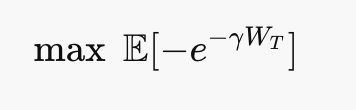
Readers who have made it this far must be韭菜 with dreams of becoming market manipulators. So to激励 the brave, I'll share a small trick to utilize the quoting mechanism. We said retail traders often have concentrated size and non-stealthy timing, so just do the opposite. Suppose Dave wants to go long 1000U. Instead of going all in at once, using the manipulator's method, first buy 100U. The quoting system will lower the price, allowing me to build a position at a cheaper level. Then I buy another 100U, and the price will continue to fall. Thus, my average entry cost will be much cheaper than going all in at once.

The story of retail's bad luck is only half told here. Besides inventory management quoting factors, the MM's handling of order flow is another element causing price divergence, namely the toxic order flow mentioned at the beginning. In the next part, I will introduce the market maker's order book and order flow, and I will also speculate on the micro-market reasons behind the 1011惨案.

To know what happens next, stay tuned for the next episode.

Связанные с этим вопросы

QWhat is the main reason why altcoin prices often move against retail traders after they buy, according to the article?

AIt is not due to subjective manipulation, but rather the result of the Avellaneda-Stoikov model's Inventory-based pricing quote skew and a protection mechanism against toxic order flow.

QHow does a market maker (MM) react when its inventory becomes short due to a large buy order from a retail trader?

AThe MM will lower its prices to attract sell orders and discourage further buying, while also widening the bid-ask spread to reduce the probability of execution and protect its exposed short position.

QWhat is the 'Reservation Price' in the context of the market maker's pricing model?

AThe Reservation Price is the price at which traders transact with the market maker. It is derived from the Inventory-based pricing model and is calculated as: Reservation Price = Mid price - γ * q, where q is the current inventory and γ is the risk aversion coefficient.

QWhat are the characteristics of retail trader orders that make them particularly vulnerable to price movements against them?

ARetail orders are often aggressive (taking liquidity), concentrated in size, not stealthy in timing, unhedged, and not split or timed strategically.

QWhat practical tip does the article suggest for a retail trader who wants to buy a large position to get a better average entry price?

AInstead of buying the entire position at once, the trader should split the order into smaller chunks. Buying a small amount first causes the MM's pricing system to lower the price, allowing subsequent buys to be executed at cheaper levels, resulting in a lower average cost.

Похожее

First Batch of Keynote Speakers and Partners Announced! Web2+3 Summit: Defining the Next Generation of Digital Economy

Web2+3 Summit: Defining the Next Generation of Digital Economy The 6th BEYOND International Technology Innovation Expo (BEYOND Expo 2026), Asia's largest tech and ecosystem exhibition, is launching a dedicated Web2+3 stage for the first time. Co-hosted by BEYOND Expo and ChainNeXT Group, the Web3 Summit will take place from May 28–30, 2026. Against the backdrop of accelerating global tech integration, the boundaries between Web2 and Web3 are rapidly blurring. With clearer global regulations for blockchain-driven internet (Web3) and the special issuance of a Hong Kong dollar stable币 license by the Hong Kong SAR government on April 10, 2026, Web3's decentralized principles are quickly merging with traditional industries (Web2) such as e-commerce, finance, and artificial intelligence. Focused on blockchain-driven digital economy elements, the summit will center on three core principles—implementability, commercial viability, and compliance. It will bring together top Web3 experts to discuss key integration areas like stablecoin payment finance (PayFi), real-world asset tokenization (RWA), and decentralized AI (DeAI), unveiling new opportunities for industrial innovation. The first wave of confirmed speakers includes Jack Kong (Director of Hong Kong Cyberport, Chairman of Nano Labs), Yat Siu (Chairman of Animoca Brands), Michael Wu (Co-founder & CEO of Amber Group), Michael Heinrich (Co-founder & CEO of 0G), and Art Abal (Co-founder of Vana). More Web3 ecosystem pioneers, AI, and fintech experts will be announced soon. Core forum topics include: - Web2+DeAI: New AI Paradigms Driven by Decentralized Infrastructure - Web2+RWA: Real-World Asset Tokenization and Global Liquidity - Web2+PayFi: Cross-Border Payments and Financial Innovation Powered by Crypto Infrastructure - Web2+3 AI: Autonomous Agents and the Crypto Economy - Web2+3 Wealth: On-Chain and Off-Chain Integrated Investment Ecosystems - Web2+3 Commerce: A New Landscape for Global Trade Driven by Stablecoins Additional agenda details will be released in the near future.

marsbit4 ч. назад

First Batch of Keynote Speakers and Partners Announced! Web2+3 Summit: Defining the Next Generation of Digital Economy

marsbit4 ч. назад

Торговля

Спот
Фьючерсы

Популярные статьи

Как купить EDGE

Добро пожаловать на HTX.com! Мы сделали приобретение edgeX (EDGE) простым и удобным. Следуйте нашему пошаговому руководству и отправляйтесь в свое крипто-путешествие.Шаг 1: Создайте аккаунт на HTXИспользуйте свой адрес электронной почты или номер телефона, чтобы зарегистрироваться и бесплатно создать аккаунт на HTX. Пройдите удобную регистрацию и откройте для себя весь функционал.Создать аккаунтШаг 2: Перейдите в Купить криптовалюту и выберите свой способ оплатыКредитная/Дебетовая Карта: Используйте свою карту Visa или Mastercard для мгновенной покупки edgeX (EDGE).Баланс: Используйте средства с баланса вашего аккаунта HTX для простой торговли.Третьи Лица: Мы добавили популярные способы оплаты, такие как Google Pay и Apple Pay, для повышения удобства.P2P: Торгуйте напрямую с другими пользователями на HTX.Внебиржевая Торговля (OTC): Мы предлагаем индивидуальные услуги и конкурентоспособные обменные курсы для трейдеров.Шаг 3: Хранение edgeX (EDGE)После приобретения вами edgeX (EDGE) храните их в своем аккаунте на HTX. В качестве альтернативы вы можете отправить их куда-либо с помощью перевода в блокчейне или использовать для торговли с другими криптовалютами.Шаг 4: Торговля edgeX (EDGE)С легкостью торгуйте edgeX (EDGE) на спотовом рынке HTX. Просто зайдите в свой аккаунт, выберите торговую пару, совершайте сделки и следите за ними в режиме реального времени. Мы предлагаем удобный интерфейс как для начинающих, так и для опытных трейдеров.

297 просмотров всегоОпубликовано 2026.03.31Обновлено 2026.03.31

Как купить EDGE

Что такое фьючерсы на акции США?

Фьючерсы на акции США представляют собой токенизированные бессрочные фьючерсы на американские акции, торгуемые на криптовалютных биржах (например, HTX).

1.1k просмотров всегоОпубликовано 2026.04.08Обновлено 2026.04.08

Что такое фьючерсы на акции США?

Обсуждения

Добро пожаловать в Сообщество HTX. Здесь вы сможете быть в курсе последних новостей о развитии платформы и получить доступ к профессиональной аналитической информации о рынке. Мнения пользователей о цене на A (A) представлены ниже.

活动图片