Abandoning Token Issuance, Abolishing veBAL: Can Balancer's 'All-or-Nothing Gamble' Bring Renewal?

marsbitОпубликовано 2026-03-24Обновлено 2026-03-24

Введение

Balancer, a veteran DeFi protocol, is undergoing a radical transformation following a major $120M security breach in November 2025 that accelerated its existing financial decline. With annual revenue of just $290K against a $2.87M operational budget, its DAO treasury was on track to be depleted within four years. TVL plummeted from a peak of $3B to under $160M. On March 23, 2026, the core team proposed two major overhauls: a tokenomics reform and an operational restructuring. The key strategy shifts from token emission-driven growth to a sustainable, fee-based model. Operational changes include dissolving Balancer Labs, reducing the team from 25 to 12.5 full-time equivalents, and cutting the annual budget by 34% to $1.9M. The protocol will focus solely on its core products: Boosted Pools, a revamped reCLAMM, and LBPs, while maintaining deployments only on Ethereum, Gnosis, Arbitrum, and Base. Tokenomics reforms are more drastic: BAL token emissions will stop immediately, and the veBAL governance system will be abolished. All protocol fees will now go entirely to the DAO treasury, and V3 protocol fees are reduced from 50% to 25% to attract LPs. A $500K compensation fund is allocated for veBAL holders. A crucial exit mechanism is proposed: a 12-week window, opening one year after the vote, allowing BAL holders to burn their tokens for stablecoins at a Net Asset Value (NAV) of $0.16 per BAL. If fully utilized, this could burn 35% of the circulating supply. The team projects...

Original Author: KarenZ, Foresight News

On November 3, 2025, a security incident resulting in losses exceeding $120 million largely shattered the growth illusion of the veteran DeFi protocol, Balancer.

This was the largest security incident in Balancer's history. But the deeper wound lies not in that astronomical figure.

Looking at the financial data attached to Balancer's latest proposal, its fundamentals are already grim: the protocol's annualized fees are approximately $1.65 million, while the DAO's estimated annualized revenue is only $290,000, accounting for 17.5%.

The remaining funds flow to veBAL holders, core pools, the Balancer Alliance plan, and other parties. The entire system appears to be a continuously running "money printer," but it's actually "leaking" on both sides: on one hand, fees are split and lost through multiple layers; on the other hand, the BAL token has an annual inflationary release of approximately 3.78 million tokens, creating continuous selling pressure of about $580,000 at current prices — note that BAL's current fully diluted valuation (FDV) is only $11 million.

The annual operating budget is as high as $2.87 million, while the annualized revenue is only $290,000, resulting in a deficit of $2.58 million.

The DAO treasury (excluding BAL) holds only $10.3 million. At this rate, the treasury has less than 4 years left.

After the security incident, Balancer's TVL took a further hit. It dropped from $800 million to approximately $300 million, and then continued to decrease. The current TVL is less than $160 million. Recall that at its peak in 2021, Balancer's TVL had reached over $3 billion.
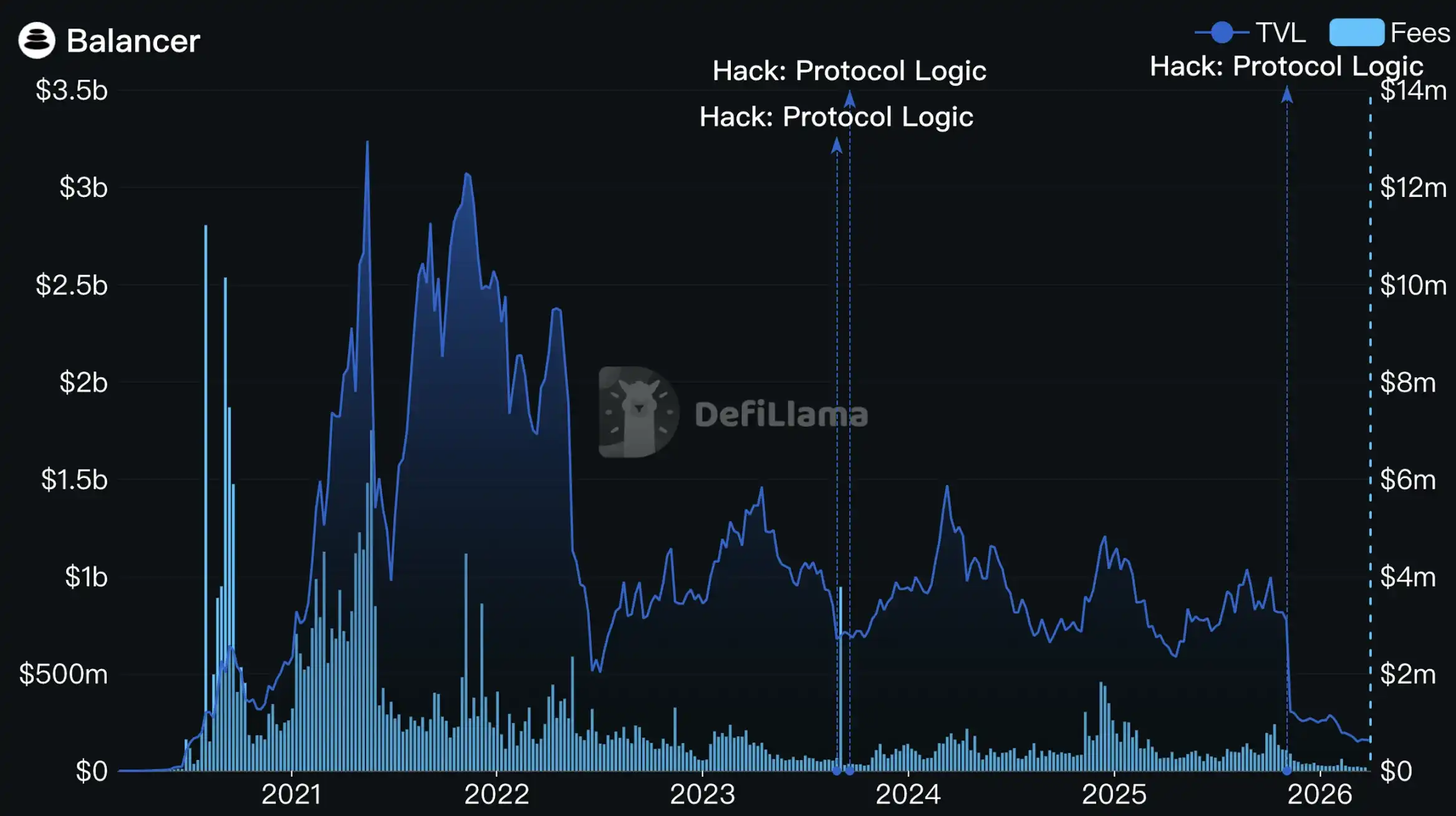
Source: DefiLlama

Balancer has officially reached a crossroads. On March 23, 2026, the Balancer core team simultaneously released two important governance proposals: a comprehensive overhaul of BAL tokenomics and an operational restructuring.

The core logic of these two documents combined can be summarized in one sentence: Abandon the growth model driven by token releases and shift towards sustainable operation driven by revenue.

Operational Restructuring: Team "Slimming Down," Annual Budget Reduced by 34%

The proposal suggests formally dissolving Balancer Labs, with its core technical personnel transitioning to contractor roles and merging into Balancer OpCo Limited, which will continue to operate as the DAO's legal proxy entity.

The team size will be compressed from about 25 people to 12.5 full-time equivalents (including dedicated service providers like Beets, MAXYZ, etc.), and the annual operating budget will be reduced from $2.87 million to $1.9 million, a 34% cut.
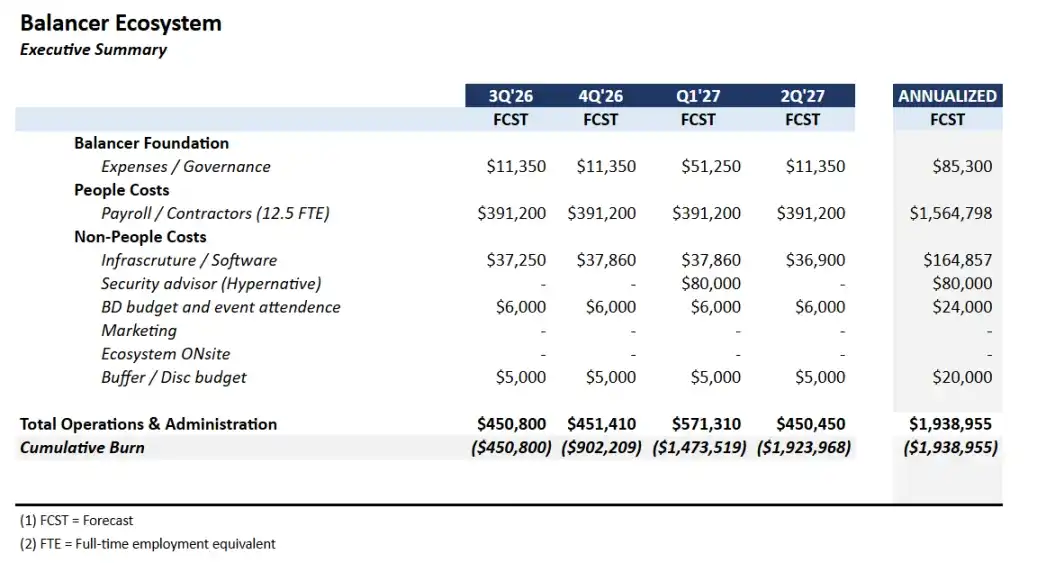
The product lines are also being drastically narrowed. The team will focus resources on three products with validated commercial viability: Boosted Pools (flagship product), reCLAMM (to be relaunched after fixing vulnerabilities, possibly renamed), and LBP (token launch pools, operated opportunistically).

Other exploratory directions, such as ETF structured products, yield optimizers, and AI-driven liquidity tools, will only proceed subject to meeting "core KPIs".

On-chain deployments are also being scaled back. The current model of maintaining V2 and V3 on over 9 chains is unsustainable. The team explicitly retains four core chains: Ethereum, Gnosis, Arbitrum, and Base. Other deployments will be reviewed individually based on fee revenue and operational costs, and terminated if they do not meet standards.

Tokenomics Reform: A Complete Overhaul, Not Minor Tweaks

Stop BAL Emissions, Abolish veBAL

If the proposal passes, Balancer will terminate BAL token incentive emissions, with no transition period.

Simultaneously, the veBAL governance mechanism will be formally abolished. Holders will stop receiving any economic rewards after the final bi-weekly fee distribution. Their locked veBAL will become purely governance credentials, waiting to expire at the end of the lock-up period.

This is a painful decision, but the logic behind it is clear: the veBAL mechanism had a structural flaw from the start, being prone to oligopolistic control. Currently, Aura Finance (a veBAL meta-governance protocol) and whales hold significant voting power, making genuine community voices increasingly faint in governance. This mechanism not only failed to promote the protocol's healthy development but became a vehicle for circular economic games — protocol money flows to middlemen via incentives, and the middlemen's votes direct more incentives towards themselves.

If veBAL was once an experiment by Balancer borrowing from Curve's design, the team now frankly admits: the experiment is over, and the results did not meet expectations.

Regarding the termination of veBAL economic rights, Balancer stated it will provide a $500,000 compensation activity, distributed directly to veBAL holders as pure cash compensation.

All Fees Go to DAO Treasury, Reduce V3 Protocol Take Rate

All protocol fees — V2 swap fees, V3 swap fees, Yield fees, LBP fees — will thereafter flow 100% to the DAO treasury, abandoning the previous multi-party split mechanism.

Simultaneously, the V3 protocol fee take rate will be reduced from 50% to 25%. This means for the same transaction, liquidity providers (LPs) previously received 50%, but will now receive 75%.

These two moves seem opposite in direction but share the same underlying logic: the former eliminates the circular economy, allowing the treasury to obtain real usable funds; the latter increases LP attractiveness, trading lower platform fees for more organic liquidity and real trading volume.

The proposal estimates that post-reform, the DAO's annualized revenue could reach approximately $1.22 million, more than 4 times the current $290,000.

Exit Option: Burn BAL for Stablecoins at $0.16 per Token

The treasury will also allocate 35% of its assets (currently about $3.6 million) to a dedicated pool. This is not for actively buying BAL on the secondary market, but to open a "burn for stablecoins" channel: BAL holders can voluntarily send their tokens to a contract to be burned, receiving stablecoins of equivalent value at the NAV price (Net Asset Value, approximately $0.16 per token).

The window will open 12 months after the proposal passes and last for 12 weeks. Any unused stablecoins after the window closes will return to the treasury. The 12-month waiting period is designed specifically to allow holders whose veBAL unlocks gradually to participate.

At the time of writing, the BAL price is $0.1548, below the NAV price. Offering an exit at the NAV price provides a more dignified option for those wanting to leave than a secondary market stampede.

If this channel is fully utilized, it would burn approximately 22.7 million BAL tokens, about 35% of the circulating supply, which is 6 times the current annual inflation emission.

9-Year "Runway": Is It Enough?

If both proposals pass, the team's projected financial model is as follows:

DAO annualized revenue ~$1.22 million (assuming TVL recovers somewhat after V3 fee reduction), annual operating expenses $1.9 million, buyback expenditure ~$3.6 million, plus the $500,000 veBAL compensation.

After completing the buyback and compensation, the treasury would still have approximately $6.2 million remaining. The annual funding gap would narrow from about $2.6 million to $700,000, giving a theoretical survival period of nearly 9 years.

For a DeFi protocol, 9 years is enough to span a full industry cycle.

But this model is built on optimistic assumptions: that reducing the V3 protocol take rate will indeed attract more organic TVL; that the slimmed-down team can truly support daily protocol operations, security maintenance, etc.; and that core products (especially reCLAMM) can successfully attract the market again after repairs.

If any link underperforms expectations, the 9-year survival period will shorten rapidly. The team itself explicitly states that if DAO monthly revenue falls below $60,000 for 3 consecutive months, a revised plan must be submitted to the community.

For Balancer, this is a nearly all-or-nothing reform. Abandoning the once-proud veBAL mechanism, abandoning the complex multi-party split structure, and returning to an extremely simplified origin: let real transaction fees drive protocol survival, not newly minted tokens maintaining false prosperity.

Whether this desperate reform will work ultimately depends on the market and time, awaiting long-term observation.


Связанные с этим вопросы

QWhat were the main reasons behind Balancer's decision to abandon the veBAL mechanism and stop BAL token emissions?

ABalancer decided to abandon veBAL and stop BAL emissions because the veBAL mechanism was structurally flawed, leading to oligopolistic control by entities like Aura Finance and large holders, which stifled genuine community governance. The token-based growth model created a circular economy where incentives flowed to middlemen instead of supporting protocol health. Additionally, the annual inflation of 3.78 million BAL tokens created significant sell pressure, exacerbating financial unsustainability.

QHow does Balancer plan to address its financial sustainability issues after the proposed changes?

ABalancer aims to achieve financial sustainability by shifting to a revenue-driven model. Key measures include redirecting 100% of protocol fees to the DAO treasury, reducing operational budget by 34% to $1.9 million annually, and lowering the V3 protocol fee take rate to 25% to attract more organic liquidity. These changes are projected to increase DAO annualized revenue to approximately $1.22 million, extending the treasury's runway to nearly 9 years.

QWhat compensation is Balancer offering to veBAL holders, and how will it be funded?

ABalancer is offering a $500,000 compensation package to veBAL holders, funded directly from the DAO treasury. This is a cash compensation for the termination of their economic rights, as veBAL will become a governance-only credential with no further financial benefits after the final fee allocation.

QWhat is the purpose of the 'burn-for-stablecoin' mechanism, and how does it work?

AThe 'burn-for-stablecoin' mechanism allows BAL holders to voluntarily burn their tokens in exchange for stablecoins at a fixed Net Asset Value (NAV) price of $0.16 per BAL. It is designed to provide an orderly exit for holders wishing to leave, reducing sell pressure on the secondary market. The DAO will allocate 35% of its treasury (about $3.6 million) for this purpose, with the window opening 12 months after proposal approval and lasting for 12 weeks.

QWhich product lines and chains will Balancer focus on after the operational restructuring?

APost-restructuring, Balancer will concentrate resources on three commercially validated product lines: Boosted Pools (flagship product), reCLAMM (to be relaunched after bug fixes and possible rebranding), and LBPs (opportunistic operation). Deployment will be limited to core chains: Ethereum, Gnosis, Arbitrum, and Base, with other chains subject to review based on fee revenue and operational costs.

Похожее

A Nation Blocks Chips, a Giant Buys a Nuclear Power Plant: Why It's Time to Seriously Consider DeAI

**Title: Great Powers Blockade Chips, Giants Buy Nuclear Plants: Why It's Time to Seriously Consider DeAI** In May 2026, the US closed loopholes for Chinese firms to acquire advanced NVIDIA chips via overseas subsidiaries. That same month, Kenya halted a $1B geothermal data center project involving Microsoft, fearing its immense energy consumption. Meanwhile, Huawei announced mass production of its Ascend AI chip. These disparate events underscore a new reality: the competition for computing power ("compute") has escalated beyond the tech industry, becoming a geopolitical and infrastructural battleground. A new era of oligopoly is forming, with control over the AI stack—from GPU chips (NVIDIA) and cloud platforms (AWS, Azure, Google Cloud) to foundational models (OpenAI, Anthropic)—concentrating in a few Western "AI Octopus" corporations. This centralization creates systemic risks: pricing power and platform lock-in for users, infrastructure fragility, and a widening "compute divide" that threatens to marginalize nations without independent AI capacity. An "AI Iron Curtain" is deepening through export controls. In response, some nations like Saudi Arabia and the UAE are investing heavily to buy compute power, aiming to transition from oil to AI economies. The EU seeks to triple its compute capacity by 2030 to reduce dependency. However, the spending gap is vast, with four US tech giants alone planning ~$750B in AI capex for 2026. The race is increasingly constrained by energy, with AI tasks consuming up to 1000x more power than web searches, pushing firms to even acquire nuclear plants. This landscape is fueling interest in Decentralized AI (DeAI). It proposes a third way: using open protocols to coordinate a global network of idle GPUs, independent developers, and data centers, creating an AI infrastructure without a single controlling entity. Leveraging blockchain and cryptographic verification, DeAI aims to break market concentration, disperse energy demands, reduce geopolitical dependencies, and enhance transparency. While still nascent in performance and stability, DeAI's core promise is not immediate superiority but providing a crucial alternative architecture to resist monopoly, censorship, and centralized power. As specialized AI hardware costs fall and open-source models flourish, the window to build this foundation is open. The very existence of such competition serves as a vital check against the inevitable abuse of concentrated power.

marsbit12 мин. назад

A Nation Blocks Chips, a Giant Buys a Nuclear Power Plant: Why It's Time to Seriously Consider DeAI

marsbit12 мин. назад

Outpoll Review: A Prediction Market Platform Built for Active Traders

Outpoll Review: A Prediction Market Platform Built for Active Traders In recent years, prediction markets have grown from a niche sector to a mainstream arena, attracting billions in trading volume and institutional capital. However, the user experience and tools for traders have not kept pace. Outpoll, a new global prediction market platform, aims to fill this gap by providing enhanced trading infrastructure for active and professional traders. Built on standard prediction market principles, Outpoll allows users to trade on the outcome of specific events. It uses fully collateralized contracts with USDC settlement, charges a competitive 0.1% fee per trade, and provides clear settlement rules upfront to minimize disputes. A key focus for Outpoll is its professional-grade trading tools. The platform supports limit and market orders, as well as take-profit and stop-loss orders for open positions—features uncommon in prediction markets. For automated trading, Outpoll offers comprehensive REST and WebSocket APIs, enabling portfolio management, price arbitrage, and integration with existing tools. The platform also features a creator-led market model, where approved experts and community leaders can create and manage markets for niche topics under platform supervision. Its integrated interface combines news feeds directly with trading functions, allowing users to monitor events and manage positions seamlessly. Outpoll launched with a native Android app (available on Google Play) and plans an iOS version later this year. In summary, Outpoll distinguishes itself with trader-focused tools, practical APIs, transparent and collateralized markets, integrated news, and an expanding creator program. For active traders, its advanced order types and API access alone make it a platform worth watching. Outpoll is now globally accessible via outpoll.com and Google Play.

marsbit20 мин. назад

Outpoll Review: A Prediction Market Platform Built for Active Traders

marsbit20 мин. назад

Bitwise: Crypto Becomes a Contrarian Investment, Three Logics to Understand the Current Market

**Summary** Matt Hougan, Bitwise's CIO, analyzes the current crypto market through three key lenses, arguing it has shifted from a momentum-driven to a contrarian investment. **1) Crypto Becomes a Contrarian Play:** The market is weak, with major assets like Bitcoin and Ethereum down significantly. Capital has moved to hot sectors like AI, leaving crypto as an "unloved" asset class. This transforms crypto investing from trend-following to a test of patience and fundamental analysis. Investors now favor projects with solid fundamentals (e.g., Hyperliquid) over speculative ones. **2) Regulatory Overhang:** The uncertain fate of the U.S. CLARITY Act, a major crypto regulatory framework, is a key headwind. With its passage in 2024 seen as far from guaranteed (estimates range from 30-55%), institutional capital remains on the sidelines, choosing less risky alternatives like AI stocks. The market needs clarity—whether the bill passes or fails—more than any specific outcome to move decisively. **3) Capital Rotates to New Fundamentals:** This cycle differs from past bear markets where money fled to Bitcoin. Now, capital seeks smaller assets with strong use cases. While major cryptos fell in May 2024, tokens like Hyperliquid (+72%), Zcash (+50%), and XLM (+44%) rallied on their specific fundamentals. This rotation confirms the new contrarian, fundamentals-driven logic and signals the bear market may be in its later stages. **Conclusion:** Short-term pressure persists due to regulatory uncertainty and competition from AI narratives. Investing in crypto now requires a contrarian mindset—acting against the crowd and focusing on fundamental value. Patience and targeting high-quality projects based on their merits are essential for capturing long-term gains.

marsbit1 ч. назад

Bitwise: Crypto Becomes a Contrarian Investment, Three Logics to Understand the Current Market

marsbit1 ч. назад

ChatGPT Might Be Disappearing Soon

OpenAI announced at its "Intelligence at Work" event that its coding assistant, Codex, will be fully integrated into the ChatGPT app within weeks. This move marks a strategic shift from a conversational AI (Chat) towards a unified "agentic" platform capable of execution. Codex, originally launched to compete with Anthropic's Claude Code, has grown rapidly to 5 million weekly active users, with 20% being non-developers like analysts and designers. Its enterprise revenue now constitutes 40% of OpenAI's total. The integration is the first step in creating a super-app combining ChatGPT (interface), Codex (execution engine), and the Atlas browser (web access). OpenAI also unveiled new Codex features: specialized Agent plugins for six professional roles, an "Annotations" tool for direct document editing, and a "Sites" function to turn work into shareable web apps. Internally, this reflects a power shift; the Codex team now leads core product strategy. While the ChatGPT brand remains for its vast user base, the platform's future is focused on autonomous agents that perform tasks, not just chat. The article notes that competition with Claude Code pushed OpenAI's development, with Codex competing on cost-effectiveness and accessibility rather than raw coding quality. It concludes that the essence of "ChatGPT" is evolving from a chatbot into an AI agent platform, with the name potentially becoming a legacy symbol of its original function.

marsbit1 ч. назад

ChatGPT Might Be Disappearing Soon

marsbit1 ч. назад

Торговля

Спот
Фьючерсы
活动图片