Aave Is Surrendering the Throne of DeFi Lending Due to Its Own Stupidity

marsbitОпубликовано 2026-04-24Обновлено 2026-04-24

Введение

An article titled "Aave Is Giving Up Its Throne in DeFi Lending Due to Its Own Foolishness" discusses how Aave mishandled a crisis following a $292 million hack of rsETH from Kelp DAO, leading to significant outflows and reputational damage. After the hack, Aave failed to promptly reassure users or commit to covering potential bad debt—estimated between $123.7 million and $230.1 million—despite having sufficient reserves. This hesitation triggered panic, resulting in $17.2 billion in outflows and liquidity crises across multiple pools. The author argues that Aave’s poor crisis management and reluctance to act quickly exacerbated the situation, damaging its reputation as the "safest DeFi" platform. Meanwhile, competitor Spark, a fork of Aave V3, capitalized on the situation by attracting fleeing funds, growing its TVL by nearly $2 billion. Spark had previously delisted rsETH, avoiding any exposure to the hack. Its proactive communication and strategic positioning contrast sharply with Aave’s delayed response. Although Aave’s founder later announced a relief plan (DeFi United) with multiple partners and a personal donation, the damage to user trust and liquidity may be lasting. The article concludes that Aave’s missteps have allowed competitors like Spark, Morpho, and Jupiter Lend to challenge its dominant position in DeFi lending.

Original | Odaily Planet Daily (@OdailyChina)

Author | Azuma (@azuma_eth)

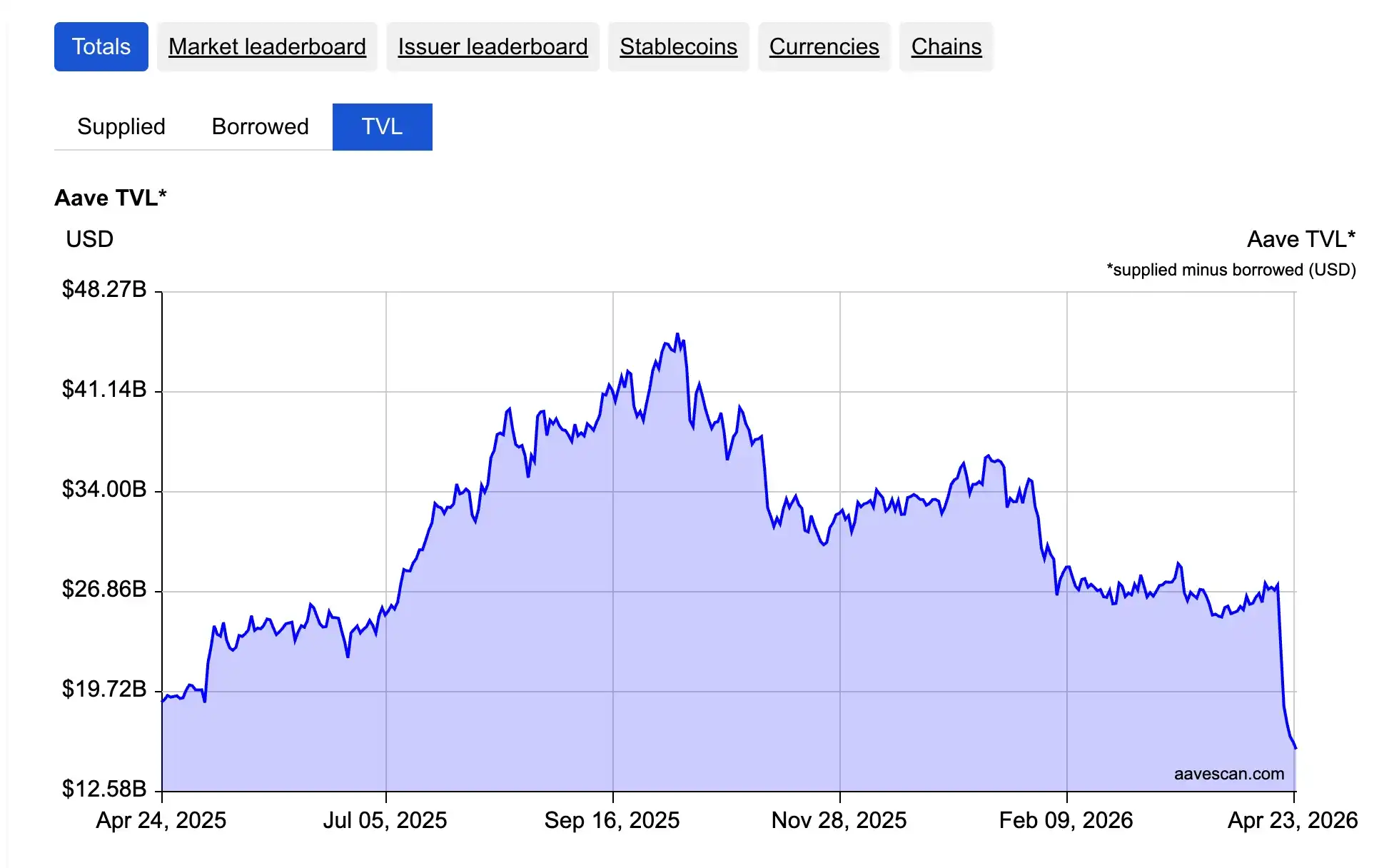
$292 million, this is the total amount of rsETH funds stolen from Kelp DAO; $17.2 billion, this is the scale of funds that have flowed out of Aave since the incident.

Aave is watching the community's panic sentiment ferment for several consecutive days due to its extremely foolish crisis PR strategy, thereby losing its once greatest advantage in the lending track—hundreds of billions of dollars in deposited funds and the user mindset label of "the safest DeFi".
  • Odaily Note: For background, please refer to "DeFi Hacked Again for $292 Million, Is Aave No Longer Safe?" and "The Tripartite Game Under the $290 Million Hole: Who Will Pay the Bill—Aave, L0, or Kelp?".

What Did Aave Do Wrong?

The details of the Kelp DAO hack need not be repeated; blaming Aave for why it granted rsETH such a high LTV is meaningless now. Here, I mainly want to discuss Aave's response strategy after the incident from the perspective of a long-term AAVE user.

First is the bad debt scale issue; Aave itself has done the math. Depending on the different handling of rsETH, there might be two possible bad debt scenarios—if the stolen loss is written off from all rsETH in circulation, it is expected to generate $123.7 million in bad debt; if the value of mainnet rsETH is protected and the loss is fully recorded in the mapped version of rsETH on Layer2, it is expected to generate $230.1 million in bad debt.

In either case, Aave has the capability to cover it with its reserves from Umbrella, the DAO treasury, and the team. I understand that Aave is unwilling to pay this money itself and wants the main responsible party, Kelp DAO, and the secondary responsible party, LayerZero, to contribute as much as possible. But the problem is that the other parties will think the same way—"Aave is so rich, the situation is so awkward, it should bear more." Therefore, in the short term, it is difficult for these three parties to reach a consensus, which implies that a solution that satisfies everyone is temporarily impossible.

But users cannot wait that long—Aave's yield levels have never been very competitive in the industry. Users who choose to deposit with Aave are all attracted by its reputation, security, and liquidity. However, the situation now is that in the most critical days after the incident, Aave consistently failed to give users some kind of bottom-line guarantee promise, but instead kept emphasizing "our code has no problems" and "how rsETH is accounted for is beyond Aave's control" to shift blame.

This is why panic sentiment kept fermenting within the community. Users tried every means to escape and avoid risk: those who could withdraw directly did so, and those who couldn't went to borrow from other pools first, causing the impact to gradually expand. So Aave's current situation is: on one hand, it faces continuous fund outflows; on the other hand, multiple pools are experiencing liquidity drying up due to utilization rates being maxed out.

This awkward situation could have been avoided (or at least not been this bad)... Since Aave can afford the money, why didn't it inject a dose of reassurance into the community from the beginning to prevent a bank run? At most, it's $230 million in bad debt (possibly less), and this money wouldn't necessarily be paid by Aave alone;后续 could continue to dispute with LayerZero and Kelp DAO.

Now, it's done. For the sake of a promised relief of at most $230 million, Aave watched $17.2 billion in deposited funds flow out (the number may continue to grow), and this doesn't even include the decline in AAVE's price these days... No matter how you calculate it, it's a huge loss.

What makes Aave even more uncomfortable is that the worse its situation becomes, the more relaxed opponents like LayerZero and Kelp DAO will be, because they will judge that Aave will be more motivated to solve the problem as soon as possible, which only puts Aave at a disadvantage in the game.

Having reached this point, Aave has brought this upon itself.

Behind Aave, Spark Is Watching Covetously

While Aave is suffering from headaches, the situation of its competitor Spark is booming and extremely positive. What is even more lamentable is that Spark is actually a competitor "personally incubated" by Aave.

Spark was originally a lending protocol forked and developed by Sky (formerly MakerDAO) based on the open-source code of Aave V3; both sides actually use the same underlying code logic. In return, there was once a profit-sharing agreement between Spark and Aave, but later Aave accused Spark of涉嫌 breaching the contract, and coupled with route differences, the two are now purely competitive.

Three months before the Kelp DAO theft, Spark had just removed support for rsETH (for details, please refer to "Same Day, Different Fate: Aave Embraces rsETH and Loses Nearly $200 Million, Spark Exits Unscathed"). You call it strategic conservatism or rigorous risk control, or even attribute it entirely to luck, but the result is that Spark was not affected at all in this incident—on this point alone, Spark can wantonly attack Aave's former "safest DeFi" label.

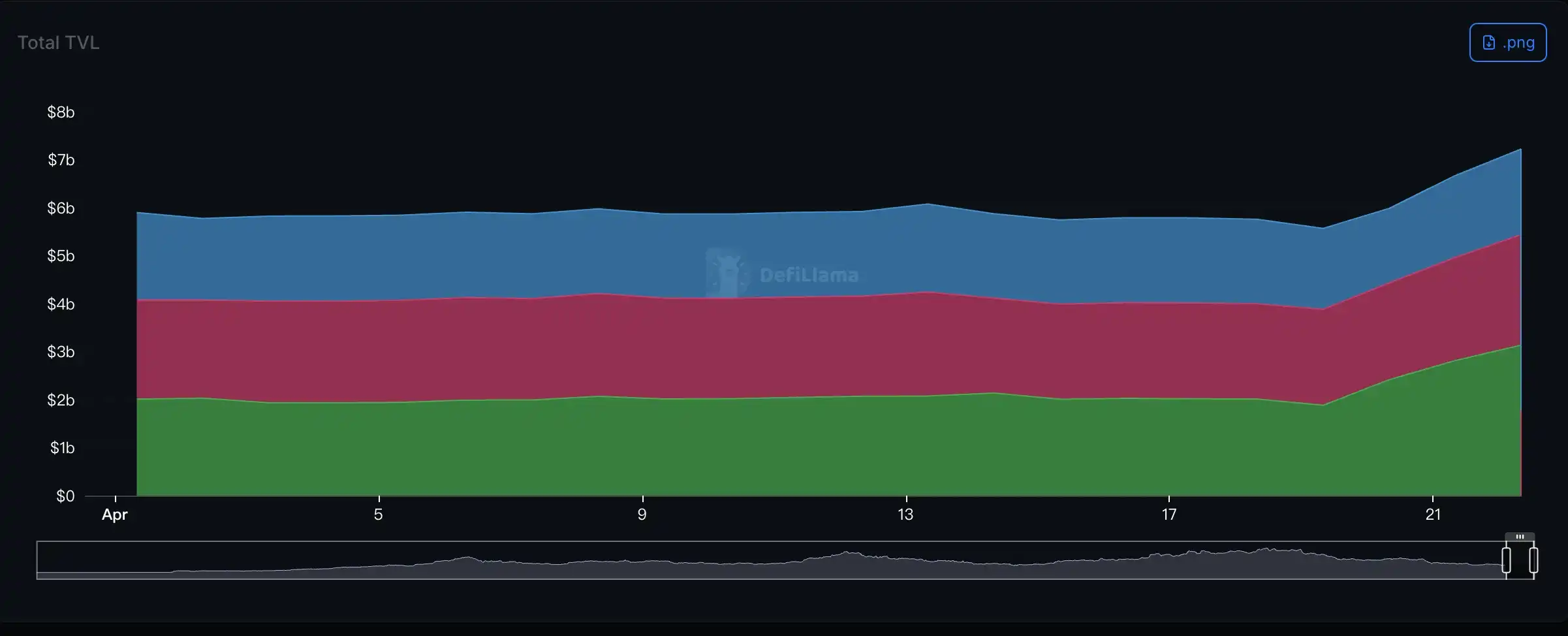
Thus, Spark became one of the safe havens for funds fleeing Aave. Since the incident, Spark's TVL has grown by nearly $2 billion (green part in the chart below). On the day of the incident, Justin Sun withdrew 53,665 ETH (worth $124 million) from Aave and subsequently deposited it into Spark. After continued accumulation in recent days, the total deposit has reached $1.3 billion—in the DeFi world, Brother Sun's operations are really something to learn.
On April 23, Upbit officially announced the launch of the Spark (SPK) Korean Won trading market. SPK, stimulated by this positive news, rose over 80% in a single day, significantly narrowing the market value gap between itself and AAVE.

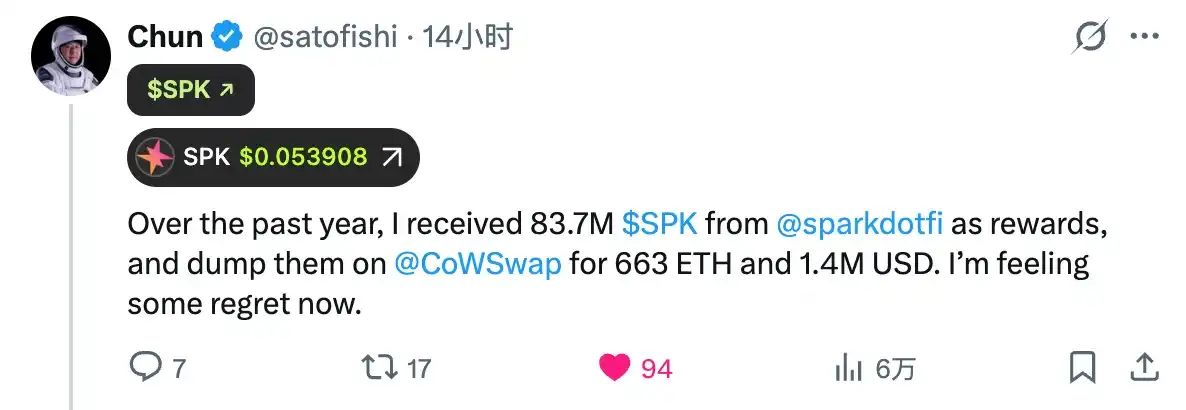
Even Wang Chun, founder of F2Pool, lamented on X: "In the past year, I received 83.7 million SPK rewards from Spark and sold them on CoWSwap for 663 ETH and $1.4 million. Now I kind of regret it."
Spark clearly realizes that this is a perfect opportunity to seize market share from Aave's mouth. Since the incident, Spark's Strategy Lead, MonetSupply, has almost become the most frequent KOL speaking out on this matter, posting dozens of times a day. Although his发言 can indeed help the public understand what happened, it objectively also加剧 the panic sentiment surrounding Aave.

But this is the purest商业 competition; MonetSupply just made the most correct choice.

Aave Is Losing the Throne of DeFi Lending

In the early morning of April 24, perhaps realizing the严峻 situation, Aave founder Stani announced on X the launch of a relief plan called DeFi United. Cooperative participants include LayerZero, Ethena, ether.fi, Ink Foundation, Golem Foundation, Trydo, etc. Stani personally will also donate 5,000 ETH to solve the current problem.

But the funds have already flowed out, and user trust has been severely damaged. Relying solely on this belated statement, Aave will find it difficult to regain deposited funds and user trust in the short term.

The DeFi lending track has long presented a pattern of "one superpower, multiple great powers," with Aave一直以来 having seemingly extremely solid leading advantages. But now, Aave is拱手 surrendering the throne. Behind it, challengers are coming aggressively; besides the booming Spark, other opponents like Morpho and Jupiter Lend also hope to take a bite out of Aave's share.

Last year, Stani bought a five-story luxury house in London for approximately $30 million, one of the most expensive transactions in the UK's sluggish luxury real estate market in the past year. I don't know if there is something like a "jinx," but with precedents like Su Zhu and others, it seems that big shots who consume conspicuously within the circle always run into some倒霉事.

I can't guess what Stani is thinking right now in his five-story luxury house.

Связанные с этим вопросы

QWhat was the main reason for the massive outflow of funds from Aave following the Kelp DAO hack?

AAave's extremely poor crisis management strategy, which failed to provide a timely and reassuring commitment to cover the potential bad debt, led to widespread community panic and a user rush to withdraw funds.

QWhat are the two potential bad debt scenarios calculated by Aave after the rsETH exploit?

AIf the stolen loss is written off from all rsETH in circulation, it would result in approximately $123.7 million in bad debt. If the value of mainnet rsETH is protected and the loss is fully attributed to the mapped version of rsETH on Layer 2, it would result in approximately $230.1 million in bad debt.

QWhich competitor protocol directly benefited from the funds flowing out of Aave, and what was a significant factor in its immunity to the hack?

ASpark Protocol directly benefited, with its TVL growing by nearly $2 billion. A significant factor was that Spark had removed support for rsETH three months prior to the hack, avoiding any exposure to the incident.

QWhat was the name of the key initiative announced by Aave founder Stani Kulechov in a belated attempt to address the crisis?

AStani Kulechov announced an initiative called 'DeFi United,' a relief plan involving partners like LayerZero and Ethena, to which he also personally pledged a donation of 5,000 ETH.

QAccording to the author, what is the fundamental reason users traditionally deposited funds into Aave, given its uncompetitive yield rates?

AUsers traditionally deposited into Aave due to its reputation for safety, security, and deep liquidity, not for competitive yield rates.

Похожее

Will the Next Crypto Bull Run Start with On-Chain Trading of SpaceX?

This article presents a scenario-based forecast for the crypto industry from 2026 to 2029, arguing that the next major cycle will be driven not by technological narratives but by legal access to real-world assets. The author predicts that by mid-2026, pre-IPO perpetual contracts for top private companies like SpaceX, OpenAI, and Anthropic on platforms like Hyperliquid will become the primary gateway for accessing quality assets, as most crypto-native tokens fail to capture real value. The much-hyped AI x Crypto intersection largely fails except for prediction markets, which thrive on betting on AI model supremacy. By 2027, public blockchain foundations are forced to choose between catering to retail speculation or building compliant infrastructure for institutions, with many opting for the latter. Growth in stablecoins and tokenized private credit/equity hits a "triple ceiling" due to regulatory and political uncertainty rather than market demand. The pivotal shift is forecast for 2028. A major liquidation event in pre-IPO perpetuals exposes the structural flaw of synthetic markets lacking a real underlying asset anchor. In response, regulatory changes finally allow the public solicitation of private securities resales to verified accredited investors. This creates a legitimate secondary market for real company equity, which then becomes the core asset class of the new bull market, relegating synthetic perps to a niche role. By 2029, the industry becomes "boring" but foundational. Tokens without claims on real cash flows or assets cease trading. Stablecoin growth is steady but politically capped. Crypto infrastructure fades from view as it gets absorbed into traditional finance backends. The article's central thesis is that the key bottleneck for crypto's next phase is legal and regulatory channels for real asset ownership, not technology.

marsbit1 ч. назад

Will the Next Crypto Bull Run Start with On-Chain Trading of SpaceX?

marsbit1 ч. назад

The Value Distribution of Stablecoins

**Summary: The Value Distribution of Stablecoins** The article argues that stablecoins are evolving from mere trading tools into broader channels for dollar access. It divides the stablecoin ecosystem into four layers to analyze how value is distributed: 1. **Issuance Layer:** Mints stablecoins, holds reserve assets, and captures the spread between reserve yield and user costs (e.g., Tether, Circle). This layer currently earns the largest profit margin. 2. **Infrastructure Layer:** Connects stablecoins to the traditional financial system, handling fiat on/off-ramps, banking integration, compliance (KYC/AML), and asset management (e.g., Bridge, BVNK). This is the "unglamorous" but critical work, building the essential bridges between crypto and real-world finance. 3. **Acquiring/Distribution Layer:** Integrates stablecoins into merchant systems, manages payment flows, and provides enterprise financial software (e.g., Stripe, Coinbase). They act as the access point for businesses. 4. **Application Layer:** The end-users and businesses that ultimately use stablecoins for payments, settlements, or as a store of value. They benefit from convenience but have little pricing power. The core thesis is that while the issuance layer currently dominates profits, the often-overlooked **infrastructure layer holds significant long-term potential**. The real challenge and barrier to mass adoption is not the on-chain transfer of stablecoins (which is simple), but the complex "last mile" integration into existing business workflows, banking systems, and regulatory frameworks across different countries. Companies in this layer are currently in a "land grab" phase, investing heavily to build networks, secure bank partnerships, and establish compliance pathways. While their position is currently pressured by the profitable issuers above and distribution platforms below, the article suggests that if stablecoins become a default financial rail for businesses, the infrastructure providers who have done the hard work of integration will ultimately gain strong pricing power and become entrenched, essential players.

marsbit8 ч. назад

The Value Distribution of Stablecoins

marsbit8 ч. назад

The Value Distribution of Stablecoins

The Value Distribution of Stablecoins The article argues that stablecoins are evolving from a mere trading tool into a broad "dollar channel." It analyzes the industry's value chain through four layers: 1. **Issuance Layer (e.g., Tether, Circle):** The top layer that mints stablecoins, holds reserve assets, and captures the thickest interest rate spread. 2. **Infrastructure Layer (e.g., Bridge, BVNK):** Connects stablecoins to the traditional financial system, handling critical but complex "dirty work" like fiat on/off-ramps, banking integration, compliance (KYC/AML), and cross-border settlement. 3. **Acquiring/Distribution Layer (e.g., Stripe, Coinbase):** Embeds stablecoins into merchant systems, manages payment flows, and integrates with enterprise software. 4. **Application Layer:** End-users and businesses that ultimately use stablecoins for payments, settlement, or storing value. The author posits that while the issuance layer currently captures the most profit, the most overlooked and potentially critical layer is infrastructure. The core challenge for stablecoin adoption isn't the on-chain transfer (which is simple), but bridging the gap between blockchain and the real-world financial system. This involves solving practical problems for businesses: fiat conversion, reconciliation, tax handling, and user onboarding. Infrastructure companies are currently in a difficult "land-grab" phase—building networks, securing banking relationships, and achieving compliance country-by-country. They face pressure from both the profitable issuance layer above and distribution platforms below. However, the author suggests this layer is building a crucial moat. Once stablecoins become a default business rail, the infrastructure players who have done the hard work of integration may gain significant, durable value and pricing power.

链捕手8 ч. назад

The Value Distribution of Stablecoins

链捕手8 ч. назад

Торговля

Спот
Фьючерсы

Популярные статьи

Как купить AAVE

Добро пожаловать на HTX.com! Мы сделали приобретение Aave Protocol (AAVE) простым и удобным. Следуйте нашему пошаговому руководству и отправляйтесь в свое крипто-путешествие.Шаг 1: Создайте аккаунт на HTXИспользуйте свой адрес электронной почты или номер телефона, чтобы зарегистрироваться и бесплатно создать аккаунт на HTX. Пройдите удобную регистрацию и откройте для себя весь функционал.Создать аккаунтШаг 2: Перейдите в Купить криптовалюту и выберите свой способ оплатыКредитная/Дебетовая Карта: Используйте свою карту Visa или Mastercard для мгновенной покупки Aave Protocol (AAVE).Баланс: Используйте средства с баланса вашего аккаунта HTX для простой торговли.Третьи Лица: Мы добавили популярные способы оплаты, такие как Google Pay и Apple Pay, для повышения удобства.P2P: Торгуйте напрямую с другими пользователями на HTX.Внебиржевая Торговля (OTC): Мы предлагаем индивидуальные услуги и конкурентоспособные обменные курсы для трейдеров.Шаг 3: Хранение Aave Protocol (AAVE)После приобретения вами Aave Protocol (AAVE) храните их в своем аккаунте на HTX. В качестве альтернативы вы можете отправить их куда-либо с помощью перевода в блокчейне или использовать для торговли с другими криптовалютами.Шаг 4: Торговля Aave Protocol (AAVE)С легкостью торгуйте Aave Protocol (AAVE) на спотовом рынке HTX. Просто зайдите в свой аккаунт, выберите торговую пару, совершайте сделки и следите за ними в режиме реального времени. Мы предлагаем удобный интерфейс как для начинающих, так и для опытных трейдеров.

963 просмотров всегоОпубликовано 2024.04.12Обновлено 2026.06.02

Как купить AAVE

Обсуждения

Добро пожаловать в Сообщество HTX. Здесь вы сможете быть в курсе последних новостей о развитии платформы и получить доступ к профессиональной аналитической информации о рынке. Мнения пользователей о цене на AAVE (AAVE) представлены ниже.

活动图片