a16z New Article: Prediction Markets Entering the Fast-Forward Phase

marsbitОпубликовано 2026-04-19Обновлено 2026-04-19

Введение

Prediction markets are evolving from niche tools focused on elections and sports into a broader financial infrastructure for pricing real-world uncertainty. Key shifts include: application expansion beyond sports into entertainment, macro, and CPI markets; the creation of direct price benchmarks for events (e.g., tariffs, Fed decisions), enabling precise hedging without correlated asset risks; and growing institutional adoption, though still early-stage. While sports drive volume, long-tail markets show faster growth. Current institutional use is primarily for data, but progression toward system integration and active trading is expected. Regulatory advancements, like margin trading, are critical for scaling. The market is transitioning toward an essential, institutional-grade tool, similar to the evolution of options markets.

Editor's Note: For a long time, prediction markets have been viewed as a kind of "fringe product": first as academic experiments, later as tools for election season discourse, and then again as an extension of sports betting. They always seemed to attach themselves to some high-attention scenario but were rarely truly understood as financial infrastructure.

However, in the author's view, prediction markets are gradually evolving from a marginal, election-and-sports-focused "event trading tool" into a financial infrastructure capable of pricing uncertainty.

The author points out that key industry changes are evident on three levels: first, application scenarios are expanding—while sports remain the traffic entry point, long-tail markets like entertainment, macroeconomics, and CPI are growing faster and beginning to carry institutional demand; second, prediction markets for the first time provide a tradable price benchmark for the "event itself," enabling institutions to directly hedge political or macro risks instead of making "secondary bets" through correlated assets; third, the path to institutional adoption is advancing, from data reference (checking odds) to system integration, and then to actual trading participation, with the current stage still being early.

Prediction markets are undergoing a process similar to the early days of the options market: "professionalization — institutionalization — infrastructuralization." Once liquidity, leverage, and regulation are gradually perfected in the future, they could become a core market tool connecting retail and institutional investors for hedging and pricing real-world uncertainty.

Finance is a highly "vertically stratified" world, where almost every niche has its own公认的 "annual mecca." Leaders from healthcare providers, payers, and biotech companies gather annually in San Francisco for the J.P. Morgan Healthcare Conference. Heavyweights in global macro and political figures from various countries go to the Swiss Alps for the World Economic Forum Annual Meeting (Davos). TMT, real estate, industrial, financial services, and almost every industry you can think of also have their own most representative flagship summits.

At the end of March this year, Kalshi's academic and institutional research department, Kalshi Research, held its first research conference in New York, bringing together academics, Wall Street executives, former political figures, and the traders who truly drive the markets. The composition of the attendees clearly indicated a trend: this industry is "maturing."

The day's events opened with a conversation between Kalshi co-founders Tarek Mansour and Luana Lopes Lara and Katherine Doherty. Below are some industry observations distilled from that dialogue and the subsequent roundtable discussions:

Markets and Life: More Than Just Elections and Sports.

During major news cycles, a fixed pattern often emerges: a major event (like the 2024 election, the Super Bowl, or more recently, March Madness college basketball) dominates the vast majority of media headlines and consequently dominates the trading volume in prediction markets. This easily creates the impression that "the value of prediction markets is only evident in these events."
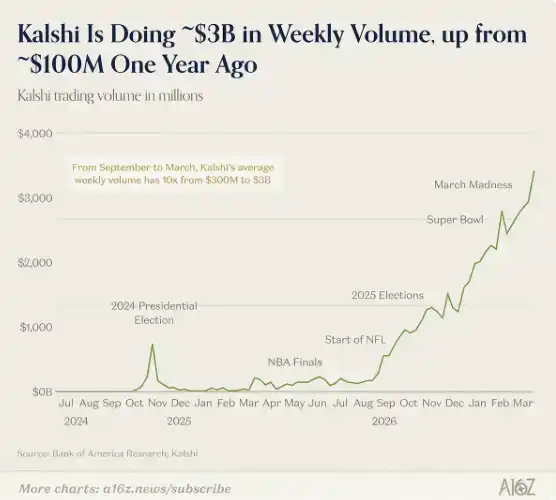
However, although early narratives often framed prediction markets as tools "only meaningful during election cycles," Kalshi's growth in other areas has been equally significant.

At the time of the research conference, weekly trading volume for sports contracts had just approached $3 billion, accounting for about 80% of Kalshi's total volume, largely driven by "March Madness." Tarek and Luana viewed this high concentration as a phased phenomenon.

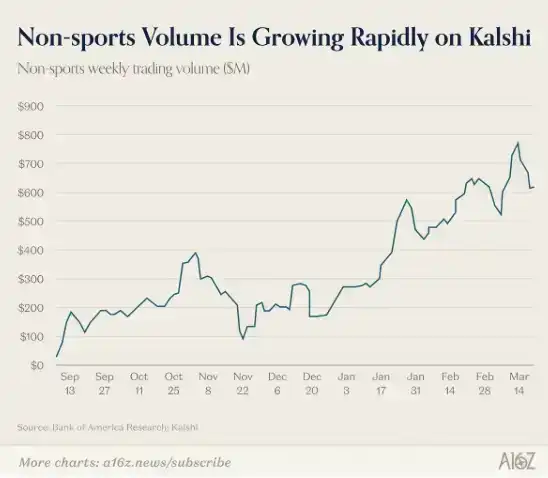
A more explanatory data point: despite the absolute size of sports trading hitting a record high, its share of total trading volume was at a historical low. This means that all other categories were growing faster.

The two founders pointed out that categories like entertainment, crypto, politics, and culture are showing stronger user growth and better trading retention structures than sports. Sports are more like a "trigger" for the mass market—they are highly familiar, have clear temporal rhythms, and strong emotional engagement, making them a typical entry product.

Meanwhile, the company has also observed significant growth in longer-tail markets. These markets currently constitute over 20% of Kalshi's trading volume and will play a more critical role in future institutional hedging and information markets.
A subsequent institutional roundtable confirmed this assessment from the demand side.

Cyril Goddeeris, Co-Head of Global Equities Business at Goldman Sachs, stated that predictions related to macro events and CPI data are the categories Wall Street is most focused on currently. Sally Shin, Executive Vice President of Growth Business at CNBC, mentioned that she already uses prediction markets like "Fed Chair's tenure" and "Non-Farm Payrolls data" as narrative tools for content. Tradeweb's Global Markets Co-Head, Troy Dixon, went further to描绘 a future picture: large investment banks will establish dedicated prediction market trading desks, with financial contracts as core products.

Why Kalshi Attracts Wall Street's Attention

An important reason traditional financial markets can function is that each core asset class has a公认的 benchmark: the S&P 500 index represents the overall performance of 500 stocks, crude oil has benchmark price systems like ICE.

But for political and macroeconomic events (e.g., who wins an election, whether tariffs pass, the outcome of a Supreme Court case), there has long been a lack of widely accepted, dynamically updated "pricing benchmarks." Prediction markets change this—now, the future of almost any event can have a real-time, liquid "price anchor."

Once an event (e.g., "Will a 30% tariff pass?") has a credible price, institutions can trade directly around that price. This allows for both trading the event itself and hedging risks in other parts of a portfolio. As Tradeweb's Troy Dixon said: "Go back to Trump's first election. There was a lot of hedging in the equity market then, the logic being to short the S&P because if Trump wins, the market will definitely fall. But that trade failed. The question was: how do you price these events? Where is the benchmark?"

Tarek also mentioned this was one of his motivations for founding Kalshi. During his tenure at Goldman Sachs, his trading desk had recommended trades based on the 2024 election and Brexit. Without prediction markets, institutions hedging political or macro events through correlated assets were actually betting on two things simultaneously: first, whether the event itself would happen, and second, the correlation between that event and the traded asset. And the second judgment could be wrong on its own.

When the event itself has a direct price benchmark, these two layers of risk are compressed into one. As Tarek said: "Now, this market is starting to price everything."

The Three Stages of True Institutional Adoption of Prediction Markets

It is clearly still too early to say that major Wall Street institutions are trading on Kalshi on a large scale. Currently, most institutions' usage remains at the "data source" level, not the "trading platform" level.

However, Luana pointed out that the path to institutional adoption of this market is clear and can be divided into three stages:

The first stage is data access: getting prediction prices into the daily workflow of institutions. For example, getting Goldman Sachs portfolio managers to habitually check Kalshi's odds data just like they check the VIX index. This stage is already happening to some extent. John Hopkins University professor and former Fed official Jonathan Wright stated: "In areas like Fed decisions, unemployment, GDP, Kalshi is almost the only reference source."

The second stage is system integration: including compliance and legal approval, technical integration, and internal education—essentially the process of introducing a new financial instrument.

The third stage is actual trading: institutions begin to directly hedge risks on the platform, trading volume and market depth gradually accumulate. At this point, more hedging demand attracts speculators, tighter spreads attract more hedgers, and the benchmark price forms a self-reinforcing positive feedback loop.

Currently, most institutions are still in the first stage, some are entering the second stage, and very few have truly entered the third stage. A major obstacle is that current market trading requires full margin. For example, a $100 position requires a $100 margin deposit. This is acceptable for individual investors but too costly for hedge funds or banks that rely on leverage and capital efficiency.

As Tarek said: "If you want to do a $100 hedge, you have to put $100 in the clearinghouse. That's too expensive for institutions. Firms like Citadel or Millennium won't do that." Kalshi has already obtained a license from the National Futures Association (NFA) and is working with the Commodity Futures Trading Commission (CFTC) to introduce margin trading mechanisms.

What Happens Next?

Michael McDonough, Head of Market Innovation at Bloomberg, summarized it most directly: "The sign of success is when these things become boring." He compared prediction markets to the options market in the 1970s, which was同样 full of controversy over manipulation and regulatory uncertainty but eventually evolved into an infrastructure, so much so that today almost no one thinks twice about it.

AQR partner Toby Moskowitz said he "would bet real money" that prediction markets will become a viable institutional tool within five years, possibly even sooner.

Vote Hub's Garrett Herren described the end state: "The question is no longer whether to use prediction markets, but how to use them. Once the question becomes that, it means they have become indispensable."

In fact, although the current scale of prediction markets is still limited, the hedging market itself is a massive field.
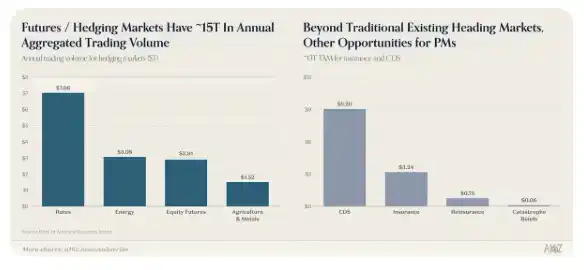
In fact, the "normalization" of prediction markets is already happening.

In the politics-themed roundtable, former Congressman Mondaire Jones mentioned that senior figures in both parties—including President Trump, House Minority Leader Jeffries, and Senate Minority Leader Schumer—have begun citing Kalshi's odds data in public. DDHQ's Scott Tranter also confirmed that prediction market data has now become a standard input within party committees. Meanwhile, Vote Hub announced it has directly integrated Kalshi data into its midterm election forecasting models.

And all of this did not exist at all two years ago. Back then, the most successful traders on Kalshi were still predominantly "amateurs." Now, that term isn't even accurate anymore.

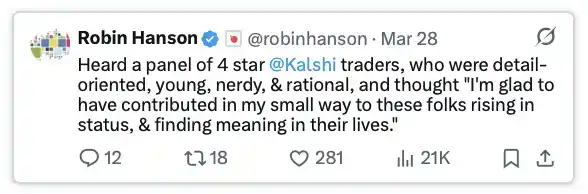
In Kalshi's "The People Behind the Markets" roundtable, four traders shared their career paths—these paths sounded no different from traditional professional traders: one spent 11 years studying the Billboard music charts, another has been refining his skills in prediction markets since 2006, when it was still a "somewhat geeky hobby that barely made money." Notably, none of these four guests came from traditional finance; they came from music, politics, and poker respectively. But they unanimously agreed that the platform truly rewards deep domain knowledge, not glossy resumes.

Prediction markets have come a long way. Initially seen as academic experiments, then as "novelty tools" during elections, later categorized as "sports-betting-like products," their positioning has constantly changed. The clear signal from this conference is: prediction markets are evolving into an infrastructure—for pricing uncertainty, serving a wide range of participants from retail traders to large institutions and diverse application scenarios.
Связанные с этим вопросы

QWhat are the three key changes in the prediction market industry highlighted in the article?

AThe three key changes are: 1) Application scenarios are expanding, with sports remaining the traffic entry point but long-tail markets like entertainment and macro growing faster and beginning to carry institutional demand. 2) Prediction markets provide a tradable price benchmark for events themselves, allowing institutions to directly hedge political or macro risks instead of making secondary bets through related assets. 3) Institutional adoption is progressing from data reference (viewing odds) to system integration and then to actual trading, currently still in the early stages.

QWhy is Kalshi attracting attention from Wall Street according to the article?

AKalshi is attracting Wall Street's attention because it provides a real-time, liquid 'price anchor' for political and macroeconomic events, which previously lacked widely accepted dynamic pricing benchmarks. This allows institutions to trade directly on events or hedge risks in their portfolios. It compresses the two layers of risk (whether the event occurs and the correlation between the event and traded assets) into one layer, making hedging more efficient.

QWhat are the three stages of institutional adoption of prediction markets as described by Luana Lopes Lara?

AThe three stages are: 1) Data access: Integrating prediction prices into institutional workflows, such as portfolio managers routinely checking Kalshi's odds data. 2) System integration: Involving compliance and legal approvals, technical对接, and internal education for introducing a new financial instrument. 3) Actual trading: Institutions start directly hedging risks on the platform, with trading volume and market depth gradually accumulating.

QWhat is a major obstacle for institutional adoption of prediction markets mentioned in the article?

AA major obstacle is the current requirement for full margin trading. For example, a $100 position requires $100 in margin. This is too costly for hedge funds or banks that rely on leverage and capital efficiency, as institutions like Citadel or Millennium would not operate this way. Kalshi is working with the CFTC to introduce margin trading mechanisms.

QHow is the prediction market evolving according to the conclusion of the article?

AThe prediction market is evolving from being seen as an academic experiment, a novelty tool during elections, or a sports-betting-like product into a financial infrastructure for pricing uncertainty. It is becoming a core market tool connecting retail and institutions for hedging and pricing real-world uncertainties, similar to the early development of the options market.

Похожее

После трёх кварталов падения: получится ли у крипторынка стабилизироваться в третьем квартале?

Криптовалютный рынок пережил худший квартал с 2022 года, общая капитализация упала на 12,6% до $2,1 трлн, а дневные объемы торгов снизились на 20,9%. Впервые за три года сократилась и капитализация стейблкоинов. Основные факторы спада — отток средств из биткоин-ETF, распродажа биткоинов корпоративным казначейством Strategy и ужесточение монетарной политики ФРС. Второй квартал завершился чистым оттоком $46,7 млрд из ETF, при этом в июне отток достиг рекордных $45 млрд. Ключевым событием третьего квартала станет заседание ФРС 28–29 июля. Мягкий сигнал может поддержать биткоин в диапазоне $68 000–84 000 и вернуть приток в ETF, тогда как жесткая риторика способна сместить торговый диапазон к $50 000–56 000. Законодательная неопределенность также давит на рынок: прогресс по закону CLARITY Act, определяющему регуляторные границы, замедлился, и вероятность его принятия в 2026 году упала до 40–45%. Несмотря на общий спад, два сегмента показали рост: объемы на рынках предсказаний выросли на 48,7%, а торговля токенизированными коллекционными предметами увеличилась на 143%. Сектор RWA продолжает стабильно развиваться, достигнув $28,1 млрд. Рынок, вероятно, миновал фазу острой распродажи, но для устойчивого восстановления необходимы ясность от ФРС и регуляторный прогресс.

marsbit2 ч. назад

После трёх кварталов падения: получится ли у крипторынка стабилизироваться в третьем квартале?

marsbit2 ч. назад

BIT Торговые часы: BTC по-прежнему под давлением 200 EMA на недельном графике, после отскока возможен перезапуск нисходящего движения; секторы хранения данных и полупроводников, выросшие ночью, начали падение в вечерней сессии

**Краткий обзор рынка: BTC под давлением, коррекция на рынке акций, внимание к данным и событиям** Рынок криптовалют демонстрирует осторожное восстановление. Bitcoin торгуется около $66 000, сталкиваясь со значительным сопротивлением в районе $68 000, где сосредоточены объемные "застрявшие" позиции. Ключевые технические уровни — 200-недельная скользящая средняя (~$63 333) и 200-недельная EMA (~$68 328). Аналитики отмечают низкую ликвидность, характерную для летнего периода. На фондовом рынке после сильного роста во вторник наблюдается коррекция. Фьючерсы на основные индексы США снижаются. Акции полупроводниковой и памяти, которые резко выросли накануне, падают в ночных торгах. Исключением стал SMCI, который вырос более чем на 15% после оптимистичного прогноза. На общий настрой негативно влияют рост цен на нефть (более $91 за баррель Brent) и доходности государственных облигаций США (10-летние — около 4,64%), что возрождает инфляционные опасения. Азиатские рынки показали нестабильную динамику. Индекс KOSPI в Корее вырос на 0,74%, а японский Nikkei 225 снизился на 0,18%. Основной риск для региона — ослабление японской иены до минимумов с 1986 года, что повышает вероятность вмешательства властей. **Ключевые события для наблюдения:** * **24 июля:** Финансовые отчеты Alphabet (Google), Tesla, IBM. Событие AMD, посвященное ИИ. * **25 июля:** Решение по процентной ставке ЕЦБ и пресс-конференция Кристин Лагард. Финансовые отчеты Intel, American Airlines, Honeywell и других. Данные по числу первичных заявок на пособие по безработице в США.

marsbit2 ч. назад

BIT Торговые часы: BTC по-прежнему под давлением 200 EMA на недельном графике, после отскока возможен перезапуск нисходящего движения; секторы хранения данных и полупроводников, выросшие ночью, начали падение в вечерней сессии

marsbit2 ч. назад

Бывший глава CFTC и президент Circle Тарберт: призывает к долгосрочной стратегии, но сам выводит $30 млн

Бывший председатель CFTC и президент Circle Хит Тарберт, публично пропагандируя долгосрочное видение компании для инвесторов на фоне падения акций на 70% с пиковых значений, сам активно распродавал свои акции CRCL. С момента IPO Circle он по плану 10b5-1 продал более 360 тысяч акций, выручив около 30 миллионов долларов, и при этом ни разу не докупал акции на открытом рынке. Эта разница между его публичными заявлениями и личными действиями вызвала критику. Карьера Тарберта демонстрирует классическое использование «вращающейся двери» между регулирующими органами и частным сектором. Уйдя с поста председателя CFTC в 2021 году, через 27 дней он занял должность главного юрисконсульта в маркет-мейкере Citadel Securities, который в тот момент находился под пристальным вниманием из-за скандала с акциями GameStop. Позже, уже работая в Citadel, Тарберт выступал за расширение полномочий CFTC на крипторынок, в то время как его работодатель планировал выход на этот рынок. В 2023 году Тарберт присоединился к Circle, где его опыт и связи сыграли ключевую роль в успешном проведении IPO компании в 2025 году. Однако его последующие массовые продажи акций, совпавшие с падением котировок и его же призывами к долгосрочным инвестициям, ставят под сомнение искренность его уверенности в будущем компании. Критики видят в его карьере образец превращения регуляторного опыта и политических связей в личную выгоду, в то время как риски несут обычные инвесторы, верящие его нарративам.

marsbit2 ч. назад

Бывший глава CFTC и президент Circle Тарберт: призывает к долгосрочной стратегии, но сам выводит $30 млн

marsbit2 ч. назад

Gate Research: Взлет «уолл-стритизации» криптофинансовых продуктов — это конкуренция или интеграция?

**Аналитический обзор Gate Research Institute: Волна "уолл-стритизации" криптофинансовых продуктов — конкуренция или интеграция?** Создание биткоина в 2009 году было ответом на финансовый кризис и стремлением построить децентрализованную систему без доверенных посредников. Однако к 2026 году значительная часть биткоинов (около 7,14%) хранится через ETF таких гигантов, как BlackRock. Это символизирует глубокую интеграцию традиционных финансов (TradFi) и крипторынка. С появлением биткоин-ETF, фьючерсов, RWA (токенизированных реальных активов) и государственных облигаций на блокчейне, традиционные институты получают всё больше влияния на выпуск, ценообразование, кастодию и дистрибуцию криптоактивов. Однако это не одностороннее поглощение, а взаимодополняющая конвергенция. Криптосфера приносит TradFi глобальную 24/7 ликвидность и программируемость, а TradFi предоставляет криптосфере регулируемые каналы, институциональное доверие и массовый доступ. Яркий пример — две противоположные, но ведущие к одной цели траектории: * **Путь А:** Криптобиржи, такие как Gate, начинают с токенизированных акций и CFD, а затем напрямую подключаются к инфраструктуре традиционных брокеров, предлагая реальную торговлю акциями США, Гонконга и Кореи за стейблкоины. * **Путь Б:** Традиционные брокеры, такие как Robinhood, интегрируют криптоактивы, а затем создают собственные Layer 2 для токенизации своих акций, стремясь к круглосуточной торговле. Обе стратегии нацелены на создание **универсального финансового аккаунта будущего** — единой точки доступа к акциям, криптовалютам, ETF, токенизированным облигациям и другим активам. Ключевой конкурентной борьбой становится не между CEX и брокерами, а между этими "супераккаунтами". Параллельно, слой RWA и токенизированных гособлигаций растёт даже на медвежьем рынке, становясь "прослойкой" для объединения капиталов. Хотя этот рынок (около $150 млрд токенизированных казначейских облигаций) ещё мал по сравнению с традиционным ($30 трлн), он демонстрирует устойчивый структурный тренд, привлекающий крупнейшие финансовые институты (JPMorgan, DTCC и др.). **Вывод:** "Уолл-стритизация" — это не поражение идеалов децентрализации, а формирование новой гибридной модели. Децентрализованные протоколы продолжают работать на базовом уровне, в то время как на уровне приложений и пользовательского опыта формируется более эффективный, глобальный и свободный объединённый рынок капитала, где активы TradFi и DeFi торгуются бок о бок в одном интерфейсе. Уолл-стрит не завоевала криптосферу, а криптосфера не обошла Уолл-стрит — они совместно строят новые финансовые рельсы.

marsbit2 ч. назад

Gate Research: Взлет «уолл-стритизации» криптофинансовых продуктов — это конкуренция или интеграция?

marsbit2 ч. назад

S&P Dow Jones и Pantera выпускают криптоиндекс, биткоин оставлен за бортом из-за «отсутствия прибыли»

Стандард энд Пурс (S&P Dow Jones Indices) совместно с Pantera Capital запускает индекс S&P Pantera Digital Asset Index. Новый индекс включает 18 токенов, но исключает биткоин, XRP и мем-токены. Критерием отбора послужила «финансовая жизнеспособность», по аналогии с S&P 500: протокол должен демонстрировать положительный доход в течение нескольких кварталов и распределять стоимость среди держателей токенов. Это первое применение фундаментального подхода к оценке криптоактивов со стороны крупнейшего в мире провайдера индексов. В первую пятерку активов вошли Ethereum (ETH), BNB, Solana (SOL), TRON (TRX) и Hyperliquid (HYPE). Pantera отмечает, что совокупный годовой доход всех протоколов индекса превышает $30 млрд. Биткоин был исключен по трем причинам: он рассматривается как монетарный актив, доступный через отдельные ETF; он не генерирует доход протокола; а смешивание его в индексе с доходными активами затрудняет фундаментальный анализ для институциональных инвесторов. Пока индекс является эталонным, но Pantera ведет переговоры о создании на его основе ETF и других инвестиционных продуктов. Компания также отмечает значительный разрыв на рынке: многие институциональные инвесторы готовы к аллокации в криптоактивы, но им не хватает структурированных продуктов, фокусирующихся на активах с реальной экономической деятельностью.

marsbit2 ч. назад

S&P Dow Jones и Pantera выпускают криптоиндекс, биткоин оставлен за бортом из-за «отсутствия прибыли»

marsbit2 ч. назад

Торговля

Спот
活动图片





