a16z Crypto: 9 Charts to Understand the Evolution of Stablecoins

marsbitОпубликовано 2026-04-25Обновлено 2026-04-25

Введение

Stablecoins are evolving from trading instruments to core financial infrastructure, driven by regulatory clarity and increased adoption. Key trends include accelerated growth following the U.S. GENIUS Act and the EU’s MiCA framework, which spurred non-USD stablecoin activity. Consumer-to-business transactions are growing fastest, doubling in 2025, while stablecoin card usage has surged. Velocity has nearly doubled since 2024, indicating active use rather than passive holding. Geographically, Asia dominates volume, led by Singapore, Hong Kong, and Japan. Notably, domestic transactions now account for nearly three-quarters of payments, highlighting stablecoins' role as local payment mediums on global infrastructure. Non-USD stablecoins, like Brazil’s BRLA, are also gaining traction. The data suggests stablecoins are becoming ubiquitous payment tools—global in design but increasingly local in practice.

Author: a16z crypto

Compiled by: Jiahuan, ChainCatcher

Stablecoins have been finding their footing for years.

Initially, they were just a trading tool, a means to transfer dollars across exchanges. Then they evolved into a savings instrument, held rather than spent. Today, the data points in a new direction: stablecoins are increasingly becoming core financial infrastructure.

The following nine charts reveal the factors driving this trend.

Regulation Accelerates Market Growth

For most of their history, regulatory uncertainty limited institutional participation. Later, the GENIUS Act brought regulatory clarity. It didn't create this trend, but it amplified and accelerated it.
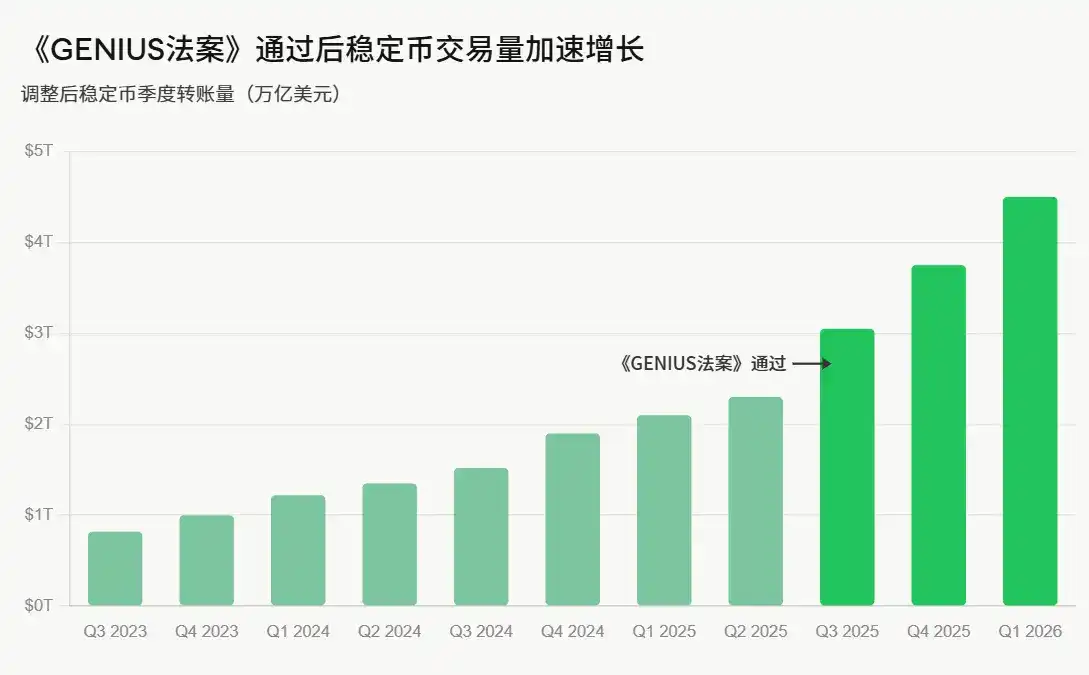
In the United States, the GENIUS Act established the first federal-level framework for stablecoin issuance. This shift is clearly visible in the data: adjusted trading volume had been rising for several quarters before the bill's passage, and growth accelerated further after its passage, reaching approximately $4.5 trillion in Q1 2026.

European regulation—the Markets in Crypto-Assets (MiCA) framework—tells a more complex story. When the法案 fully came into effect at the end of 2024, several major exchanges delisted USDT to comply, leading to a surge in activity for non-dollar stablecoins, which一度 exceeded $40 billion.
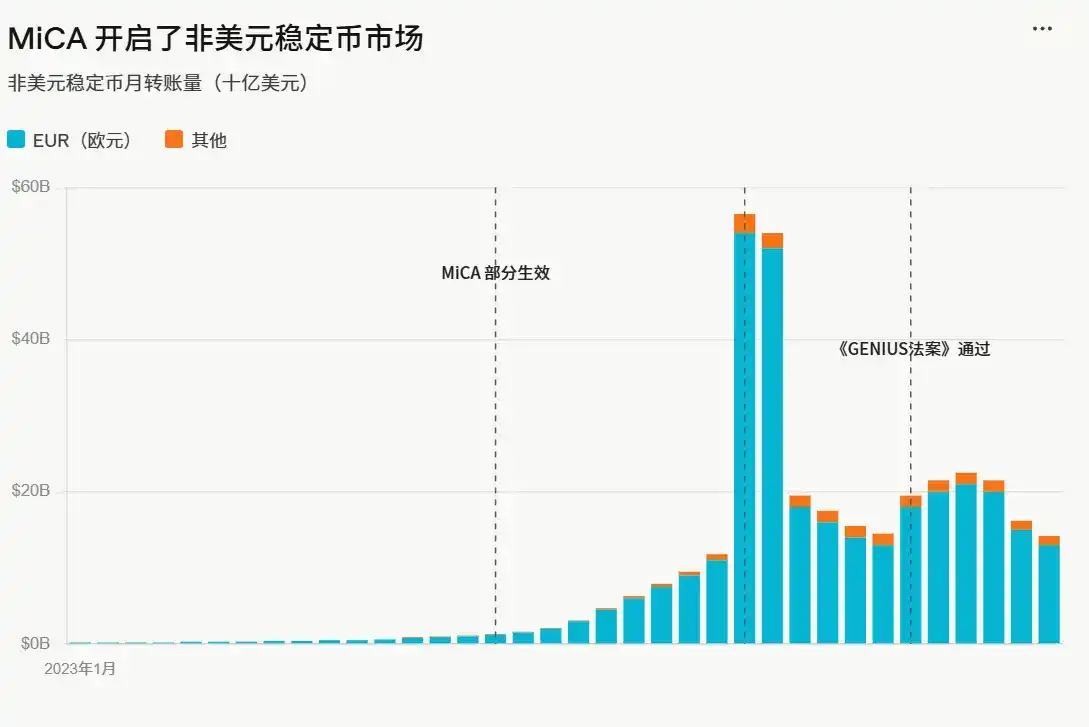
Since then, trading volume has stabilized at levels higher than the pre-MiCA baseline, around $15 billion to $25 billion per month. Regulation created a lasting market for non-dollar stablecoins that previously barely existed.

Stablecoin Commercial Activity is Growing

Perhaps the most noteworthy structural change lies in how people are actually using stablecoins.
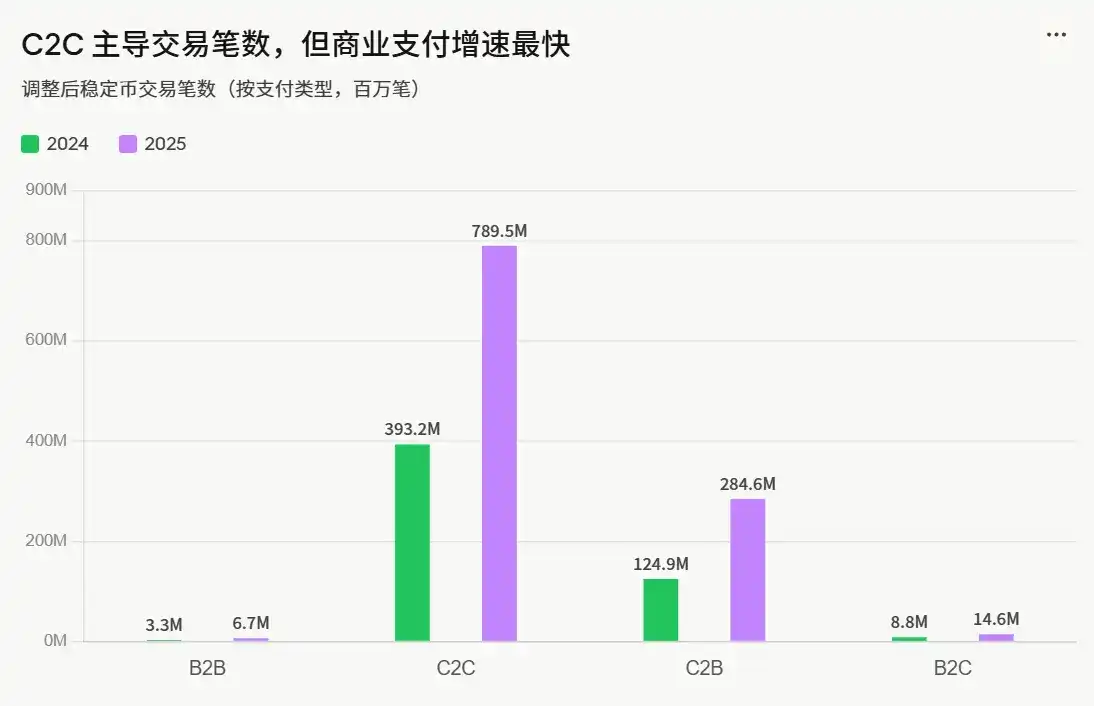
In terms of raw transaction count, the C2C category far surpasses all others: reaching 789.5 million in 2025. But Consumer-to-Business (C2B) stablecoin transactions grew the fastest, reaching 284.6 million in 2025 compared to 124.9 million in 2024, more than doubling year-over-year (+128%).

Data from stablecoin card infrastructure highlights this trend.
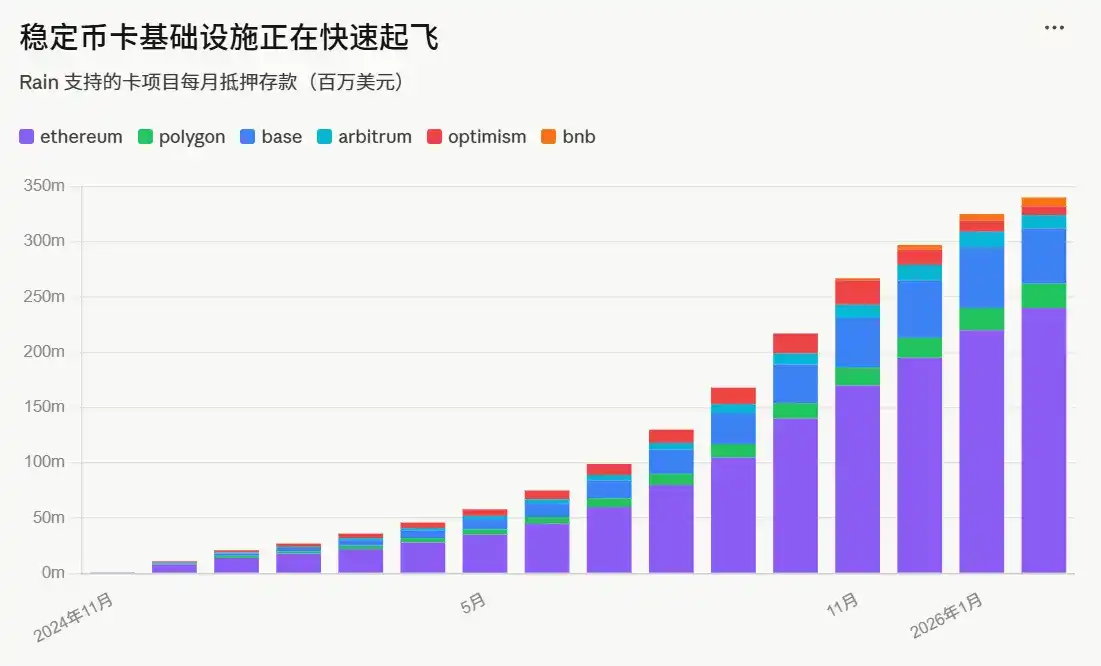
Monthly collateral deposits for stablecoin card programs supported by Rain (including Etherfi Cash, Kast, Wallbit, etc.) grew from nearly zero in November 2024 to over $300 million per month by early 2026. While this is collateral supporting spending, not direct spending of stablecoins, the trajectory is striking: stablecoin commercial activity is on the rise.

Stablecoin Velocity is Increasing

Every dollar of stablecoin supply is turning over more frequently.

Since early 2024, the velocity of stablecoins (the ratio of adjusted monthly transfer volume to circulating supply) has almost doubled, rising from 2.6x to 6x. An increase in velocity means demand for stablecoin transactions is outpacing new issuance, and the existing supply is working harder.
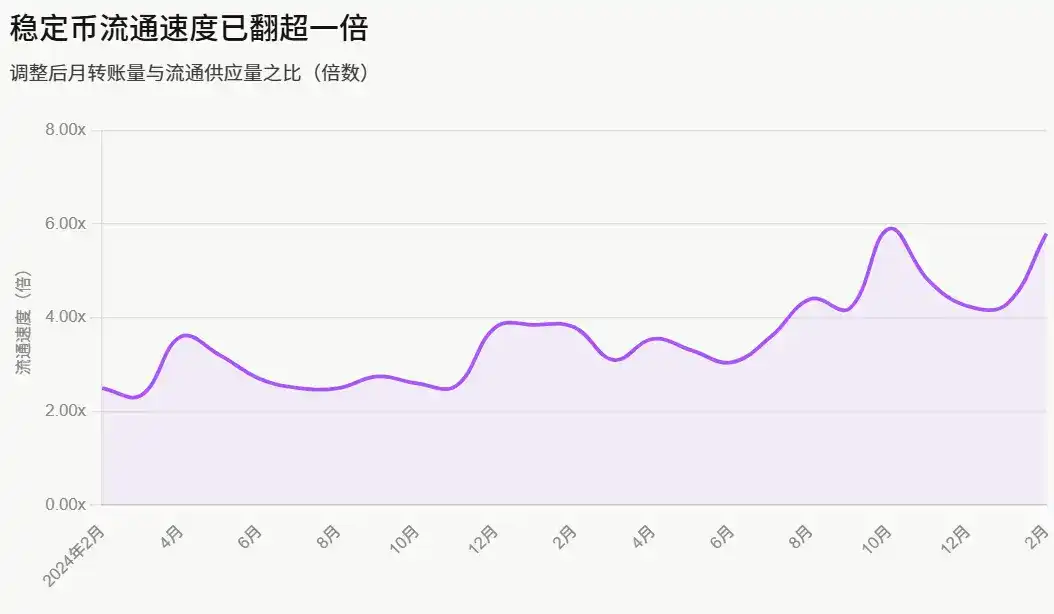
This is a hallmark of a true payment network—the base currency is being actively used, not just held.

Stablecoin Volume Reflects More Payments

If trading, fund flows, and exchange mechanisms—which make up the bulk of stablecoin transactions—are excluded, the estimated total for payments between different entities last year was still between $350 billion and $550 billion.

By volume, the Business-to-Business (B2B) sector dominates stablecoin payments (unsurprising given its scale). But other sectors, such as direct Consumer-to-Consumer (C2C) payments and interactions with merchants, are also expanding rapidly.

Stablecoin Payments are Currently Concentrated in Specific Regions

Geographically, stablecoin payment activity is not evenly distributed.

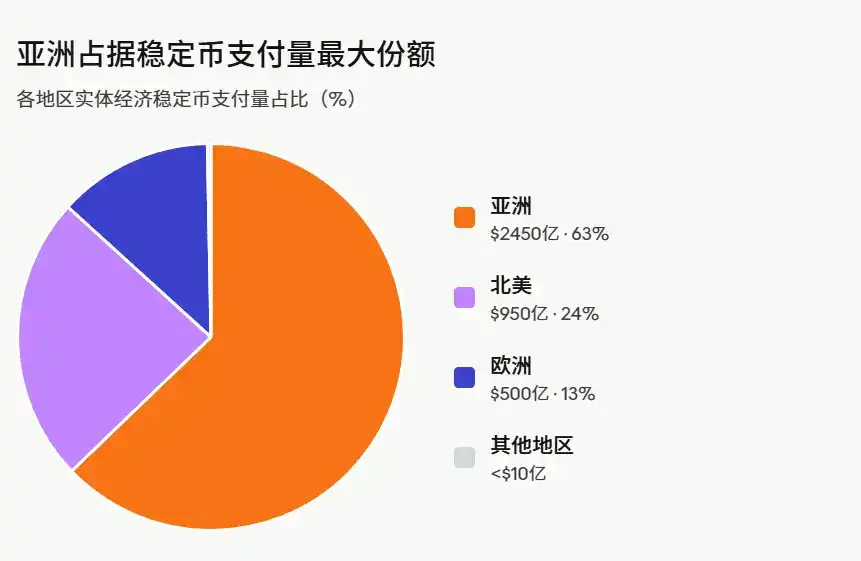
Nearly two-thirds of the transaction volume comes from Asia, primarily concentrated in Singapore, Hong Kong, and Japan.

North America accounts for about a quarter. Europe's share is around 13%. Latin America and Africa together make up only a very small portion, less than $1 billion.
Not Just Cross-Border Payments, But Local Currencies on Global Rails

The development of non-dollar stablecoins is not limited to Europe; it is also evident in emerging markets, driven by various factors.

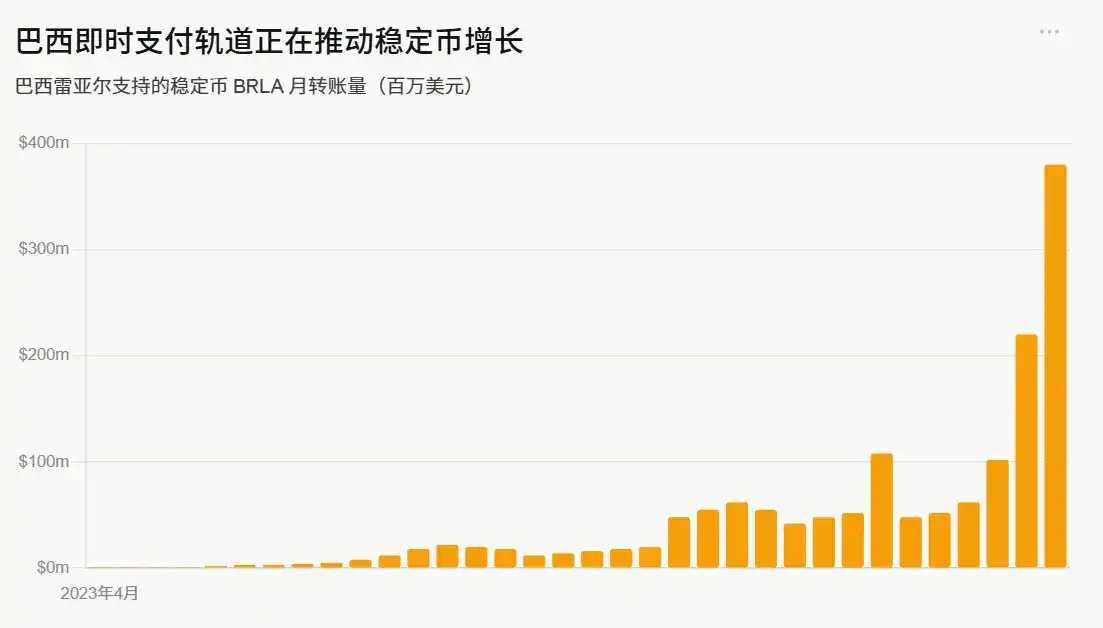
Brazil is a prime example. The monthly transfer volume of BRLA (a stablecoin backed by the Brazilian Real) has grown from nearly zero in early 2023 to about $400 million per month by early 2026. Access to the PIX instant payment network has driven its adoption.
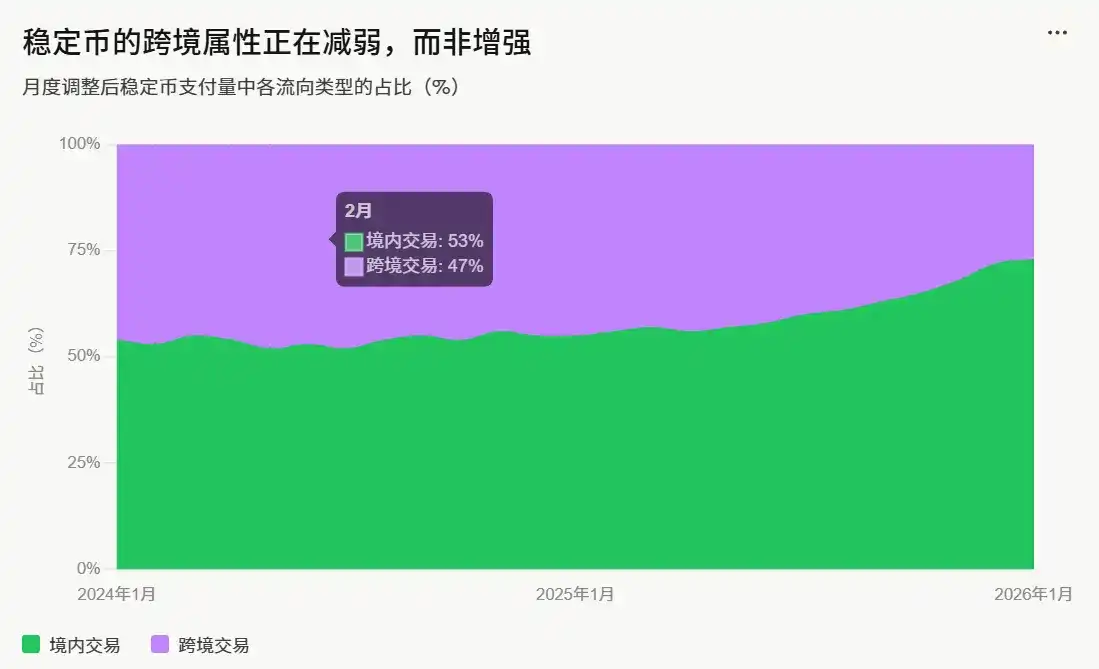
Although stablecoins are often described as cross-border tools, the proportion of cross-border activity has actually been declining, not rising.

Domestic transactions (stablecoin transfers occurring within the same country/region) have grown from about half of the payment volume in early 2024 to nearly three-quarters by early 2026. What does this mean? Stablecoins are not only establishing themselves as remittance or forex tools but also becoming a local payment medium running on global infrastructure.
Putting all these factors together, a clear picture emerges, though it's not the one most people expected: many thought stablecoins would be purely focused on cross-border transactions. Instead, they are becoming increasingly localized.

While the US dollar remains the core f币锚定 for the vast majority of stablecoins, stablecoins are by no means simply an export of the dollar. Non-dollar variants, such as euro-backed and Brazilian real-backed local currency stablecoins, are gaining popularity.

Although peer-to-peer (C2C) stablecoin transfers far exceed other types of payment flows in quantity, increasingly usage is flowing towards everyday consumption (C2B).

Each quarter's data provides more evidence that stablecoins are developing into general-purpose payment infrastructure. They are global by design but increasingly local in practice.

It's still early days. But the shape of this system is becoming clearer.

Связанные с этим вопросы

QWhat was the impact of the GENIUS Act on stablecoin trading volume in the US?

AThe GENIUS Act established the first federal-level framework for stablecoin issuance in the US. Before its passage, adjusted trading volume had been increasing for several consecutive quarters. After its enactment, growth accelerated further, reaching approximately $4.5 trillion in Q1 2026.

QWhich region accounts for the largest share of stablecoin payment volume, and which specific areas are the main contributors?

AAsia accounts for nearly two-thirds of the stablecoin payment volume. The main contributors are Singapore, Hong Kong, and Japan.

QWhat is the most significant structural change in how people use stablecoins, as indicated by transaction growth?

AThe most significant structural change is the growth in Consumer-to-Business (C2B) stablecoin transactions. This category saw the fastest growth, more than doubling (+128%) from 124.9 million transactions in 2024 to 284.6 million in 2025.

QWhat does the increasing velocity of stablecoins indicate about their use?

AThe increasing velocity of stablecoins, which nearly doubled from 2.6x to 6x since early 2024, indicates that the demand for stablecoin transactions is outpacing new issuance. It means the existing supply is circulating more frequently, which is a hallmark of a genuine payment network where the base currency is being actively used, not just held.

QContrary to common belief, what trend is observed in the proportion of cross-border stablecoin activity?

AContrary to the common belief that stablecoins are primarily for cross-border transactions, the proportion of cross-border activity has actually been decreasing. Domestic transactions (stablecoin transfers within the same country/region) grew from about half of the payment volume in early 2024 to nearly three-quarters by early 2026.

Похожее

ПОСЛЕДНИЕ НОВОСТИ: Дональд Трамп сделал резкое заявление по поводу Ирана! Он остановил атаки

Президент США Дональд Трамп заявил о приостановке запланированных масштабных военных действий против Ирана. Это решение было принято после обращения к нему Саудовской Аравии, ОАЭ, Катара и самого Ирана с просьбой предоставить время для дипломатических переговоров. Союзники в регионе полагают, что соглашение близко. Первоначальный этап переговоров будет сосредоточен на вопросах безопасности и возобновлении нормальной работы Ормузского пролива — ключевого маршрута для мировой нефтеторговли, чья безопасность критически важна для глобальных цен на энергоносители. После решения этих вопросов планируется начать переговоры по иранской ядерной программе. Новый раунд переговоров с Ираном начнётся завтра. В своём выступлении Трамп также коснулся темы валютного рынка, заявив, что США вмешались в поддержку японской иены, подчеркнув крепкие союзнические и взаимовыгодные экономические отношения с Японией.

cryptonews.ru1 ч. назад

ПОСЛЕДНИЕ НОВОСТИ: Дональд Трамп сделал резкое заявление по поводу Ирана! Он остановил атаки

cryptonews.ru1 ч. назад

Банк Италии не увидел системных преимуществ стейблкоинов в переводах

Исследование Банка Италии показало, что стейблкоины (на примере USDC) не демонстрируют устойчивых системных преимуществ в стоимости и скорости международных денежных переводов по сравнению с традиционными сервисами. Анализ транзакций на 200 USDC в 10 платежных коридорах (Италия — Бразилия, Аргентина, Япония, ОАЭ, ЮАР и др.) выявил, что финальная стоимость переводов варьировалась от 0,3% до почти 9%. Сроки исполнения колебались от менее 20 минут в коридорах с инфраструктурой мгновенных платежей до 1-2 рабочих дней в ее отсутствие. Ключевые издержки и задержки связаны не с комиссиями блокчейна, а с процессами конвертации в фиатные валюты и работой локальных платежных систем. Хотя в большинстве изучных направлений стоимость переводов со стейблкоинами была ниже среднемирового показателя в 6,65%, по сравнению с сервисом Wise преимущество наблюдалось только в трех из семи сопоставимых случаев. Авторы отмечают, что преимущества стейблкоинов могли бы быть более заметны, если бы их можно было напрямую тратить без конвертации. Также подчеркивается, что запретительное регулирование не устраняет спрос на стейблкоины, а излишне жесткие правила лишь усложняют их использование для розничных клиентов. В контексте исследования упоминается значительное снижение общей капитализации рынка стейблкоинов в июле.

cryptonews.ru2 ч. назад

Банк Италии не увидел системных преимуществ стейблкоинов в переводах

cryptonews.ru2 ч. назад

«Биткойн-бум» в разгаре: новое заявление Сэйлора вызвало спекуляции о покупках

Исполнительный председатель MicroStrategy Майкл Сэйлор 2 августа опубликовал сообщение «Bitcoin Drive engaged», что вызвало спекуляции о новой покупке биткойнов компанией. Его отчет показал, что резерв MicroStrategy составляет 843 775 BTC стоимостью около $53,25 млрд, со средней себестоимостью $75 653 и нереализованным убытком в $10,58 млрд. Ранее аналогичный сигнал предшествовал объявлению о пополнении долларового резерва. В то же время, реестр компании отразил две недавние продажи на общую сумму 3 588 BTC, сократив запасы. Эти продажи, согласно документам SEC, были проведены для финансирования выплат по привилегированным акциям. Неделей ранее компания не покупала биткойны, увеличив свой долларовый резерв примерно до $3,75 млрд. Финансовые риски остаются высокими после отчетности об операционном убытке в $8,33 млрд за второй квартал 2026 года. Ожидается, что обновление данных в понедельник покажет, означает ли сообщение Сэйлора возврат к накоплению биткойнов, поскольку компания балансирует между своими крупными запасами криптовалюты и растущими денежными обязательствами.

cryptonews.ru2 ч. назад

«Биткойн-бум» в разгаре: новое заявление Сэйлора вызвало спекуляции о покупках

cryptonews.ru2 ч. назад

Паттерн на графике биткоина «голоса и плечи» сулит подъём к $67,200

Несмотря на медленное снижение в начале августа, на графике биткоина формируется перевёрнутая разворотная модель «голова и плечи». Цена $BTC колеблется около $63,200, формируя правое плечо, что является основным поводом для краткосрочного оптимизма. Ключевой вопрос — хватит ли покупателям сил для рывка к уровню $67,200 для подтверждения разворота. В то же время в паре ETH/BTC уже пробито разворотное дно. Ethereum демонстрирует относительную силу, закрепился в восходящем тренде и движется к цели 0,0312, а против доллара тестирует уровень $1875, открывая путь к $2163. Эта ротация капитала в пользу ETH лишает биткоин объёма, необходимого для быстрого роста. Таким образом, ситуация для биткоина остаётся напряжённой: либо он в ближайшие дни последует примеру Ethereum и осуществит быстрый рост выше $67,200, либо, если атака на «шею» паттерна не состоится, медведи возьмут контроль и отправят цену к уровням поддержки $60,000 и $58,000.

cryptonews.ru2 ч. назад

Паттерн на графике биткоина «голоса и плечи» сулит подъём к $67,200

cryptonews.ru2 ч. назад

Акции компаний, занимающихся искусственным интеллектом, торгуются как «мемокоины», в то время как биткоин практически не меняет цены — обзор недели

В еженедельном обзоре рассматривается волатильность на рынках, вызванная распродажей в секторе ИИ и проблемами крупного хедж-фонда «Situational Awareness», что привело к значительным падениям на азиатских фондовых рынках. Акцентируется внимание на макроэкономических факторах, включая политику ФРС и интервенции Банка Японии. В криптосфере обсуждаются закрытие бирж BitMart и банкротство Storj Labs, трудности компаний вроде Coinbase, а также действия MicroStrategy по наращиванию резервов. Поднимаются темы инсайдерской торговли на Hyperliquid и отключения малопопулярных активов в Aave. Отдельно выделяется энтузиазм венчурных инвесторов вокруг Bittensor ($TAO). Завершается обзор серьёзным предупреждением об уязвимости аппаратных кошельков Coldcard, призывая пользователей к немедленным действиям и повышенной бдительности при самохранении активов.

cryptonews.ru2 ч. назад

Акции компаний, занимающихся искусственным интеллектом, торгуются как «мемокоины», в то время как биткоин практически не меняет цены — обзор недели

cryptonews.ru2 ч. назад

Торговля

Спот
活动图片





