A Hair Dryer Blows Open the World's Largest Nvidia Chip Smuggling Case

marsbitОпубликовано 2026-03-20Обновлено 2026-03-20

Введение

A co-founder and senior executive of Supermicro, Wally Liaw, has been arrested in California for orchestrating the largest AI chip smuggling case in history, involving $2.5 billion worth of Nvidia GPUs illegally shipped to China. The scheme involved using a Southeast Asian shell company to purchase servers under false pretenses, which were then repackaged and rerouted to China. To deceive auditors, the group created counterfeit servers with identical exteriors but no internal chips, using hairdryers to carefully remove and transfer serial number labels from genuine packaging. Despite prior warnings and awareness of similar arrests, Liaw continued the operation, accelerating shipments before new U.S. export restrictions took effect. Supermicro's stock fell 13% following the news, and the company has suspended Liaw and terminated others involved. The case highlights the persistent high demand for Nvidia chips in China, where black market prices can be 50% higher, driving sophisticated smuggling operations despite escalating U.S. export controls.

Author: David, Shenchao TechFlow

Early this morning, Wally Liaw, co-founder of Supermicro, was arrested in California.

Supermicro is one of the world's largest AI server manufacturers and a core supply chain partner of Nvidia, having received $13 billion in orders for Nvidia Blackwell chips in a single quarter last year.

Liaw has been with the company since its founding in 1993 and is currently a senior vice president and board member.

The charges against him are:

Smuggling $2.5 billion worth of Nvidia AI chip servers into China through shell companies in Southeast Asia. The maximum sentence is 20 years.

The U.S. Department of Justice has characterized this case as the largest AI chip smuggling case in history.

However, the details of this case are very much like a movie plot.

According to the indictment, Liaw and his accomplices arranged for a Southeast Asian company to act as a "white glove," purchasing large quantities of servers equipped with Nvidia GPUs from Supermicro under the guise of "self-use." Once the servers arrived in Southeast Asia, workers tore off the original packaging, placed them into unmarked boxes, and shipped them to China.

The real goods were shipped away, but Supermicro's compliance team and the U.S. Department of Commerce would periodically inspect the warehouse and scan serial numbers. The warehouse couldn't just be empty.

So they built thousands of fake servers.

The shells were identical to the real ones, but they contained no chips and could not be powered on. They were specifically placed in the warehouse for auditors to see.

Having fake servers wasn't enough; the serial numbers on the packaging also had to match. Workers used hair dryers to heat the serial number stickers on the real packaging, peeled them off completely, and then stuck them onto the boxes of the fake servers...
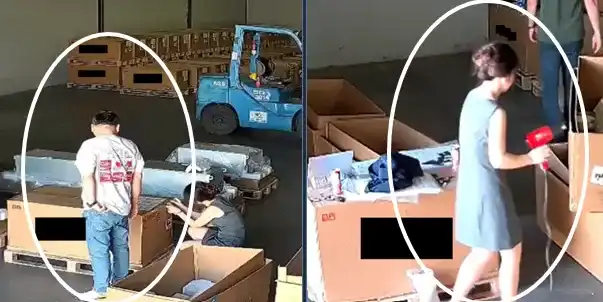
The auditors scanned the codes, and the system showed everything was normal.

Surveillance footage in the factory captured the hair dryer moment. But the real goods were already on their way to China.

Even more outrageous, on one occasion when Supermicro's own compliance team sent someone to inspect, an accomplice named Sun took photos and videos of the fake servers and sent them to the auditor as "proof" that the "goods were all there."

Another time, when U.S. Department of Commerce export control officials came for an inspection, someone on site directly impersonated a lawyer to receive them...

The main perpetrator, Liaw, is 71 years old and holds Supermicro stock worth $430 million. In theory, he doesn't need the money.

There's another detail in the indictment. A broker once forwarded a news link to Liaw about several Chinese nationals being arrested in the U.S. for smuggling AI chips.

Liaw's reply was a string of crying face emojis, and then he continued with the operation.

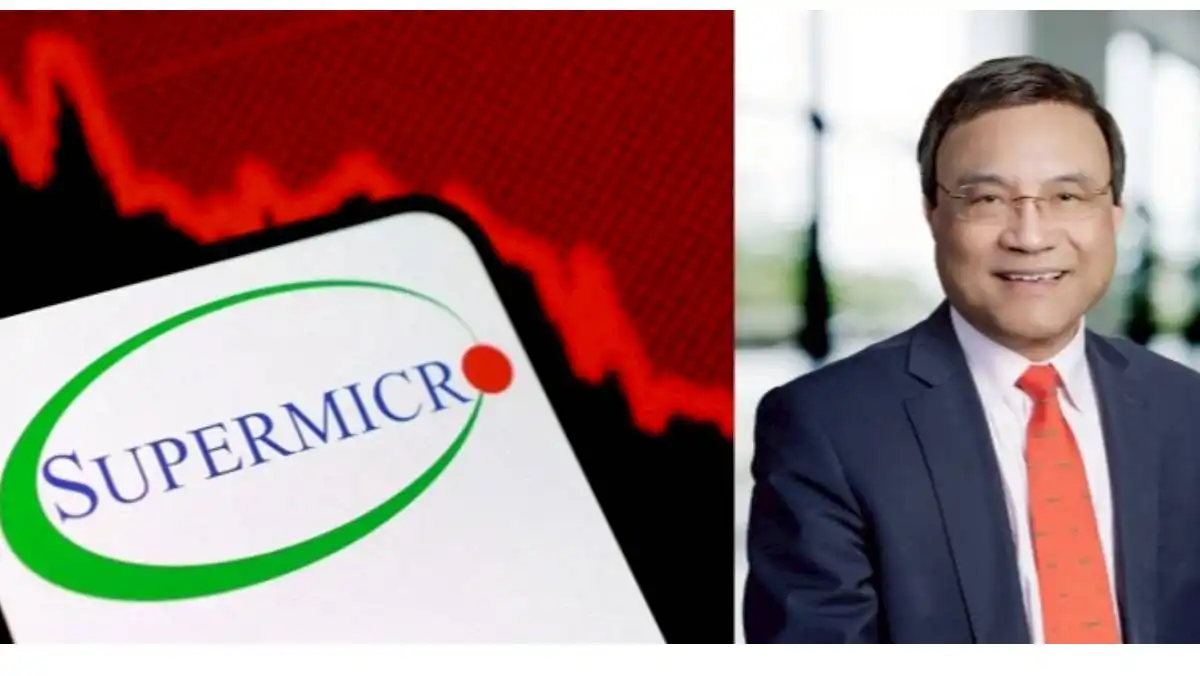
After the news was announced, Supermicro's stock fell 13% in after-hours trading. The company stated that Liaw has been suspended, the involved party Sun has been terminated, and sales manager Steven Chang from the Taiwan office is currently at large.

Supermicro was not named as a defendant. The company stated it has a "robust compliance system."

But this is not the first time this company's compliance system has had problems.

$2.5 Billion Chip Smuggling Pipeline

This smuggling chain wasn't built overnight.

The indictment shows that Liaw was very proactive in running the operation. He directly used encrypted communication tools to ask the person in charge of the Southeast Asian company: How many can you take in January? February? March? April? Just give a rough estimate, and then we'll use this number to apply for a chip quota from Nvidia.

So the process was:

First, confirm the demand from Chinese buyers, then use that volume to negotiate a quota from Nvidia, citing "self-use" by the Southeast Asian company. Once Nvidia approved the quota, the servers were assembled in the U.S., shipped to Taiwan, then transferred to the Southeast Asian company, which removed the packaging and shipped them to China.
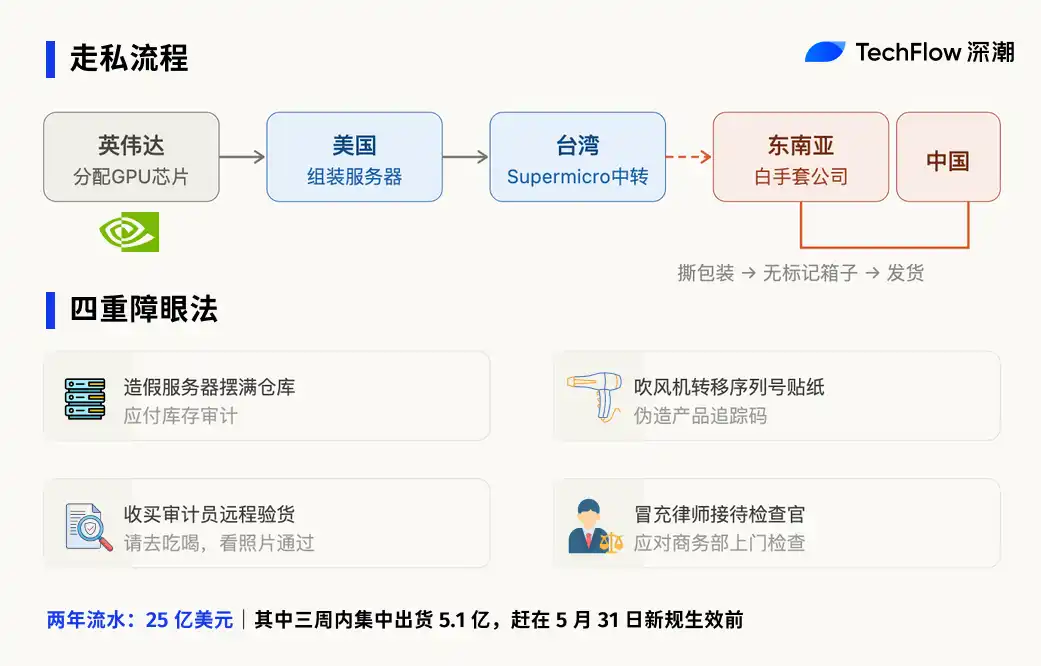
From clients to supply sources to logistics, Liaw single-handedly managed the entire chain. He wasn't a middleman; he was the co-founder and business development head of Supermicro.

Using his own company's supply chain to smuggle his own company's products.

Between 2024 and 2025, servers worth $2.5 billion flowed out through this pipeline. The indictment says this scale gradually expanded, using the phrase:

Growing increasingly bold.

The boldest single transaction occurred from late April to mid-May 2025. In three weeks, $510 million worth of servers were transferred from the U.S. to China via Southeast Asia.

Why the sudden acceleration? Possibly because Liaw saw a White House statement.
In early 2025, the U.S. government announced a new export control rule for AI products, scheduled to take effect in mid-May, further tightening chip export reviews to regions like Southeast Asia. Liaw forwarded this news to the head of the Southeast Asian company, adding a note:

"We need to speed these up before May 13!"

May 13th was the effective date of the new rule. Before that, the existing loopholes could still be used. So the final three weeks became a mad dash. Volume that usually took months to move was compressed into twenty days.

Meanwhile, Steven Chang from the Taiwan office was responsible for another task: ensuring no one came for a real inspection.

The indictment says he prevented auditors from checking the actual areas where servers were stored in the Southeast Asian data center and specifically arranged for an auditor he called "friendly" to conduct the review.

All the forged documents, fake servers, and hair dryer label transfers were meant to keep this pipeline running uninterrupted. And the speed of the pipeline peaked in the final three weeks.

But Supermicro isn't the only one in the chip smuggling business.

Over the past two years, the U.S. Department of Justice has already dismantled several chip smuggling networks. The scales range from tens of millions to hundreds of millions of dollars, with methods becoming increasingly outrageous. And the identities of the participants have also been escalating.

The Stricter the Chip Ban, the More Respectable the Smugglers

Supermicro isn't the first to be caught.

Looking back two years, the chip smuggling business has undergone three generations of evolution. The identities of the participants have escalated, the methods have become more like legitimate business, and the scale has grown larger.

The first generation was "ant moving."

When the chip ban first came out in 2022, smuggling was still manual labor. International students, tourists, and personal shoppers would carry one or two Nvidia GPUs at a time, hiding them in personal luggage through customs, claiming they were for personal use if stopped.

Some hid chips in boxes of live lobsters, others strapped them to their bodies under fake pregnancy bellies.

In Shenzhen's Huaqiangbei, these chips had a complete after-sales industry chain. Specialized workshops repaired broken cards and disassembled chips, handling over 500 per month, charging $1,400 to $2,800 per chip. After repair, they were sold to data centers and AI startups.

Smugglers at this stage had no companies, no documents; they relied on human effort and courage. The amounts per transaction were small, but every little bit helped.
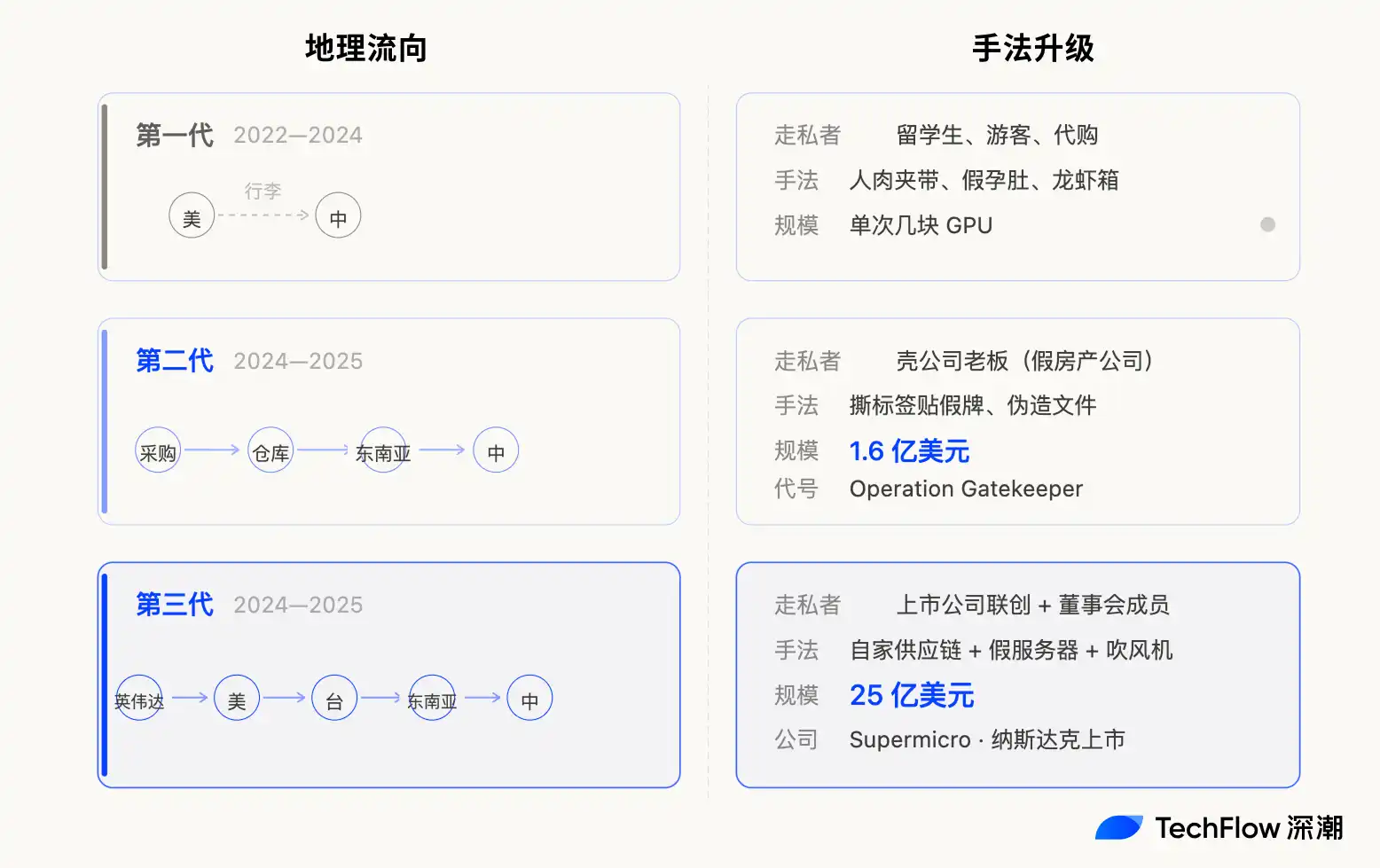
The second generation began using companies, selling dog meat under a sheep's head.

In late 2025, the U.S. Department of Justice dismantled a smuggling network codenamed "Operation Gatekeeper." The main perpetrator was a man living in Houston named Alan Hsu, 43 years old. He used a company under his name to purchase Nvidia chips in bulk from Lenovo and ship them to a warehouse in New Jersey.

This company was called Janford Realtor, registered as a real estate company.

It never conducted a single real estate transaction.

After the chips arrived at the warehouse, workers tore off the original Nvidia labels and stuck on the name of a fictional company—"SANDKYAN." They were then transshipped via Malaysia and Thailand, eventually entering China. The entire network moved over $160 million in goods in eight months.

The most dramatic moment in this case occurred during the takedown. FBI agents secretly infiltrated the New Jersey warehouse beforehand and quietly removed all the GPUs inside. The smugglers discovered the goods were missing, thought they had been stolen, and sent people to the warehouse to "redeem" them.

The ransom was negotiated to $1 million, and the person who came to collect was arrested on the spot by the FBI.

The third generation is represented by professionals like those at Supermicro.

No longer fake companies, no longer middlemen, but the co-founder of a listed company personally running the operation.

No need to buy chips from others; their own company is a core supplier to Nvidia. No need to forge buyer identities; they use the company's own supply chain, own customer relationships, and own quotas to apply for chips, then internally bypass their own company's compliance team.

From ant moving to fake real estate companies, to Silicon Valley listed company executives. The three generations of smugglers have only one thing in common:

The end buyers are all in China, and the chips are all Nvidia's.

The difference is, the person carrying a backpack through customs in 2022 was gambling with their freedom. The person sitting in a Silicon Valley office running the operation in 2026 is gambling with a company worth tens of billions of dollars.

Every time the ban is upgraded, the profit from smuggling jumps a step, and the status of those willing to enter the game also jumps a step.

So how profitable is this business really?

The Black Market Price of a Chip

Why can't chip smuggling be stopped? The answer lies in the price.

According to multiple overseas media reports, the selling price of Nvidia's high-end GPUs on the Chinese black market is generally about 50% higher than the official U.S. channels. The ban created a price difference, the price difference created profit, and the profit created smugglers.

Demand is rigid. Ray Wang, an analyst at semiconductor analysis firm SemiAnalysis, said in an interview with CNBC:

Over 60% of China's top AI models currently still run on Nvidia hardware. Training a large model requires thousands of high-end GPUs; you can't start work even one short.

This means Chinese AI companies don't just "want to buy" Nvidia chips; they "must buy" them.
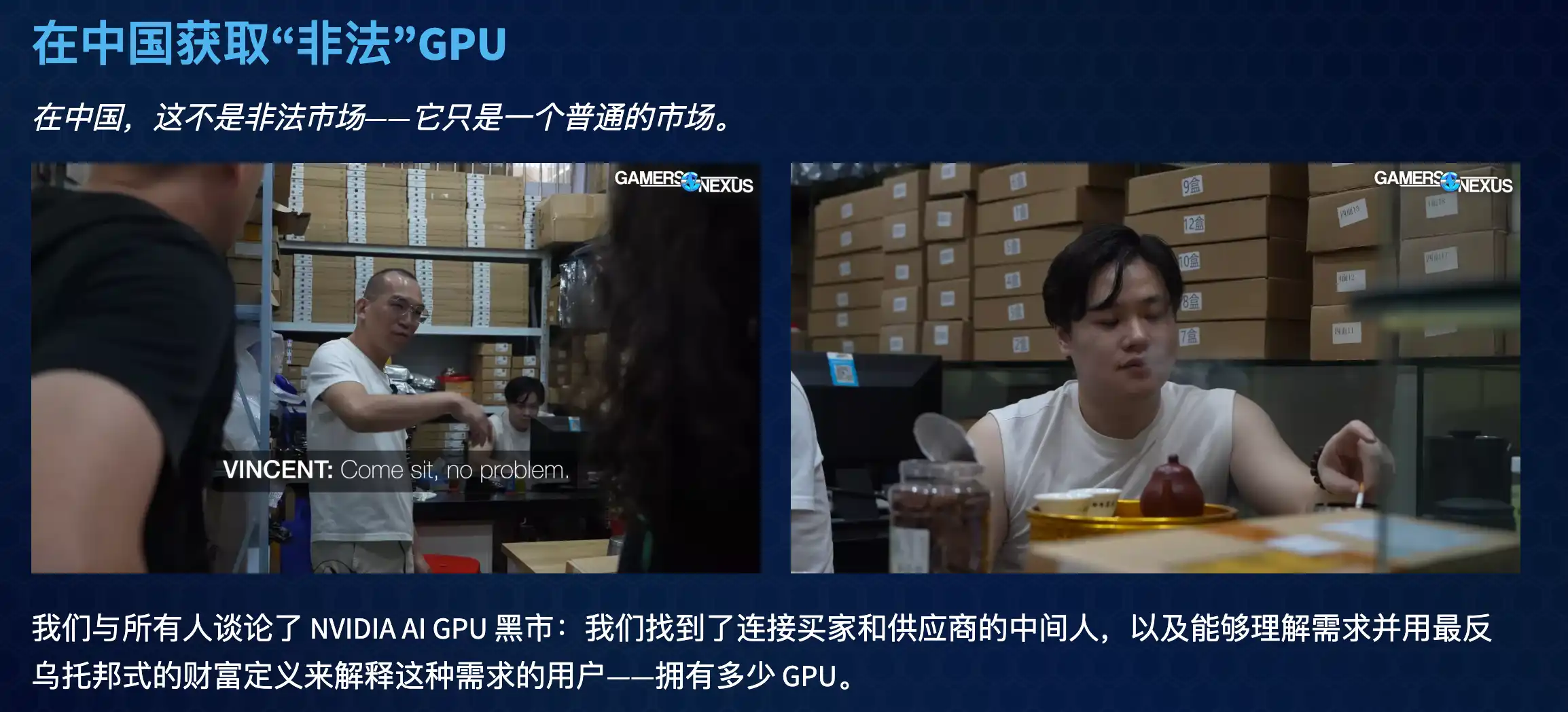
Image source:GamersNexus in-depth investigation of the Huaqiangbei chip market

What about the supply side?

After chips leave Nvidia's factory, they pass through distributors, system integrators, and server manufacturers. Every link is a potential entry point for smuggling. U.S. export controls primarily restrict the sales and shipping step, relying on buyers to self-declare the end user.

Once the chips leave the U.S., the subsequent steps rely largely on self-policing.

A Financial Times report last year estimated that in just the three months after April 2025, over $1 billion worth of embargoed chips flowed into China through various channels. Industry insiders estimate the entire black market's monthly turnover could be on the order of $1 billion...

And ironically, the U.S. government's own policies have been wavering.

Last December, the Justice Department high-profile announced the dismantling of the Operation Gatekeeper smuggling network, arresting several suspects. But on the same day, Trump announced on Truth Social: Allowing Nvidia to sell H200 chips to China.

Later, the U.S. government opened another loophole, allowing Nvidia to sell the less powerful H20 chips to China, on the condition that Nvidia pay 15% of the sales revenue to the U.S. government.

Cracking down on smuggling on one hand, selling it themselves on the other, and even taking a cut. This makes the entire ban system difficult to explain.

You tell a chip broker that smuggling is illegal, and he might reply: The government is selling it too, they just call it "conditional export."

The deeper paradox is that Nvidia is now the world's highest-valued company, with a market cap of $4.3 trillion. The more advanced its chips, the greater the demand, the higher the black market premium, and the more lucrative the smuggling becomes.

A Hair Dryer Can't Blow Away Demand

What signal do people inside chip companies see when the government itself is both cracking down on smuggling and approving exports?

The protagonist of this article, Supermicro, also helped Musk build the Colossus AI computing cluster in 122 days and received $13 billion in Nvidia Blackwell orders last quarter.

The people who build the servers and the people who smuggle the servers are the same group.

A $2.5 billion smuggling case ultimately failed because of a hair dryer. Surveillance footage captured workers using a hair dryer to peel off labels; it's now posted on the U.S. Department of Justice website for anyone to see.

In the same week Liaw was arrested, Nvidia CEO Jensen Huang publicly stated that the company is facing a backlog of $1 trillion in chip orders.

A trillion dollars in demand is sitting there, and the black market premium is sitting there.

Perhaps the next person willing to pick up a hair dryer won't have to wait long.

Связанные с этим вопросы

QWho was arrested in connection with the largest AI chip smuggling case, and what was their role at Supermicro?

AWally Liaw, the co-founder and senior vice president of Supermicro, was arrested for smuggling $2.5 billion worth of Nvidia AI chips to China.

QWhat method did the smugglers use to deceive auditors during compliance checks?

AThey created fake servers with identical exteriors but no chips inside, and used a hairdryer to heat and transfer the serial number stickers from real packaging to the fake servers' boxes.

QWhy did the smuggling operation accelerate in April and May 2025?

AThey accelerated the operation to bypass new U.S. AI product export control rules set to take effect on May 13, 2025, which would tighten chip export reviews to regions like Southeast Asia.

QWhat is the estimated premium for Nvidia's high-end GPUs on the Chinese black market compared to U.S. prices?

ANvidia's high-end GPUs are sold at a premium of about 50% on the Chinese black market compared to U.S. official channels.

QHow has the profile of chip smugglers evolved from 2022 to 2026 according to the article?

ASmugglers evolved from individuals carrying chips in luggage (2022), to using shell companies like fake real estate firms (2025), and finally to high-level executives of listed companies like Supermicro's co-founder directly orchestrating the smuggling (2026).

Похожее

South Korean Exchanges 'Battle' Regulators, Challenging the Boundaries of Enforcement and Legislation

South Korea's cryptocurrency industry is engaged in a rare, direct confrontation with regulators. The Financial Intelligence Unit (FIU), the primary anti-money laundering (AML) watchdog, has recently imposed heavy penalties on major exchanges like Upbit and Bithumb for alleged violations involving unregistered overseas VASPs and AML procedures. However, exchanges are now actively challenging these actions in court and through industry associations. In a significant shift, the Seoul Administrative Court ruled in favor of Upbit's operator, Dunamu, overturning part of an FIU-ordered business suspension. The court found the FIU's penalty criteria and justification insufficiently clear. Similarly, the court suspended the enforcement of a six-month business suspension against Bithumb pending a final ruling, citing potential irreversible harm to the exchange. Beyond legal battles, the industry is contesting proposed legislative amendments. The Digital Asset eXchange Alliance (DAXA) strongly opposes a draft rule that would mandate Suspicious Transaction Reports (STRs) for all crypto transfers over 10 million KRW (~$6,800). DAXA argues this "poison pill" clause violates legal principles and would overwhelm the STR system, increasing reports from 63,000 to an estimated 5.45 million annually for major exchanges, thereby crippling effective AML monitoring. This conflict highlights a structural tension in South Korea's crypto governance: comprehensive digital asset laws are still developing, while regulators rely heavily on AML enforcement. The industry's move from passive compliance to active legal and legislative challenges signifies a new phase, pressing for clearer rules and more proportionate enforcement. While short-term disputes may intensify, this clash could ultimately lead to a more mature and sustainable regulatory framework for South Korea's vibrant crypto market.

marsbit13 мин. назад

South Korean Exchanges 'Battle' Regulators, Challenging the Boundaries of Enforcement and Legislation

marsbit13 мин. назад

After 50x Storage Surge, Justin Sun Always Looks to the Next Decade

Sun Yuchen, known for his controversial stunts like a $30 million lunch with Warren Buffett (canceled due to a kidney stone) and eating a $6.2 million duct-taped banana, is often overshadowed by a significant fact: his decade-long track record of spotting major investment trends. In 2016, he famously advised young people to invest in Bitcoin, Nvidia, Tesla, and Tencent instead of buying property. A hypothetical $20,000 investment in Nvidia and Tesla from that list would now be worth over 50 million RMB. His latest major call was on November 6, 2025, predicting a "50x storage opportunity" tied to the AI boom, which materialized with Sandisk's stock surging nearly 50-fold by 2026. Looking ahead, Sun now focuses on the next frontier: Physical AI. He identifies four key areas: 1. **Embodied AI/Robotics**: He sees this reaching its "iPhone moment," with companies like UBTech and Galaxy General leading in commercialization. 2. **Drones**: Viewed as the first commercially viable form of Physical AI, revolutionizing sectors from warfare (e.g., AeroVironment's Switchblade) to logistics. 3. **Spatial Computing**: Beyond VR, it's about AI understanding physical space, a foundational technology for robotics and autonomous systems, exemplified by Apple's Vision Pro. 4. **Space Exploration**: After a 2025 suborbital flight with Blue Origin, Sun advocates for space as the ultimate frontier, discussing blockchain's potential role in space asset management and data transactions. His investment philosophy involves betting on entire, inevitable trends rather than single companies. For robotics, he sees Tesla (the body/manufacturer) and Nvidia (the brain/AI platform) as complementary plays. In defense drones, he highlights companies making tanks obsolete (AeroVironment) and those augmenting fighter jets (Kratos). For space, he participated in Blue Origin's flight and anticipates SpaceX's potential IPO to redefine the sector's valuation. Sun Yuchen's vision frames the next two decades not as a revolution in information flow (like the internet), but in the fundamental operation of the physical world through AI-powered robots, autonomous systems, and spatial intelligence, ultimately extending human and AI activity into space. While many still focus on conventional assets, he continues to look toward the next technological horizon.

marsbit1 ч. назад

After 50x Storage Surge, Justin Sun Always Looks to the Next Decade

marsbit1 ч. назад

The Billionaires Behind the Most Expensive Midterm Election in History

"The Most Expensive Midterm Elections and Their Billionaire Backers" This analysis details the unprecedented scale of spending in the 2026 midterm elections, highlighting the key billionaire donors shaping the political landscape. Jeff Yass, founder of Susquehanna International Group, has contributed over $81 million, ranking third among individual donors behind George Soros ($102.6M) and Elon Musk ($84.8M). Yass is a major donor to Trump's MAGA Inc. and supports school choice and various candidates. Overall, federal committees have raised over $4.7 billion this cycle, with political ad spending projected to reach $10.8 billion. Republican-aligned groups are significantly out-raising their Democratic counterparts. "Dark money" from undisclosed sources continues to grow. The core stakes involve control of Congress and policy direction for Trump's final term. Donors are also motivated by specific issues: Sergey Brin and Chris Larsen are funding opposition to a proposed California wealth tax and supporting crypto-friendly policies. Other top donors include OpenAI's Greg Brockman and his wife Anna ($50M total to MAGA Inc. and an AI-focused PAC), Richard Uihlein ($45.3M to conservative causes), venture capitalists Marc Andreessen and Ben Horowitz (each over $44M to crypto/AI PACs and MAGA Inc.), Miriam Adelson ($42.6M to GOP leadership PACs), Paul Singer ($33.9M), and Diane Hendricks ($25.8M to MAGA Inc.). The article notes that the peak fundraising period is still ahead, with major primaries approaching.

marsbit1 ч. назад

The Billionaires Behind the Most Expensive Midterm Election in History

marsbit1 ч. назад

The Largest IPO in History Is Approaching, Surpassing SpaceX, 28 Years of AI Self-Iteration, Countdown to Intelligence Explosion

"Anthropic Nears Trillion-Dollar IPO, Fueled by Explosive Growth and 2028 'Intelligence Explosion' Warning Anthropic is considering a deal valuing the AI company near $1 trillion, potentially leading to one of the largest IPOs ever and surpassing SpaceX. Its revenue has skyrocketed, with Annual Recurring Revenue (ARR) reaching $45 billion in May 2026—a 500% increase in just five months. This vertical growth curve is attributed to its key products, Claude Code and Cowork, dominating AI coding and enterprise collaboration. Beyond commercial success, co-founder Jack Clark issued a pivotal warning in an interview: there is a greater than 50% chance that by the end of 2028, AI systems will achieve recursive self-improvement—the ability to autonomously build a 'better version' of themselves, initiating an 'intelligence explosion.' This prophecy underpins the company's astronomical valuation, as the market prices in the potential for transformative and disruptive AI. Further signaling its ambition, Anthropic formed a $1.5 billion joint venture with Goldman Sachs and Blackstone, aiming to disrupt traditional consulting firms like McKinsey by deploying Claude AI for complex strategic work. This move tests AI's capacity to replace high-level cognitive labor, a precursor to its predicted autonomous evolution. The narrative presents a dual future: unprecedented economic opportunity alongside significant risks like economic restructuring and security threats. Anthropic's meteoric rise and Clark's 2028 prediction frame the coming years as a countdown to a potential technological singularity."

marsbit1 ч. назад

The Largest IPO in History Is Approaching, Surpassing SpaceX, 28 Years of AI Self-Iteration, Countdown to Intelligence Explosion

marsbit1 ч. назад

Торговля

Спот
Фьючерсы

Популярные статьи

Как купить S

Добро пожаловать на HTX.com! Мы сделали приобретение Sonic (S) простым и удобным. Следуйте нашему пошаговому руководству и отправляйтесь в свое крипто-путешествие.Шаг 1: Создайте аккаунт на HTXИспользуйте свой адрес электронной почты или номер телефона, чтобы зарегистрироваться и бесплатно создать аккаунт на HTX. Пройдите удобную регистрацию и откройте для себя весь функционал.Создать аккаунтШаг 2: Перейдите в Купить криптовалюту и выберите свой способ оплатыКредитная/Дебетовая Карта: Используйте свою карту Visa или Mastercard для мгновенной покупки Sonic (S).Баланс: Используйте средства с баланса вашего аккаунта HTX для простой торговли.Третьи Лица: Мы добавили популярные способы оплаты, такие как Google Pay и Apple Pay, для повышения удобства.P2P: Торгуйте напрямую с другими пользователями на HTX.Внебиржевая Торговля (OTC): Мы предлагаем индивидуальные услуги и конкурентоспособные обменные курсы для трейдеров.Шаг 3: Хранение Sonic (S)После приобретения вами Sonic (S) храните их в своем аккаунте на HTX. В качестве альтернативы вы можете отправить их куда-либо с помощью перевода в блокчейне или использовать для торговли с другими криптовалютами.Шаг 4: Торговля Sonic (S)С легкостью торгуйте Sonic (S) на спотовом рынке HTX. Просто зайдите в свой аккаунт, выберите торговую пару, совершайте сделки и следите за ними в режиме реального времени. Мы предлагаем удобный интерфейс как для начинающих, так и для опытных трейдеров.

1.3k просмотров всегоОпубликовано 2025.01.15Обновлено 2025.03.21

Как купить S

Sonic: Обновления под руководством Андре Кронье – новая звезда Layer-1 на фоне спада рынка

Он решает проблемы масштабируемости, совместимости между блокчейнами и стимулов для разработчиков с помощью технологических инноваций.

2.2k просмотров всегоОпубликовано 2025.04.09Обновлено 2025.04.09

Sonic: Обновления под руководством Андре Кронье – новая звезда Layer-1 на фоне спада рынка

HTX Learn: Пройдите обучение по "Sonic" и разделите 1000 USDT

HTX Learn — ваш проводник в мир перспективных проектов, и мы запускаем специальное мероприятие "Учитесь и Зарабатывайте", посвящённое этим проектам. Наше новое направление .

1.8k просмотров всегоОпубликовано 2025.04.10Обновлено 2025.04.10

HTX Learn: Пройдите обучение по "Sonic" и разделите 1000 USDT

Обсуждения

Добро пожаловать в Сообщество HTX. Здесь вы сможете быть в курсе последних новостей о развитии платформы и получить доступ к профессиональной аналитической информации о рынке. Мнения пользователей о цене на S (S) представлены ниже.

活动图片















