A 'Clarity Act': Why Has It Caused Such an Uproar in the Crypto World?

比推Опубликовано 2026-01-17Обновлено 2026-01-17

Введение

A historical perspective reveals that money has rarely been neutral—it inherently carries an expectation of return. From ancient Mesopotamia to modern banking, the principle that holding or lending money should yield compensation has persisted. Against this backdrop, stablecoins emerged, promising faster settlement, lower costs, and 24/7 availability within a borderless digital economy. However, the proposed U.S. CLARITY Act, combined with the already-passed GENIUS Act, seeks to prohibit stablecoin issuers from paying interest or rewards to holders, permitting only limited “activity-based rewards.” This has sparked intense opposition from both the crypto industry and banking sectors. Critics argue that the bill effectively reduces stablecoins to mere payment conduits rather than capital-optimizing assets, contradicting the historical function of money. Key concerns include unfair competition, as traditional banks can offer interest and rewards while stablecoin issuers are restricted. The bill also introduces ambiguities around decentralized finance (DeFi) and tokenized assets, potentially stifling innovation and pushing capital overseas. Prominent industry figures, including Coinbase CEO Brian Armstrong, have withdrawn support, stating they would prefer no legislation over a harmful one. The bill currently lacks sufficient congressional support, particularly from Democrats, and faces skepticism for reinforcing existing banking structures rather than fostering healthy compe...

Author: Prathik Desai

Original Title: The CLARITY Paradox: When clearer rules cloud competition

Compiled and Edited by: BitpushNews


Historically, money has rarely been neutral; it inherently possesses an appreciative attribute. Long before the emergence of modern banking, people expected that holding or lending money should yield returns.

As early as the third millennium BCE, ancient Mesopotamia saw practices of charging interest on silver loans. From the fifth century BCE onwards, ancient Greece utilized maritime loans to finance high-risk sea trade.

In this system, lenders provided funds for a merchant's single voyage. If the ship sank, they bore the entire loss, but if it returned successfully, they demanded high interest rates (typically between 22% and 30%). In Rome, interest was deeply embedded in economic life, often triggering debt crises that made voluntary debt relief a political necessity.

Throughout these systems, one concept remained consistent: money was not merely a passive store of value. Holding money without compensation was the exception. Even with the advent of modern finance, the perception of money's nature was further reinforced. Bank deposits could yield interest for savers. It was widely accepted that money that did not appreciate would gradually lose its economic value.

It is against this backdrop that stablecoins entered the financial system. If you strip away the blockchain facade, they share little in common with any cryptocurrency or speculative asset. They present themselves as digital dollars, adapted to a blockchain world that eliminates geographical boundaries and saves costs. Stablecoins promise faster settlement, lower friction, and 24/7 availability.

However, U.S. law seeks to prohibit stablecoin issuers from paying yields (or interest) to holders.

This is why the CLARITY Act, currently under review in the U.S. Congress, has become such highly contentious legislation. Viewed in conjunction with its sister bill, the GENIUS Act, which passed in July 2025, this act prohibits stablecoin issuers from paying interest to holders but allows for "activity-based rewards."

This has prompted strong opposition from the banking industry to the current draft of the legislation. Some amendments proposed by banking lobbyists aim to completely stifle stablecoin rewards.

In today's in-depth analysis, I will explain why the CLARITY Act in its current form could impact the crypto industry and why this has left the crypto sector visibly dissatisfied with this legislative proposal.

Let's get into it...

Within 48 hours of reviewing the Senate Banking Committee's draft, Coinbase publicly withdrew its support.

"We would rather have no bill than a bad bill," its CEO Brian Armstrong stated on Twitter, arguing that this proposal, which claims to provide regulatory clarity, would make the industry's situation worse than it is now.

Just hours after the largest U.S. listed crypto company withdrew its support, the Senate Banking Committee postponed its markup session—a meeting intended to discuss amendments to the bill.

The core objections to the bill cannot be ignored. The bill aims to treat stablecoins purely as payment instruments, not as any form of monetary equivalent. This is precisely the crux of the controversy, enough to unsettle anyone expecting stablecoins to revolutionize payments.

This version of the bill demotes stablecoins to mere pipelines, rather than assets that can be used to optimize capital. As I described earlier, money has never operated this way. By prohibiting interest at the base level and banning activity-based rewards for stablecoin use, the bill restricts stablecoins from achieving yield optimization, which is what they claim to excel at.

This is also where concerns about competition arise. If banks are allowed to pay interest on deposits and offer rewards for debit/credit card usage, why prohibit stablecoin issuers from doing the same? This tilts the playing field in favor of existing financial institutions and undermines many of the long-term benefits promised by stablecoins.

Brian's criticism extends beyond stablecoin yields and rewards, also touching on how the bill does more harm than good. He also pointed out the issue of the DeFi ban.
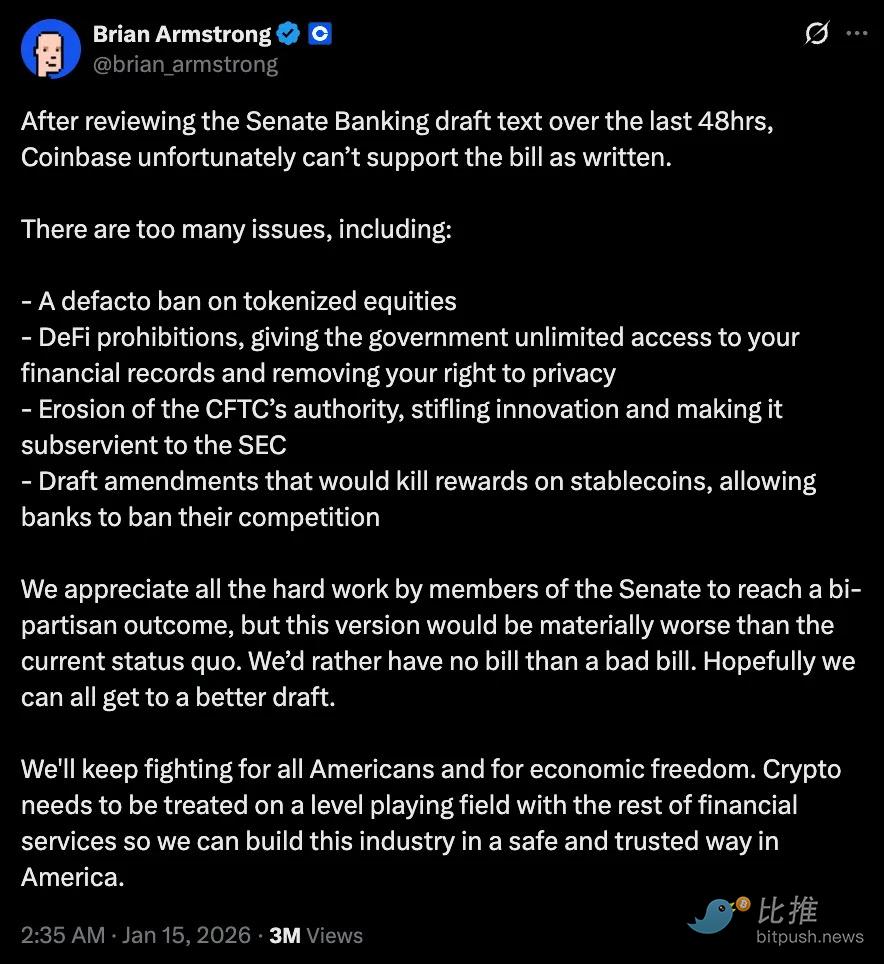
@brian_armstrong

The DeFi Education Fund, a DeFi policy and advocacy organization, also urged senators to oppose legislative amendment proposals that appear "anti-DeFi."

"While we have not yet seen the text of these amendments, their description suggests they would severely harm DeFi technology and/or make market structure legislation more unfavorable for software developers," the organization posted on X.
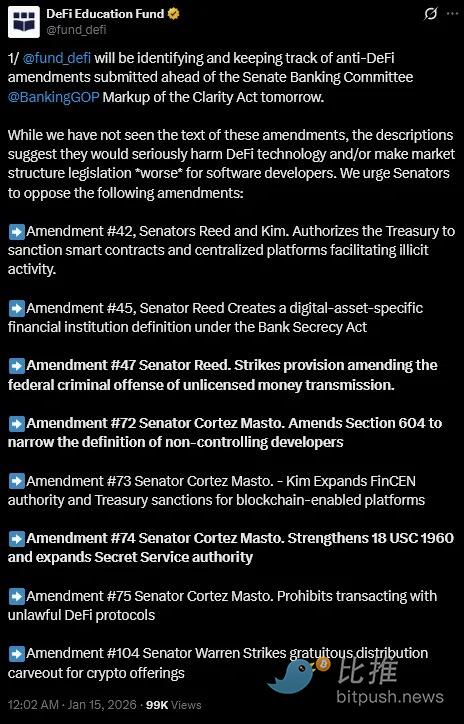
@fund_defi

Although the CLARITY Act formally acknowledges decentralization, its definition is narrow. Protocols under "common control" or those retaining the ability to modify rules or restrict transactions risk being subjected to bank-like compliance obligations.

Regulation aims to introduce scrutiny and accountability. However, decentralization is not static. It is a dynamic spectrum, requiring evolving governance and contingency controls to provide resilience, not dominance. These rigid definitions create additional uncertainty for developers and users.

Next is the tokenization space, where there is a vast gap between promise and policy. Tokenized stocks and funds offer faster settlement, lower counterparty risk, and more continuous price discovery. Ultimately, they enable more efficient markets by compressing clearing cycles and reducing capital trapped in post-trade processes.

However, the current draft of the CLARITY Act leaves tokenized securities in a regulatory vacuum. Its wording does not explicitly prohibit them but introduces sufficient uncertainty regarding the custody of tokenized stocks.

If stablecoins are framed within the payments sphere and tokenized assets are constrained at the issuance stage, the path to more efficient capital markets will be significantly narrowed.

Some argue that stablecoins can exist as payment tools, while yields can be provided through tokenized money market funds, DeFi vaults, or traditional banks. This is not technically wrong. But there will always be market participants seeking more efficient ways to optimize capital. Innovation drives people to find workarounds. Often, these workarounds might involve moving capital overseas. Sometimes, this movement might even be opaque, in ways that regulators might later regret not foreseeing.

However, one argument stands above all others as the primary reason for opposing the bill. It's hard not to see that the bill in its current form structurally reinforces banks, weakens the prospects for innovation, and shackles an industry that could help optimize our current markets.

Worse, it might achieve this at two very high costs. The bill stifles any hope of healthy competition between the banking and crypto industries, while simultaneously allowing banks to profit more. Secondly, it leaves customers at the mercy of these banks, unable to choose to optimize their own yields within a regulated market.

These are high prices to pay, and precisely why critics are reluctant to offer support.

It is concerning that the bill is packaged as an effort to protect consumers, provide regulatory certainty, and bring crypto into the system, while its terms subtly suggest the opposite purpose.

These terms predetermine which parts of the financial system are allowed to compete for value. While banks can continue to operate within familiar boundaries, stablecoin issuers will feel compelled to exist and operate within a narrower economic landscape.

But money dislikes remaining passive. It flows towards efficiency. History shows that whenever capital is constrained in one channel, it always finds another. Ironically, this is precisely the situation the regulation aims to prevent.

Favorably for the crypto industry, the disagreement over this bill is not limited to the crypto sphere.

The bill still lacks sufficient support in Congress. Some Democrats are unwilling to vote in favor without discussion and deliberation on certain proposed amendments. Without their support, the bill cannot advance, even if it dismisses the crypto industry's opposition as noise. Even if all 53 Republicans vote for the bill, it would need at least 7 Democratic votes in the full Senate to pass with a supermajority and overcome a filibuster.

I do not expect the U.S. to produce a bill that satisfies everyone. I don't even think that is possible or desirable. The issue is that the U.S. is not merely regulating a new class of assets; it is attempting to legislate for a form of money whose inherent properties make it highly competitive. This makes it more difficult because it forces lawmakers to confront competition and draft terms that might challenge existing institutions (in this case, banks).

The impulse to tighten definitions, restrict permitted activities, and preserve existing structures is understandable. However, this risks turning regulation into a defensive tool that repels rather than attracts capital.

Therefore, it is essential to correctly understand the质疑 (questioning/doubts) surrounding the Clarity Act—this is not opposition to regulation itself. If the goal is to truly integrate crypto assets into the financial system, rather than simply fencing them off, then the U.S. needs to formulate rules that allow new forms of money to compete, experiment, and evolve within clear regulatory boundaries. This, in turn, would force traditional financial institutions to enhance their own.

In the final analysis, legislation that harms those it is supposed to protect is worse than no legislation at all.


Twitter:https://twitter.com/BitpushNewsCN

Bitpush TG Discussion Group:https://t.me/BitPushCommunity

Bitpush TG Subscription: https://t.me/bitpush

Original article link:https://www.bitpush.news/articles/7603621

Связанные с этим вопросы

QWhat is the core controversy surrounding the CLARITY Act according to the article?

AThe core controversy is that the CLARITY Act aims to treat stablecoins purely as payment tools and prohibits issuers from paying interest or rewards to holders. This is seen as stifling competition by favoring traditional banks, which are allowed to pay interest on deposits, and limiting the potential benefits and efficiency that stablecoins promise.

QWhy did Coinbase's CEO, Brian Armstrong, publicly withdraw support for the CLARITY Act?

ABrian Armstrong withdrew support because he believed the proposed legislation, in its current form, would make the industry's situation worse than it is now. He stated, 'We would rather have no bill than a bad bill,' criticizing it for restricting stablecoin rewards and also raising concerns about its impact on decentralized finance (DeFi).

QHow does the article argue that the CLARITY Act historically contradicts the nature of money?

AThe article argues that throughout history, money has rarely been neutral and has inherently had an appreciation attribute, with practices like charging interest on loans dating back to ancient Mesopotamia. It states that 'money dislikes remaining passive' and flows toward efficiency. The Act, by prohibiting returns on stablecoins, contradicts this historical expectation that holding money should be compensated.

QWhat specific concern does the DeFi Education Fund have regarding the CLARITY Act?

AThe DeFi Education Fund expressed concern over proposed amendments to the Act that it described as 'anti-DeFi.' Although it hadn't seen the exact text, the organization warned that these amendments could severely harm DeFi technology and make market structure legislation more unfavorable for software developers, potentially imposing bank-like compliance obligations on decentralized protocols.

QWhat is the political hurdle for the CLARITY Act to pass in the U.S. Senate as mentioned in the article?

AThe article states that the Act lacks sufficient support in Congress. Even if all 53 Republicans voted for it, the bill would need at least 7 Democratic votes to achieve a supermajority and overcome a filibuster in the full Senate. Some Democrats are unwilling to vote for it without discussion and consideration of certain proposed amendments.

Похожее

SpaceX, OpenAI, Anthropic: The Three AI Giants Racing for IPO, Which One Is Worth Betting On?

SpaceX, OpenAI, and Anthropic are poised for historic IPOs within weeks, potentially raising a combined $180 billion—a sum exceeding the entire internet bubble's fundraising. The hosts of the Limitless Podcast argue this isn't just individual company financing but an unprecedented capital concentration for AI infrastructure, driven by an insatiable need for compute, data centers, power, and chips. SpaceX's IPO is notable for reportedly changing market index rules to allow faster inclusion, potentially funneling trillions in passive retirement funds into its stock, despite its unproven space-based data center business model. In contrast, Anthropic demonstrates explosive growth, with ARR reportedly hitting $45 billion and approaching profitability, fueled by strong enterprise adoption of products like Claude Code. Google's separate $80 billion raise highlights the immense capital pressure, even for giants. The discussion acknowledges bubble risks but leans optimistic. The hosts contend the massive spending is building essential physical infrastructure for the next technological era. A key bottleneck isn't capital but the real-world limits of chip manufacturing and construction speed. As long as demand for AI compute outstrips supply, this investment cycle represents a foundational build-out rather than a purely financial bubble. All three companies are seen as foundational bets on the future, with Anthropic often cited as the most immediately compelling due to its proven revenue trajectory.

marsbit54 мин. назад

SpaceX, OpenAI, Anthropic: The Three AI Giants Racing for IPO, Which One Is Worth Betting On?

marsbit54 мин. назад

From 'Old Guys' to 'New Favorites': How AI Is Revaluing Old Infrastructure from Dell to Nokia?

From "Vintage Tech" to "New AI Darlings": How AI Revalues Old Infrastructure One year ago, tech giants like Dell, Nokia, Cisco, and Western Data were seen as slow-growth, low-valuation stories, far from the AI spotlight dominated by players like Nvidia. Now, these legacy tech stocks are gaining market attention, sparking debate on whether this is genuine industry revaluation or a temporary narrative. As AI moves from model parameters to real-world data centers, the market is recognizing companies with proven delivery and infrastructure capabilities. This shift marks a change in the AI investment thesis: from pure model and GPU focus to the complex systems engineering required for deployment. Companies like Dell, HPE, and Corning are being revalued not for being "sexy" AI innovators, but for their decades of accumulated expertise in supply chains, enterprise delivery, and infrastructure—assets that have become critical in the AI buildout phase. The revaluation is unfolding across three key infrastructure lines: 1. **Servers & System Integration:** Dell and HPE are emerging as crucial system integrators or "general contractors" for AI data centers, translating GPU orders into complete, deployable server racks integrated with power, cooling, and networking. 2. **Networking & Connectivity:** AI's scale demands robust high-speed connections. Corning (fiber optics), Nokia (AI-RAN, 6G), and Cisco (data center switches) are gaining importance for enabling efficient data transfer within and between AI clusters. 3. **Storage:** Beyond high-speed memory (HBM/DRAM), the AI data explosion is driving demand for high-capacity hard drives (HDDs) from companies like Western Digital and Seagate to handle training data, logs, and cold storage cost-effectively. For this revaluation to be substantive and not just a narrative, three criteria are key: 1) Concrete AI-related order and revenue growth (e.g., Dell's AI server sales), 2) Upward revisions to company financial guidance, and 3) Sustainable improvements in profit quality, not just top-line revenue spikes. In essence, AI's transition to a real construction phase is re-pricing "old assets" against "new demand." The opportunity, however, is selective. Only those legacy firms that are demonstrably integrated into the capital expenditure chains of data center and enterprise AI deployment are likely to experience a true "logic re-rating" rather than just a temporary valuation bounce.

marsbit1 ч. назад

From 'Old Guys' to 'New Favorites': How AI Is Revaluing Old Infrastructure from Dell to Nokia?

marsbit1 ч. назад

The Merger of Codex and ChatGPT Marks the Beginning of a Major Reshuffle in Programming Tools

OpenAI is shifting its strategic focus from ChatGPT to Codex, merging them along with the browser tool Atlas into a unified desktop super-app. This move signals an internal belief that Codex, originally a programming tool, represents the next evolution of AI more than conversational models like ChatGPT. Over the past year, Codex's weekly active users have surged past 5 million. The key distinction is that while ChatGPT answers questions, Codex executes tasks. Enterprises increasingly value this ability to get work done over simply receiving advice. Consequently, Codex is attracting professionals beyond developers, including analysts, bankers, marketers, and product managers. OpenAI's reorganization and increased investment in Codex stem from recognizing that the future of AI competition lies in execution capabilities, not just conversation. The company is launching role-specific plugins (e.g., for data analysis, sales, design) to transform Codex into a broad knowledge work platform that automates and redefines white-collar workflows. Beyond being a tool, Codex reflects OpenAI's ambition to redefine software. New features like "Sites"—which generates interactive websites from documents—and collaborative "Annotations" aim to create a paradigm where the AI understands the goal and handles the tools and steps, functioning more like a digital colleague than traditional software. The ultimate goal is a unified experience where the user cares only about the completed task.

marsbit1 ч. назад

The Merger of Codex and ChatGPT Marks the Beginning of a Major Reshuffle in Programming Tools

marsbit1 ч. назад

Interpreting Investment Opportunities in the Age of Great Navigation, Invesco Great Wall Fund Releases '2026 Report on Chinese Enterprises Going Global'

Invesco Great Wall Fund has released its "2026 China Corporate Globalization Report," titled "The 'Great Navigation Era' of Chinese Enterprises." The report analyzes the new trends and investment opportunities as Chinese companies expand globally, moving from simple product exports to comprehensive overseas operations involving services, branding, and local production. Driven by factors like trade friction, the pursuit of higher profit margins abroad, and policy support, globalization is becoming essential for Chinese companies. The report outlines an evolution: from early product export ("Globalization 1.0") to the current "Globalization 2.0," characterized by overseas capacity, capital goods investment, consumer brand expansion, and service exports. Chinese firms' competitive advantages are highlighted, including a vast engineer talent pool, low-cost and robust infrastructure, and complete industrial clusters. Specific sectors with significant出海 potential are identified: * **Capital Goods** (e.g., engineering machinery, power equipment): Benefiting from global demand, especially in Belt & Road markets and the AI-driven power grid upgrade cycle. * **Consumer Brands**: Transitioning from cost to brand advantage, leveraging供应链 efficiency. * **Technology & Innovation**: Including AI applications, optical modules within global tech supply chains, and new energy vehicles focusing on local production. * **Pharmaceuticals**: Chinese biotech firms are becoming preferred partners for global pharma, with potential for breakthrough drugs in areas like oncology and weight loss. The report concludes that corporate globalization represents a sustained, core theme for China's capital markets, though companies must navigate challenges like geopolitics and localization.

marsbit1 ч. назад

Interpreting Investment Opportunities in the Age of Great Navigation, Invesco Great Wall Fund Releases '2026 Report on Chinese Enterprises Going Global'

marsbit1 ч. назад

Торговля

Спот
Фьючерсы
活动图片