A 26-Year-Old Shortlist Uncovered, Featuring the CEO of Anthropic

marsbitОпубликовано 2026-08-10Обновлено 2026-08-10

Введение

A 26-year-old list of participants from the 2000 U.S. Physics Olympiad training camp has resurfaced, revealing a remarkable roster of future tech leaders. Among the 24 high school students was Dario Amodei, now the CEO of Anthropic (valued at $965 billion), who was not selected for the final 5-member International Olympiad team. Other notable alumni on the list include Vladimir Novakovski, founder of AI social platform Lighter (raised $68M); Badr Albanna, an AI research engineer at Duolingo; and Nilah Monnier Ioannidis, a computational biology professor at UC Berkeley. The article details the intense, multi-stage competition that filtered 1,100 students down to 24, and ultimately 5 for the international contest. It then traces the diverse, high-impact careers of both the winners and those who didn't make the final cut. For instance, silver medalist Gregory Price also excelled in math and computer science Olympiads, while bronze medalist Jason Oh became a UCLA law professor. The list underscores how such elite academic competitions often serve as a long-term talent network and predictor of success in science, technology, and entrepreneurship, with connections forged in youth later translating into professional collaborations and investments.

How dramatic!

A dusty old list from 26 years ago was recently unearthed by netizens, and the post instantly went viral.

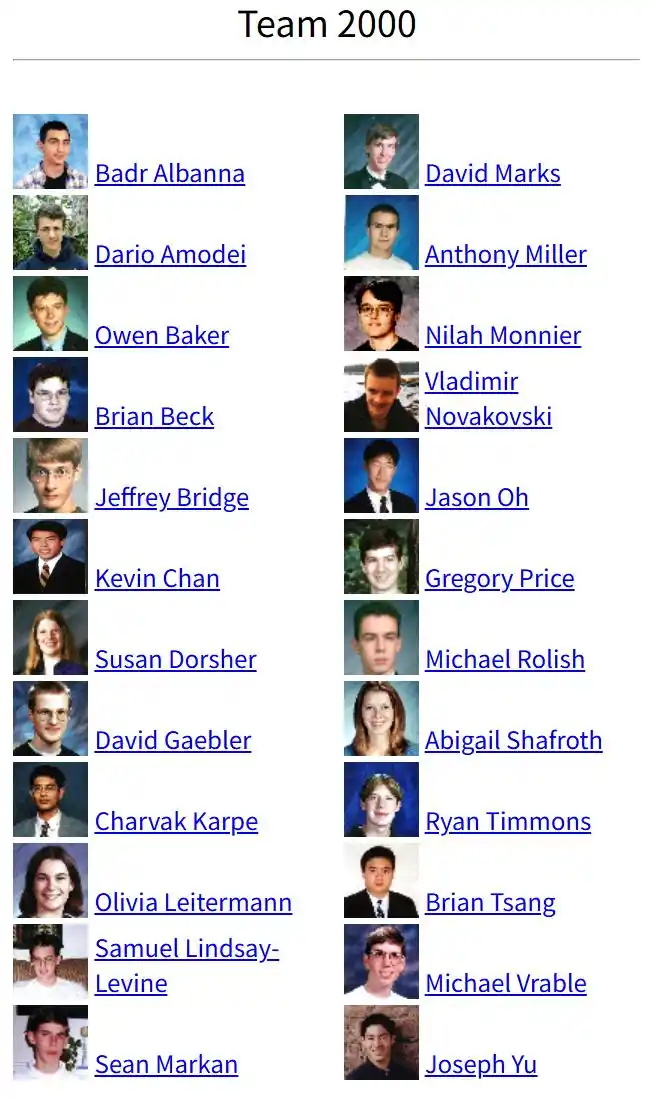
The list comes from the 24-member training camp for the 2000 US Physics Olympiad, and a name lies there prominently: Dario Amodei.

Yes, that's the Amodei who leads Anthropic, valued at $965 billion, with a personal fortune of $15.5 billion.

And that's not all, as you scroll down the list:

Lighter founder Vladimir Novakovski, Duolingo AI research engineer Badr Albanna, UC Berkeley computational biology professor Nilah Monnier Ioannidis are all on it.

A high school physics competition from 26 years ago managed to assemble half of Silicon Valley's talent map.

A Five-Hour Exam Sifted Through 19 Geniuses

The story took place at the University of Maryland in May 2000.

The American Association of Physics Teachers (AAPT) still preserves this training camp archive: 24 names on a static webpage with a distinct turn-of-the-millennium aesthetic.

How difficult was it to get a seat in that room?

According to the process AAPT published at the time, roughly 1,100 qualified students typically took the first round of exams each year. The top 200 advanced to the next round, from which 24 were selected for the training camp.

The final selection was a five-hour exam.

The 24 students had to solve three physics problems under near-competition conditions to vie for the 5 spots on the US team for the International Physics Olympiad.

The final list was announced: Anthony Miller, Jason Oh, Gregory Price, Michael Vrable, Joseph Yu.

The five winners later flew to Leicester, UK, to compete in the 31st International Physics Olympiad (IPhO).

Facing 300 contestants from 62 countries and regions, these five high schoolers delivered impressive results.

Gregory Price scored 35.2 points to win a silver medal, the highest score for the US team, ranking 16th overall; the other four contestants all won bronze medals.

The US team ranked 7th overall, with all 5 team members medaling.
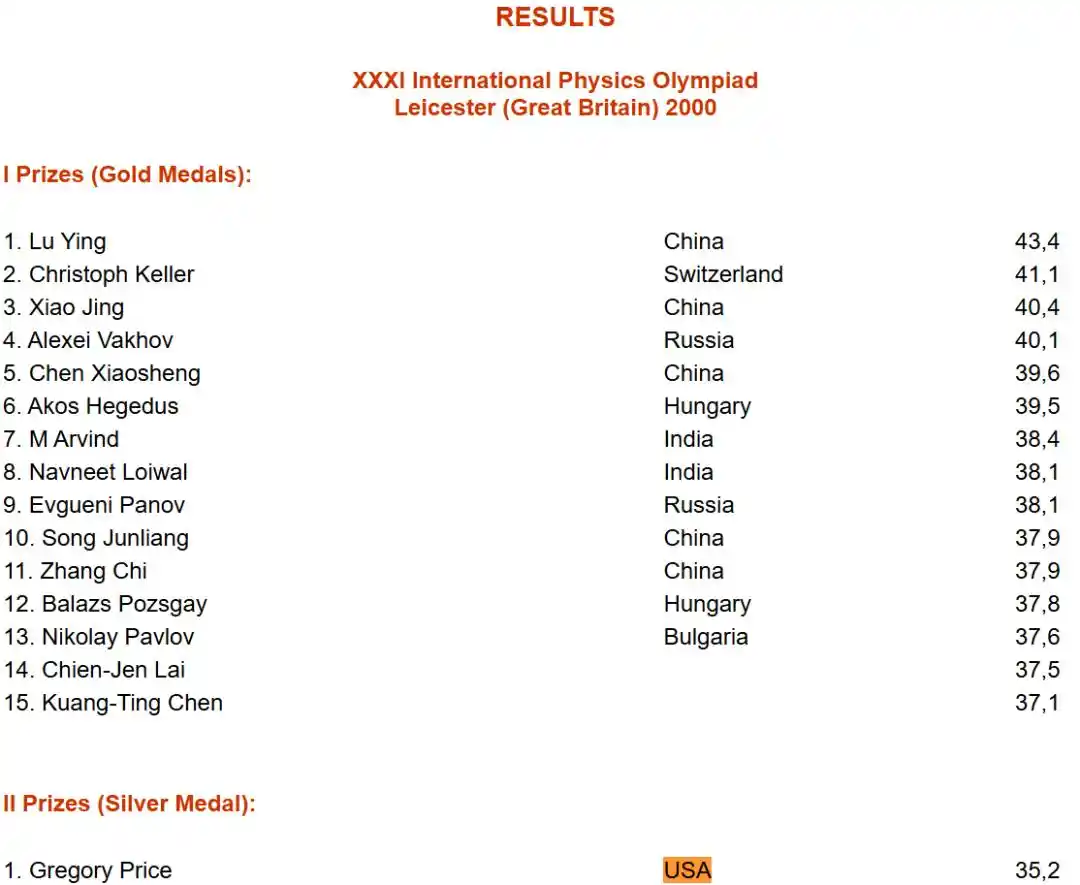
By the way, China dominated the rankings that year: Lu Ying scored 43.4 points to take the global individual top spot, and the team also placed first overall.

The Teen Who Fell Short Later Created Claude

Although he didn't make the top five, Dario didn't leave physics.

On the contrary, he pursued a PhD in physics at Princeton University, researching statistical mechanical models and neural circuits.

In 2014, he left academia to join Baidu's AI lab in Silicon Valley, working on the Deep Speech 2 system, before moving to Google Brain.

In 2016, he joined OpenAI, rising to Vice President of Research, helping lead the development of GPT-2 and GPT-3. He was also a co-author of the early paper on the Reinforcement Learning from Human Feedback (RLHF) method for aligning AI with human preferences.
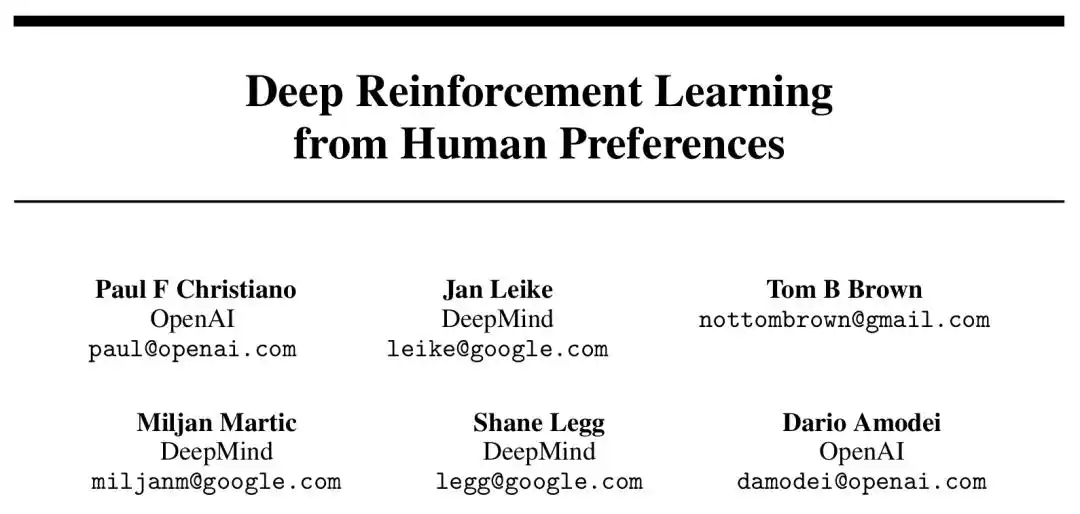
Paper address: https://arxiv.org/abs/1706.03741

In 2021, Dario co-founded Anthropic with six other founders, serving as CEO.

What happened next is well-known—they created Claude.

One List, Half of Silicon Valley

If Dario's comeback took 26 years, Vladimir Novakovski needed only one.

After falling short, he made a comeback in 2001, successfully made the US team, and won a silver medal at that year's International Physics Olympiad.

His later story was even more meteoric.

He went to Harvard and graduated early, then was personally recruited by Citadel founder Ken Griffin to work in quantitative trading.

After leaving Citadel, he served as head of machine learning at Quora, then as VP of Engineering at fintech company Addepar. In 2017, he co-founded the AI social platform Lunchclub, later renamed Lighter.

In 2025, Lighter raised $68 million in funding led by Founders Fund and Ribbit Capital, with a current valuation of about $1.5 billion.
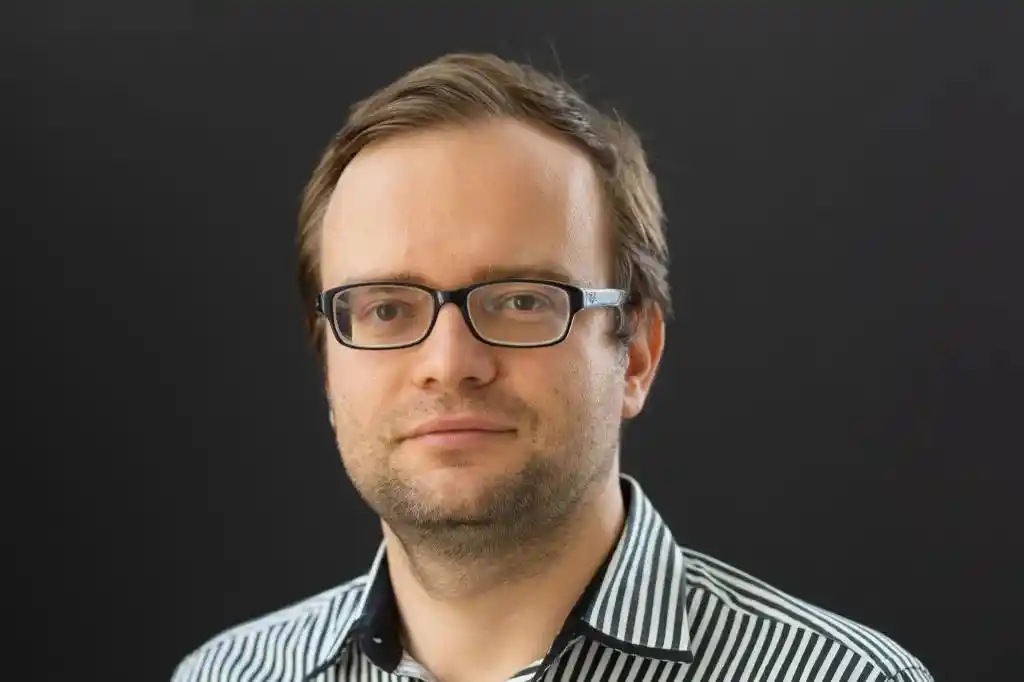
Badr Albanna on the same list took two major career turns.

He earned a PhD in physics from UC Berkeley, later became a professor at institutions like Fordham University, modeling the auditory cortex of the brain using statistical mechanics and information theory.

Later, he joined Duolingo as an AI research engineer, applying multi-armed bandits and causal models to personalized notifications and commercialization systems.

The "Time to practice English" notification you might receive daily could be powered by his models.
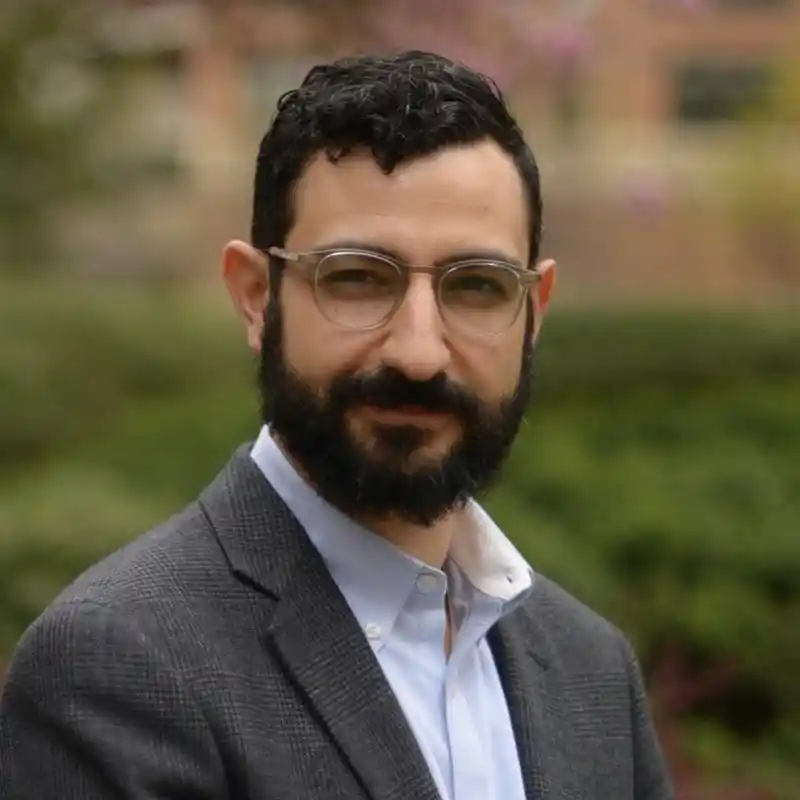
Nilah Monnier brought her physics training into computational biology.

She earned a PhD in biophysics at Harvard, conducted her research work at MIT—analyzing the motion of particles inside cells using hidden Markov models and Bayesian inference. During her postdoctoral phase at Stanford, and now teaches at UC Berkeley.

REVEL, a tool she helped develop, is already being used to predict the pathogenicity of missense variants.
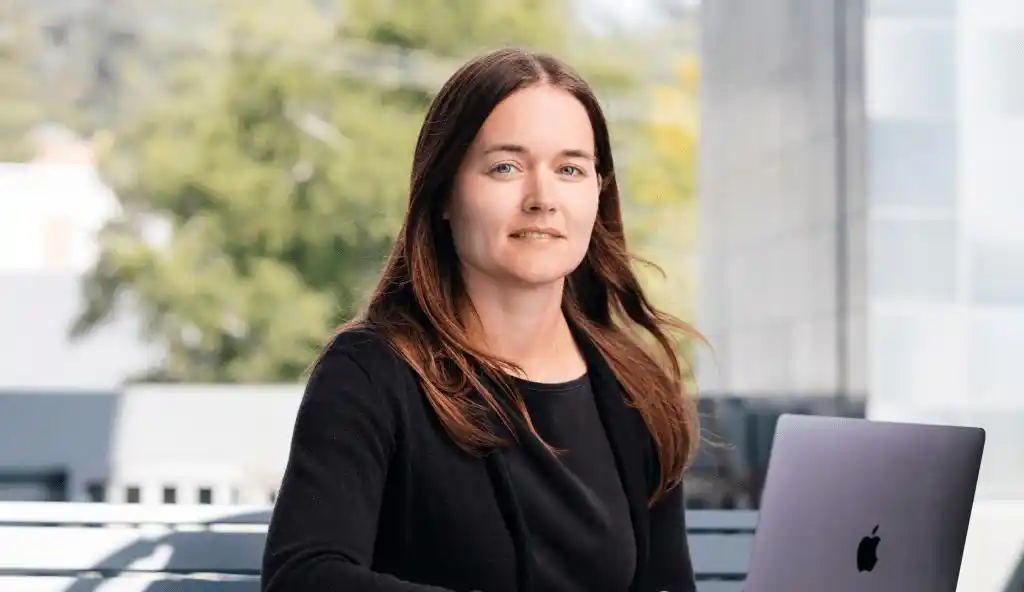
The Top Five Also Had Meteoric Careers

The final team of five didn't stop at their medals either.

Silver medalist Gregory Price was only a sophomore at Thomas Jefferson High School for Science and Technology in Virginia that year and hadn't even formally taken a physics class.

He earned that silver medal with mathematical talent and an old college physics textbook.

And his competition season wasn't over: the same year, he also represented the US at the International Olympiad in Informatics (IOI), winning another bronze medal, ranking 91st among 278 contestants.

He also casually won first place in the junior category of the nation's largest math competition.

Excelling in physics, math, and computer science—this setup goes beyond just being a 'specialized genius.'

Bronze medalist Jason Oh took an even more unexpected path.

After the Olympiad, he first studied physics and math at Caltech, transferred to Harvard after two years, and graduated with highest honors in physics and mathematics.

Then, he turned to Harvard Law School.

Today, Jason Oh is a professor at UCLA School of Law, the Lowell Milken Chair, researching tax policy and public finance.

Another bronze medalist, Michael Vrable, went from Harvey Mudd College to a PhD in Computer Science at UC San Diego, focusing on cloud storage backup, with the Cumulus backup system as his representative work.

After earning his PhD in 2011, he joined Google to work on security research.

There is less public information about the later careers of the other two bronze medalists, but their credentials from back then are testament enough to their caliber.

Anthony Miller interned at the Princeton Plasma Physics Lab during his freshman year summer, working on gas analysis systems for a new reactor; Joseph Yu was the president of both his school's math and science clubs.

The Invisible Talent Exchange for Top Labs

By now, it's clear that the true output of this training camp was the trust forged years ago, ready to be reconnected at any time.

For example, Robinhood co-founder Vlad Tenev is an old acquaintance Novakovski met through the Olympiad circles. Over twenty years later, Tenev's Robinhood became one of the investors in Lighter's funding round.

The camaraderie built solving problems together as teenagers thus turned into real money written into the equity structure table.

Scott Wu, who co-founded Lunchclub with Vladimir, is a multiple-gold-medal winner at the International Olympiad in Informatics and now leads Cognition, the company behind the AI programmer Devin.

More crucially, this pipeline is far from limited to the 2000 cohort.

The "Notable Alumni" section on the USAPhO Wikipedia page spans nearly two decades, from Chris Hirata in 1996 (who won an IPhO gold medal at age 13 and later became a renowned astrophysicist) all the way to 2014.
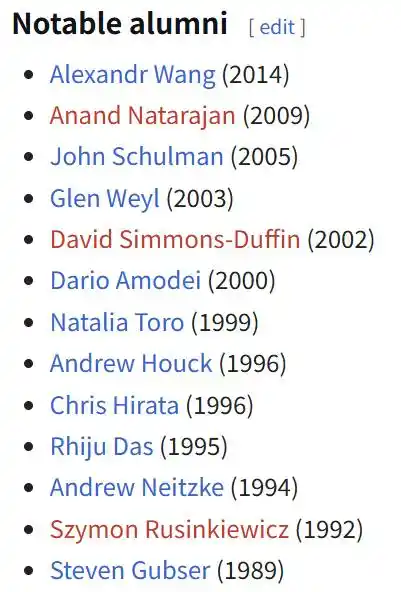
One of the youngest listed is Alexandr Wang (2014), placed next to Dario Amodei (2000) —

Founder of Scale AI, whose shares Meta later bought for $14.3 billion, and who was personally invited to lead the Superintelligence Lab.
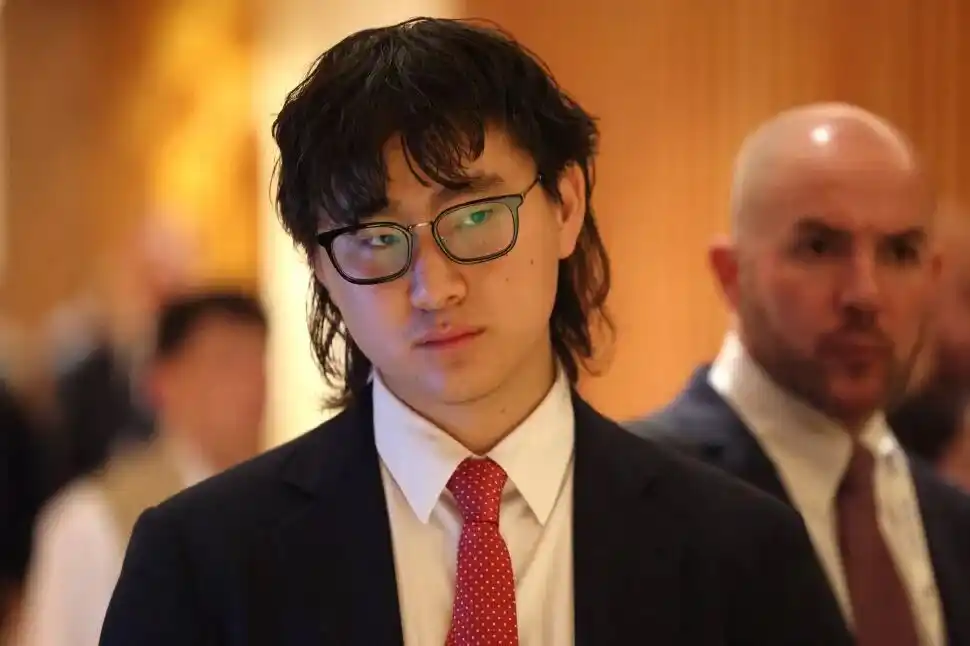
Twenty-six years ago, that five-hour exam selected the five individuals who were the fastest and most accurate at solving problems that day.

The AI era has now brought to light all 24 names again.

References:

https://x.com/Phoenixyin13/status/2085297714519052730

https://www.aapt.org/olympiad2000/team2000.html

This article is from WeChat public account "新智元", author: ASI启示录

Связанные с этим вопросы

QWho was the CEO of Anthropic mentioned in the article, and how was he connected to the 2000 US Physics Olympiad training camp?

AThe CEO of Anthropic mentioned is Dario Amodei. He was a participant in the 24-member 2000 US Physics Olympiad training camp, where he was ultimately one of the 19 students not selected for the final 5-member team to compete in the International Physics Olympiad.

QWhat were the eventual career achievements of Vladimir Novakovski, another participant from the 2000 training camp list?

AVladimir Novakovski returned to the competition in 2001, made the US team, and won a silver medal at the International Physics Olympiad. He later co-founded the AI social platform Lunchclub, which was renamed Lighter. In 2025, Lighter raised $68 million in funding and reached a valuation of approximately $1.5 billion.

QWhich country's team achieved the highest overall score at the 31st International Physics Olympiad (IPhO) in 2000, according to the article?

AAccording to the article, the Chinese team achieved the highest overall team score at the 31st International Physics Olympiad in 2000. Individually, Lu Ying from China also scored the highest globally with 43.4 points.

QAside from physics, in which other prestigious academic competitions did Gregory Price, the silver medalist from the 2000 US team, excel?

AGregory Price, the silver medalist, also represented the United States at the International Olympiad in Informatics (IOI) in 2000, winning a bronze medal. Additionally, he secured first place in his grade level at the largest mathematics competition in the United States.

QWhat is the broader significance of the US Physics Olympiad training camp alumni network, as illustrated by examples in the article?

AThe article illustrates that the US Physics Olympiad training camp network serves as a long-term 'talent exchange' for top-tier laboratories and startups. The connections and trust formed during these competitions have translated into significant professional collaborations and investments decades later, such as Robinhood's Vlad Tenev investing in Lighter and the various successful careers in AI, academia, and law launched by the 2000 cohort.

Похожее

Бизнес на золоте сингапурского розничного гиганта: ежемесячные продажи золотых украшений в 500 кг без ставок на цену золота. Золотой лизинг вдохновляет на дизайн доходов для RWA в блокчейне

Сингапурский розничный гигант Mustafa Centre продаёт около 500 кг золотых украшений в месяц, имея запас почти в тонну золота на сумму свыше $100 млн, но не подвергается рискам от колебаний цены на золото. Секрет в вековой практике золотого лизинга: компания ежедневно восполняет проданный объём, сохраняя запас постоянным и зарабатывая только на торговой наценке. Это создаёт устойчивый, неспекулятивный спрос на аренду физического золота для финансирования операций без блокировки капитала. Соответствующее предложение исходит от институциональных игроков, таких как токенизированный фонд MG 999 на платформе Libeara, который предоставляет золото в лизинг под залог. Протоколы thUSD и thGOLD соединяют этот традиционный рыночный механизм с криптосферой, направляя доход от лизинга золота держателям токенов. Таким образом, реальная экономическая активность (продажа ювелирных изделий) генерирует "реальный доход" для децентрализованных финансов, демонстрируя практическую модель для RWA.

marsbit4 мин. назад

Бизнес на золоте сингапурского розничного гиганта: ежемесячные продажи золотых украшений в 500 кг без ставок на цену золота. Золотой лизинг вдохновляет на дизайн доходов для RWA в блокчейне

marsbit4 мин. назад

Кристофер Нолан назвал ИИ троянским конём Голливуда

Крупнейшие студии (Netflix, Google DeepMind, Amazon) активно внедряют ИИ в кинопроизводство, что вызывает сопротивление творческих гильдий. Режиссёр Кристофер Нолан назвал ИИ «прозрачным троянским конём», подчёркивая видимые, но игнорируемые риски. Он принципиально отказался от CGI в своём новом фильме «Одиссея», снятом на плёнку. Netflix, купив компанию InterPositive, использует генеративный ИИ в сотнях проектов для удешевления и ускорения постпродакшна. Google DeepMind и Amazon также инвестируют в разработку ИИ-инструментов для индустрии. Однако массовое использование ИИ, особенно на примере китайских микродрам, грозит потоками низкокачественного, шаблонного контента с техническими артефактами. Лишь менее 0,5% таких работ становятся хитами. Внедрение ИИ происходит на фоне трудовых споров: новое соглашение SAG-AFTRA ужесточает правила использования цифровых копий актёров. Как и в 1990-е с приходом CGI, технология не заменяет ремесло полностью, а формирует новый гибридный рынок, где скорость внедрения зависит от баланса сил между студиями и гильдиями.

cryptonews.ru9 мин. назад

Кристофер Нолан назвал ИИ троянским конём Голливуда

cryptonews.ru9 мин. назад

Рейтинг торговых платформ за июль: спотовый рынок упал на 35%, торговля фьючерсами сохраняет устойчивость

Обзор торговых площадок за июль 2026 года показывает общее снижение активности. Объем спотовых торгов на основных централизованных биржах (CEX) упал на 35,51% по сравнению с июнем. Снижение объема торгов бессрочными фьючерсами (перпетами) было менее выраженным и составило 19,59% на CEX, что указывает на сохраняющийся спрос на маржинальную торговлю. Интересно, что веб-трафик на сайтах основных CEX вырос на 3,00%, однако загрузки приложений снизились на 2,09%. Это говорит о том, что рост интереса пользователей не привел к увеличению реальной торговой активности, и на рынке преобладают настроения выжидания. В сегменте децентрализованных бирж (Perp DEX) объем торгов бессрочными фьючерсами сократился на 26,88%, а посещаемость их сайтов упала на 10,57%. Таким образом, рынок входит в фазу охлаждения, особенно это заметно в спотовом сегменте, в то время как производные финансовые инструменты демонстрируют относительную устойчивость. *Примечание: часть данных может содержать искусственный объем от ботов. Источники: Coingecko (торговые данные), Similarweb (трафик), данные по загрузкам приложений.*

marsbit10 мин. назад

Рейтинг торговых платформ за июль: спотовый рынок упал на 35%, торговля фьючерсами сохраняет устойчивость

marsbit10 мин. назад

Artemis: Обзор отчетности Figma за второй квартал, с оптимизмом смотрим на текущие рыночные оценки

Автор Artemis Analytics анализирует квартальную отчетность Figma (Q2 2026). Несмотря на сильные показатели (выручка $370,1 млн, рост 48%, NRR 136%), акции упали на 17%. Аналитик считает это ошибкой рынка, который недооценивает трансформацию Figma в ключевой дизайн-слой для создателей ПО в эпоху ИИ. Основные тезисы: 1. **Подъем product engineer.** Границы между дизайнерами и инженерами размываются. Инженеров больше, и они все чаще используют Figma, что расширяет пользовательскую базу. 2. **Агенты ИИ как новые пользователи.** В будущем у каждого сотрудника может быть ИИ-агент, работающий в Figma (редактирование, генерация кода). Это открывает новую модель монетизации: плата за место пользователя + плата за потребленные агентом вычислительные ресурсы. 3. **Расширение маржи.** ИИ-функции Figma (Make, Agent и др.) изначально снизили валовую маржу, но теперь, с введением платных кредитов, стали источником дохода и способствуют ее росту. **Риск:** Прямые ИИ-инструменты (Claude/OpenAI) потенциально могут автоматизировать дизайн-процесс, минуя Figma. Однако, сильная экосистема, накопленные дизайн-системы и привычки пользователей создают высокий барьер. **Вывод:** Рынок все еще оценивает Figma как инструмент только для дизайнеров. На самом же деле, компания позиционируется как центральная платформа для всех создателей ПО и их ИИ-агентов, что означает гораздо больший потенциал рынка (TAM), чем заложено в текущей цене акций.

marsbit12 мин. назад

Artemis: Обзор отчетности Figma за второй квартал, с оптимизмом смотрим на текущие рыночные оценки

marsbit12 мин. назад

Когда POAP тоже подходит к концу: наступает «волна закрытий» в криптоиндустрии, как обычным пользователям справиться?

Криптоиндустрия переживает волну закрытия проектов, включая такие известные имена, как BitMEX и POAP. Многие из этих проектов не были пустыми, а имели реальных пользователей и работающие продукты. Основная причина — отсутствие устойчивой бизнес-модели и реального дохода, особенно после ухода "дешевых денег" предыдущего цикла. Как пользователю защитить себя? Ключевой принцип «Not your keys, not your coins» (не твои ключи — не твои монеты) решает только проблему контроля над счетом, но не гарантирует возможность вывода активов. Важно понимать три уровня контроля: 1. **Контроль аккаунта:** Ваши приватные ключи. 2. **Право на актив:** Является ли актив в вашем кошельке нативным (например, ETH) или лишь "распиской" (например, LP-токен, renBTC) от протокола. 3. **Право на вывод:** Можете ли вы вывести актив, если протокол, смарт-контракт или даже целая блокчейн-сеть перестанут работать. Таким образом, даже с активом в вашем кошельке его стоимость может быть потеряна, если зависимый от него протокол закроется. Перед использованием DeFi, кросс-чейн сервисов и других протоколов необходимо оценивать: * **Реальные доходы проекта** (не TVL) после прекращения стимулирования ликвидности. * **Активность разработки** (GitHub, дорожная карта). * **Пути вывода:** Как вернуть базовый актив, если официальный интерфейс перестанет работать. Закрытие таких проектов, как POAP, напоминает, что даже полезные и любимые продукты имеют жизненный цикл. Это признак взросления индустрии. Ключевой урок для пользователя — не связывать сохранность своих активов с вечным существованием конкретного проекта.

marsbit15 мин. назад

Когда POAP тоже подходит к концу: наступает «волна закрытий» в криптоиндустрии, как обычным пользователям справиться?

marsbit15 мин. назад

Торговля

Спот
活动图片