What's the Connection Between Pinduoduo's Huang Zheng and Blockchain?

链捕手Опубликовано 2026-06-15Обновлено 2026-06-15

Введение

This text explores the unexpected connection between Pinduoduo founder Colin Huang and blockchain, as suggested in his article *Turning Capitalism Upside Down*. Huang argues Pinduoduo's core business is about managing "uncertainty." He posits that wealth flows to the rich because they absorb life's uncertainties (e.g., illness, job loss) that devastate the poor, who pay a premium for certainty through insurance or stable prices. Pinduoduo's model attempts a "reverse insurance": by aggregating consumer demand via group-buying and flash sales, it creates a large, predictable order for manufacturers. This certainty allows factories to remove risk premiums, passing savings back as lower prices, thus partially reversing the wealth flow. The key obstacle, Huang notes, is that an individual's buying intent is an unreliable promise. He then asks if blockchain is the natural solution for this "reverse insurance." The text elaborates that blockchain, through smart contracts with binding deposits, could transform casual intent into a costly-to-break, enforceable commitment. This replaces interpersonal trust with coded rules, making promises credible, pricable, and resistant to fraud. Finally, the author draws a parallel to Bitcoin, framing two paths to creating certainty: the "Pinduoduo path" of aggregating decentralized will into scale, and the "Bitcoin path" of locking rules into immutable code. Both sacrifice something—personal freedom or system flexibility—to manufacture trust an...

Author: Seven Research

An elder colleague once recommended that I read Huang Zheng's "Turning Capitalism on Its Head." After the recommendation, I sought it out and read it, and jotted down some thoughts afterward.

Why bring it up now? Because many might find it hard to imagine that Huang Zheng—someone in e-commerce, famous for "low prices" and "help me cut the price"—could have anything to do with blockchain. Yet, after reading that article, I discovered there indeed is a connection, and it was pointed out by Huang Zheng himself.

I. The Underlying Logic of Pinduoduo: A Business About "Uncertainty"

First, let's talk about what this article is about.

Most people see Pinduoduo and see cheapness, see targeting lower-tier markets. But Huang Zheng himself said that what he's actually doing is an "insurance" business—a business about "uncertainty."

He first poses a poignant question: Why does money always flow toward the wealthy?

His answer: Because the wealthy bear "uncertainty" for others. The probabilities of life's misfortunes—sickness, unemployment, major illness—striking anyone are roughly the same. But the same blow that might cripple a poor person is just a small, calculable fluctuation on a rich person's ledger. Thus, the poor are willing to spend money for "peace of mind"—buying insurance, depositing money in banks for meager interest, preferring to pay more for goods to get certainty. Money, bit by bit, flows from the bottom to the top. This is the "upright" way.

II. "Reverse Insurance": Turning Capitalism on Its Head

So, can it be turned upside down? Can ordinary people, in turn, sell "certainty" to capital?

The difficulty lies in this: an individual's promise is worthless. You can cancel an online order anytime with zero cost to yourself; merchants have no recourse. They can only overstock, passing the cost back into the price. Huang Zheng puts it bluntly:

"Your action is treated as a statistical fluctuation, not as a promise that must be fulfilled."

But what if it's not one person, but ten thousand? Pinduoduo's group buying, flash sales—essentially, they catch you before you can hesitate, locking ten thousand people's "intention to buy" at the same moment, forcefully assembling a guaranteed order, eliminating the factory's risk of "producing and not selling." Grateful for this certainty, the factory converts the premium it would have set aside for risk into a "price reduction" returned to consumers. Money flows backward a notch. This is what he calls "reverse insurance."
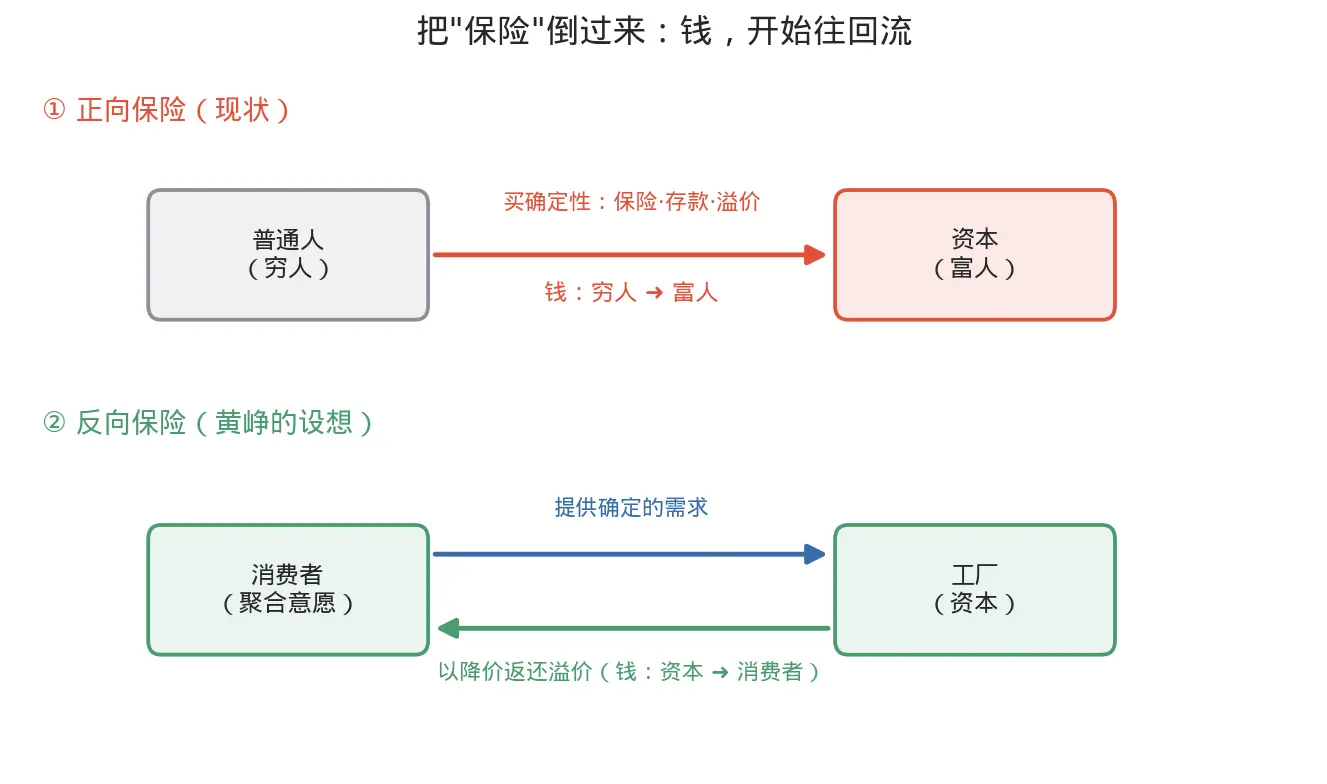
III. The Final Puzzle Piece: Blockchain

By now, you might still not see the connection to blockchain. Honestly, I didn't either at first.

It's near the end of the article that Huang Zheng himself poses a question. He says that to productize, standardize, and monetize this kind of "certainty," a decentralized approach is needed to prevent fraud and create a virtuous cycle of good money driving out bad; then he asks: Isn't blockchain inherently designed for this kind of "reverse insurance"?

Just this one sentence made me pause. An e-commerce entrepreneur, after a long detour, lands the point squarely on blockchain. He doesn't elaborate further, but upon reflection, it makes perfect sense.

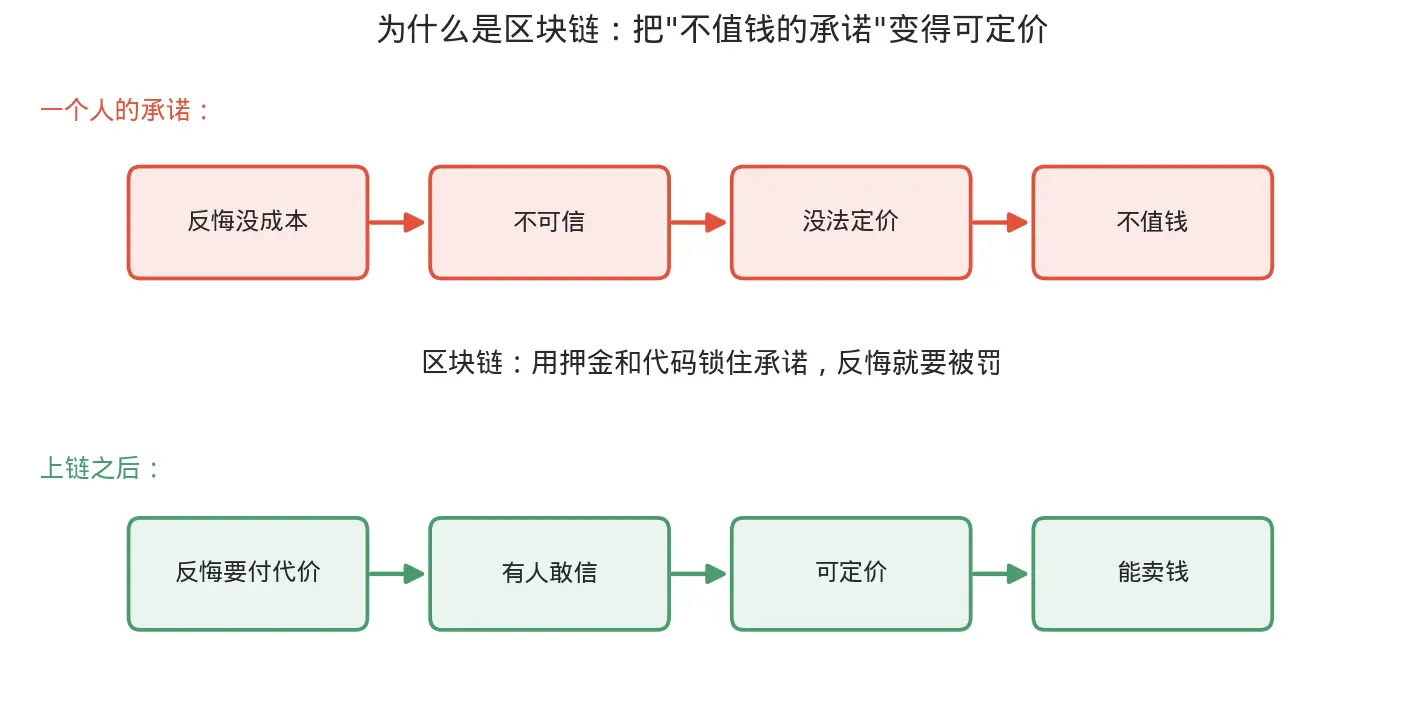
The biggest deadlock for reverse insurance, as mentioned, is that "an ordinary person's promise is worthless"—costless, untrustworthy, unpriced. And blockchain precisely cures this disease:

  • Use smart contracts to irrevocably bind your promise to a deposit. If you renege, the deposit is forfeited, and you face penalties.

  • This way, your "intention to buy" becomes, for the first time, a real promise with a cost to breaking it, a promise that can be enforced. Only then would the factory dare to believe it and arrange production accordingly.

Ultimately, it shifts the basis of "trust" from people to rules. You see, the missing puzzle piece he needed—making promises trustworthy, priceable, and immune to middleman fees—is exactly the inherent capability of blockchain.
IV. Extended Thought: Two Paths to Creating Certainty

Following his question, I couldn't help but think one layer deeper about Bitcoin (an occupational hazard, forgive me for bringing crypto into this).

Bitcoin is essentially the purest example of "trusting rules": fixed supply, open-source algorithm, immutable rules.

  • The certainty of fiat currency relies on the restraint of the issuer; it's rule by man.

  • The certainty of Bitcoin relies on cold, impersonal, unfeeling code; it's rule by law.

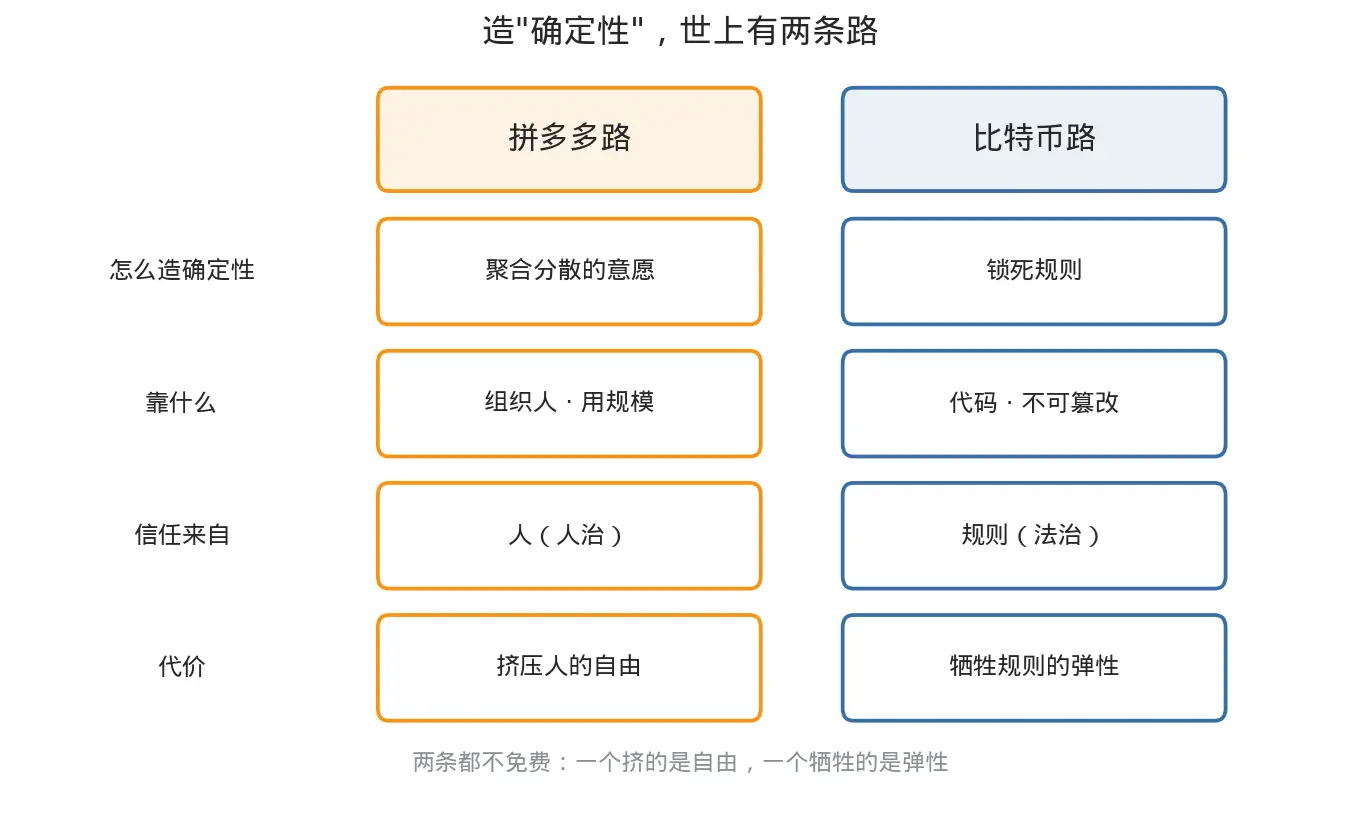
One relies on people, the other on rules. So, there are actually two paths in the world to creating certainty:

  1. The Pinduoduo path: Aggregate scattered intentions into momentum, using scale to forcibly flatten uncertainty.

  2. The Bitcoin path: Lock the rules completely from the start, leaving no room for human discretion or intervention.

Neither path is free. The former squeezes human freedom; the latter sacrifices rule flexibility.
If you're interested, you can also re-read the article "Turning Capitalism on Its Head."

Связанные с этим вопросы

QWhat is the fundamental business logic of Pinduoduo according to the article?

AAccording to the article, the fundamental business logic of Pinduoduo is a business about 'uncertainty' or an 'insurance' business. Founder Colin Huang argues that Pinduoduo operates on the principle of a 'reverse insurance' model.

QHow does Pinduoduo's 'reverse insurance' model work to redistribute wealth flow?

APinduoduo's 'reverse insurance' model works by aggregating the diffuse intentions of numerous consumers into a single, large, and certain purchase order at a specific moment (e.g., through group buying). This provides manufacturers with production certainty, allowing them to eliminate the 'risk premium' they would normally charge. The cost savings are then passed back to consumers as lower prices, causing money to flow 'backwards' from capital to ordinary people.

QWhat is the core problem that prevents ordinary people's commitments from being valuable, and how does blockchain potentially solve it?

AThe core problem is that an individual's promise or purchase intent lacks credibility and is costless to break (e.g., easy cancellations). Blockchain, through smart contracts, can bind a promise to a deposit. If the promise is broken, the deposit is forfeited, creating a tangible cost for reneging. This transforms a casual 'intent to buy' into a credible, enforceable, and financially accountable commitment that manufacturers can trust.

QAccording to the article's extension, what are the two paths to creating 'certainty' as exemplified by Pinduoduo and Bitcoin?

AThe article outlines two paths: 1) The 'Pinduoduo Path': Creating certainty by aggregating scattered intentions into a large-scale force that flattens out uncertainty through collective action. 2) The 'Bitcoin Path': Creating certainty by locking rules into immutable code from the outset, eliminating the possibility of human discretion or manipulation, thus relying on 'rule of code' rather than 'rule of man'.

QWhat key question did Colin Huang himself raise that connects his 'reverse insurance' concept to blockchain technology?

AColin Huang raised the question: 'Is blockchain inherently born for this kind of 'reverse insurance'?' He suggested that the decentralized, fraud-resistant nature of blockchain, which enables a virtuous cycle of good money driving out bad, is perfectly suited for productizing, standardizing, and monetizing the 'certainty' required for his model.

Похожее

US Government Suddenly Halts Anthropic's Strongest Model, "Quasi-IPO Stock Price" Plunges 3.7% Overnight

U.S. Government Halts Anthropic's Top AI Models, 'Pre-IPO' Price Drops 3.7% On June 12, the U.S. government ordered Anthropic to shut down access to its two most powerful AI models, Claude Fable 5 and Claude Mythos 5, citing national security concerns. The directive, issued by the Department of Commerce, required Anthropic to block access for all foreign nationals, leading the company to disable the models globally for all users. Anthropic strongly opposed the move, arguing the government's basis was a "narrow jailbreak vulnerability" and warning that applying such a standard industry-wide would effectively halt all frontier model deployments. The news impacted Anthropic's implied valuation in speculative markets. The Anthropic perpetual contract on Hyperliquid fell approximately 3.7% to around $1,627, down from highs above $1,800 following the models' release. Unauthorized tokenized products linked to Anthropic on Solana also saw significant declines. The models, launched just days earlier on June 9, represented a major capability leap for Anthropic. Fable 5 was its first public release of a "Mythos"-tier model above its flagship Claude Opus. The shutdown creates an ironic situation for Anthropic, a company founded on "AI safety" principles, and adds uncertainty to its ongoing IPO preparations. The company is actively engaging with regulators to resolve what it calls a "misunderstanding" and restore service.

marsbit5 мин. назад

US Government Suddenly Halts Anthropic's Strongest Model, "Quasi-IPO Stock Price" Plunges 3.7% Overnight

marsbit5 мин. назад

SpaceX IPO Creates Trillion-Dollar Billionaire: Musk's Wealth Equals Half of Crypto Market

SpaceX's record-breaking IPO has propelled Elon Musk to become the first modern billionaire with a personal net worth exceeding $1 trillion, reaching $1.11 trillion according to Bloomberg. This staggering wealth surpasses the total market capitalization of all cryptocurrencies excluding Bitcoin and equals roughly half of the entire crypto market's value. The milestone highlights extreme wealth concentration and the significant devaluation of the altcoin market, whose total cap has nearly halved since late 2025 as capital flows into large tech stocks. SpaceX's Nasdaq debut saw its valuation hit $2.2 trillion, with shares soaring from a $135 offer price to close at $161. Its first-day trading volume of $85 billion set a new global IPO record. Musk owns 42% of the company. Despite his wealth dwarfing the altcoin sector, Musk maintains deep ties to digital assets. He personally holds Bitcoin, Ethereum, and Dogecoin, while his companies, SpaceX and Tesla, collectively hold over 30,000 Bitcoin, ranking among the top corporate BTC holders globally. His acquisition and integration of financial data tools into X (formerly Twitter) further connect his ecosystem to the markets. Ultimately, Musk's trillion-dollar status underscores the immense wealth controlled by tech founders, though this fortune remains largely tied to volatile stock prices rather than liquid assets.

Foresight News13 мин. назад

SpaceX IPO Creates Trillion-Dollar Billionaire: Musk's Wealth Equals Half of Crypto Market

Foresight News13 мин. назад

Hardcore First Look | Ocean Embodied Intelligence Company 'Shihang Intelligence' Secures Record-Breaking 1 Billion in Funding, Zhu Xiaohu, Temasek Place Bets

Breaking News | Ocean Embodied Intelligence company "Shihang Intelligent" secures a record-breaking 1 billion RMB (approximately 10 billion yuan) in Series A financing, with investment from Zhu Xiaohu and Temasek. Author: Qiu Xiaofen | Editor: Yuan Silai Ocean Embodied Intelligence company "Shihang Intelligent" has completed its Series A funding round, raising over 1 billion RMB. This marks the largest single funding round in the global marine robotics field to date. Investors include upstream momentum funds from chip companies "Moore Thread" and "Kunlunxin," Singapore's state-owned investment platform Vertex Growth, and listed company Dyneo, among others. Existing investors like GSR Ventures (whose founder Zhu Xiaohu has invested for the fifth time), Vertex Ventures China, Hua Ying Capital, and Long Capital also significantly increased their investments. Founder and CEO Chen Xiaobo, a 1989-born alumnus of Harbin Engineering University, is a long-time expert in underwater robotics. He received the National Defense Science and Technology Progress Award at age 28 (the youngest recipient) and led the development of China's first commercial underwater cleaning robot. The funds will be used for core technology R&D, global market expansion, and building the industry chain ecosystem to scale the application of marine robots in complex underwater scenarios. The ocean is considered one of the most challenging environments for robotics due to low light, high turbidity, complex currents, limited communication, high pressure, and corrosion. "Shihang Intelligent" focuses on developing core underlying technologies for marine robots, covering six key systems: power, control, sensing, navigation, sealing, and deployment. Its robots are capable of operating at depths from 0 to 10,000 meters with full degrees of freedom, performing complex maneuvers, autonomous navigation, and multi-robot collaboration. Applications include ship cleaning, underwater security, offshore wind power, marine ranching, and seabed inspection. The company's order value for the first half of 2026 alone has exceeded 1 billion RMB. Its "Orca Robot" is used by major shipping companies and has performed maintenance on over a thousand large vessels. In April of this year, the company launched its ocean embodied large model "Cangqiong CEORION." Unlike traditional remote-controlled or pre-programmed robots, this model integrates environmental perception, task understanding, and action generation into a single end-to-end architecture. Trained on millions of hours of commercial operation data and simulation data, it covers 12 major underwater operation scenarios. In simulations, it achieved over 90% task success rate and over 70% zero-shot adaptation capability to unseen environments. A built-in physics reasoning module reduces collision risk by 80%, enabling autonomous operation even with weak or no communication. Recently, "Shihang Intelligent" was selected as a core technology partner for Singapore's Maritime and Port Authority national hull inspection and cleaning program. These advancements indicate marine robotics is moving from pilot projects to scaled applications, with real-world operations generating valuable data to continuously improve robot capabilities. CEO Chen Xiaobo stated the company will continue investing in core marine robotics technology, the embodied intelligence model, and global application scenarios to expand into more high-risk, high-difficulty, and high-value underwater operations.

marsbit39 мин. назад

Hardcore First Look | Ocean Embodied Intelligence Company 'Shihang Intelligence' Secures Record-Breaking 1 Billion in Funding, Zhu Xiaohu, Temasek Place Bets

marsbit39 мин. назад

Three Months, 35 Billion Yuan: Investors Rush to Grab the OpenAI of the Physical World

Investors flock to a physical AI startup as the race for the "OpenAI of the physical world" heats up. Ji Jia Shi Jie (GigaWorld), a company dedicated to developing Artificial General Intelligence (AGI) for the physical world, has raised 3.5 billion RMB (approximately $490 million) in just three months, according to a report from investment media outlet Touzijie. The latest B2 funding round of 1 billion RMB attracted a wide range of top-tier investors, including sovereign wealth funds, industrial capital, and financial institutions. This brings the total funding for the young company, now valued over 10 billion RMB, to 3.5 billion RMB across three recent rounds. The company is led by Huang Guan, a post-90s Tsinghua University PhD with extensive experience in AI, autonomous driving, and entrepreneurship. Its core innovation is a "dual-pyramid" system comprising a five-layer data pyramid (from internet videos to real-world robot data) and a three-layer algorithm pyramid focused on world simulation, action alignment, and reinforcement learning. This system underpins its key models: the "World Action Model" (e.g., GigaBrain series for robot control) and the "World Generation Model" (e.g., GigaWorld series for simulating and understanding the physical world). Its models have reportedly achieved top rankings in global robotics benchmarks. Ji Jia Shi Jie argues that while current digital AGI excels in information processing, the next frontier is physical AGI—systems that can understand and interact with the real world. The company believes the field is approaching its "GPT-3 moment," a key inflection point in capability scaling. To achieve this, the company is pursuing a dual-market strategy. For the consumer (C) market, it launched the "SeeLight" brand and its S1 general-purpose humanoid robot, which has secured initial orders for deployment in real homes. For the business (B) market, it focuses on industrial automation with its Maker series robots, having signed agreements for large-scale deployment in factories, and its DriveDreamer world model for autonomous driving, which is already in use with over 30 automakers and tech companies. The report concludes that by bridging the gap between digital intelligence and physical action, Ji Jia Shi Jie aims to unlock a new wave of productivity, ultimately bringing physical AGI into everyday life.

marsbit1 ч. назад

Three Months, 35 Billion Yuan: Investors Rush to Grab the OpenAI of the Physical World

marsbit1 ч. назад

The Storage Magnate Who Conquered a Trillion-Dollar Kingdom, Yet Ultimately Could Not Become the Richest

**Summary:** "The Memory Magnate Who Built a Trillion-Dollar Empire, Yet Never Became the Richest" explores the journey of Zhu Yiming, founder of GigaDevice (603986) and co-founder of the soon-to-IPO ChangXin Memory Technologies (CXMT). The article positions GigaDevice, a fabless chip designer now valued at ~¥340 billion, as a prequel to the massive IDM (Integrated Device Manufacturer) venture, CXMT. Starting in 2005 with minimal capital, Zhu strategically "picked up the pieces" by focusing on niche markets like NOR Flash and microcontrollers (MCUs), areas major players were exiting. This allowed GigaDevice to grow into a diversified semiconductor company, maintaining robust profitability even during industry downturns by controlling costs. However, the piece argues that in the highly cyclical and capital-intensive memory chip industry, the fabless model has limits. True resilience and scale require the ability for "counter-cyclical expansion" – investing heavily during downturns – a tactic only possible for IDMs like Samsung or SK Hynix. This insight led Zhu to partner with the Hefei city government in 2016 to establish CXMT, an IDM focused on DRAM. Zhu's symbolic moves, like forfeiting salary and diluting his equity, were crucial in securing the massive state and bank funding needed. CXMT's equipment base is now valued even higher than that of BYD's vast auto manufacturing empire. Despite the potential for CXMT to reach a market cap of ¥1-2 trillion upon its IPO, Zhu's indirect stake in both companies is estimated below 3%, placing his personal wealth far below that of China's top billionaires. The article concludes that his strategic vision built a trillion-yuan memory landscape, but the capital structure necessary to achieve it precluded a personal fortune of similar scale.

marsbit2 ч. назад

The Storage Magnate Who Conquered a Trillion-Dollar Kingdom, Yet Ultimately Could Not Become the Richest

marsbit2 ч. назад

Торговля

Спот
Фьючерсы

Популярные статьи

Как купить S

Добро пожаловать на HTX.com! Мы сделали приобретение Sonic (S) простым и удобным. Следуйте нашему пошаговому руководству и отправляйтесь в свое крипто-путешествие.Шаг 1: Создайте аккаунт на HTXИспользуйте свой адрес электронной почты или номер телефона, чтобы зарегистрироваться и бесплатно создать аккаунт на HTX. Пройдите удобную регистрацию и откройте для себя весь функционал.Создать аккаунтШаг 2: Перейдите в Купить криптовалюту и выберите свой способ оплатыКредитная/Дебетовая Карта: Используйте свою карту Visa или Mastercard для мгновенной покупки Sonic (S).Баланс: Используйте средства с баланса вашего аккаунта HTX для простой торговли.Третьи Лица: Мы добавили популярные способы оплаты, такие как Google Pay и Apple Pay, для повышения удобства.P2P: Торгуйте напрямую с другими пользователями на HTX.Внебиржевая Торговля (OTC): Мы предлагаем индивидуальные услуги и конкурентоспособные обменные курсы для трейдеров.Шаг 3: Хранение Sonic (S)После приобретения вами Sonic (S) храните их в своем аккаунте на HTX. В качестве альтернативы вы можете отправить их куда-либо с помощью перевода в блокчейне или использовать для торговли с другими криптовалютами.Шаг 4: Торговля Sonic (S)С легкостью торгуйте Sonic (S) на спотовом рынке HTX. Просто зайдите в свой аккаунт, выберите торговую пару, совершайте сделки и следите за ними в режиме реального времени. Мы предлагаем удобный интерфейс как для начинающих, так и для опытных трейдеров.

1.5k просмотров всегоОпубликовано 2025.01.15Обновлено 2026.06.02

Как купить S

Sonic: Обновления под руководством Андре Кронье – новая звезда Layer-1 на фоне спада рынка

Он решает проблемы масштабируемости, совместимости между блокчейнами и стимулов для разработчиков с помощью технологических инноваций.

2.3k просмотров всегоОпубликовано 2025.04.09Обновлено 2025.04.09

Sonic: Обновления под руководством Андре Кронье – новая звезда Layer-1 на фоне спада рынка

HTX Learn: Пройдите обучение по "Sonic" и разделите 1000 USDT

HTX Learn — ваш проводник в мир перспективных проектов, и мы запускаем специальное мероприятие "Учитесь и Зарабатывайте", посвящённое этим проектам. Наше новое направление .

1.8k просмотров всегоОпубликовано 2025.04.10Обновлено 2025.04.10

HTX Learn: Пройдите обучение по "Sonic" и разделите 1000 USDT

Обсуждения

Добро пожаловать в Сообщество HTX. Здесь вы сможете быть в курсе последних новостей о развитии платформы и получить доступ к профессиональной аналитической информации о рынке. Мнения пользователей о цене на S (S) представлены ниже.

活动图片