From Subsidies to Token-Based Pricing to Price Cuts: Is OpenAI Sparking a Price War? Is the Inflection Point for Token Economics Nearing?

marsbitОпубликовано 2026-06-11Обновлено 2026-06-11

Введение

The commercialization of generative AI is facing a critical inflection point as a potential price war looms. According to The Wall Street Journal, OpenAI is considering a significant cut to its token fees to compete with rival Anthropic, signaling a shift from a growth-at-all-costs model focused on token consumption. This move comes as both companies, reportedly losing billions on compute, prepare for IPOs, and as enterprise customers face "bill shock" from switching to usage-based token billing. Reports indicate poor ROI, with one analysis finding only 18 cents of every dollar spent on AI tokens generates user-facing value. The industry's initial phases—from flat-rate subscriptions to aggressive subsidies—have given way to a reckoning with real costs. Analysts debate the future: some predict a bifurcation between premium, high-cost models for complex tasks and cheaper alternatives for routine work, while others believe overall spending will still rise as agentic AI increases tokens per task. Notably, Chinese model DeepSeek's low-cost API is gaining traction with U.S. enterprises, adding competitive pressure. The core challenge is redefining value beyond token volume ("tokenmaxxing") toward measurable productivity ("valuemaxxing"), as the entire AI value chain, from cloud providers to chipmakers, feels the ripple effects of unsustainable pricing.

When a real Token price war erupts, how will the AI industry make money? The entire valuation logic for AI commercialization is at a moment where it needs to be rewritten. The era of competing on "cost-effectiveness" and "scarcity" may have arrived. For OpenAI, "the situation is deteriorating further." Analysis points out that "if OpenAI goes into decline, it could very likely drag down Nvidia, Oracle, Coreweave, and others."

The commercialization narrative of generative AI is facing its most profound self-examination in three years. From exchanging subsidies for users, to monthly subscription plans that hide costs, to Token-based billing exposing enterprise bill crises, the AI industry has completed a three-stage leap in commercialization within three years—and a potential price war could reset this entire monetization logic back to zero.

According to The Wall Street Journal, OpenAI is considering significantly lowering the Token fees it charges users, in order to compete for enterprise clients from rival Anthropic. Sources familiar with the matter stated that this move is partly to "seize the initiative," as OpenAI expects Anthropic to take similar price-cutting actions. OpenAI CEO Sam Altman recently admitted at an event that AI usage costs have become "a huge problem," and said the company will "help people get more value for less money."

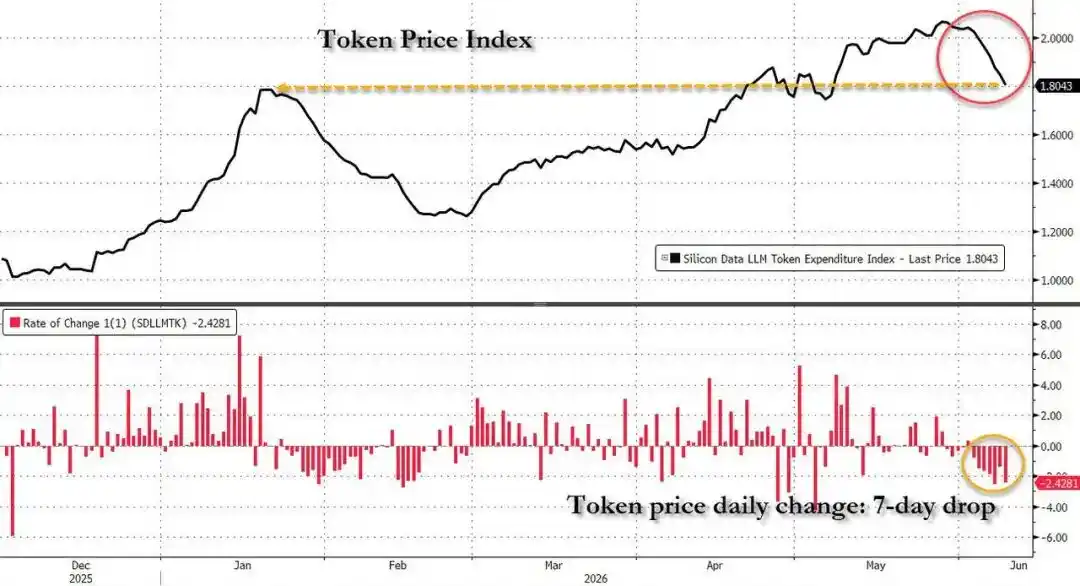
The timing of this news is particularly sensitive. OpenAI secretly filed for an IPO this week, while Anthropic is also in the final countdown to its own listing. Meanwhile, Bloomberg's Silicon Data LLM Token Expenditure Index has fallen for seven consecutive trading days, marking its longest losing streak since January this year, reflecting the market's deep-seated anxiety about the sustainability of AI bills. The report bluntly states that a price war would directly erode the profit margins of both companies—and both are already losing tens of billions of dollars due to the massive computing power required by AI systems.
The core of this discussion is no longer just a single price-cut decision, but a more fundamental question: As the narrative of "more Token consumption is better" reaches its end, who will tell the next commercialization story for the AI industry, and how will it be told?

01

The Initial Three Stages: From Monthly Subsidies to Token Bills

The commercialization of generative AI has undergone a clear three-phase evolution in just three years.

Stage One: Monthly and Annual Subscriptions set the industry baseline. In February 2023, OpenAI launched ChatGPT Plus with a monthly fee of $19.99, pioneering paid C-end access for large models; Baidu, Alibaba, and Tencent followed suit, making fixed-fee subscriptions the standard for early-stage business models.

Stage Two: The subsidy war erupted in full force. To boost ARR (Annual Recurring Revenue), the core anchor for financing valuations, major players turned to large-scale subsidies: Google offered students 15 months of Gemini Advanced for free, OpenAI launched a Team membership plan at $1 for the first month, ByteDance's Doubao entered the market with pricing "99.3% lower than the industry standard," and Baidu announced its core models would be free. The essence of subsidies was trading losses for growth—reportedly, Microsoft lost an average of over $20 per user per month under the GitHub Copilot subscription model, with some heavy users costing up to $80 a month in losses.

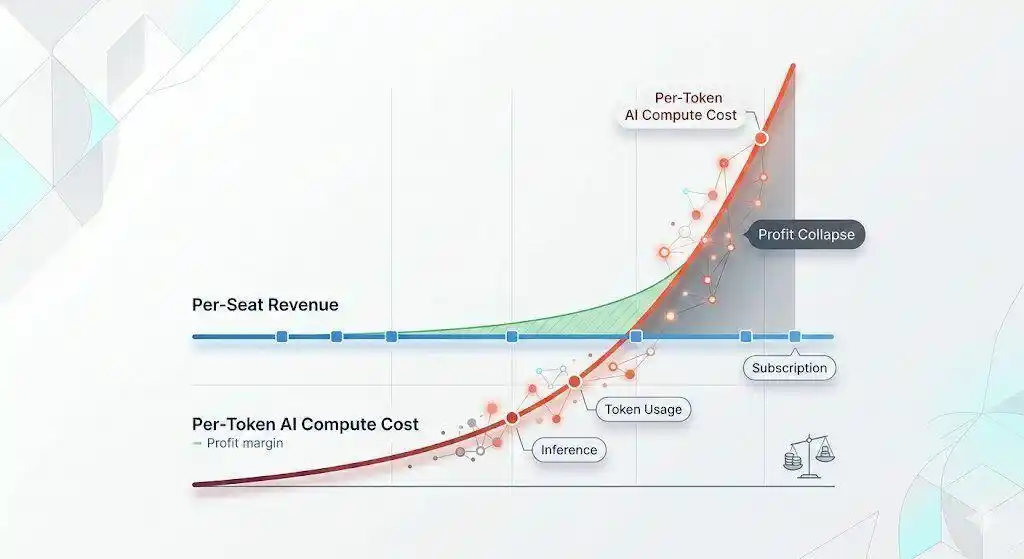
Stage Three: The forced switch to usage-based billing. On June 1, 2026, Microsoft announced that all GitHub Copilot plans would officially transition to Token-based billing, converting the $19 monthly fee directly into an equivalent Token credit. This change brought the true costs long hidden by subscription models into the open—according to user calculations in the Reddit community, a single agent programming session could consume $30 to $40, depleting a monthly plan in just one use.

02

Bill Out of Control: When Tokens Cost More Than People

The implementation of Token-based pay-as-you-go billing fully revealed the true face of enterprise AI expenditure.

The numbers on the enterprise side are staggering. Uber COO Andrew Macdonald publicly stated in May 2026 that the link between the growth in Token consumption and substantive product improvement "does not yet exist," and even coined a term for it: "tokenmaxxing," describing employees performing valueless tasks to boost usage metrics.

More direct data: Uber exhausted its annual Token budget in just the first four months of 2026; Salesforce expects to pay Anthropic around $300 million for the full year.

Anthropic's own developer documentation shows that developers using Claude Code incur an average cost of about $13 per workday, with 90% of users having daily costs below $30—translating this, a 10-person development team could spend over $75,600 per year on Token fees alone.

The return on investment is equally alarming. Enterprise data platform Entelligence.AI, after aggregating data from 2,444 companies, found that for every $1 spent on AI Token fees, only 18 cents generated actual value that reached users; 44 cents were used to fix bugs introduced by the AI itself, 27 cents went towards rework, and 11 cents were consumed by review friction.
Faced with runaway bills, enterprises have begun proactive control measures. Amazon halted internal AI usage leaderboards, instructing employees "not to use AI just for the sake of using it"; Microsoft plans to gradually phase out Claude Code subscriptions for employees in some key product divisions. Goldman Sachs notes that some companies' spending on AI Tokens already accounts for 10% of their total employee labor costs, and this proportion could rise further in the coming quarters. This isn't about demand disappearing, but the end of the era of reckless AI spending.

03

Act Four: Price War Ignited, OpenAI Considers Major Price Cuts

It is against this backdrop that the fuse for a price war was lit.

According to The Wall Street Journal, Altman's consideration of price cuts was directly triggered by the pressure to catch up with Anthropic. Anthropic's revenue has grown significantly recently, its programming tool Claude Code has become popular among software engineers, and this five-year-old startup's valuation has even surpassed OpenAI's for the first time.

However, the cost of this price war will be exceptionally heavy. If prices are significantly lowered, it will further compress the already negative profit margins of both companies, and the competitive landscape offers very limited room for maneuver.

And a fundamental risk long identified by investors is that OpenAI and Anthropic's products are highly substitutable; clients can easily switch from one to the other—meaning price cuts, even if they retain customers in the short term, cannot truly build a moat and only delay market share loss.

This dilemma also transmits outwards through the financial cycle between cloud computing giants and AI labs.

According to corporate disclosure documents compiled by The Information, OpenAI and Anthropic together account for over half of the approximately $2 trillion in future cloud service commitments from Microsoft, Oracle, Google, and Amazon. If price cuts lead to downward revisions in revenue expectations, this transmission chain will face pressure from both ends.

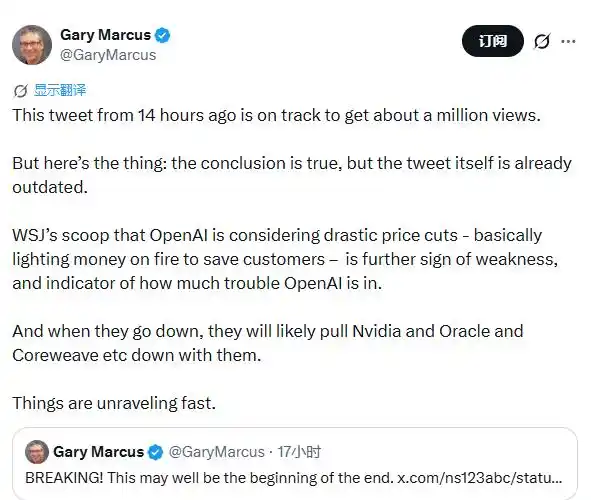
American neuroscientist and AI expert Gary Marcus said: "This further exposes the fragility of OpenAI and indicates how serious the predicament it faces is. If OpenAI goes into decline, it could very likely drag down companies like Nvidia, Oracle, Coreweave. The situation is deteriorating rapidly."
A divergence of views is playing out openly on Wall Street. JPMorgan TMT analyst Mark Schilsky believes the current billing anxiety is merely a "minimum speed bump on the road to higher spending": if the average price per million tokens falls, but the penetration rate of paid AI among US companies continues to rise, overall token usage will mathematically increase substantially; coupled with agentic AI pushing single-task token consumption to several times that of traditional Q&A modes, long-term total expenditure is expected to be significantly higher than current levels.

Goldman Sachs semiconductor analyst Jim Covello holds a more pessimistic view, believing that the current industry chain prosperity has directed almost all value towards semiconductor companies, a phenomenon "unprecedented in history and unsustainable." Once enterprises face the true price of usage-based billing, the capital flows supporting GPU procurement and model training could face a reversal.

04

Act Five: The Next Story for Token Economics?

After the price war, the next chapter of AI industry commercialization has yet to be written, but its outline is emerging.

A report from Citadel Securities offers a directional framework: tiered pricing and charging based on scarcity. Its core logic is that inference-intensive frontier AI won't disappear but will increasingly concentrate in the hands of a few large enterprises capable of bearing the compute costs; for the broader range of enterprises, simpler models might be a more productive path until physical constraints ease. This implies AI usage will move towards stratification—high-value, complex tasks will continue to use frontier models, while routine and batch tasks will shift towards cheaper or local models.

JPMorgan holds a relatively optimistic judgment: even if the per-unit token price falls, the proliferation of agentic AI will multiply token consumption per task—existing data shows that after agentification, token consumption per task can become 3.5 times the original—potentially still expanding the overall expenditure scale. The current billing anxiety might just be a "minimum speed bump on the road to higher spending."

Nebius Chief Revenue Officer Marc Boroditsky proposed the concept of "valuemaxxing," advocating for the industry to shift from pursuing Token consumption maximization to making every Token truly generate value. This direction is gradually becoming an industry consensus—but true commercial implementation still requires AI labs to find a pricing system that both reflects the true cost and is acceptable to enterprise clients. This is precisely the core unresolved proposition in all current debates.

However, perhaps the most overlooked variable in this price war is Chinese models.

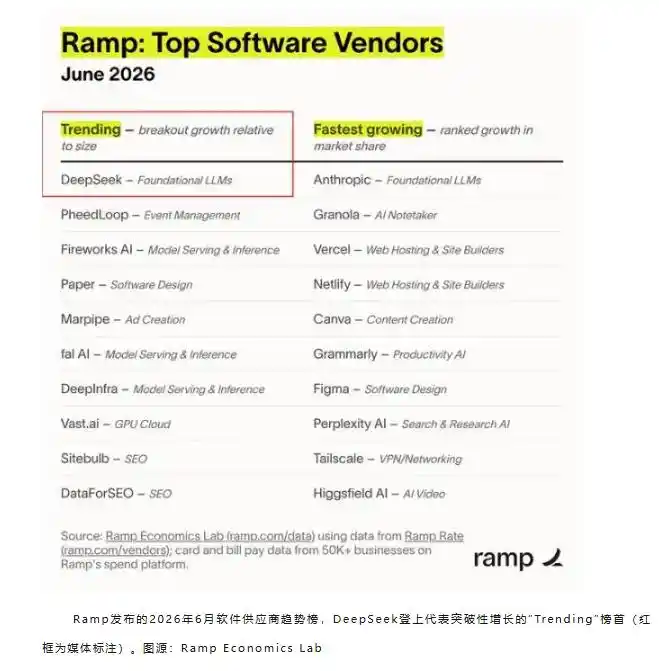
According to June data from American corporate spend management platform Ramp, DeepSeek has topped the list for growth in US enterprise software subscriptions. Ramp Chief Economist Ara Kharazian specifically emphasized that this is not about local deployment of open-source models, but rather "enterprises are directly sending and receiving data through DeepSeek," indicating real paid direct usage—he admitted "did not anticipate US companies would go and use DeepSeek." According to third-party estimates, DeepSeek V4-Pro's API price is about one-tenth that of GPT-5.5, and about one-eleventh that of Claude Opus 4.7.
As OpenAI and Anthropic, two tigers, fight, the ultimate beneficiary might be the player that has long embedded "accessible pricing" into its DNA and doesn't need to answer to IPO investors about profit margins. This may not be the most popular ending for this price war, but it is becoming an increasingly hard-to-ignore reality.

This article is from the WeChat public account "Hard AI," author: Xu Chao

Связанные с этим вопросы

QAccording to the article, what are the three main stages of generative AI's commercialization evolution?

AThe article outlines three stages: 1) Monthly/annual subscription plans establishing the baseline, like ChatGPT Plus. 2) A comprehensive subsidy war to drive user growth and valuations, with companies offering free or heavily discounted access. 3) The mandatory switch to usage-based (Token) billing, which exposed the true costs previously hidden by flat-rate subscriptions.

QWhat is 'tokenmaxxing' as mentioned in the article, and what problem does it highlight for businesses?

A'Tokenmaxxing' is a term coined by Uber's COO, describing the behavior where employees perform valueless tasks just to increase AI Token usage. It highlights the problem that increased Token consumption does not necessarily correlate with meaningful productivity gains or product improvements, leading to wasteful and uncontrolled AI spending for enterprises.

QWhy is a potential price war between OpenAI and Anthropic described as particularly costly and risky in the article?

AA price war is risky because both companies are already losing billions on the massive compute power required for AI systems. Lowering prices would further squeeze their negative profit margins. Furthermore, their products are highly substitutable, meaning price cuts may temporarily retain customers but do not build a sustainable competitive moat, potentially just delaying market share loss without solving the core profitability issue.

QWhat new pricing or usage frameworks are suggested as potential next chapters for AI commercialization after a price war?

AThe article suggests frameworks like tiered pricing based on scarcity/value, where advanced, compute-intensive models are reserved for high-value tasks at large enterprises, while simpler, cheaper models handle routine tasks. Another concept is 'valuemaxxing'—shifting the industry focus from maximizing Token consumption to ensuring each Token delivers actual value. Morgan Stanley also suggests that the rise of agentic AI could multiply Token use per task, potentially offsetting unit price declines.

QHow does the article characterize the role of Chinese AI models, specifically DeepSeek, in the current competitive landscape?

AThe article presents Chinese models like DeepSeek as a significant and often overlooked variable. It notes DeepSeek's API is priced at roughly one-tenth of GPT-5.5 and one-eleventh of Claude Opus. Data shows DeepSeek topping U.S. enterprise software subscription growth, indicating real paid adoption. The article suggests that while OpenAI and Anthropic compete, the ultimate beneficiary might be a player like DeepSeek, which has 'inclusive pricing' in its DNA and less immediate pressure to show profitability to IPO investors.

Похожее

NEAR to Airdrop 330,000 Tokens, Betting on TVL Reaching $70 Million

On June 11th, NEAR Protocol launched the Near@3.33 Milestone Incentive Program, targeting users of its Confidential Intents privacy cross-chain execution feature. The program will distribute 333,333 milestone tokens when the Confidential Intents Total Value Locked (TVL) reaches $70 million. Users must have conducted Confidential transactions on near.com and maintain a Confidential balance above $100 in any asset to qualify, with a single wallet capped at 2% of the current airdrop pool. The milestone tokens will be locked upon receipt and cannot be sold or transferred. They can only be converted 1:1 to NEAR tokens once NEAR's Volume Weighted Average Price (VWAP) maintains $3.33 or higher for three consecutive trading days. As of the report, Confidential Intents TVL exceeds $20.69 million, needing roughly a 3x increase to trigger the airdrop. Confidential Intents, launched in February 2026, is NEAR's privacy execution layer designed to prevent MEV, front-running, and strategy leaks by building confidentiality directly into the execution environment. Its TVL has grown from zero to approximately $15 million in about three months. NEAR token price, which surged from around $1 in April to a peak of $3.08, currently trades near $2. The program aims to boost user activity for Confidential Intents, with future incentive rounds planned as community engagement increases.

Foresight News10 мин. назад

NEAR to Airdrop 330,000 Tokens, Betting on TVL Reaching $70 Million

Foresight News10 мин. назад

Crypto Market Makers Are Collectively Seeking Change as Money Becomes Harder to Earn

**Summary: Crypto Market Makers Adapt as Margins Shrink** Leading crypto market maker GSR exemplifies a broader industry shift, moving beyond traditional market-making to become a full-service "Web3 investment bank." Its recent strategic acquisitions—including an SEC-registered broker-dealer, rebranded as GSR Securities—and purchases of token advisory firms aim to create an integrated platform covering token design, fundraising, listing, liquidity provision, and asset management. This includes launching an ETF and investing in tokenization platforms like Libeara, backed by a strategic investment from Standard Chartered's SC Ventures. This transformation is not unique to GSR. Other major players like Keyrock, B2C2, Wintermute, and DWF Labs are also expanding geographically, pursuing regulatory licenses (especially under frameworks like MiCA in the EU), and diversifying into over-the-counter (OTC) trading, asset management, and real-world asset tokenization. The driving force behind this collective pivot is a rapidly changing market. Profits from traditional altcoin market-making are declining due to fewer viable projects, reduced client budgets, increased competition, and smarter, more demanding clients. Simultaneously, regulatory pressures are mounting, making compliance a baseline cost. Extreme market events further expose teams lacking robust risk controls. Consequently, the crypto market-making business model is evolving from one reliant on information asymmetry and volatility to a more institutionalized, regulated, and service-diverse industry. Survival now depends on building systemic capabilities beyond mere liquidity provision.

marsbit15 мин. назад

Crypto Market Makers Are Collectively Seeking Change as Money Becomes Harder to Earn

marsbit15 мин. назад

Market Adjusts Following Google's $84.7 Billion Fundraising, AI Valuations Now Focus on Payback Speed

After Alphabet's announcement of an $84.75 billion equity financing round, market focus for AI investment is shifting from pure growth narratives to capital efficiency and payback periods. The core argument is that AI is being re-priced from a software-like growth story into a heavy-asset infrastructure cycle, requiring massive capital expenditure (CapEx) on chips, data centers, and power grids. While Alphabet's financing itself is not a distress signal—part of it is for administrative purposes like tax obligations on stock compensation—it highlights the enormous capital demands of AI infrastructure. This demand extends beyond tech giants to pure-play AI model companies (like OpenAI, Anthropic), data center REITs, and utilities. Major tech firms are projected to spend heavily on AI data centers in 2026, signaling a broad-based capital cycle the market must absorb. Consequently, valuation logic is changing. Investors are moving away from questions about who has the strongest AI narrative and are now prioritizing clear visibility into orders, stable cash flows, and the cost of capital. This has led to recent pressure on high-multiple AI software and semiconductor stocks, while "picks-and-shovels" hardware, data center, and power assets with firmer near-term demand may see relative support. The key going forward will be monitoring whether rising CapEx guidance across companies is matched by a timely monetization of AI investments into revenue and cash flow. The market's tolerance for high spending depends on demonstrable returns. While the long-term AI thesis remains intact, the valuation framework has fundamentally shifted to emphasize capital discipline and payback speed.

marsbit23 мин. назад

Market Adjusts Following Google's $84.7 Billion Fundraising, AI Valuations Now Focus on Payback Speed

marsbit23 мин. назад

Торговля

Спот
Фьючерсы

Популярные статьи

Как купить WAR

Добро пожаловать на HTX.com! Мы сделали приобретение WAR (WAR) простым и удобным. Следуйте нашему пошаговому руководству и отправляйтесь в свое крипто-путешествие.Шаг 1: Создайте аккаунт на HTXИспользуйте свой адрес электронной почты или номер телефона, чтобы зарегистрироваться и бесплатно создать аккаунт на HTX. Пройдите удобную регистрацию и откройте для себя весь функционал.Создать аккаунтШаг 2: Перейдите в Купить криптовалюту и выберите свой способ оплатыКредитная/Дебетовая Карта: Используйте свою карту Visa или Mastercard для мгновенной покупки WAR (WAR).Баланс: Используйте средства с баланса вашего аккаунта HTX для простой торговли.Третьи Лица: Мы добавили популярные способы оплаты, такие как Google Pay и Apple Pay, для повышения удобства.P2P: Торгуйте напрямую с другими пользователями на HTX.Внебиржевая Торговля (OTC): Мы предлагаем индивидуальные услуги и конкурентоспособные обменные курсы для трейдеров.Шаг 3: Хранение WAR (WAR)После приобретения вами WAR (WAR) храните их в своем аккаунте на HTX. В качестве альтернативы вы можете отправить их куда-либо с помощью перевода в блокчейне или использовать для торговли с другими криптовалютами.Шаг 4: Торговля WAR (WAR)С легкостью торгуйте WAR (WAR) на спотовом рынке HTX. Просто зайдите в свой аккаунт, выберите торговую пару, совершайте сделки и следите за ними в режиме реального времени. Мы предлагаем удобный интерфейс как для начинающих, так и для опытных трейдеров.

380 просмотров всегоОпубликовано 2024.12.11Обновлено 2026.06.02

Как купить WAR

Обсуждения

Добро пожаловать в Сообщество HTX. Здесь вы сможете быть в курсе последних новостей о развитии платформы и получить доступ к профессиональной аналитической информации о рынке. Мнения пользователей о цене на WAR (WAR) представлены ниже.

活动图片