Author: Climber, CryptoPulse
Original Title: The Era of AI Agent is Coming: The Crypto Investment Logic Behind OpenClaw
Over the past two years, the evolution of AI technology has undergone distinct phases. From initial large language model chat tools to AI assistants capable of invoking tools, and now the rapidly emerging AI Agents.
AI is no longer just answering questions; it is beginning to perform tasks, call programs, and even autonomously complete complex work. Under this trend, an open-source project named OpenClaw has gradually entered the view of the tech community and the crypto industry.
OpenClaw is seen by many as the infrastructure for the AI agent era. Its emergence not only changes the way developers build AI applications but may also bring a new narrative direction to the crypto industry. From on-chain transactions to automated investing, and then to decentralized AI networks, the technological paradigm represented by OpenClaw is redefining the possibilities of combining AI and blockchain.
I. OpenClaw: The Open-Source Operating System for the AI Agent Era
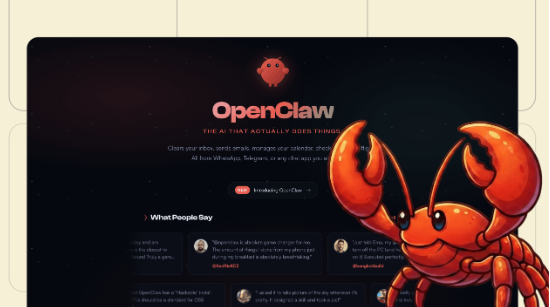
OpenClaw is essentially an AI Agent framework. To put it simply, its role is to enable AI to not just chat but to perform tasks like a human. Developers can use OpenClaw to connect AI to various tools, such as browsers, databases, API interfaces, or script programs, enabling AI to complete complex tasks.
In traditional large language model applications, AI is more "passively responsive." Users ask questions, and the model provides answers, with the entire interaction process always controlled by humans. But in the Agent mode, AI can autonomously plan task steps based on goals.
For example, when a user gives an instruction to analyze a certain market and generate a report, AI can automatically complete data search, information organization, chart generation, and final content output. This capability means that AI is beginning to transform from a tool to an executor.
The core architecture of OpenClaw typically includes several key parts:
First is the large language model itself, such as GPT, Claude, or other models, which are responsible for reasoning and decision-making. Second is the Agent scheduling system, used to manage task flows and call tools. The third part is the skill module, which can also be understood as a plugin system, enabling AI to perform specific actions, such as scraping web pages, processing data, or calling blockchain interfaces. Finally, there is the runtime environment, responsible for actually executing AI's operations.
The significance of this architecture is that it modularizes AI capabilities. Developers do not need to build complex AI systems from scratch; they only need to connect models and tools on the OpenClaw framework to quickly build an AI agent that can perform tasks. This significantly lowers the threshold for AI application development and also leads to a trend similar to a modular market in the AI ecosystem.
Another important reason OpenClaw has attracted attention is its open-source nature. Open source means developers can freely modify the code, extend functions, and build new applications on its basis.
Because of this, OpenClaw's community has grown very rapidly, with more and more developers building automation tools, workflow systems, and AI agent applications within its ecosystem.
From a technology trend perspective, AI development is moving from model competition to Agent ecosystem competition. Future AI applications will likely not be single models but systems where multiple AI agents work together. The framework provided by OpenClaw fits this trend well, so it is regarded by many as one of the infrastructures of the AI Agent era.
II. AI Agents On-Chain: OpenClaw Reshapes the Crypto Narrative
The emergence of OpenClaw is not just a technological innovation for the crypto industry; more importantly, it may change the way on-chain applications operate. Blockchain networks themselves are automated systems, and AI agents can become "digital participants" running on the chain.
In traditional crypto markets, most transactions and operations still require manual completion. For example, analyzing market data, executing trading strategies, participating in DeFi liquidity management. These actions often require experienced investors or professional institutions to complete. But when AI Agents get involved, these tasks can be automated.
A typical scenario is the AI trading agent. Using an Agent framework like OpenClaw, developers can build AI systems that can automatically analyze market data, formulate strategies, and execute trades.

Such systems can run 24/7, automatically adjusting strategies based on on-chain data, price fluctuations, and market sentiment. For the crypto market, this means more machine participants will enter the trading ecosystem.
Another potential impact is the automation of on-chain data analysis. Blockchain data is public and transparent, but the volume is huge, making it difficult for ordinary users to utilize effectively.
AI agents can analyze on-chain fund flows, whale address behaviors, and market trends in real-time, and convert this information into investment decision suggestions. This capability may change the way traditional crypto research is conducted.
OpenClaw may also promote the deep integration of AI and DeFi. In the DeFi ecosystem, liquidity management, yield optimization, and cross-protocol arbitrage themselves highly rely on automated strategies.
If AI agents can analyze the market in real-time and automatically execute operations, then DeFi products will become more intelligent. For example, AI can automatically adjust liquidity provision strategies based on market conditions or allocate funds across multiple protocols.
In addition, AI agents may also become "users" of on-chain applications. In the future, some blockchain networks may no longer only have human addresses but also a large number of AI addresses. These AI addresses can participate in transactions, governance, and even protocol operations. In other words, a new type of participant may emerge in the blockchain ecosystem, namely members of the AI economy.
From a macro perspective, the greatest significance of combining AI Agents with blockchain is that it further enhances the degree of on-chain automation. Blockchain solves the trust problem, while AI agents solve the decision-making problem. When the two are combined, a true "automated digital economy" may be formed.
III. OpenClaw and the Track Opportunities Under the AI Agent Transformation
With the development of AI Agent frameworks like OpenClaw, some crypto tracks may usher in new narrative opportunities. The most directly benefiting area is AI + Crypto infrastructure. These projects typically focus on providing computing power, data, or network support for AI.

For example, the decentralized computing power network Render Network aims to provide distributed GPU resources for AI and graphics computing. As the number of AI agents increases, the demand for computing power will continue to grow, and the value of such networks may further increase.
Another important track is the AI data market. The training and operation of AI models and agents require a large amount of data, and blockchain can provide a decentralized data trading mechanism.
For example, Ocean Protocol attempts to build a data sharing market, allowing data owners to sell data access rights while ensuring privacy. In the era of AI Agents, the value of data may be further highlighted.
The rise of AI agents may also benefit automated trading and strategy platforms. As more AI systems enter the market, the importance of on-chain trading infrastructure will also continue to rise.
For instance, high-performance DeFi protocols or automated trading platforms may become important places for AI agents to execute strategies. This means trading infrastructure and liquidity protocols will also gain new demand.
In addition, decentralized AI networks may also become an important track. For example, Fetch.ai proposed the concept of an "autonomous agent network" early on, trying to let AI agents run autonomously on the blockchain and exchange value. With the popularity of tools like OpenClaw, such concepts may regain market attention.
Finally, AI agents may also change the mode of on-chain governance. In future DAO organizations, AI agents may represent users in voting, proposing governance suggestions, and even managing funds. Such changes mean that DAO governance tools and AI collaboration platforms may also usher in new development space.
From an investment logic perspective, the core of the AI Agent narrative is not a single project but an entire ecosystem chain. From computing power and data to the application layer, new opportunities may appear in every link. OpenClaw, as an AI Agent framework, plays more of a role as a technical catalyst, promoting the development of the entire AI automation ecosystem.
Conclusion
The emergence of OpenClaw marks AI technology entering a new stage. AI is no longer just an auxiliary tool but is beginning to become a digital agent that can perform tasks. When this capability is combined with blockchain, it may give birth to a more automated digital economic system.
For the crypto industry, this is both a technological innovation and a narrative upgrade. From AI trading agents to decentralized AI networks, to on-chain automated governance, AI Agents are bringing new imagination space to blockchain. In the coming years, AI agents may become an important part of the blockchain ecosystem, just like smart contracts.
Twitter:https://twitter.com/BitpushNewsCN
Bitpush TG Communication Group:https://t.me/BitPushCommunity
Bitpush TG Subscription: https://t.me/bitpush