Author: Ben Lakoff
Translation: Deep Tide TechFlow
Deep Tide Guide: When Bankless founder sold all ETH and 19-year-old developers flocked to Solana, the bearish narrative for Ethereum became consensus. However, Ben Lakoff, a partner at BanklessVC, believes this is a repeat of Microsoft's "Ballmer Era"—superficially the narrative is bearish, but underlying fundamentals are steadily growing. A 30% staking rate, ETF accumulation, and clearer regulations are compressing the circulating supply. While crypto regulation is shifting from an existential threat to a legal framework, it's precisely the time to get in.
Welcome to the May trading flow summary.
This month's thesis section is a bit longer, so I've put it upfront. All financing rounds, fund raises, and hackathon results are placed afterward.
Ethereum's Ballmer Era
Last month, David Hoffman sold all his ETH at $2,070 and wrote a thoughtful article explaining why. It spread all over X (Twitter).
David subsequently joined the Chopping Block podcast, and I really enjoyed that conversation. Tarun said Ethereum is "ossifying" because no 19-year-olds want to build there. Max Resnick called the Ethereum Foundation "risk-averse." The bullish Haseeb gave the entire bearish sentiment a name: this is Ethereum's Ballmer Era. That phrase resonated with me.
This framework is too good to let go.
Yes, I'm bullish on "crypto," I'm bullish on BTC, I'm bullish on ETH... I'm bullish on the trend. But pretending the bearish thesis is weak is just self-deception, so I want to elaborate further on my position. These are my views, not necessarily representing BanklessVC's views, and certainly not investment advice.
The Bearish Thesis Has a Name, and It's Not Wrong
The substance is real. In fact, we've dropped another 10% since that article was published.
David's argument: ETH as money was always a long-term bet, and the rollup-centric roadmap makes it even longer. Ethereum is a "giver, not a taker"... it's designed to distribute block space at cost. L2s capture 98% margins on blob revenue. The gas limit is gradually increasing to 100M+. The BPO fork aggressively expands blob supply. The $30B to $163B stablecoin surge creates value for Circle and Tether, not ETH. Meanwhile, SOL, NEAR, BNB, and TRX have repriced as fee-driven comparables. He's mechanically correct. The protocol is designed for abundant block space, the exact opposite of the fee-driven value capture you want.
Tarun's "ossification" view is the cultural version of the same thing. Talent follows founder energy, and that energy is now on Solana, Monad, Hyperliquid, and whatever comes next (maybe not Ethereum, not crypto). Resnick's "risk-averse EF" is the institutional version. The foundation is devoutly focused on protecting network integrity at a moment when it needs to stay competitive.
Haseeb is right. A "Ballmer Era." Slow product cadence. Botched transitions. Sharper competitors with killer instinct. Loud critics who are right on the points.
What Microsoft Actually Did During the Ballmer Era
Ballmer ran Microsoft from 2000 to 2014. The joke: wasted 14 years. Missed mobile, missed search, missed social, shipped Vista, threw a few chairs.
That's the joke I remember, but what does the joke miss? MSFT stock went sideways for over a decade, while the enterprise franchise compounded relentlessly underneath. Dividends did most of the work. Office and Windows licenses printed money the entire "Microsoft is dead" narrative period. Then Satya took over, and MSFT went 10x.
The lesson (at least in the Microsoft version) is that deeply embedded, enterprise-loved, time-tested infrastructure tends to keep compounding through its own bearish narrative. The bearish narrative is often correct on the surface. Just not enough to short.
Ethereum is still the largest credibly neutral public chain for tokenized assets. BUIDL launched there. ~66% of USDC supply is there. The deepest DeFi liquidity is there.
But the lead is shrinking fast. BUIDL isn't just on Ethereum (~40%), down from ~85% a year ago. USDC exists on 34 chains. Western Union chose Solana over Ethereum for USDPT. The institutional default is shifting from singular "Ethereum" to plural "public chains."
Still bullish for the incumbent. Just not a monopoly anymore. Whether 19-year-olds want to build there is a real long-term concern. But it's not what decides the next two years.
Beneath the Noise: The Circulating Supply Is Collapsing
This is the part most bearish takes miss.
~30% of ETH is staked. Treasury corps hold another 6%+ and growing. BitMine alone holds 4.47% of the supply and is publicly targeting 5%. Spot ETFs keep absorbing more. The SEC/CFTC March 17 ruling classifying staking rewards as non-securities unlocked the entire staking ETF pipeline. Five other issuers (Fidelity, Franklin, Invesco, 21Shares, VanEck) have staking amendments pending Q2 decisions.
Every ETH staked through an ETF is ETH that cannot be sold on price impulse. Net issuance is ~0.23% annualized. The float is shrinking faster than that, and on most days these intake sides are bidding. The math doesn't care if ETH is boring.
So David is right, ETH won't reprice from fee burn. The roadmap chose abundance. But ETH can reprice from float compression, staking yield demand, and institutional Schelling point premium without winning the fee war. At least near-term.
Crypto's TAM Keeps Rising
Zooming out a bit from ETH. The real story of the last 12 months is crypto regulation shifting from an existential threat to a legal framework.
The GENIUS Act is now law. Payment stablecoins have a federal regime. The CLARITY Act passed the House in July, passed the Senate Banking Committee on May 14, and structurally looks likely to pass before midterms. Stablecoin circulating supply is over $2.8T and compounding. Tokenized treasuries are scaling. Spot ETFs exist for a growing list of assets.
This isn't the crypto-dies phase. This is the crypto-becomes-a-regulated-trillion-dollar-slice-of-the-financial-system phase where boring institutions are mandated to plug in.
In prior bears, we genuinely worried whether this ecosystem would exist in the future. But, with some caveats, and they matter.
First: Crypto winning vs. decentralized crypto winning are not the same thing. The truly scary bear case isn't David's fee math. It's "blockchain winning" eventually looking like Canton, JPM Onyx, DTCC's permissioned ledgers and a few Avalanche subnets, with the public crypto asset complex capturing basically none of the real value.
That world exists (and is concerning), but I'd bet on the public chain side for a few reasons. Pure permissioned chains as the institutional answer have been pitched for a decade and keep losing adoption (maybe this time is different?). The architecture actually winning is permissioned assets on public chain rails: BUIDL, BENJI, Ondo's USDY. Tokens execute KYC and transfer restrictions; settlement runs on Ethereum, Solana, and other public infrastructure. The empirical record of KYC pools coexisting with open public pools (Aave Arc, Compound Treasury) is that they fail.
That's still bullish for public chains, including ETH, as settlement layers. But it's weaker than full DeFi composability. Permissioned assets cannot freely compose with open pools, but the gated-access version is the mode winning.
Second: The question is no longer whether crypto adoption happens. It's which crypto captures it. The honest answer is, not all goes to ETH, but the institutionalized, regulated, "needs credibly neutral" giant chunk almost certainly. Because the alternative is asking tier-1 banks to settle tokenized assets on chains run like startups... unlikely.
This is where the Ballmer framework underrates the bull case. It only works if the underlying market keeps growing. Crypto's underlying market is growing fast in the most regulator-blessed, institutionalized way.
Barbell Strategy: Bullish on the Trend, Not Extremism
The bear thesis I take seriously isn't the fee analysis. It's leadership and competition. EF might indeed need its Satya moment. The killer instinct vacuum is real. Solana, Monad, and Hyperliquid aren't slowing down. ETH/BTC and ETH/SOL could go sideways or lower for a while before turning.
The way to position around this is simple: stop being an extremist.
Hold ETH for the time-tested/institutionalized/float compression trade. Hold SOL for the consumer/throughput/distribution trade. Hold BTC for macro hedge. Hold a small basket of next-gen L1s and application-layer winners where the cultural energy is actually flowing.
I know. ETH is a $250B asset, impacted by macro trends, and your capital allocation always involves trade-offs. I'm not an extremist, but I'm still bullish on ETH. Summarizing why:
The float is shrinking faster than issuance.
Q2 staking ETF approvals are a live, dated catalyst.
CLARITY Act passage broadly unleashes institutional crypto. Clearer rules let regulated capital deploy at scale across the asset class. ETH's moat is incumbent network effects plus credible neutrality, making it the default public chain settlement layer for tokenized assets, even as the lead shrinks.
The bear thesis is so loud it's now consensus. The historical hit rate of consensus bear at $2K after a 60% drawdown is low.
The optionality value of a "Satya moment" isn't priced in. If EF gets reorged, or a more aggressive entity emerges to lead protocol development, that's pure upside no bear model includes.
I see this trade as "David is partially right and ETH still works." Microsoft worked under Ballmer. Crypto adoption is winning. The assets you most want to own are the ones most deeply embedded in the part of crypto the US government just spent two years writing rules for.
Zoom out on what regulators are actually saying. The SEC and CFTC are telling you they want to rebuild finance on-chain. Bring dollars on-chain. In that world, how is this not insanely bullish? Maybe if you're a cypherpunk, this isn't the world you envisioned... gated assets, KYC rails, everything requiring permission. But for public chains as settlement infrastructure? Unquestionably bullish.
That's the crux of where we are in the cycle. AI is the center of attention, full stop. It's hot, parabolic, and as an early-stage investor, that's exactly the problem. You want to deploy capital where it's not hot. When a sector is this overheated, it's hard to put capital to work anywhere but the earliest pre-seed stage without paying a premium.
Crypto, right now, is not hot. The bear thesis is consensus. The energy is elsewhere. That's the setup you want, not the one you run from.
On a long enough timeline, everything becomes AI, everything becomes blockchain. One of these is priced like it already happened. The other just got a two-year head start written into law, and everyone is looking the other way.
Buckle up. Now turning to the rest of crypto/web3 financings :)
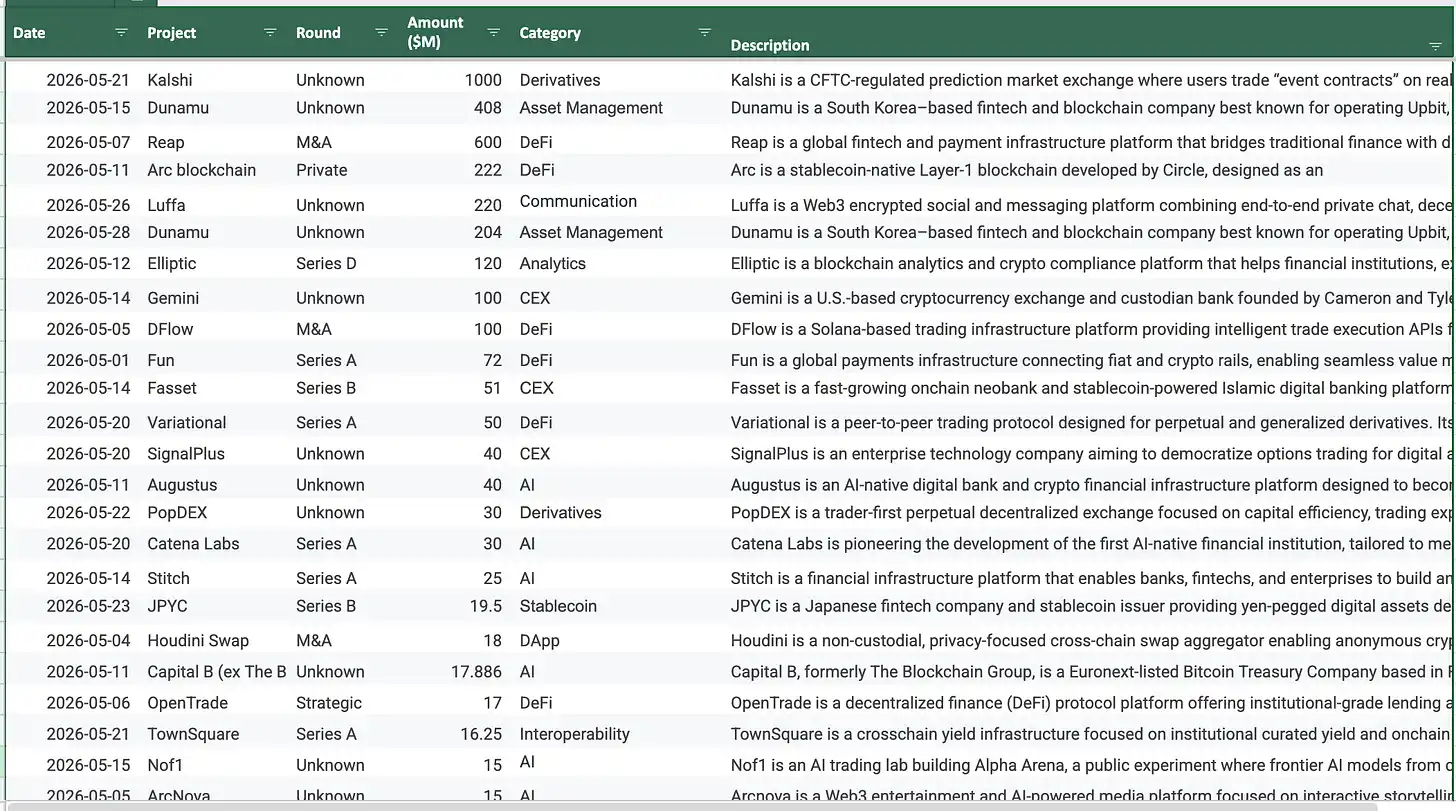
Top 10 Crypto Financing Rounds
Kalshi | Series F | Prediction Markets | $1B | 2026-05-07
Led by Coatue, with participation from Sequoia, a16z, IVP, Paradigm, Morgan Stanley, and ARK Invest. This $1B round values Kalshi at $22B, double the $11B valuation just five months prior. Annualized trading volume tripled in six months to $178B, with institutional volume up 800%. Kalshi is CFTC-regulated and not crypto-native, so call it the asterisk on this list, but it now has >90% of US prediction market activity, and prediction markets are one of the cleanest on-ramp stories crypto has right now.
Dunamu (Upbit) | Strategic Investment | Centralized Exchange | $408M | 2026-05-28
Three Samsung-affiliated companies (Samsung Securities, Samsung SDS, Samsung Card) agreed to purchase ~4% of Dunamu, operator of South Korea's largest crypto exchange Upbit, for ~$408M (612.8B KRW). Each buyer mentioned positioning for KRW-pegged stablecoins, tokenized securities, and on-chain settlement ahead of Korea's Digital Asset Basic Act. This is part of a May sprint transferring ~14% of Dunamu to Korean giants like Hana and Hanwha. Closing June 19.
Circle (Arc) | Token Presale | Infrastructure/Stablecoins | $222M | 2026-05-11
Circle raised $222M (FDV $3B) for Arc, its institutional L1 for stablecoin settlement and tokenized assets. a16z crypto put in $75M, with participation from BlackRock, Apollo, ICE, Standard Chartered Ventures, SBI, Janus Henderson, General Catalyst, Marshall Wace, ARK, Haun, and Bullish. This is the clearest "TradFi is picking rails" signal of 2026. A regulated stablecoin issuer is building its own chain, with the largest asset manager on the cap table.
Ripple (Ripple Prime) | Debt Financing | Infrastructure/Prime Brokerage | $200M | 2026-05-11
Ripple secured $200M in debt financing from a fund managed by Neuberger Specialty Finance to expand lending capacity for its multi-asset prime brokerage, Ripple Prime. Existing institutional loans serve as collateral. Ripple Prime revenue is up 3x YoY since Ripple acquired the platform in 2025. Traditional finance credit backing crypto prime brokerage loan books.
Elliptic | Series D | Compliance/AI x Crypto | $120M | 2026-05-12
Led by One Peak in this $120M round (valuation $670M), with participation from Nasdaq Ventures, Deutsche Bank, and British Business Bank. This is the largest pure equity VC round of the month. Elliptic is building agentic AML/compliance tooling. Reading with post-April lens: this is the ops/compliance layer DeFi keeps being reminded it needs, now with TradFi capital behind it.
Fun | Series A | Payments/Consumer | $72M | 2026-05-01
Co-led by Multicoin Capital and SignalFire, with participation from Infinity Ventures, Pharsalus Capital, and Justin Mateen. Fun is a crypto/fiat on-ramp powering financial platforms like Polymarket. Largest consumer/payments VC round of the month, a clean bet on the prediction market and consumer crypto heatwave track.
Fasset | Series B | Stablecoins/Payments | $51M | 2026-05-14
Led by SBI Group in this $51M raise, with Investcorp and Arz Portföy participating. Fasset is a stablecoin-powered neobank for emerging markets, with ~$32B annualized transaction volume. Real proof-of-concept for the stablecoin-as-payments thesis, and in the places that matter most: the corners of the world where dollar rails are genuinely life-changing.
Variational | Series A | DeFi/Derivatives/RWA | $50M | 2026-05-20
Led by Dragonfly, with participation from Bain Capital Crypto and Coinbase Ventures. Variational operates an RFQ-style platform for on-chain perpetuals on real-world assets: oil, gold, silver, copper. The team's call is that RWA perps could surpass BTC and ETH perps within a year. Most thesis-heavy small trade of the month.
OpenTrade | Strategic/Growth | Stablecoins/RWA | $17M | 2026-05-06
Mercury Fund and Notion Capital backed OpenTrade's $17M raise to scale its yield infrastructure for stablecoins backed by real-world assets. Another data point for the month's dominant theme: the interest-bearing stablecoin track with underlying RWA collateral.
Cycles | Seed | Infrastructure/Clearing | $6.4M | 2026-05-21
Led by Blockchange Ventures, with participation from Coinbase Ventures, Compound VC, and Primitive Ventures. Small in size, but this is exactly the kind of institutional-grade plumbing that must exist before the "next $10T inflow" story comes true.
Click here to view all financing rounds for May
May Crypto VC Fund Raise Announcements
A quieter month for new fund announcements after a busy April, but two big moves...
Haun Ventures | Fund II $1B | May 2026
Katie Haun's firm raised $1B across an early-stage fund and a later-stage companion fund, pushing AUM above $2B. Top three priority themes: next-gen financial infrastructure, asset tokenization and new markets, and the "agent economy" where AI systems transact on behalf of humans. Capital will be deployed over the next 2-3 years.
a16z crypto | Crypto Fund V $2.2B | May 2026
The fund we flagged in March as targeting ~$2B closed officially at $2.2B. All stages, 10-year investment horizon, focused on real-world utility: stablecoins, payments, financial services, perps, lending, prediction markets, asset tokenization. a16z's framing is that crypto fundamentals are "at all-time highs."
Reminder, if you're interested in learning more about Bankless Ventures Fund II, please fill out this form and we'll be in touch!
ETHGlobal New York 2026 | June 12-14, 2026
NYC, in-person. Preceded by ETHConf NYC (June 8-10) and Pragma NYC.
Base Onchain Summer Hackathon | ~June 2026 (Date TBD)
Virtual. Base's flagship on-chain hackathon; last one attracted 7,500+ builders, sponsors included Stripe, Shopify, Farcaster, and Zora. (2026 dates not confirmed yet, please verify on Devfolio.)
ETHGlobal Lisbon 2026 | July 24-26, 2026
Lisbon, Portugal, in-person. Pragma Lisbon July 25.
Solana Frontier Hackathon | Apr 6 - May 11, 2026
Virtual. Crypto's largest startup competition, ~2,857 submissions over five weeks. Prizes: $30K grand champion, $10K each for 20 standout teams, plus $2.5M in venture funding and accelerator admission from Colosseum. Winners not announced by month-end; judging in progress, watch blog.colosseum.com early to mid-June.
ETHPrague 2026 | May 8-10, 2026
Prague, Czech Republic (City Hall). Fifth edition; conference plus hackathon, focused on Ethereum's "solarpunk" future.
Solana Mobile Hackathon | April 2026
Virtual. Concluded, 400+ app submissions from builders in 66 countries.
Solana Frontier Demo Day | June 2026 (Date TBD)
Virtual. Final demos for Frontier hackathon teams, expected after winners announcement.
ETHGlobal New York Showcase Day | June 14, 2026
NYC. Project judging and showcases on final day of hackathon.
ETHPrague 2026 Closing Showcase | May 10, 2026
Prague. Demos and judging on final day of ETHPrague hackathon.
Accelerator Applications Open
Solana Incubator (Cohort 5) | Apps Open / Early Deadline ~June 5
NYC. 3-month program starting Sept 2026; rolling review, preference for early applicants. Looking for 4-6 teams (existing Solana teams, web3 teams considering Solana, or web2 teams adding web3).
Alliance DAO (ALL18) | Apps Open / Rolling Review
Virtual + in-person retreats. ALL18 starts Sept 7, 2026; interview decisions ~2 weeks post-application. ~5% acceptance rate; median graduate raise $3.5M at $25M valuation.
a16z Crypto Startup Accelerator (CSX) | Apps Open (Please verify next cohort)
In-person, 9-week program, hosted twice annually in different cities. $500K for 7% equity; ~3% acceptance rate.
Outlier Ventures Base Camp | Rolling Applications
Virtual + in-person. 12-week accelerator, accepting early applications for 2026 DeAI, DeFi, RWA, and DePIN tracks.
Techstars Web3 | Apps Open
Virtual + in-person. Reportedly open for 2026 applications.
That's a wrap for May!
Thanks everyone, and good luck!
Ben Lakoff, CFA
https://twitter.com/benlakoff