Goldman Sachs Research Report Analysis: Chip Shortage to Persist Until 2028, Maintain Buy Recommendations

marsbitОпубликовано 2026-06-01Обновлено 2026-06-01

Введение

Goldman Sachs Research Report Summary: Memory Shortage Until 2028, Maintain Buy Recommendations Goldman Sachs' latest Asia-Pacific equities report, "The 720," forecasts a sustained memory chip upcycle extending into 2028, driven by strong AI server demand visibility, limited supply growth, and binding long-term agreements. The firm believes the market significantly underestimates the cycle's duration, as evidenced by low P/E ratios for memory stocks. Key sector calls include raising 12-month price targets for Samsung Electronics and SK Hynix, and upgrading Kioxia from Hold to Buy, citing higher and more sustainable peak profits over the next 2-3 years. The report also highlights the broader AI hardware supply chain benefiting from hyperscaler capex acceleration. Recommendations include: * MediaTek (Buy) for its data center/ASIC pivot. * Eoptolink (Buy) on 1.6T optical module ramp-up. * Biren (Buy) for its AI chip migration. * Huaqin (Buy, newly covered) for its shift from consumer electronics ODM to AI data centers. * Lenovo (Buy) on the AI PC refresh cycle. Other notable mentions include China property developers (under an optimistic scenario), BYD for its affordable city NOA strategy, and select Japanese semiconductor equipment makers. A macro theme notes the divergence between AI-boom beneficiaries (e.g., Korea, Taiwan) and energy-importing economies facing inflationary pressure. The report concludes with standard disclaimers, noting that price targets are f...

Author: Tidal Research

On June 1st, Goldman Sachs released its daily Asia-Pacific stock summary, "The 720," featuring a long list of names on the cover including Samsung, SK Hynix, Kioxia, MediaTek, Lenovo, and BYD. It appears to be a comprehensive shopping list, but a closer read reveals its absolute core: memory chips.
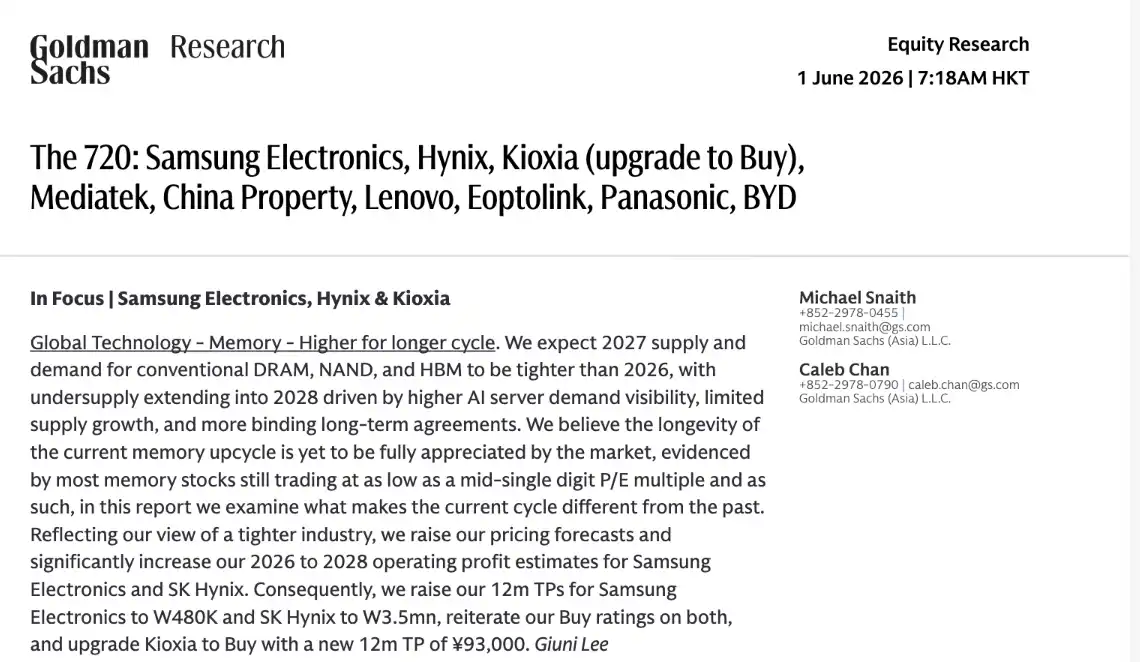
One of the most significant judgments in this Goldman Sachs report is that the current memory upcycle "will last longer" (higher for longer), with the shortage expected to persist all the way until 2028, a length vastly underestimated by the market. The evidence lies in valuations: most memory stocks are still trading at mid-single-digit price-to-earnings ratios, as if the market believes this is just another ordinary cyclical rebound, but Goldman Sachs sees it differently.

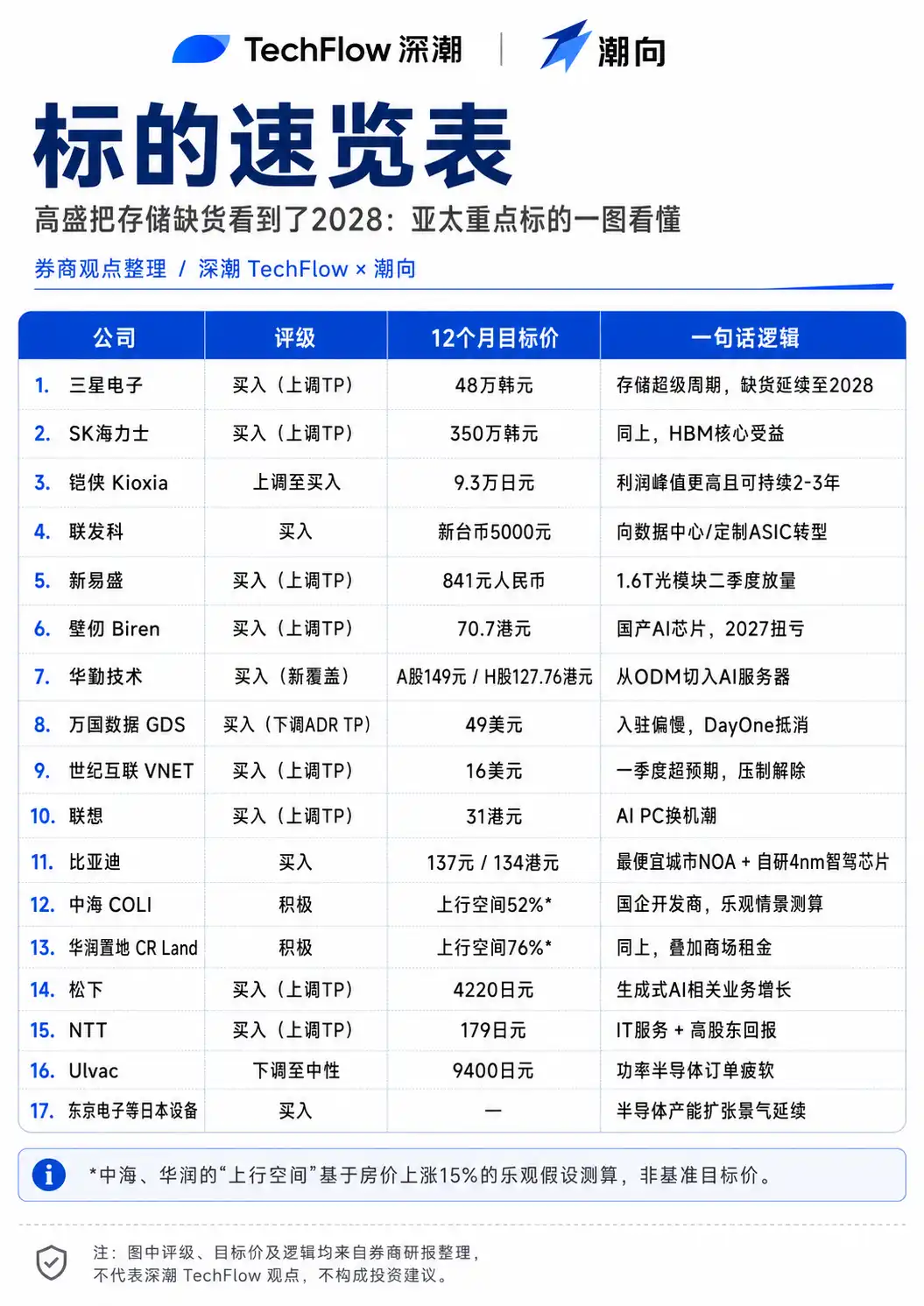
Below, we break it down by importance, concluding with a quick-reference table of targets.

Main Event: Memory Shortage to Last Until 2028, Three Companies Collectively Upgraded

Goldman Sachs compares this cycle to past ones and concludes this time is different. The reasons are threefold: higher visibility of AI server demand, limited supply growth, and increasingly firm long-term supply agreements (locking in orders and prices). Combined, these factors suggest that DRAM, NAND, and HBM supply-demand will be even tighter in 2027 than in 2026, with shortages extending into 2028.

The most intuitive evidence is Goldman's DRAM supply-demand chart. Negative numbers represent supply shortage; the deeper the deficit, the stronger the price support. Goldman has now revised its forecasts for 2026 to 2028 deeper into shortage territory. Specifically, the 2027 forecast was revised from an earlier -2.5% to -5.9%, more than doubling. In plain language: Goldman believes memory manufacturers will face increasing shortages in the next few years, meaning price increases can be sustained longer.

Regarding specific companies, three were collectively adjusted:

  • Samsung Electronics: 12-month price target raised to 480,000 KRW, Buy rating maintained.
  • SK Hynix: 12-month price target raised to 3.5 million KRW, Buy rating maintained.
  • Kioxia: Upgraded from Neutral to Buy, new price target set at 9,300 JPY.

Kioxia is the only rating upgrade in this report, and Goldman's logic is worth noting separately: it believes the profit peak of this cycle is higher than previously anticipated and can be maintained for two to three years, rather than surging and then falling back quickly. Based on this, Goldman has raised its operating profit forecasts for Kioxia for fiscal years 2027 to 2029 by 16% to 48% in one go and expects gross margins to remain at a high level around 80%. Predicting three years of sustainably high profits for a company in the strongly cyclical memory business is a very strong statement.

AI Computing Chain "Full Package": From Chips to Optical Modules to Data Centers

Beyond memory, this report touches upon nearly the entire AI hardware supply chain in China and Asia, unified by one main thread: global cloud hyperscaler capital expenditures are accelerating, and money is flowing down this chain.

  • MediaTek: Buy, price target set at 5,000 TWD. The highlight is its transition from mobile chips to data centers and custom ASICs (AI chips tailor-made for specific clients). The company's target is to achieve $2 billion in data center/AI ASIC revenue by 2026 and capture a 10% to 15% share of the $70-80 billion ASIC market by 2027.
  • Eoptolink: Buy, price target raised to 841 RMB. It manufactures optical modules, critical components for high-speed data transmission in AI data centers. Goldman is bullish on its 1.6T optical modules ramping up starting Q2 and accelerating in the second half, along with capacity expansion in Thailand. It raised profit forecasts for 2027 and 2028 by 5% and 6%, respectively.
  • Biren: Buy, price target raised to 70.7 HKD. A domestic Chinese AI chip manufacturer, its Bili166 product has received a first-tier security and reliability rating. Goldman expects it to turn profitable by 2027 as its product portfolio migrates to higher-performance, more expensive AI chips. Revenue forecasts for 2026 to 2030 were raised by 4% to 28%.
  • Huaqin: Buy, a newly covered target in this report. A-share price target set at 149 RMB, with simultaneous first-time coverage of its H-shares, target set at 127.76 HKD. The logic is its move from consumer electronics ODM into AI data centers, with expected revenue CAGR of 32% from 2025 to 2027.
  • Data Center Duo: GDS maintains Buy rating, but its ADR target is lowered to $49 (due to slower move-in rates, lower monthly service revenue, partially offset by higher valuation for overseas DayOne business); VNET maintains Buy rating, target raised to $16 (due to Q1 earnings beat, strong execution of capacity ramp-up, and removal of strategic investor overhang).
  • Lenovo: Buy, price target raised from 27 HKD to 31 HKD. The bet is on the AI PC refresh cycle. Goldman expects its notebook market share to expand to 28% by 2028, with AI notebook penetration reaching 66%, lifting overall average selling prices. Its profit forecasts for Lenovo's FY2027 and FY2028 are 22% and 25% higher than the Bloomberg consensus, indicating significant divergence.

Stocks Mentioned Outside the AI Main Theme

  • Chinese Real Estate (COLI, CR Land): Goldman is assessing the sustainability of the recent real estate sector rebound. It assumes an optimistic scenario where 15 key cities follow Shanghai and Shenzhen's property price recovery, leading to a 15% price increase by the end of 2028. Under this premise, it estimates cash profits for COLI and CR Land could expand by over 30% and over 50%, respectively, by 2028. Using a sum-of-the-parts valuation, Goldman suggests further upside potential of 52% for COLI and 76% for CR Land, maintaining a positive view on these stronger state-owned developers. Key point: this calculation is based on an optimistic assumption, not the base case forecast.
  • BYD: Buy, price target set at 137 RMB / 134 HKD. The highlight is its "Tianshen Eye B" City Navigation Guided Pilot (City NOA) becoming a 12,000 RMB option across its lineup at its Intelligent Driving Strategy Conference, making its entry-level City NOA-equipped model the cheapest in China at 78,800 RMB. It also unveiled its first self-developed 4nm intelligent driving chip, "Xuánjī A3," which is already in mass production. Goldman believes these engineering capabilities can boost high-end intelligent driving penetration, lower costs, and improve margins.
  • Japanese Semiconductor Equipment: Goldman maintains Buy ratings on Lasertec, Ebara, Disco, and Tokyo Electron. The only contrarian move was downgrading vacuum equipment manufacturer Ulvac (6728.T) from Buy to Neutral, lowering the target to 9,400 JPY, citing weak high-margin power semiconductor orders and slower-than-expected gross margin expansion.
  • Panasonic HD: Buy, price target raised from 4,000 JPY to 4,220 JPY, bullish on generative AI-related businesses (backup power, copper-clad laminate CCL, high-performance capacitors).
  • NTT: Buy, price target slightly raised from 176 JPY to 179 JPY, focusing on domestic IT service demand and the safety margin provided by a shareholder total return rate of around 5%.

A Macro Theme: AI Boom Clashes with Energy Crisis

Stringing together the individual stocks is Goldman's macro judgment: Emerging markets are being pulled in two by two opposing forces. On one side is the AI investment boom, and on the other is energy supply contraction due to the blockade of the Strait of Hormuz.

Tech-exporting economies like South Korea and Taiwan benefit from surging exports and current account surpluses; while energy-importing countries face rising inflation, weaker currencies, and fuel subsidies straining their finances. Goldman expects the Q4 average Brent crude price to be $90/barrel, continuing pressure on heavily oil-import-dependent economies. It recommends overweighting stocks in China, South Korea, Brazil, and South Africa. This line connects with the recent macro background of the Iran situation and oil prices.

Two other points directly affecting A-share capital flows:

Chinese imports surged 23.6% year-on-year in the first four months of this year, but Goldman believes this is a highly concentrated phenomenon, with gold and semiconductors accounting for about 65% of the import growth increment, not indicative of a continuous worsening of the external balance.

Regarding the CSI and CNI index semi-annual rebalancing, Goldman estimates it will trigger over $48 billion in two-way passive fund flows. The technology hardware & semiconductor and capital goods sectors are expected to see the largest inflows (approximately $3.1 billion and $1.4 billion, respectively), while healthcare and banks see the largest outflows. Newly added constituents "expected to receive the largest net passive inflows" include Huagong Tech, Yuanjie Tech, Huahong Semiconductor, GigaDevice, VeriSilicon, etc. For index rebalancing arbitrage funds, this is a clear signal.

Finally, as usual, Goldman left an Easter egg: 2026 World Cup winning probability forecast: Spain leads at 26%, followed by France at 19%, Argentina at 14%, Brazil at 8%, and England at 5%. The model penalized the defending champion Argentina; take it as a bit of fun.

Quick Reference Table of Targets
This article is TechFlow's compilation and interpretation of a third-party brokerage research report. The ratings, price targets, profit forecasts, and related judgments cited herein represent the views of the report's analysts and their affiliated institutions only. They do not represent the views of TechFlow and do not constitute any investment advice.

Please note the following three points when reading:

1. Price targets are analysts' expectations for a future period (typically 12 months). They are forecasts, not promises, and are subject to frequent adjustment based on company performance and market conditions.

2. Sell-side research reports are inherently bullish. It is common for brokerages to issue "Buy" ratings on covered companies, and some covered companies may have investment banking or other business relationships with the brokerage. A list predominantly featuring "Buy" ratings should be read with this inherent bias in mind.

3. The value of a research report lies in its mainline logic and the underlying assumptions it depends on, not any single price target. The logic for related targets holds only if the main theme holds; if the main theme is disproven, the entire chain of targets will come loose together. Focus on the logic, not just the price.

Markets involve risks; decisions should be made independently. This article should not be used as the basis for buying or selling any securities.
Связанные с этим вопросы

QAccording to the Goldman Sachs report, what is the core reason for the prolonged shortage in the memory chip sector until 2028?

AThe report cites three core reasons: higher visibility of AI server demand, limited supply growth, and increasingly binding long-term supply agreements (LTA) that lock in orders and prices. The combination of these factors leads to a projected tighter supply-demand situation for DRAM, NAND, and HBM in 2027 than in 2026, extending the shortage into 2028.

QWhich memory company received a rating upgrade from Goldman Sachs in this report, and what was the key rationale?

AKioxia received a rating upgrade from Neutral to Buy. The key rationale is Goldman Sachs' belief that the profit peak in this cycle will be higher and more sustainable than previously thought, lasting two to three years. Consequently, they significantly raised Kioxia's operating profit forecasts for FY2027 to FY2029 by 16% to 48% and expect its gross margin to remain around a high level of 80%.

QWhat is the primary macro theme Goldman Sachs uses to connect the various stock recommendations in the report?

AThe primary macro theme is that emerging markets are being pulled in two opposite directions. On one side is the AI investment boom, benefiting tech-exporting economies. On the other side is energy supply contraction due to the blockade of the Strait of Hormuz, which pressures energy-importing countries with higher inflation, weaker currencies, and strained finances. This leads to a recommended overweight stance on stocks in China, South Korea, Brazil, and South Africa.

QBesides memory chips, what other major sector or theme did Goldman Sachs focus on for its stock recommendations, and name one related company.

ABesides memory chips, Goldman Sachs focused extensively on the AI compute hardware supply chain. One related company is MediaTek. The report highlights its transition from mobile chips to data centers and custom AI ASICs, with a company target of $2 billion in data center/AI ASIC revenue in 2026 and aiming for a 10%-15% share of the $70-80 billion ASIC market by 2027.

QWhat important disclaimer does the article provide regarding the investment ratings and target prices mentioned from the Goldman Sachs report?

AThe article states that the ratings, target prices, profit forecasts, and related judgments cited are solely the views of the Goldman Sachs analysts and represent the position of their institution. They do not represent the views of the publishing platform (Shenchao TechFlow) and do not constitute any investment advice. It reminds readers that target prices are predictions subject to change, that sell-side research has a natural bullish bias, and that the value lies in the core logic and its underlying assumptions, not just the price targets.

Похожее

For Hedging, Buy Gold and Oil; For Explosive Growth, Buy AI; Bitcoin, the 'Outdated' Asset, Enters a Bear Market

Bitcoin’s price has recently fallen sharply, hitting a two-month low near $66,000, with Ethereum also dropping to a three-month low. While surface explanations point to ETF outflows, geopolitical tensions, and corporate selling, a deeper issue is emerging: Bitcoin is losing a crucial asset competition. For years, Bitcoin thrived in a low-rate environment where investors sought alternatives amid inflation fears and dissatisfaction with traditional options. Now, the market landscape has shifted, leaving Bitcoin stuck in an "awkward middle ground," facing challenges on three fronts: 1. **As an inflation hedge, gold is winning.** Investors worried about persistent inflation are turning to tangible assets like gold, energy stocks, and commodity producers, which offer more direct pricing power and physical backing. 2. **For growth exposure, AI is winning.** Those seeking high growth now favor AI-related companies with actual revenues and profits, an area where Bitcoin's lack of cash flow puts it at a disadvantage. 3. **Within crypto, infrastructure and stablecoins are winning.** Even investors wanting crypto exposure have alternatives like exchanges, stablecoin issuers, and tokenization firms, whose performance is directly tied to real-world adoption and offers clearer operational leverage. The recent market reaction to inflation warnings highlights this shift. Instead of boosting Bitcoin as "digital gold," such news now drives flows toward traditional inflation-sensitive assets. Therefore, recent events like ETF outflows and corporate selling are seen not as causes, but as symptoms of this new reality. Capital has more compelling options, and investors are becoming more selective. The emerging bear case for Bitcoin is no longer about it being a fraud or failed technology, but rather that **scarcity alone is no longer enough**. It is no longer seen as the best hedge, the best growth asset, or the only crypto play.

marsbit1 мин. назад

For Hedging, Buy Gold and Oil; For Explosive Growth, Buy AI; Bitcoin, the 'Outdated' Asset, Enters a Bear Market

marsbit1 мин. назад

SaaS Battle Royale: The Survivors Who Win All Share One Common Trait

**Summary** The AI revolution has triggered a "SaaS apocalypse," forcing a brutal market shakeout. The key dividing line is the pricing model. Companies like Snowflake and Datadog, which charge based on consumption (e.g., data processed or compute used), are thriving. AI workloads actively *generate* more demand for their services, fueling growth. Datadog's accelerating revenue is a prime example. Microsoft and Palantir, as platform/ecosystem players, also benefit by acting as essential channels for AI deployment. In contrast, traditional SaaS firms built on per-seat or per-task licensing (e.g., Intuit, Adobe) face direct pressure, as AI threatens to automate the very human tasks their software supports. Companies like Salesforce, a per-seat giant, are caught in the middle. While showing strong AI monetization (e.g., its Agentforce platform) and experimenting with consumption-based "Flex Credits," its stock remains under pressure, illustrating that the market rewards *completed* transitions, not just the intent. The recent Microsoft Build conference underscored key trends: AI is evolving from an assistant to an autonomous "agent," and platform providers like Microsoft are consolidating their control. The market's recovery is highly selective, focused on identifying which companies are "fed by AI" versus "eaten by AI." Future focus will be on the diffusion of this recovery to transforming companies and the real-world adoption data of AI agents like Microsoft Copilot.

marsbit19 мин. назад

SaaS Battle Royale: The Survivors Who Win All Share One Common Trait

marsbit19 мин. назад

Trend in US Stocks: Jensen Huang's One Sentence Triggers $47 Billion Surge; Google Raises Funds for First Time in 20 Years

U.S. markets reached record highs on June 2nd, but the real story was the intensifying AI arms race, now pivoting from chip supremacy to a scramble for capital to fund compute infrastructure. The day highlighted two stark realities: Nvidia CEO Jensen Huang's endorsement of Marvell Technology as the "next trillion-dollar company" at Computex fueled a historic 32.5% surge, adding $47 billion to its value. Conversely, Alphabet announced its first equity raise in two decades—an $80 billion plan—signaling that even its massive cash flow can't keep pace with soaring AI capital expenditures, forecast to exceed $180 billion in 2026. While the S&P 500 closed above 7,600 for the first time, led by tech and semiconductor stocks (SOXX +5.79%), sector performance was mixed. Alphabet's 4% drop dragged down communications services, illustrating market anxiety over the unsustainable cost of the AI buildout. Hewlett Packard Enterprise soared 25% on stellar earnings, proving AI's benefits extend beyond chip designers to infrastructure providers. Beneath the index highs, concerns linger over extreme concentration in a few AI stocks and geopolitical tensions. The focus now shifts to upcoming economic data, particularly Friday's nonfarm payrolls, which could challenge the market's current "ignore rates, chase AI" mentality.

marsbit50 мин. назад

Trend in US Stocks: Jensen Huang's One Sentence Triggers $47 Billion Surge; Google Raises Funds for First Time in 20 Years

marsbit50 мин. назад

Торговля

Спот
Фьючерсы

Популярные статьи

Как купить CHIP

Добро пожаловать на HTX.com! Мы сделали приобретение USD.AI (CHIP) простым и удобным. Следуйте нашему пошаговому руководству и отправляйтесь в свое крипто-путешествие.Шаг 1: Создайте аккаунт на HTXИспользуйте свой адрес электронной почты или номер телефона, чтобы зарегистрироваться и бесплатно создать аккаунт на HTX. Пройдите удобную регистрацию и откройте для себя весь функционал.Создать аккаунтШаг 2: Перейдите в Купить криптовалюту и выберите свой способ оплатыКредитная/Дебетовая Карта: Используйте свою карту Visa или Mastercard для мгновенной покупки USD.AI (CHIP).Баланс: Используйте средства с баланса вашего аккаунта HTX для простой торговли.Третьи Лица: Мы добавили популярные способы оплаты, такие как Google Pay и Apple Pay, для повышения удобства.P2P: Торгуйте напрямую с другими пользователями на HTX.Внебиржевая Торговля (OTC): Мы предлагаем индивидуальные услуги и конкурентоспособные обменные курсы для трейдеров.Шаг 3: Хранение USD.AI (CHIP)После приобретения вами USD.AI (CHIP) храните их в своем аккаунте на HTX. В качестве альтернативы вы можете отправить их куда-либо с помощью перевода в блокчейне или использовать для торговли с другими криптовалютами.Шаг 4: Торговля USD.AI (CHIP)С легкостью торгуйте USD.AI (CHIP) на спотовом рынке HTX. Просто зайдите в свой аккаунт, выберите торговую пару, совершайте сделки и следите за ними в режиме реального времени. Мы предлагаем удобный интерфейс как для начинающих, так и для опытных трейдеров.

331 просмотров всегоОпубликовано 2026.04.21Обновлено 2026.06.02

Как купить CHIP

Обсуждения

Добро пожаловать в Сообщество HTX. Здесь вы сможете быть в курсе последних новостей о развитии платформы и получить доступ к профессиональной аналитической информации о рынке. Мнения пользователей о цене на CHIP (CHIP) представлены ниже.

活动图片