Japan plans major shift as crypto moves from payments to securities law

cointelegraphОпубликовано 2025-12-10Обновлено 2025-12-10

Введение

Japan's Financial Services Agency (FSA) is planning to shift cryptocurrency regulation from the Payment Services Act to the Financial Instruments and Exchange Act (FIEA), treating crypto primarily as investment products rather than payment methods. This move aims to enhance user protection by imposing stricter disclosure rules for initial exchange offerings (IEOs), including mandatory pre-sale information, third-party code audits, and issuer identity disclosure. The new framework also strengthens measures against unregistered platforms and explicitly prohibits insider trading. The regulatory shift coincides with government discussions to implement a flat 20% tax rate on crypto trading profits.

Japan’s financial regulators are preparing to move crypto asset oversight out of the country’s payments regime and into a framework designed for investment and securities markets.

The Financial Services Agency (FSA) on Wednesday released a comprehensive report from the Financial System Council’s Working Group on the regulatory status of cryptocurrencies across multiple sectors.

The document outlines a plan to shift the legal basis for crypto regulation from the Payment Services Act (PSA) to the Financial Instruments and Exchange Act (FIEA), which is the primary law regulating securities markets, issuance, trading and disclosures.

“Crypto assets are increasingly being used as investment targets both domestically and internationally,” the report noted, underscoring the need to protect users by providing regulation that treats crypto as a financial product.

Strengthening data disclosure regulations

One of the core changes brought by bringing crypto under FIEA regulatory scope is strengthening data disclosure requirements for initial exchange offerings (IEOs), or token sales managed by crypto exchanges.

“Crypto transactions conducted by users are similar to securities transactions, and may involve the sale of new crypto assets or the buying and selling already in circulation,” the document reads, highlighting the importance of timely information during IEO sales.
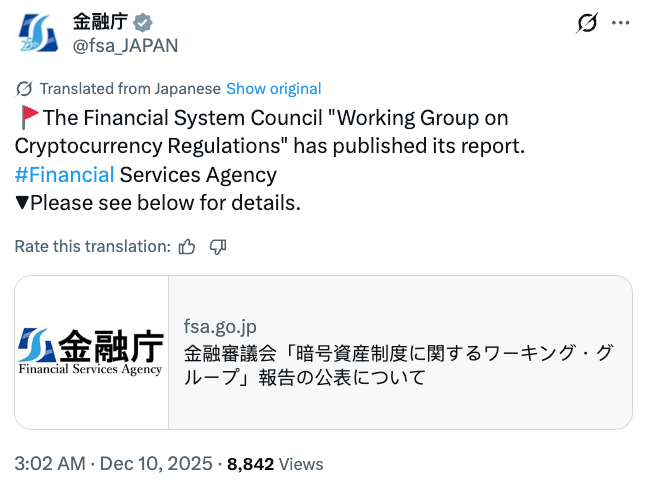
Source: FSA Japan

Among the requirements for IEOs, the proposal mandates that exchanges provide pre-sale disclosures, including detailed information about the core entities behind the offering. It also requires code audits by independent third-party experts and encourages consideration of feedback from self-regulatory organizations.

In addition to exchanges, it places responsibilities on issuers, requiring them to disclose their identities, regardless of whether the project is decentralized, and how tokens are issued and distributed.

Related: Crypto payments coming to PlayStation as Sony plans stablecoin launch in 2026

The proposed framework would also give regulators stronger tools to crack down on unregistered platforms, particularly those operating from overseas or tied to decentralized exchanges. It also includes explicit prohibitions on insider trading, echoing provisions of the European Union’s Markets in Crypto-Assets (MiCA) framework and South Korea’s regulations.

The news came amid the Japanese government’s consideration of plans to reduce the maximum tax rate on crypto profits by imposing a flat rate of 20% on all gains from crypto trading.

On Tuesday, FSA also signaled a cautious stance on permitting derivatives for foreign crypto asset exchange-traded funds, reportedly describing the underlying assets as “not desirable.”

Magazine: When privacy and AML laws conflict: Crypto projects’ impossible choice

Похожее

Q4 Net Loss of $667 Million, Yet Stock Soars 16%, Don't Buy Coinbase Now

Coinbase reported a net loss of $667 million in Q4 2025, with revenue of $1.78 billion falling short of expectations. Despite this, its stock surged 16.46% the next day, reflecting short-term market confidence. However, analysts caution against investing in Coinbase at this time, citing high cyclicality and near-term headwinds. The company’s revenue is split between transaction-based income (56%) and subscription & services (44%). Transaction revenue relies heavily on retail trading spreads, which remain vulnerable to crypto market volatility. Subscription revenue includes stablecoin-related income (mainly from USDC interest sharing), staking, and emerging services like Coinbase One and Base L2. Key challenges include Coinbase’s high correlation with Bitcoin’s, regulatory uncertainty in the U.S., and growing competition from decentralized exchanges (DEXs) globally. Although Coinbase maintains a dominant position in the U.S. due to its regulatory compliance and trust, analysts expect continued pressure on brokerage fundamentals through 2026. Earnings are projected to underperform consensus estimates by 14% in 2026, with potential downside in a prolonged crypto downturn. While regulatory clarity may eventually benefit Coinbase, its effects are likely too slow to offset near-term financial weakness. Analysts advise waiting for a better entry point, as current risk-adjusted returns appear unfavorable.

marsbit41 мин. назад

Q4 Net Loss of $667 Million, Yet Stock Soars 16%, Don't Buy Coinbase Now

marsbit41 мин. назад

Q4 Net Loss of $667 Million, Yet Stock Soars 16%, Don't Buy Coinbase Now

Coinbase reported a net loss of $667 million in Q4 2025, with revenue of $1.78 billion falling short of expectations. Despite this, its stock surged 16.46% the next day, reflecting short-term market optimism. However, analysts caution against investing in Coinbase at this time, citing high cyclicality and near-term headwinds. Revenue is split between transaction-based income (56%) and subscription/services (44%). Transaction revenue relies heavily on retail trading spreads, which are under pressure due to declining crypto prices and reduced volatility. Subscription revenue, led by USDC interest income and staking, offers diversification but remains sensitive to interest rates and market conditions. Key debates include whether Coinbase can reduce its dependence on crypto market cycles, the sustainability of stablecoin profits, and the impact of future regulations. While the company holds a dominant position in the U.S. market due to its regulatory compliance and trust, it faces growing competition from decentralized exchanges globally. Analysts project underperformance in 2026, with earnings potentially 14% below consensus due to compressed client assets and trading activity. Although regulatory clarity may benefit Coinbase long-term, it is unlikely to offset immediate financial pressures. Valuation scenarios range from a negative IRR in a bear case to a high IRR in an optimistic rebound, but near-term risks currently outweigh potential returns.

Odaily星球日报44 мин. назад

Q4 Net Loss of $667 Million, Yet Stock Soars 16%, Don't Buy Coinbase Now

Odaily星球日报44 мин. назад

Торговля

Спот
Фьючерсы
活动图片