Trump's Midterm Election Donors Exposed: From Crypto.com to OpenAI, Crypto and AI Giants Generously Contribute

marsbitОпубликовано 2026-02-04Обновлено 2026-02-04

Введение

Donald Trump's midterm election fundraising has reached $429 million, with his super PAC holding $304 million—tens of millions more than Democratic opponents. Significant contributions came from the crypto and AI sectors, including $5 million from Elon Musk, $25 million from OpenAI co-founder Greg Brockman and his wife, and $16 million from SIG co-founder Jeff Yass. Crypto.com donated $30 million, while Blockchain.com and a16z founders Ben Horowitz and Marc Andreessen each contributed. Major donations also poured in from energy, healthcare, and finance industries, such as $10 million from Extremity Care, $12.5 million from energy entrepreneur Kelcy Warren, and $1 million each from figures like NFL Dallas Cowboys owner Jerry Jones and Chevron board member John Hess.

Is Trump's midterm election in jeopardy? ????

——Not sure, but he definitely has more money than his opponents! He has raised a total of $429 million, with his super PAC currently holding $304 million, tens of millions more than the Democratic camp!

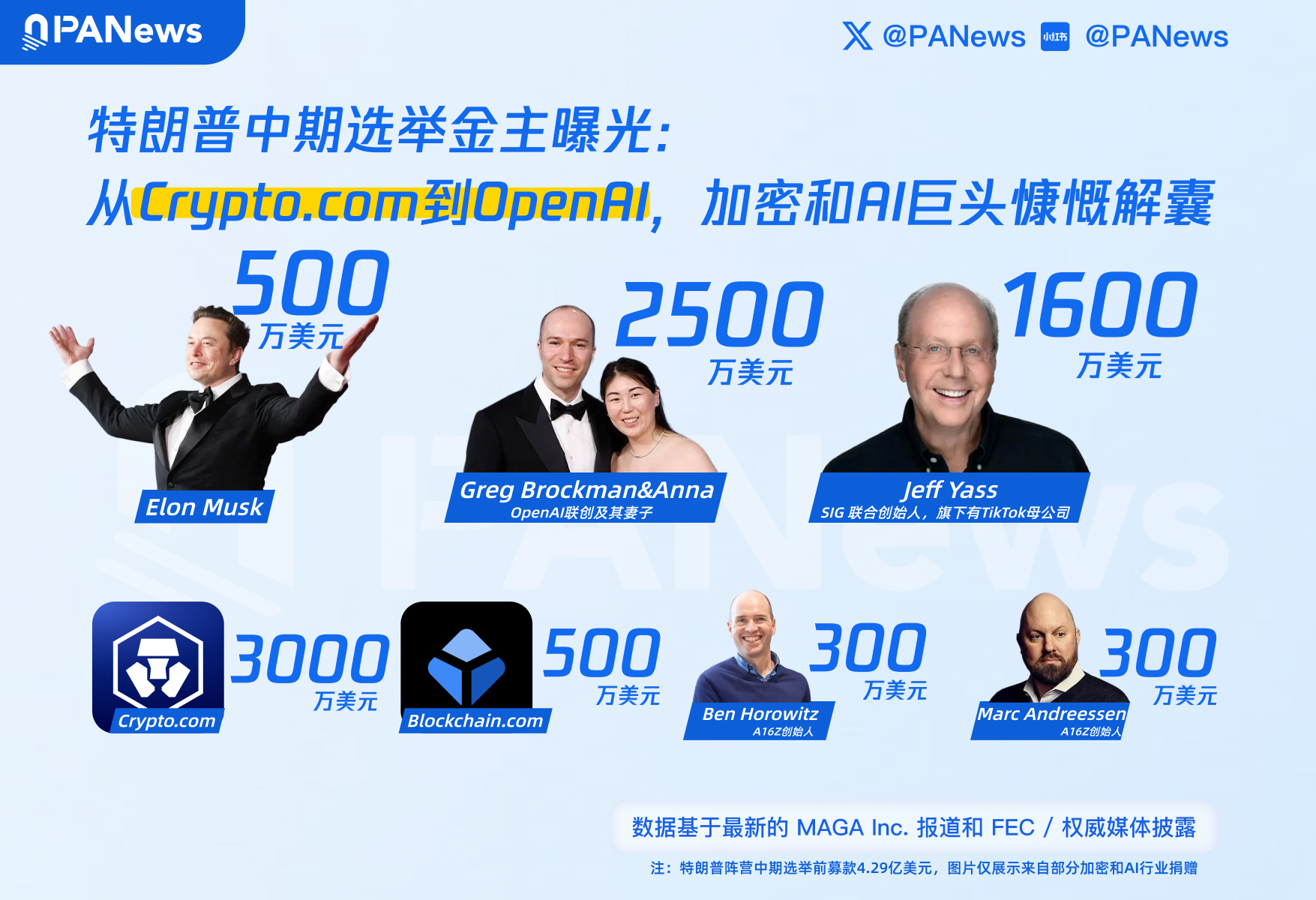
In this round of donations, the AI and crypto industries also accounted for a significant proportion:

Elon Musk: $5 million
OpenAI co-founder Greg Brockman and his wife Anna: $25 million
SIG co-founder Jeff Yass: $16 million

Crypto.com: $30 million
Blockchain.com: $5 million
A16Z founder Ben Horowitz: $3 million
A16Z founder Marc Andreessen: $3 million

Funds from the energy, healthcare, and financial industries are also heavily betting:

Extremity Care (medical company) and related parties: $10 million
RAI Services (tobacco company): $3 million

Energy entrepreneur Kelcy Warren: $12.5 million
Private equity investor Konstantin Sokolov: $11 million
Banker Julio Herrera Velutini and his daughter: $3.5 million
NYSE parent company ICE CEO Jeffrey Sprecher: $2.5 million
Food business heir Lynsi Snyder-Ellingson: $2 million
Venture capitalist William E. Ford: $1.25 million
NFL Dallas Cowboys owner Jerry Jones: $1 million
Chevron board member John Hess: $1 million
John Hess's wife Susan Hess: $1 million
Investor Warren Stephens: $1 million
Entrepreneur Jared Isaacman: $1 million
Связанные с этим вопросы

QHow much money did Donald Trump raise for the midterm elections according to the article?

ADonald Trump raised a total of $429 million for the midterm elections.

QWhich AI and crypto industry leaders made significant donations to Trump's campaign, and how much did they contribute?

AElon Musk donated $5 million, OpenAI co-founder Greg Brockman and his wife Anna donated $25 million, and SIG co-founder Jeff Yass donated $16 million. From the crypto industry, Crypto.com donated $30 million, Blockchain.com donated $5 million, and A16Z founders Ben Horowitz and Marc Andreessen each donated $3 million.

QWhat is the amount of money currently available in Trump's super PAC, and how does it compare to the Democratic camp?

ATrump's super PAC currently has $304 million, which is tens of millions more than the Democratic camp.

QBesides AI and crypto, which other industries contributed significantly to Trump's midterm election funds?

ASignificant contributions also came from the energy, healthcare, and financial industries, including donations from Extremity Care ($10 million), RAI Services ($3 million), energy entrepreneur Kelcy Warren ($12.5 million), and others.

QWho are some of the notable individual donors from outside the AI and crypto sectors mentioned in the article?

ANotable individual donors include NYSE parent ICE CEO Jeffrey Sprecher ($2.5 million), NFL Dallas Cowboys owner Jerry Jones ($1 million), Chevron board member John Hess and his wife Susan Hess ($1 million each), and food business heiress Lynsi Snyder-Ellingson ($2 million).

Похожее

2026 Robot Track in Practice: Who is Paving the Way, Who is Mining, and Who is Building the System?

The 2026 embodied AI and DePIN narrative is shifting from hype to real-world applications. This analysis examines three leading projects in the robot economy: peaq, PrismaX, and OpenMind. peaq ($PEAQ) is a Layer-1 blockchain for the "Machine Economy," enabling devices to act as autonomous economic agents. A key case is a tokenized robotic farm in Hong Kong that generates real yield (e.g., 3820 USDT distributed to a user) from selling hydroponic vegetables, offering an ~18% APY. With partnerships like Bosch and Mastercard, and a ~$78M FDV, it's seen as an undervalued infrastructure play. PrismaX, backed by a $11M a16z-led round, focuses on generating crucial physical-world AI training data through human teleoperation. Users remotely operate real robots to earn points for a future airdrop. While attracting users, it faces risks from low-quality data farming and unproven commercial scalability. OpenMind ($ROBO) aims to be the "Android OS" for robots, providing a unified app store. It has partnered with 10+ major hardware firms (e.g., Unitree, UBTECH) and launched with 5+ apps. However, its $400M FDV is considered high, and it faces competition from closed systems like Tesla's Optimus. Together, these projects represent the essential stack for decentralized embodied AI: PrismaX (data layer) trains robots, OpenMind (OS/application layer) enables cross-hardware functionality, and peaq (network/incentive layer) facilitates automated economic transactions. The synergy between these layers is key to scaling practical applications.

marsbit47 мин. назад

2026 Robot Track in Practice: Who is Paving the Way, Who is Mining, and Who is Building the System?

marsbit47 мин. назад

Торговля

Спот
Фьючерсы
活动图片