Distinguishing Types of Drawdowns Is More Important Than Blindly Buying the Dip

marsbitОпубликовано 2026-02-15Обновлено 2026-02-15

Введение

Distinguishing between types of drawdowns is more important than blindly buying the dip. Academic finance categorizes risk into systemic (market-wide, unavoidable) and idiosyncratic (company-specific). Similarly, drawdowns can be market-driven (systemic, like the 2008 crisis) or company-specific (idiosyncratic, like the recent AI-driven selloff in software stocks). Using FactSet (FDS) as an example, the article illustrates that a systemic drawdown, such as in 2008/09, was a test of the market's durability, not FactSet's economic moat. In these cases, investors can leverage a behavioral advantage—patience and a long-term view—as history shows markets tend to recover. Conversely, the current 2025/26 drawdown in software stocks is largely idiosyncratic, driven by specific fears that AI could disrupt industry pricing power and erode moats. To capitalize on such a drawdown, an investor needs an analytical advantage: a more accurate vision of the company's future a decade from now than the market's pessimistic price implies. This requires understanding why informed sellers are wrong, a fine line between conviction and arrogance. The key takeaway is not to apply a blunt behavioral solution (like simply buying the dip) to a problem that requires nuanced, fundamental analysis.

Original Author: Todd Wenning

Original Compilation: Deep Tide TechFlow

Guide: Academic finance theory categorizes risk into systematic risk and idiosyncratic risk. Similarly, stock drawdowns can also be divided into two types: market-driven systematic drawdowns (such as the 2008 financial crisis) and company-specific idiosyncratic drawdowns (such as the current software stock crash driven by AI concerns).

Using FactSet as an example, Todd Wenning points out: during a systematic drawdown, you can leverage a behavioral advantage (patiently waiting for the market to recover); but during an idiosyncratic drawdown, you need an analytical advantage—having a more accurate vision of what the company will look like in ten years than the market does.

Amid the current AI impact on software stocks, investors must distinguish: is this a temporary market panic, or is the moat truly crumbling?

class="ql-align-justify">Do not use a blunt behavioral solution to solve a problem that requires nuanced analysis.

Full Text Below:

Academic finance theory posits two types of risk: systematic and idiosyncratic.

  • Systematic risk is unavoidable market risk. It cannot be eliminated through diversification, and it is the only type of risk for which you are compensated.
  • On the other hand, idiosyncratic risk is company-specific risk. Because you can cheaply purchase a diversified portfolio of uncorrelated businesses, you are not compensated for taking on this risk.

We can debate Modern Portfolio Theory another day, but the systematic-idiosyncratic framework is helpful for understanding different types of drawdowns (the percentage decline from peak to trough of an investment) and how we, as investors, should evaluate opportunities.

From the moment we picked up our first value investing book, we were taught to take advantage of a despondent Mr. Market when stocks are sold off. If we remain calm while he loses his senses, we will prove ourselves to be stoic value investors.

But not all drawdowns are the same. Some are market-driven (systematic), while others are company-specific (idiosyncratic). Before you make a move, you need to know which type you're looking at.

Generated by Gemini

The recent sell-off in software stocks due to AI concerns illustrates this point. Let's look at the 20-year history of drawdowns between FactSet (FDS, blue) and the S&P 500 (measured via the SPY ETF, orange).
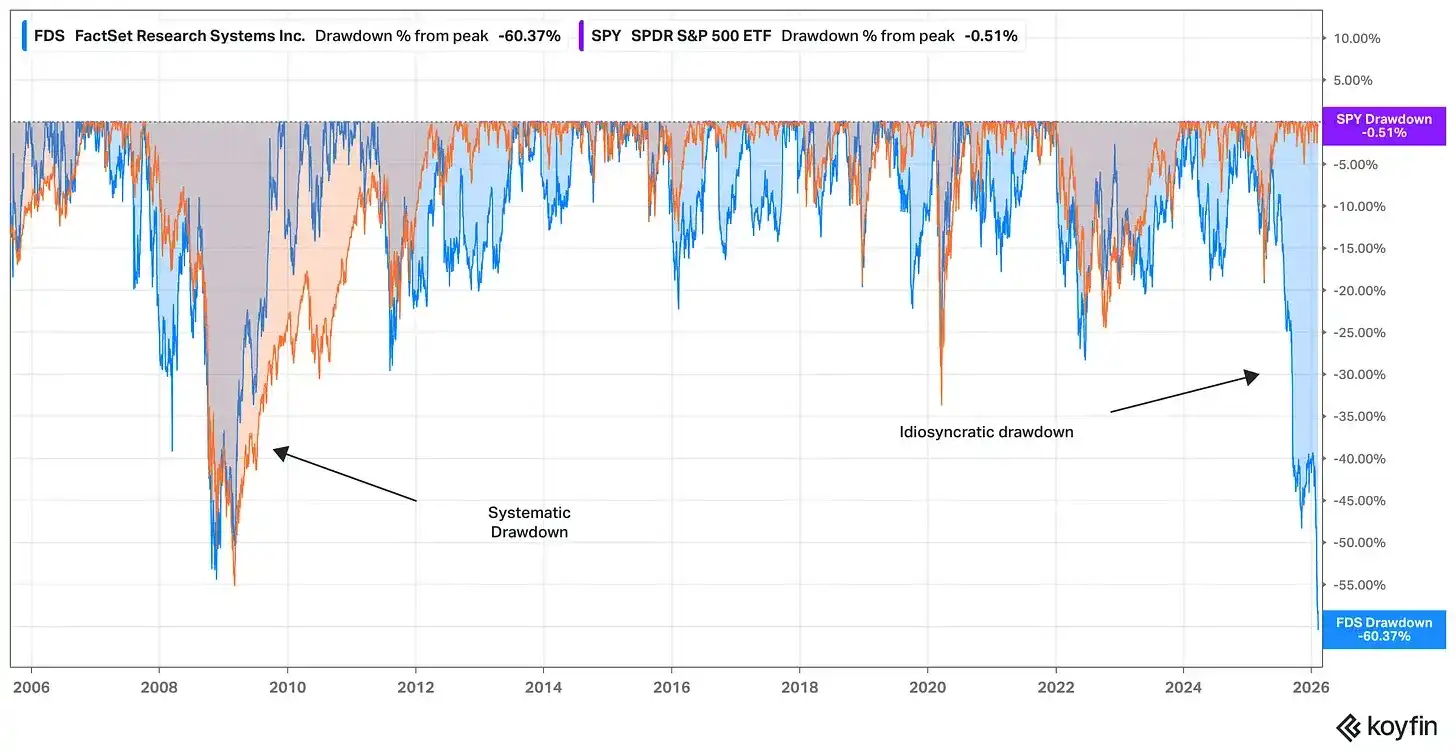
Source: Koyfin, as of February 12, 2026

FactSet's drawdown during the financial crisis was primarily systematic. In 2008/09, the entire market was worried about the durability of the financial system, and FactSet could not be immune to these concerns, especially since it sells products to financial professionals.

At that time, the stock's drawdown had less to do with FactSet's economic moat and more about whether FactSet's moat would matter if the financial system collapsed.

The 2025/26 FactSet drawdown is the opposite case. Here, the concerns are almost entirely focused on FactSet's moat and growth runway, alongside broader fears about accelerating AI capabilities disrupting pricing power in the software industry.

In a systematic drawdown, you can more reasonably make a time arbitrage bet. History shows that markets tend to rebound, and companies with intact moats may emerge even stronger than before, so if you are willing and able to remain patient while others panic, you can leverage a strong stomach to exploit a behavioral advantage.

Photo by Walker Fenton on Unsplash

However, in an idiosyncratic drawdown, the market is telling you that something is wrong with the business itself. Specifically, it suggests increasing uncertainty about the business's terminal value.

Therefore, if you hope to take advantage of an idiosyncratic drawdown, you need to possess an analytical advantage in addition to a behavioral one.

To succeed, you need to have a more accurate vision of what the company will look like in ten years than the current market price implies.

Even if you know a company well, this is not easy to do. Stocks don't typically fall 50% relative to the market for no reason. A lot of once-steadfast holders—even investors you might respect for their deep research—had to capitulate for this to happen.

If you are going to step in as a buyer during an idiosyncratic drawdown, you need to have an answer for why these otherwise informed and thoughtful investors were wrong to sell and why your vision is correct.

There's a fine line between conviction and arrogance.

Whether you are holding a stock in a drawdown or looking to initiate a new position in one, it's important that you understand what type of bet you are making.

Idiosyncratic drawdowns can tempt value investors to start looking for opportunities. Before you take the plunge, make sure you aren't using a blunt behavioral solution to solve a problem that requires nuanced analysis.

Stay patient, stay focused.

Todd

Связанные с этим вопросы

QAccording to the article, what are the two main types of risk in academic financial theory?

ASystematic risk and idiosyncratic risk.

QWhat is the key difference in the type of advantage an investor needs to exploit a systematic drawdown versus an idiosyncratic one?

AAn investor can exploit a systematic drawdown with a behavioral advantage (patience), but to exploit an idiosyncratic drawdown, they need an analytical advantage (a more accurate vision of the company's future).

QUsing the example from the article, what was the primary cause of FactSet's drawdown during the 2008/09 financial crisis?

AFactSet's drawdown during the 2008/09 crisis was primarily systematic, driven by market-wide fears about the durability of the financial system.

QWhat does the article suggest is the market implying about a business during an idiosyncratic drawdown?

ADuring an idiosyncratic drawdown, the market is implying that there is a problem with the business itself and that its terminal value is becoming increasingly uncertain.

QWhat is the 'fine line' the article warns investors about when considering a purchase during an idiosyncratic drawdown?

AThe fine line is between conviction and arrogance. An investor must be able to explain why the sellers were wrong and their own vision is correct, without being overconfident.

Похожее

$292 Million KelpDAO Cross-Chain Bridge Hack: Who Should Foot the Bill?

On April 18, 2026, an attacker stole 116,500 rsETH (worth ~$292M) from KelpDAO’s cross-chain bridge in 46 minutes—the largest DeFi exploit of 2026. The stolen assets were deposited into Aave V3 as collateral, causing $177–200M in bad debt and triggering a cascade of losses across nine DeFi protocols. Aave’s TVL dropped by ~$6B overnight. This legal analysis argues that KelpDAO and LayerZero Labs share concurrent liability, with fault apportioned 60%/40%. KelpDAO negligently configured its bridge with a 1-of-1 decentralized verifier network (DVN)—a single point of failure—despite LayerZero’s explicit recommendation of a 2-of-3 setup. LayerZero, which operated the compromised DVN, failed to secure its RPC infrastructure against a known poisoning attack vector. Both protocols’ terms of service cap liability at $200 (KelpDAO) or $50 (LayerZero), but these limits are likely unenforceable due to unconscionability, gross negligence exceptions, and potential securities law invalidation (if rsETH is deemed a security under the Howey test). Aave’s governance also faces fiduciary duty claims for raising rsETH’s loan-to-value ratio to 93%—far above competitors’ 72–75%—without adequately assessing bridge risks, amplifying the systemic fallout. Practical recovery targets include LayerZero Labs (a registered Canadian entity), KelpDAO’s founders, auditors, and identifiable Aave governance delegates. The incident underscores escalating legal risks for DeFi protocols, infrastructure providers, and governance participants.

marsbit37 мин. назад

$292 Million KelpDAO Cross-Chain Bridge Hack: Who Should Foot the Bill?

marsbit37 мин. назад

Insider Trading in War: 5 People Involved, the Highest Earner Was Arrested

On April 24, the U.S. Department of Justice arrested U.S. Army Special Forces Staff Sergeant Gannon Ken Van Dyke for insider trading related to the capture of Venezuelan President Nicolás Maduro on January 3. Van Dyke allegedly profited over $400,000 by placing bets on a prediction market, Polymarket, using insider knowledge of the covert operation. According to the indictment, Van Dyke registered an account (0x31a5) on December 26 and made a series of bets predicting Maduro’s capture and U.S. military involvement in Venezuela. He withdrew most of his funds on the day of the operation and attempted to obscure his tracks by transferring assets through crypto and brokerage accounts. This case marks the first time the DOJ has prosecuted insider trading on Polymarket. PolyBeats had previously identified five suspicious accounts, including Van Dyke’s—the highest earner—in January. The other accounts, with profits ranging from $34,000 to $145,000, remain under unofficial scrutiny but have not been charged. Their lower profits, indirect access to information, and unclear legal boundaries may complicate prosecution. Polymarket has since strengthened its market integrity rules, explicitly prohibiting trading based on confidential or insider information. Van Dyke’s arrest, nearly four months after his trades, signals increased regulatory attention and the persistent traceability of blockchain-based transactions.

marsbit38 мин. назад

Insider Trading in War: 5 People Involved, the Highest Earner Was Arrested

marsbit38 мин. назад

Bitwise: Bullish on Bitcoin's Performance in the Second Half of the Year, AI and Regulation Will Spark a New Altcoin Season

Bitwise CIO Matt Hougan and Research Lead Ryan Rasmussen express strong bullish sentiment on Bitcoin's long-term prospects, suggesting that its $1 million price target may be too conservative. They argue Bitcoin serves a dual role: as digital gold and a potential global settlement asset, especially amid declining trust in traditional monetary systems. Despite a weak Q1 2026 where nearly all crypto assets and prices saw double-digit declines, the analysts remain optimistic due to strong forward-looking catalysts, including institutional adoption via Bitcoin ETFs from major firms like Morgan Stanley and Goldman Sachs. Geopolitical instability, such as Iran’s mention of using Bitcoin for international payments, increases the value of Bitcoin’s “out-of-the-money call option” as a non-political, global settlement currency. This enhances its appeal beyond a mere store of value. . Additionally, Hougan highlights that a clearer regulatory token framework under current SEC leadership, combined with AI efficiency gains and high-performance blockchains, could fuel a new “altseason” by late 2026. This may lead to a wave of legitimate, value-capturing token projects, unlike the earlier ICO boom. . Bitwise also announced an Avalanche ETF, citing its unique architecture and rapid growth in real-world asset (RWA) tokenization, which has surged 10x to nearly $30 billion in two years. The firm believes Layer 1 blockchains are still early in their growth cycle, with significant potential ahead.

marsbit1 ч. назад

Bitwise: Bullish on Bitcoin's Performance in the Second Half of the Year, AI and Regulation Will Spark a New Altcoin Season

marsbit1 ч. назад

Торговля

Спот
Фьючерсы
活动图片