Connecticut can’t take action against Kalshi for now, judge rules

cointelegraphОпубликовано 2025-12-10Обновлено 2025-12-10

Введение

A US judge has temporarily blocked Connecticut from taking enforcement action against prediction markets platform Kalshi, which received a cease and desist order from the state’s Department of Consumer Protection (DCP) for allegedly conducting unlicensed sports gambling. Kalshi sued the DCP, arguing its event contracts are legal under federal law and fall under the exclusive jurisdiction of the Commodity Futures Trading Commission. The court has paused enforcement while it reviews Kalshi’s motion for a preliminary injunction, with further legal proceedings scheduled through February. Kalshi, a CFTC-regulated platform that saw record trading volume in November, is also engaged in similar legal battles with multiple states, including New York, Massachusetts, New Jersey, Nevada, Maryland, and Ohio, over regulatory jurisdiction and gambling licensing.

A US judge has granted prediction markets platform Kalshi a temporary reprieve from enforcement after the state of Connecticut sent it a cease and desist order last week for allegedly conducting unlicensed gambling.

The Connecticut Department of Consumer Protection (DCP) sent Kalshi, along with Robinhood and Crypto.com, cease and desist orders on Dec. 2, accusing them of “conducting unlicensed online gambling, more specifically sports wagering, in Connecticut through its online sports event contracts.”

Kalshi sued the DCP a day later, arguing its event contracts “are lawful under federal law” and its platform was subject to the Commodity Futures Trading Commission’s “exclusive jurisdiction,” and filed a motion on Friday to temporarily stop the DCP’s action.
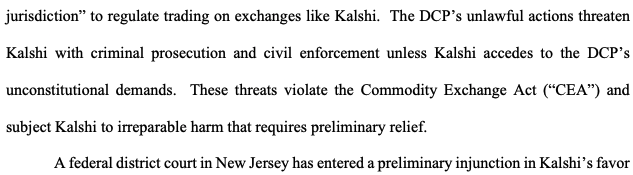
An excerpt from Kalshi’s preliminary injunction motion arguing that the DCP’s action violates federal commodities laws. Source: CourtListener

Connecticut federal court judge Vernon Oliver said in an order on Monday that the DCP must “refrain from taking enforcement action against Kalshi” as the court considers the company’s bid to temporarily stop the regulator.

The order adds that the DCP should file a response to the company by Jan. 9 and Kalshi should file further support for its motion by Jan. 30, with oral arguments for the case to be held in mid-February.

Kalshi is in a battle with multiple US states

Kalshi is a federally regulated designated contract maker under the CFTC and, in January, began offering contracts nationally that allow bets on the outcome of events such as sports and politics.

Related: How prediction markets raise insider trading and credit risks

Its platform has become hugely popular this year and saw a record $4.54 billion monthly trading volume in November, attracting billions in investments, with Kalshi closing a $1 billion funding round earlier this month at a valuation of $11 billion.

However, multiple US state regulators have taken issue with Kalshi’s offerings, which have led to the company being embroiled in lawsuits over whether it is subject to state-level gambling laws.

Kalshi sued the New York State Gaming Commission in October after the regulator sent a cease and desist order claiming it offered a platform for sports wagering without a license.

In September, Massachusetts’ state attorney general sued Kalshi in state court, which the company asked to be tossed. So far this year, Kalshi has sued state regulators in New Jersey, Nevada, Maryland and Ohio, accusing each of regulatory overreach.

Magazine: Can Robinhood or Kraken’s tokenized stocks ever be truly decentralized?
Похожее

Crypto Market Prices the Verdict: $1.8 Billion Bet on Do Kwon's Sentencing Outcome

The cryptocurrency market is witnessing an extraordinary $1.8 billion in futures trading volume for LUNA and LUNA2 tokens, despite their lack of fundamental value. This surge in speculative activity is directly tied to the upcoming sentencing hearing of Terraform Labs co-founder Do Kwon in a New York federal court on December 11th. Prosecutors are seeking a 12-year prison sentence for Kwon’s role in the $40 billion Terra-LUNA collapse, while his defense team is arguing for a 5-year term. This 7-year discrepancy has created a high-stakes betting environment. The market is characterized by extreme divergence, with a high volume of short positions (indicated by negative funding rates) and a powerful counter-force of buyers attempting to squeeze those shorts. The article argues that the current LUNA traders are not the original victims of the crash but are now primarily event-driven speculators, quantitative funds, and opportunistic traders. For them, LUNA has been transformed from a failed project into a pure "legal derivative," a volatile instrument whose price is entirely driven by the legal outcome of Kwon's case, devoid of any fundamental anchor. The author concludes that regardless of the sentencing outcome—whether a harsh or light sentence—the event's conclusion will likely cause LUNA's price to collapse. A harsh sentence would reaffirm its zero fundamental value, while a light sentence would trigger a "sell the news" event. This situation exemplifies the crypto market's cold, hyper-efficient ability to price and monetize anything, including justice and a person's freedom, reducing moral judgment to mere noise against the pursuit of volatility and profit.

比推53 мин. назад

Crypto Market Prices the Verdict: $1.8 Billion Bet on Do Kwon's Sentencing Outcome

比推53 мин. назад

Торговля

Спот
Фьючерсы
活动图片