Weekly Token Unlocks: HYPE Unlocks Tokens Worth Approximately $300 Million

marsbitОпубликовано 2026-02-01Обновлено 2026-02-01

Введение

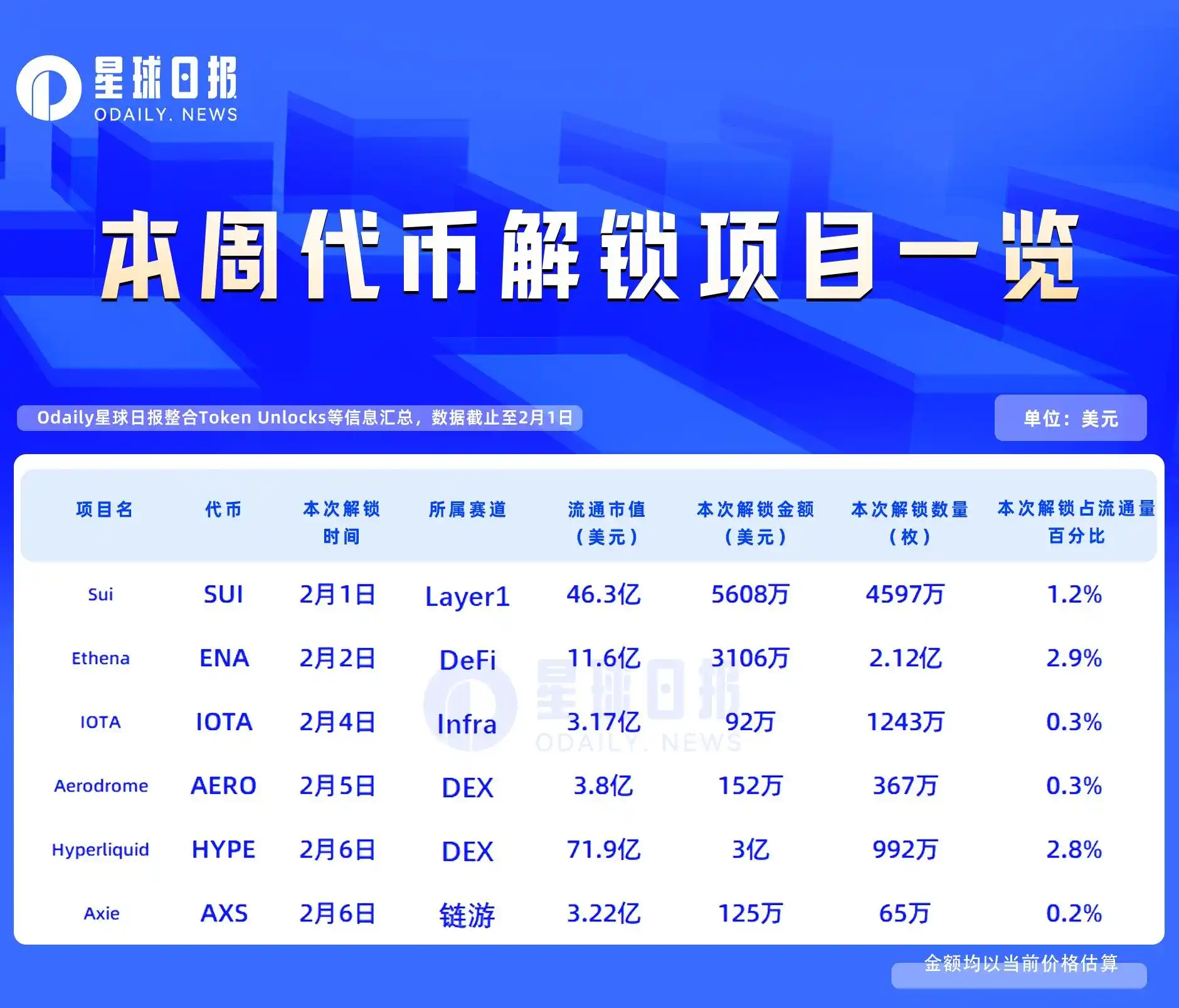
Weekly Token Unlock Report: HYPE and ENA Lead Major Releases This week sees significant token unlocks from two major projects. Hyperliquid (HYPE) is set to release 9.92 million tokens, valued at approximately $300 million. Hyperliquid is a high-performance blockchain aiming to build a fully on-chain, open financial system. Additionally, Ethena (ENA) will unlock 212 million tokens, worth around $31.06 million. Ethena Labs is the issuer of the USDe algorithmic stablecoin, which uses a mechanism involving collateral in BTC and stETH, along with short perpetual futures positions, to maintain its peg and generate yield. Both projects have provided their specific release schedules as shown in the accompanying charts.

Hyperliquid

Project Twitter: https://x.com/HyperliquidX

Project Website: https://hyperfoundation.org/

This Unlock Amount: 9.92 million tokens

This Unlock Value: Approximately $300 million

Hyperliquid is a high-performance blockchain built with the vision of creating a fully on-chain open financial system. Liquidity, user applications, and trading activities synergize on a unified platform, aiming to accommodate all financial operations.

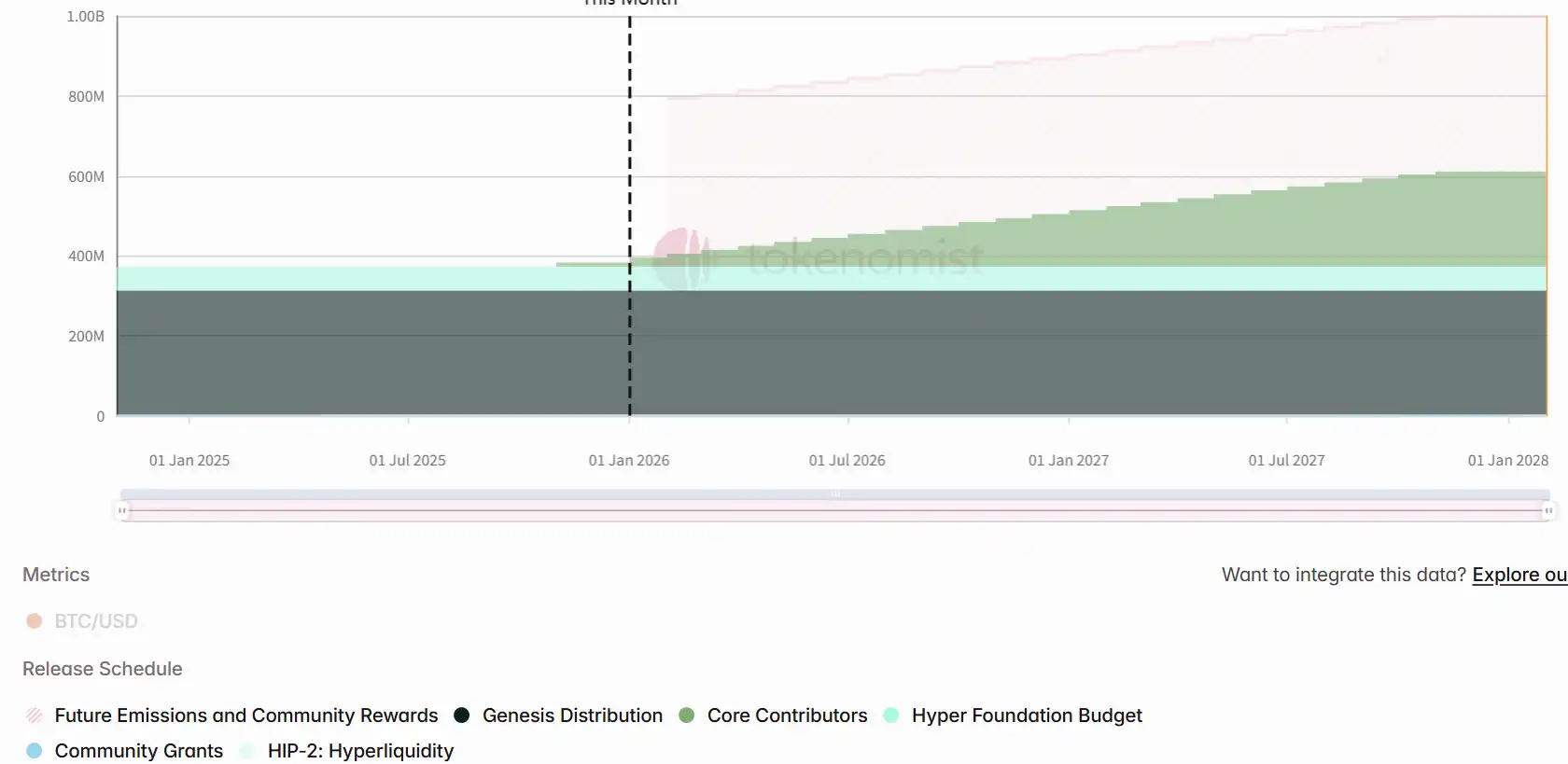
The specific release curve is as follows:
Ethena

Project Twitter: https://x.com/ethena_labs

Project Website: https://www.ethena.fi/

This Unlock Amount: 212 million tokens

This Unlock Value: Approximately $31.06 million

The algorithmic stablecoin USDe, launched by Ethena Labs, currently relies on collateral such as BTC and stETH, along with their inherent yields. It simultaneously creates Bitcoin and ETH short positions to balance Delta and utilizes perpetual/futures funding rates to maintain the peg and provide yields. Essentially, it uses the yield from the long spot position to hedge against the losses from the equivalent short position, achieving balance while capturing ETH staking rewards and the funding rate from the short position.

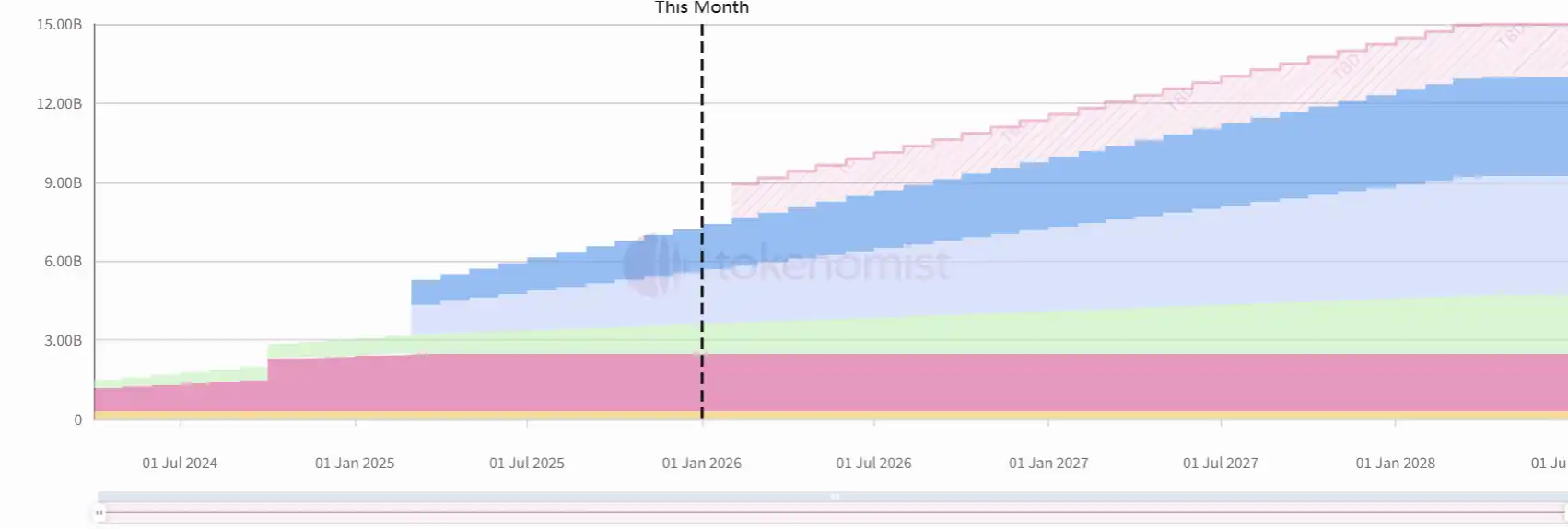
The specific release curve is as follows:
Связанные с этим вопросы

QWhat is the total value of tokens unlocked by Hyperliquid this week?

AApproximately $300 million worth of tokens.

QHow many HYPE tokens were unlocked by Hyperliquid?

A9.92 million tokens.

QWhat is the purpose of the Hyperliquid blockchain?

ATo build a fully on-chain open financial system that unifies liquidity, user applications, and trading activity on a single platform to accommodate all financial businesses.

QHow many ENA tokens were unlocked by Ethena this week?

A212 million tokens.

QWhat is the mechanism behind Ethena Labs' USDe stablecoin?

AUSDe is an algorithmic stablecoin that uses collateral in BTC and stETH, creates short positions in Bitcoin and ETH to balance Delta, and utilizes perpetual/futures funding rates to maintain its peg and provide yield.

Похожее

Zhejiang University Research Team Proposes New Approach: Teaching AI How the Human Brain Understands the World

A research team from Zhejiang University published a paper in *Nature Communications* challenging the prevailing notion that larger AI models inherently think more like humans. They found that while model performance on recognizing concrete concepts improved as parameters increased (from 74.94% to 85.87%), performance on abstract concept tasks slightly declined (from 54.37% to 52.82%) in models like SimCLR, CLIP, and DINOv2. The key difference lies in how concepts are organized. Humans naturally form hierarchical categories (e.g., grouping a swan and an owl into "birds"), enabling them to apply past knowledge to new situations. Models, however, rely heavily on statistical patterns in data and struggle to form stable, abstract categories. The team proposed a novel solution: using human brain signals (recorded when viewing images) to supervise and guide the model's internal organization of concepts. This method, termed transferring "human conceptual structures," helped the model learn a brain-like categorical system. In experiments, the model showed improved few-shot learning and generalization, with a 20.5% average improvement on a task requiring abstract categorization like distinguishing living vs. non-living things, even outperforming much larger models. This research shifts the focus from simply scaling model size ("bigger is better") to designing smarter internal structures ("structured is smarter"). It highlights a new pathway for developing AI that possesses more human-like abstract reasoning and adaptive learning capabilities.

marsbit4 ч. назад

Zhejiang University Research Team Proposes New Approach: Teaching AI How the Human Brain Understands the World

marsbit4 ч. назад

Торговля

Спот
Фьючерсы
活动图片