Hoskinson Reaffirms Cardano Focus After IO Treasury Proposals Pass

bitcoinistОпубликовано 2026-05-26Обновлено 2026-05-26

Введение

Cardano's community treasury vote has ratified the "Developer Experience Initiative" proposed by Input Output (IO), securing funding for a six-month project to improve developer tooling and onboarding. The proposal passed with 67.90% approval, marking a governance win for founder Charles Hoskinson. He framed the vote as a critical response to developer complaints about fragmented tools and documentation, and a test of Cardano's post-Voltaire governance system, which he declared "real" and functional. The result coincided with Hoskinson publicly reaffirming his "100%" focus on Cardano and its privacy-focused sidechain, Midnight, following news of the closure of a separate personal healthcare venture. He emphasized the importance of ecosystem coordination among key organizations and committed to increased visibility for Cardano and Midnight at upcoming industry events. The broader funding round delivered a mixed outcome, with several other IO proposals failing to pass, indicating the community's selective support for core development work over other infrastructure and ecosystem spending requests.

Cardano’s IO-backed Developer Experience Initiative has been ratified after a closely watched treasury vote, giving Charles Hoskinson a fresh governance win at the same time he is publicly trying to re-center his attention on ADA and Midnight.

The proposal, a treasury withdrawal request tied to developer tooling and onboarding, was listed by AdaStat as ratified and approved, with 67.90% Yes support against 32.10% No. The vote involved roughly ₳3.72 billion in Yes stake and ₳1.76 billion in No stake, according to the tracker. The governance action had been submitted on April 22, 2026, and expired on May 24, 2026, in Epoch 633, according to Gov.tools.

IO Secures Crucial Cardano Funding

The result matters because the vote had become more than a routine funding request. Hours before the deadline, Hoskinson wrote that the proposal was “just 0.5% away” from passing and framed the measure as a response to persistent complaints from developers: fragmented tooling, scattered documentation, weak onboarding and a steep learning curve.

IO’s own description of the initiative presents it as a six-month, 3.6 million ada push to make Cardano easier to build on, including a one-command project setup, audit-ready smart contract templates, a unified developer portal and support for community tooling. Hoskinson had repeatedly warned that IO may need to wind down parts of its research operation if the proposal did not secure approval.

IO has argued that the developer base remains a structural weakness. In a May 18 post outlining the proposal, Robertino Martinez wrote that it has “around 17x fewer developers than Ethereum,” with the gap continuing to widen while Cardano’s developer numbers remain largely flat. The same post said fragmented documentation, unmaintained tools and the absence of a clear onboarding path were causing builders to arrive in “a disjointed and scattered ecosystem.”

Hoskinson used the vote’s closing stretch to cast the governance process as evidence that the network’s post-Voltaire system is functioning, even when outcomes are contested. “Cardano is alive. The community is engaged. And that matters more than any single vote,” he wrote. “But this process has shown me something important: Cardano’s governance is real. You are not passive holders. You are owners.”

Hoskinson Confirms Cardano Focus

The post also moved beyond the single proposal. Hoskinson said the process had reinforced the importance of the so-called Pentad — IOG, EMURGO, the Cardano Foundation, the Midnight Foundation and Intersect — as a coordination layer for the ecosystem. He invited those organizations to “sit down and have a real conversation about the future of governance” and how to formalize that coordination going forward.

The timing was notable. Two days earlier, Cowboy State Daily reported that Hoskinson Health & Wellness Clinic in Gillette, Wyoming, would close on July 31, ending an ambitious rural healthcare project backed by Hoskinson. The publication described the clinic as part of a roughly $250 million effort to build what had been billed as the “Mayo Clinic of the West,” and cited clinic leadership as saying the organization was “no longer financially sustainable.”

That background gave Hoskinson’s post a sharper edge. He did not mention the clinic closure directly in the Cardano governance statement, but he addressed questions about his focus. “I am 100% focused on Cardano and Midnight. Always have been. Let me prove it,” he wrote.

He also said he would attend the Cardano Summit in Singapore and appear on stage, while personally committing to partially top up Cardano and Midnight’s Token2049 sponsorship to Title level. “Being on that main stage is where Cardano and Midnight need to be heard,” Hoskinson said.

Cardano Funding Round Delivers Mixed Result

The broader treasury round showed that Cardano’s new governance system is willing to split the ticket. Several IO-led proposals passed, including the Developer Experience Initiative, Cardano Upgrades, the Consensus Initiative and Cardano High Assurance Technical Collaboration.

But others did not. IO’s maintenance proposal with Ensurable Systems and its Plutus proposal with VacuumLabs both expired just short of the 67% DRep threshold, while the L2 Scalability Initiative with Midgard Labs, Blockfrost’s indexing proposal and Pogun’s Bitcoin DeFi funding request failed by wider margins.

That makes the result harder to frame as a simple endorsement or rejection of IO. DReps backed some core protocol and developer-experience work while withholding approval from other infrastructure, maintenance and ecosystem-spending requests.

At press time, ADA traded at $0.2446.
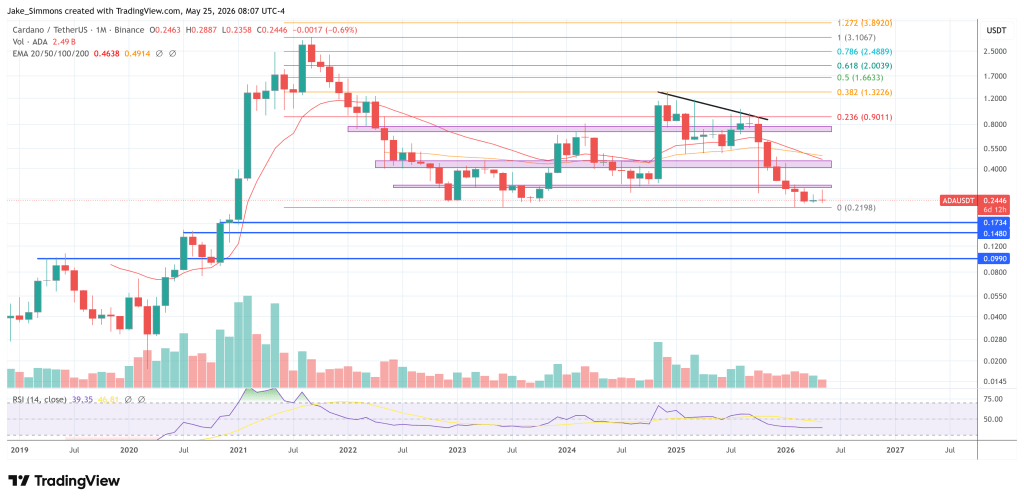
ADA remains below key resistance, 1-month chart | Source: ADAUSDT on TradingView.com

Связанные с этим вопросы

QWhat was the main purpose of the IO-backed Developer Experience Initiative proposal that passed in the Cardano treasury vote?

AThe main purpose of the proposal was to improve Cardano's developer experience over six months with a 3.6 million ada budget. It aimed to address issues like fragmented tooling, scattered documentation, weak onboarding, and a steep learning curve by creating a one-command project setup, audit-ready smart contract templates, a unified developer portal, and supporting community tooling.

QHow did Charles Hoskinson frame the importance of the governance vote, regardless of its outcome?

AHoskinson framed the governance process itself as evidence that Cardano's post-Voltaire governance system is functioning correctly. He stated that it showed the community is engaged and that Cardano's governance is real, emphasizing that token holders are active owners, not just passive participants.

QWhat personal commitment did Charles Hoskinson make regarding Cardano and Midnight's presence at Token2049?

ACharles Hoskinson personally committed to partially top up Cardano and Midnight's sponsorship for Token2049 to the Title level. He also stated he would attend the Cardano Summit in Singapore and appear on stage, emphasizing that being on the main stage is where these projects need to be heard.

QBesides the Developer Experience Initiative, what does the article indicate about the results of other proposals in the same funding round?

AThe broader treasury round delivered mixed results. While several IO-led proposals like Cardano Upgrades and the Consensus Initiative passed, others failed or expired. These included IO's maintenance proposal with Ensurable Systems, its Plutus proposal with VacuumLabs, the L2 Scalability Initiative with Midgard Labs, Blockfrost's indexing proposal, and Pogun's Bitcoin DeFi funding request. This indicates DReps selectively supported core protocol work but rejected other infrastructure and spending requests.

QWhat context regarding Charles Hoskinson's other ventures was provided in the article, and how did he respond to it?

AThe article noted that two days before his governance post, it was reported that the Hoskinson Health & Wellness Clinic in Wyoming would close, ending a major rural healthcare project he backed. In his Cardano statement, Hoskinson did not mention the closure directly but addressed questions about his focus by declaring, "I am 100% focused on Cardano and Midnight. Always have been. Let me prove it."

Похожее

Kelp DAO's $400 Million Bad Debt Was Covered, But at a $12 Billion Cost to Aave

On May 26th, Kelp DAO successfully transferred its final batch of rsETH, completing the 37-day process of fully backing rsETH 1:1 after a security incident. However, the resolution came at a significant cost to Aave. The protocol's TVL plummeted by over $12 billion in the following month. Furthermore, a separate legal battle over 30,766 frozen ETH continues in court, posing ongoing reputational risk. The recovery was enabled by an unprecedented, one-time coalition dubbed "DeFi United," involving major contributions from Aave's founder, treasury, Consensys, Mantle, and others. Despite this, the event triggered a major outflow of funds, with whales like Justin Sun moving capital to competitors like Spark. Aave's path to regaining its position relies heavily on the successful execution of its multi-pronged strategy. Its new V4 protocol, designed for open, heterogeneous asset markets, faces delays due to internal governance disputes. Meanwhile, the V3 version remains the core revenue generator, and the permissioned Horizon fork is targeting institutional RWA (Real-World Assets) growth—a segment less impacted by the rsETH incident but dependent on traditional finance adoption timelines. The key takeaway is that while the immediate bad debt was covered, Aave paid a steep price in lost trust and capital. Recovering market share depends on accelerating V4's rollout and advancing its institutional RWA offerings, both of which face external and internal hurdles. The "DeFi United" safety net is unlikely to be replicable for future crises.

marsbit11 мин. назад

Kelp DAO's $400 Million Bad Debt Was Covered, But at a $12 Billion Cost to Aave

marsbit11 мин. назад

TechFlow Intelligence Report: Xiaomi Announces 200 Billion HKD Stock Buyback Plan, Spot Gold Falls Nearly 1%

TechFlow Report: Xiaomi announced a HK$200 billion stock buyback plan, while spot gold fell nearly 1%. A wider range of tech headlines includes Google unveiling its powerful video editing model Gemini Omni and the original "Attention is All You Need" authors advocating for a move beyond Transformer architecture. In other AI news, IBM reported its first successful use of a quantum computer to train an AI model, and Qwen3.5 released uncensored local model versions. The crypto/Web3 sector saw discussions on opaque stablecoin products and DEX fee changes. Major tech companies are under scrutiny: Uber's COO publicly questioned the ROI of AI investments, Motorola was accused of hijacking Amazon app links for affiliate codes, and Google faced criticism for using web data to fuel its AI. U.S. markets are focused on high S&P 500 valuations (31.8x P/E) and an intense concentration of capital in semiconductor stocks, with warnings about the sustainability of the AI data center boom. Geopolitical tensions, featuring simultaneous U.S. airstrikes on Iran and peace talks, caused significant oil price volatility. Other notable developments include Ferrari's first pure EV priced at 4.35 million yuan and Boston Dynamics' Atlas robot learning soccer from videos. The underlying theme suggests the AI narrative is shifting from boundless potential to requiring tangible results, while traditional geopolitical risks remain a powerful force in markets.

marsbit14 мин. назад

TechFlow Intelligence Report: Xiaomi Announces 200 Billion HKD Stock Buyback Plan, Spot Gold Falls Nearly 1%

marsbit14 мин. назад

Coin & Stock Barometer: Bitcoin Miner MARA Holdings Spends Over $860,000 on Bulletproof Vehicle Services for Executives; Bitmine Included in Preliminary List for FTSE Russell 1000 Index (May 19)

Crypto Market Wrap & Key Corporate Updates (May 19) The crypto market saw a decline followed by a minor rebound, while U.S. crypto-related stocks fell broadly. In corporate news: **MARA Holdings**, a Bitcoin miner, disclosed spending over $869,000 on vehicle ballistic armor services for its CEO and CFO under its security program. The board cited higher risks associated with the company's public disclosure of holding substantial Bitcoin assets. According to BitcoinTreasuries.NET, Elon Musk's **SpaceX and Tesla** collectively hold 30,221 BTC ($2.3B), which would rank them as the fifth-largest public company holder if combined. **DDC Enterprise Limited** increased its Bitcoin holdings by 200 BTC, bringing its total to 2,583 BTC. The firm stated it plans to continue accumulating BTC based on liquidity, not short-term price movements. Bitcoin treasury company **Nakamoto** announced a 1-for-40 reverse stock split to regain compliance with Nasdaq's minimum bid price requirement. The company reported a Q1 2026 net loss of $238.8M, partly due to a $102.5M unrealized loss on its Bitcoin holdings. **Tether** acquired SoftBank's stake in **Twenty One Capital (XXI)**, increasing its control. Tether's CEO expressed strengthened confidence in XXI's long-term Bitcoin strategy. Fundstrat's **Tom Lee** stated that **Bitmine (BMNR)** has been included in the preliminary list for the FTSE Russell 1000 Index. Concurrently, two new wallets suspected to be linked to Bitmine withdrew 60,000 ETH ($126M) from Bitgo and Kraken. Solana treasury company **Solmate Infrastructure** announced a registered direct offering of shares to raise approximately $11.4 million. **AI Financial**, a WLFI treasury company, reported a Q1 2026 net loss of $271.5M and raised substantial doubt about its ability to continue as a going concern, partly due to unrealized losses on its WLFI token holdings. **SUI Group** disclosed it holds over 108.7 million SUI tokens (~$115M), with its market cap to net asset value ratio at 0.91x. *Disclaimer: This summary is for informational purposes only and does not constitute investment advice.*

marsbit30 мин. назад

Coin & Stock Barometer: Bitcoin Miner MARA Holdings Spends Over $860,000 on Bulletproof Vehicle Services for Executives; Bitmine Included in Preliminary List for FTSE Russell 1000 Index (May 19)

marsbit30 мин. назад

China's AI Fronts: From Yan'an to Midway

This article analyzes the competitive landscape of China's AI industry through a dual-front war analogy: the "Eastern Front" of business model competition and the "Western Front" of global strategic positioning. **The Eastern Front: The Scramble for Supply Lines and Monetization** The "Eastern Front" examines the contrasting strategies of three Chinese tech giants—Tencent, Alibaba, and ByteDance—in the face of AI's high marginal costs. Tencent integrates AI as a catalyst within its existing ecosystems (advertising, gaming, cloud) for monetization, prioritizing high-value scenarios over user growth. Alibaba bets on a full-stack, self-developed approach from chips to applications, aiming to control costs and ecosystem, though this requires immense patience and resources. ByteDance, with Doubao as its flagship, pursues a traditional traffic-driven, "super app" strategy but faces severe monetization challenges as its massive user base incurs unsustainable operational costs. The central challenge for all is building a reliable "supply line" (sustainable funding/profit) and achieving efficient monetization, moving beyond being mere "token factories." **The Western Front: "Preserving Land" vs. "Preserving People"** The "Western Front" frames a global strategic divergence. The U.S. model ("preserving land") focuses on closed-source, high-premium models (e.g., Anthropic) targeting lucrative enterprise markets. China's strategy ("preserving people") leverages open-source models (e.g., Alibaba's Qwen, DeepSeek) and extremely low pricing to attract global developers and capture long-tail markets, akin to a "surround the cities from the countryside" approach. The goal is to make Chinese models the default infrastructure, locking in future ecosystem value. However, the critical test is whether this open-source ecosystem can achieve a commercial闭环, converting developer adoption into tangible revenue (e.g., via cloud services), and bridging the monetization gap with Western models that charge for value, not just tokens. **Conclusion: The Long March from Factory to Brand** The article concludes that China's AI industry possesses technology, users, and scenarios but must integrate them to create and capture value. Its ultimate success depends on navigating both fronts: companies must establish sustainable monetization on the Eastern Front, while the industry's Western strategy must evolve from simply "preserving people" (developer adoption) to truly "preserving both people and land" — transforming open-source ecosystem dominance into commercial success and premium brand value. This journey from being a "token factory" to a "value highland" will require strategic patience and the ability to outlast competitors in a prolonged contest.

marsbit1 ч. назад

China's AI Fronts: From Yan'an to Midway

marsbit1 ч. назад

Торговля

Спот
Фьючерсы

Популярные статьи

Как купить S

Добро пожаловать на HTX.com! Мы сделали приобретение Sonic (S) простым и удобным. Следуйте нашему пошаговому руководству и отправляйтесь в свое крипто-путешествие.Шаг 1: Создайте аккаунт на HTXИспользуйте свой адрес электронной почты или номер телефона, чтобы зарегистрироваться и бесплатно создать аккаунт на HTX. Пройдите удобную регистрацию и откройте для себя весь функционал.Создать аккаунтШаг 2: Перейдите в Купить криптовалюту и выберите свой способ оплатыКредитная/Дебетовая Карта: Используйте свою карту Visa или Mastercard для мгновенной покупки Sonic (S).Баланс: Используйте средства с баланса вашего аккаунта HTX для простой торговли.Третьи Лица: Мы добавили популярные способы оплаты, такие как Google Pay и Apple Pay, для повышения удобства.P2P: Торгуйте напрямую с другими пользователями на HTX.Внебиржевая Торговля (OTC): Мы предлагаем индивидуальные услуги и конкурентоспособные обменные курсы для трейдеров.Шаг 3: Хранение Sonic (S)После приобретения вами Sonic (S) храните их в своем аккаунте на HTX. В качестве альтернативы вы можете отправить их куда-либо с помощью перевода в блокчейне или использовать для торговли с другими криптовалютами.Шаг 4: Торговля Sonic (S)С легкостью торгуйте Sonic (S) на спотовом рынке HTX. Просто зайдите в свой аккаунт, выберите торговую пару, совершайте сделки и следите за ними в режиме реального времени. Мы предлагаем удобный интерфейс как для начинающих, так и для опытных трейдеров.

1.4k просмотров всегоОпубликовано 2025.01.15Обновлено 2025.03.21

Как купить S

Sonic: Обновления под руководством Андре Кронье – новая звезда Layer-1 на фоне спада рынка

Он решает проблемы масштабируемости, совместимости между блокчейнами и стимулов для разработчиков с помощью технологических инноваций.

2.3k просмотров всегоОпубликовано 2025.04.09Обновлено 2025.04.09

Sonic: Обновления под руководством Андре Кронье – новая звезда Layer-1 на фоне спада рынка

HTX Learn: Пройдите обучение по "Sonic" и разделите 1000 USDT

HTX Learn — ваш проводник в мир перспективных проектов, и мы запускаем специальное мероприятие "Учитесь и Зарабатывайте", посвящённое этим проектам. Наше новое направление .

1.8k просмотров всегоОпубликовано 2025.04.10Обновлено 2025.04.10

HTX Learn: Пройдите обучение по "Sonic" и разделите 1000 USDT

Обсуждения

Добро пожаловать в Сообщество HTX. Здесь вы сможете быть в курсе последних новостей о развитии платформы и получить доступ к профессиональной аналитической информации о рынке. Мнения пользователей о цене на S (S) представлены ниже.

活动图片