A Robotic Version of MicroStrategy Has Arrived! Can Ordinary People Invest in Giants in the Robotics Sector?

marsbitОпубликовано 2026-05-21Обновлено 2026-05-21

Введение

Andrew Kang, a prominent former crypto investor, has shifted his focus to AI and robotics, taking on the role of CEO at RoboStrategy. This publicly traded closed-end fund, inspired by MicroStrategy's capital model, aims to give retail investors access to early-stage robotics investments, a sector traditionally dominated by institutional capital. RoboStrategy recently listed on NASDAQ under the ticker "BOT" and secured a $2 billion equity financing commitment. Kang, co-founder of Mechanism Capital, began investing in robotics two years ago, with a notable early investment in Figure AI. RoboStrategy's portfolio now includes several robotics companies across hardware and software. The fund differentiates itself through permanent capital, a team of industry experts, and strong marketing capabilities. Its core strategy, termed R.I.S.E., involves raising capital when its share price trades at a premium to Net Asset Value (NAV), investing in high-conviction private robotics companies, scaling those investments, and using the resulting NAV growth to attract further capital—creating a potential flywheel effect. However, risks include its current high share price premium over NAV, the subjective valuation and illiquidity of its private holdings, and the inherent volatility of a closed-end fund structure.

Author: Nancy, PANews

Andrew Kang, a star investor once active in the crypto market, is shifting his focus to the AI and robotics sectors. On May 20, Andrew Kang announced his official appointment as CEO of RoboStrategy, responsible for the company's strategic direction and investment portfolio management.

As an innovative fund inspired by the capital model of the crypto DAT company Strategy, RoboStrategy recently officially launched on Nasdaq and secured up to $20 billion in equity financing commitments, quickly drawing market attention.

From Crypto to Robotics, Already Invested in Star Companies Like Figure

RoboStrategy is a public closed-end fund focused on robotics and embodied AI, co-founded by Andrew Kang and Marc Weinstein in 2025. Its goal is to open up early-stage robotics investment opportunities, previously accessible only to a few institutional investors, to a broader base of ordinary investors.

Andrew Kang and Marc Weinstein are also co-founders of the crypto investment firm Mechanism Capital. Since its establishment in 2020, Mechanism Capital has invested in over a hundred crypto projects, including well-known protocols and platforms such as Arbitrum, Pendle, Near, Deribit, and 1inch. However, based on public information, Mechanism Capital has rarely disclosed new crypto investment activities since October 2025. Andrew Kang recently admitted that he has not been closely following the crypto market for the past few months.

In contrast, he has been dedicating more effort to the robotics field. According to Andrew Kang, he began researching the robotics industry two years ago, but at that time, most VCs advised against entering this sector. In the market environment back then, robotics companies generally faced fundraising difficulties. The industry lacked mature, large-scale success stories, and there were many doubts from the outside world regarding their commercialization paths, technology implementation capabilities, and potential market size.

In his view, however, the acceleration of embodied AI development will completely transform the entire industry. Humanoid robots are one of the few directions with the potential to go "from zero to a multi-trillion dollar market," similar to the developmental stage of Bitcoin in 2013, but with a larger long-term market space. Particularly as manufacturing, logistics, and service industries continue to face labor shortages, embodied AI and robotics technologies are accelerating their entry into real industrial scenarios.

Therefore, in February 2024, Andrew Kang completed his first significant investment in robotics, investing $19 million in Figure AI. Today, Figure AI has become one of the world's highest-valued humanoid robotics companies, with a latest valuation of $39 billion, compared to its pre-money valuation of approximately $2 billion in February 2024. (Related reading:The Entrepreneur from the Farm: After Building Flying Cars, Gambles on a $39 Billion Giant in the Robotics Sector)

However, Andrew Kang also realized that the future development of the robotics industry will heavily rely on massive long-term capital, which is difficult to sustain through individuals or traditional funds alone. Meanwhile, robotics startups also need a long-term capital platform that truly understands industry demands to help them secure continuous financing, industrial resources, and market recognition support. More importantly, current robotics innovation is mainly concentrated in the private market, making it difficult for most ordinary investors to participate.

Based on this, Andrew Kang co-founded RoboStrategy. Currently, RoboStrategy has invested in robotics companies including Figure AI, Apptronik, Dyna Robotics, Dexmate, Standard Bots, and Path Robotics, covering multiple areas from hardware and infrastructure to software, with an average investment size per round of approximately $7 million.

In Andrew Kang's view, compared to traditional VCs, RoboStrategy possesses several differentiated advantages. First, as a closed-end fund, its capital is permanent, free from the fund term limitations of traditional VCs, allowing it to adopt an extremely long-term perspective in deploying in the robotics and embodied AI industry. Second, the team brings together multiple seasoned professionals from the robotics industry, including long-time founders or operators, making it regarded by many startups as one of the "most professional and knowledgeable investment institutions in the robotics industry." Additionally, leveraging the team's strengths in digital marketing and social media, RoboStrategy not only has stronger fund distribution capabilities but is also more adept at expanding market influence and industry awareness, thereby helping its portfolio companies gain more attention, talent, and resources.

Launched on Nasdaq, Attempting to Replicate the Strategy Capital Flywheel

As the first closed-end fund specifically designed for public market investors, RoboStrategy officially began trading on Nasdaq on May 11, under the ticker symbol "BOT." As of now, the BOT stock price is around $28.2, having declined approximately 21.58% since listing.

Public information shows that RoboStrategy board member Jason Zhao purchased 400,000 shares of the company at $10 per share in October last year; subsequently, Andrew Kang also purchased 246,000 shares at the same price. Meanwhile, the investment advisory firm FP Strategies LLC continued to increase its holdings by 290,000 shares at $10 per share in April this year, currently holding a cumulative total of approximately 390,000 shares.

In terms of capital operation logic, RoboStrategy draws inspiration from Strategy's Bitcoin treasury model. The latter continuously issues stocks and convertible bonds in the public capital market to obtain low-cost funds for consistently increasing its Bitcoin holdings, leveraging stock price premiums to form a capital flywheel. This model has been emulated by numerous companies.

RoboStrategy attempts to replicate this logic in the robotics sector. The fund's core idea is to use three main financing instruments—CEF, PIPE, and ATM—to continuously raise funds when the fund's stock price trades at a premium relative to its Net Asset Value (NAV), then deploy that capital into high-growth private robotics and embodied AI companies, thereby constructing the R.I.S.E capital compound interest flywheel.
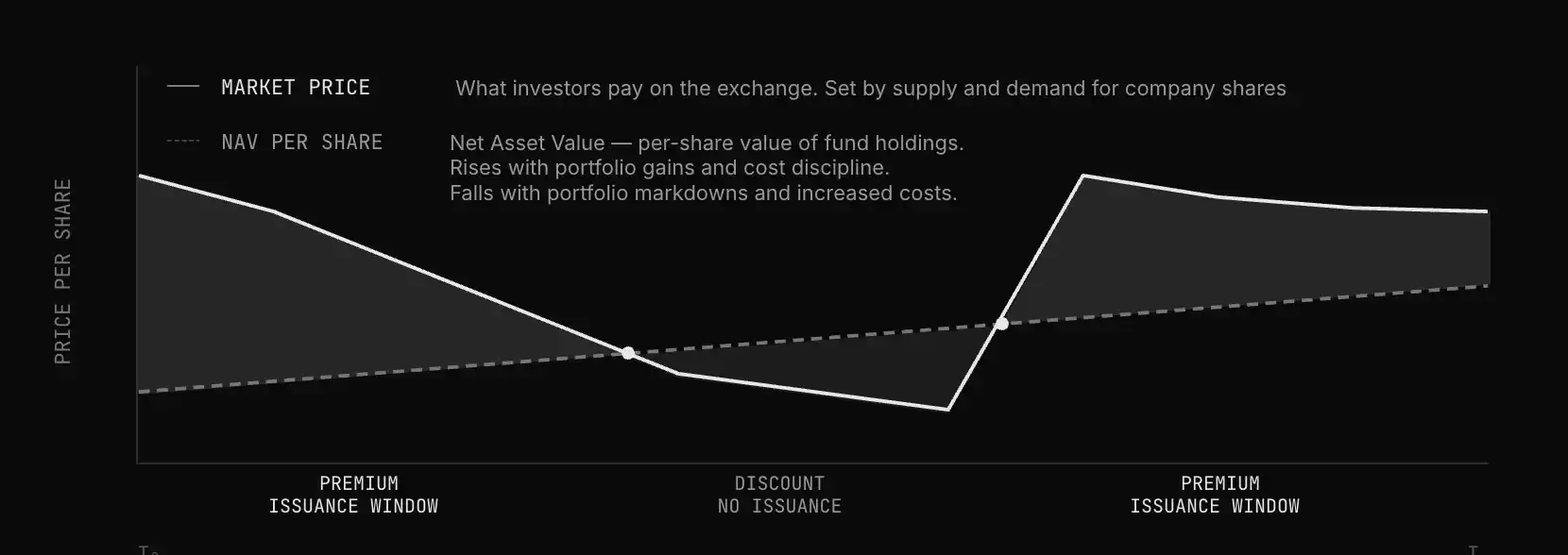
The so-called R.I.S.E represents four stages:

· Raise: Issue shares at a premium when the market price is above NAV to obtain more cash.

· Invest: Through deep due diligence, allocate funds to high-conviction robotics projects.

· Scale: Portfolio companies use the new capital to accelerate expansion, driving fund NAV growth.

· Expand: As NAV increases and industry enthusiasm rises, further attract investors and new capital, expanding the fund's scale and influence.

This model essentially utilizes the dual pricing mechanism of closed-end funds (market price vs. net asset value), aiming to achieve compound growth in NAV per share over the long term, while replacing the multi-layered fee structure of traditional private equity funds with a single public fund structure.

Earlier this month, RoboStrategy signed a $20 billion Committed Equity Financing (CEF) agreement with Roth Principal Investments, a subsidiary of Roth Capital Partners, to support its strategic growth plans.

However, just as most crypto DAT companies' treasury stories are difficult to sustain, RoboStrategy also faces risks that cannot be ignored.

As of March 31, 2026, RoboStrategy's NAV was approximately $7.31 per share, with total net assets around $145.5 million. Based on the current stock price, the market's valuation premium for it is close to 3 times. But a high premium does not mean discount risk will not materialize. Meanwhile, since the fund's investment targets are mostly unlisted robotics companies, their asset valuations themselves are highly subjective and have limited liquidity. Exit paths heavily rely on IPO or M&A markets. Once the capital environment cools down, these assets may face valuation adjustment pressure.

Furthermore, the closed-end fund structure means investors cannot redeem shares at any time like with open-end funds; they can only trade on the secondary market. Therefore, price volatility is often amplified.

Whether RoboStrategy can sustain its high premium and market enthusiasm in the long term remains to be verified by the market.


Связанные с этим вопросы

QWhat is RoboStrategy, and what is its primary goal?

ARoboStrategy is a publicly traded, closed-end fund focused on robotics and embodied AI. Its primary goal is to open up early-stage investment opportunities in the robotics sector, traditionally available only to institutional investors, to the broader public market.

QWho founded RoboStrategy, and what is Andrew Kang's background?

ARoboStrategy was co-founded by Andrew Kang and Marc Weinstein in 2025. Andrew Kang is a former star investor in the crypto market and a co-founder of the crypto investment firm Mechanism Capital. He has now shifted his focus to the AI and robotics sector and serves as the CEO of RoboStrategy.

QHow is RoboStrategy's capital model inspired by MicroStrategy?

ARoboStrategy's capital model is inspired by MicroStrategy's Bitcoin treasury strategy. It aims to create a capital flywheel by issuing shares at a premium when its market price exceeds its Net Asset Value (NAV). The raised capital is then invested in high-growth private robotics companies, aiming to increase the fund's NAV and attract more capital, similar to MicroStrategy's approach with Bitcoin.

QWhat does the R.I.S.E. strategy stand for in the context of RoboStrategy?

AR.I.S.E. is RoboStrategy's four-stage capital strategy: Raise (issuing shares at a premium), Invest (allocating capital to high-conviction robotics projects), Scale (helping portfolio companies grow to increase NAV), and Expand (attracting more investors and capital as NAV and industry interest rise).

QWhat are some key risks associated with investing in RoboStrategy?

AKey risks include: 1) Potential discount to NAV if market sentiment cools. 2) Subjective and illiquid valuations of its private company investments. 3) High dependence on favorable IPO or M&A markets for exits. 4) Price volatility amplified by its closed-end fund structure, which prevents direct redemptions, forcing trades on the secondary market.

Похожее

GitHub Empire on the Brink of Collapse: Source Code Leak, 18-Year Veteran Leaves, Microsoft Loses 1.5 Billion Developers

GitHub is facing an unprecedented crisis, marked by a massive exodus of developers and severe operational failures. The tipping point came when Mitchell Hashimoto, creator of Ghostty and an 18-year GitHub user, publicly severed ties, citing persistent platform outages that made serious work impossible. This departure highlights a broader pattern of user frustration. The platform's instability has drawn complaints from major corporate clients like Citibank and Intel, forcing Microsoft to issue substantial service credits. A critical incident last month saw an accidentally triggered, unreleased feature cause widespread repository rollbacks, erasing recent code changes and pushing enterprises to migrate. Security has catastrophically breached. In May 2026, hackers infiltrated over 3,800 of GitHub's internal repositories via a poisoned VS Code extension installed by a developer, leading to the attempted sale of core source code for $50,000. This follows the discovery of a critical zero-day vulnerability in March that threatened access to millions of repositories. Internally, GitHub's autonomy has collapsed. After the resignation of CEO Thomas Dohmke in mid-2025, Microsoft eliminated the CEO role, folding GitHub into its CoreAI division under the unpopular leadership of Jay Parikh. This triggered a talent drain, with key executives and engineers leaving. A disruptive migration of GitHub's infrastructure to Azure servers, pushed by CTO Vladimir Fedorov, is blamed for the recurring outages. Competitively, GitHub Copilot is under "existential threat" from superior AI coding tools like Cursor (now owned by SpaceX) and Claude Code, which offer more advanced contextual coding and automation. Ironically, Microsoft's own engineers reportedly preferred Claude Code, forcing management to revoke licenses. Financially, GitHub is a loss leader. Despite Copilot surpassing 4.7 million paid users and $3 billion in annual revenue, the AI inference costs for free services massively outstrip subscription income, hurting Microsoft's cloud margins. The recent shift from a flat fee to a pay-as-you-go model for Copilot has further alienated developers. The core question for Microsoft is whether a centralized code repository remains essential in the AI agent era. The erosion of trust, developer culture, and platform reliability threatens the very ecosystem Microsoft spent decades building.

marsbit1 ч. назад

GitHub Empire on the Brink of Collapse: Source Code Leak, 18-Year Veteran Leaves, Microsoft Loses 1.5 Billion Developers

marsbit1 ч. назад

SEC Promotes Tokenized Stocks, Is the Traditional Finance Industry Starting to Worry?

The U.S. Securities and Exchange Commission (SEC) is preparing to formally release an "innovation exemption" framework this week. This framework would allow third parties to tokenize U.S. stocks like Apple and Tesla without approval from the listed companies. The move, rooted in a deregulatory vision proposed by pro-crypto commissioners earlier this year, could accelerate the migration of traditional stock markets to blockchain. This development poses a structural threat of "fragmentation" to traditional finance. Core concerns are liquidity fragmentation—where trading volume disperses across multiple blockchains and platforms, leading to price disparities and reduced market efficiency—and revenue fragmentation—where trading fees and intermediary income shift away from domestic exchanges to overseas or competing platforms. The report compares the traditional stock market to a monopolistic "supermarket." Tokenization enables countless "street stalls" to operate outside this system, threatening the exchange's dominance, diluting liquidity for large orders, and slicing into revenue streams. Evidence of this capital fragmentation is already emerging. On the same day the SEC signaled the framework, decentralized platform Hyperliquid saw its RWA (real-world asset) open interest hit a record $2.6 billion, driven by demand for 24/7 on-chain trading of traditional assets. Traditional institutions face a dilemma: either collaborate to build tokenization infrastructure proactively or lobby regulators to block innovation. Regulators must balance controlling the pace of innovation with preventing domestic revenue from being captured by offshore platforms. Key future battles will revolve around defining shareholder rights for tokenized assets and regulating platforms that have grown in regulatory gray areas. In the digital asset era, inaction risks the permanent loss of long-held fee monopolies and financial leadership as capital continues to disperse.

marsbit1 ч. назад

SEC Promotes Tokenized Stocks, Is the Traditional Finance Industry Starting to Worry?

marsbit1 ч. назад

A Comprehensive Analysis of On-Chain Pre-IPO: Why is the Pricing Power of SpaceX and OpenAI Moving On-Chain?

This podcast episode explores the rise of on-chain pre-IPO price discovery and trading, focusing on companies like SpaceX, OpenAI, and Anthropic. Key trends include the recent launch of a SpaceX pre-IPO perpetual contract on Hyperliquid, the secondary market trading of AI company shares, and a new partnership between Nasdaq Private Market and Polymarket. Dio Casares explains why AI companies like OpenAI and Anthropic actively deny the legitimacy of secondary trades. Primary reasons are to protect their primary funding rounds (as secondary trades don't provide cash to the company) and to avoid complex legal and administrative responsibilities associated with settling these transactions. He argues that on-chain **derivatives** (like perpetuals) are a more viable solution than **tokenized spot markets**, as they better navigate U.S. regulatory holding period requirements, provide effective hedging, and avoid antagonizing the companies themselves by competing with their primary raises. The discussion covers the risks and methods of gaining pre-IPO exposure, from direct investments and SPVs to riskier, layered structures that can lead to legal complications and settlement issues. Casares also maps the landscape of key players, differentiating between traditional secondary brokers (like Forge, Hiive, and Setter) and on-chain derivatives protocols (like Trade.xyz/Ventuals on Hyperliquid) and tokenization platforms (often on Solana). He positions Patagon as a facilitator for access to private market deals but clarifies it avoids on-chain tokenization to maintain good relations with portfolio companies. Looking ahead, the convergence of a historic IPO pipeline (with potential trillion-dollar valuations), the 24/7 nature of crypto markets, and the strategic use of pre-market perpetuals as a "loss leader" suggest continued growth and competition in the on-chain pre-IPO space.

marsbit1 ч. назад

A Comprehensive Analysis of On-Chain Pre-IPO: Why is the Pricing Power of SpaceX and OpenAI Moving On-Chain?

marsbit1 ч. назад

Token Packages Are Here, Are Telecom Operators in a Hurry?

Major Chinese telecom operators are launching token-based AI computing packages, sparking public debate and highlighting a strategic shift amid slowing traditional revenue growth. In May, Shanghai Telecom introduced token plans (e.g., 9.9 RMB for 10 million tokens), quickly followed by nationwide offerings from China Telecom, China Mobile, and China Unicom. While priced higher than major AI firms like DeepSeek, these packages allow users to access multiple AI models via API using their phone bills, similar to purchasing universal mobile data. The move reflects operators' anxiety as traditional voice, SMS, and data services stagnate. With revenue growth hitting multi-year lows in 2025, AI and computing power represent a critical new frontier. However, current C端 offerings, such as AI photo editing or virtual pets, are seen as non-essential and highlight operators' role as "pipes" or integrators rather than creators of compelling AI products. Beyond consumer packages, operators aim to become key infrastructure players in China’s national computing power network. They position themselves as the "power grid" delivering AI算力, leveraging their vast network of base stations to ensure low-latency, reliable coverage, especially for applications like autonomous driving. This infrastructure role, coupled with unified national调度, could make算力 a ubiquitous utility, driving new consumption scenarios even if mass adoption of token packages remains uncertain.

marsbit1 ч. назад

Token Packages Are Here, Are Telecom Operators in a Hurry?

marsbit1 ч. назад

Торговля

Спот
Фьючерсы

Популярные статьи

Как купить PEOPLE

Добро пожаловать на HTX.com! Мы сделали приобретение ConstitutionDAO (PEOPLE) простым и удобным. Следуйте нашему пошаговому руководству и отправляйтесь в свое крипто-путешествие.Шаг 1: Создайте аккаунт на HTXИспользуйте свой адрес электронной почты или номер телефона, чтобы зарегистрироваться и бесплатно создать аккаунт на HTX. Пройдите удобную регистрацию и откройте для себя весь функционал.Создать аккаунтШаг 2: Перейдите в Купить криптовалюту и выберите свой способ оплатыКредитная/Дебетовая Карта: Используйте свою карту Visa или Mastercard для мгновенной покупки ConstitutionDAO (PEOPLE).Баланс: Используйте средства с баланса вашего аккаунта HTX для простой торговли.Третьи Лица: Мы добавили популярные способы оплаты, такие как Google Pay и Apple Pay, для повышения удобства.P2P: Торгуйте напрямую с другими пользователями на HTX.Внебиржевая Торговля (OTC): Мы предлагаем индивидуальные услуги и конкурентоспособные обменные курсы для трейдеров.Шаг 3: Хранение ConstitutionDAO (PEOPLE)После приобретения вами ConstitutionDAO (PEOPLE) храните их в своем аккаунте на HTX. В качестве альтернативы вы можете отправить их куда-либо с помощью перевода в блокчейне или использовать для торговли с другими криптовалютами.Шаг 4: Торговля ConstitutionDAO (PEOPLE)С легкостью торгуйте ConstitutionDAO (PEOPLE) на спотовом рынке HTX. Просто зайдите в свой аккаунт, выберите торговую пару, совершайте сделки и следите за ними в режиме реального времени. Мы предлагаем удобный интерфейс как для начинающих, так и для опытных трейдеров.

747 просмотров всегоОпубликовано 2024.04.12Обновлено 2025.03.21

Как купить PEOPLE

Обсуждения

Добро пожаловать в Сообщество HTX. Здесь вы сможете быть в курсе последних новостей о развитии платформы и получить доступ к профессиональной аналитической информации о рынке. Мнения пользователей о цене на PEOPLE (PEOPLE) представлены ниже.

活动图片