Jensen Huang's Latest Forecast on Marvell Valuation: Interconnect Business Guidance Raised Over 70%, 2028 Revenue Estimated at $16.5 Billion

marsbitОпубликовано 2026-06-03Обновлено 2026-06-03

Введение

Marvell has significantly raised its AI-driven revenue guidance after a strong showing at the Evercore TMT conference, buoyed by robust orders. The company now forecasts fiscal 2027 revenue of approximately $11.5 billion, with its Interconnect business growth projection lifted from ~50% to over 70%. Current growth is fueled by mature "beyond the rack" products like PAM DSPs, TIAs, and pluggable optical modules. However, the more strategically important "in the rack" segment, including co-packaged optics (CPO), is still preparing for 2027 mass production, targeting several hundred million dollars in annualized revenue by 2028. While Marvell's custom ASIC business aims to double next year to over $4 billion, and it benefits from partnerships like the one with NVIDIA, its high valuation already incorporates substantial future optimism. The company faces competition from Broadcom, which holds a scale advantage. The key uncertainty remains the successful large-scale deployment of CPO technology, including yield, cost curves, and customer adoption. Execution milestones in 2027 will be critical to validate the current growth narrative and sustain the elevated stock price.

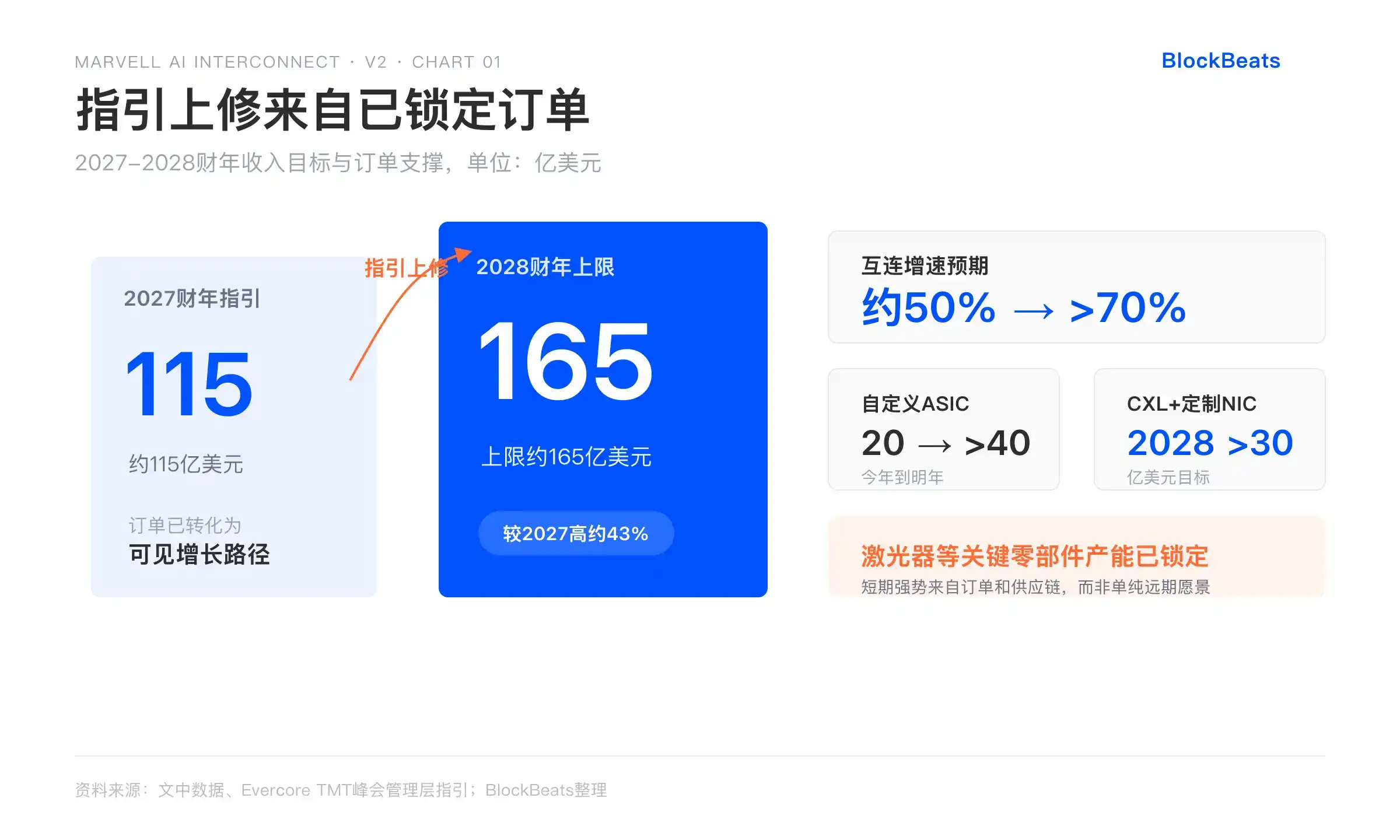
Following Jensen Huang's fervent endorsement, Marvell confirmed exceptionally strong AI-related orders at the Evercore TMT Summit and raised its fiscal year 2027 revenue guidance to approximately $11.5 billion. The growth expectation for its interconnect business was increased from around 50% to over 70%. Custom ASIC business is projected at about $2 billion this year, with a goal to double next year. The company's stock has surged nearly 140%-158% cumulatively since 2026, far outpacing peers and the market average, with several instances of single-day gains exceeding 30% and significantly amplified trading volume.

Most reports interpret this series of signals as Marvell solidifying its position as the leader in AI interconnect, with its data center business becoming the absolute core. However, the current growth driver remains its proven Scale-Out business, leveraging mass production advantages in PAM DSP, TIA drivers, and pluggable optical modules. The more strategically significant Scale-Up optics and CPO (Co-Packaged Optics), which represent higher value per cluster, are still preparing for mass production in 2027. The execution certainty from early deployment to forming hundreds of millions in annualized revenue by 2028 is key to judging whether the growth momentum can extend into 2028, whether the company can transition from a component supplier to a strategic partner for cloud providers, and whether the current high valuation already fully reflects optimistic expectations.

Summit Updates Show AI Orders Indeed Strong

Marvell based its revised guidance at the summit on secured AI orders and locked-in supply chains, not on distant visions. Fiscal year 2027 revenue guidance was raised to about $11.5 billion, with the upper bound for 2028 further increased to approximately $16.5 billion. The interconnect business's year-over-year growth for 2027 was revised upwards to over 70%. Custom ASICs are expected to contribute around $2 billion this year, targeting over $4 billion next year, and the external CXL plus custom NIC business aims for over $3 billion by 2028.

These figures have concrete support. Management repeatedly mentioned that capital expenditure-driven demand is very robust, orders have translated into a visible growth path, key components like lasers, though facing tight lead times, have secured capacity, and PAM DSP maintains a first-to-market rhythm each generation (1.6T deployed at scale this year, 3.2T sampling next year). This aligns with the path outlined in previous earnings calls, pointing to real demand, not just optimistic projections.

However, the stock price has already traded this story aggressively in advance. Year-to-date returns far surpass industry peers and indices. Post-surge, volatility and option-implied volatility have risen simultaneously. Market discussion has shifted from identifying beneficiaries to 'how much longer can it rise?' and downside risks. This creates a stark contrast: the near-term order-driven momentum is clear, but market pricing already incorporates many mid-to-long-term optimistic assumptions.

Following the strong guidance, investors naturally question which specific businesses are driving this growth and the respective contributions from Scale-Out and Scale-Up segments.
Current Growth Driver is Mature Scale-Out Business

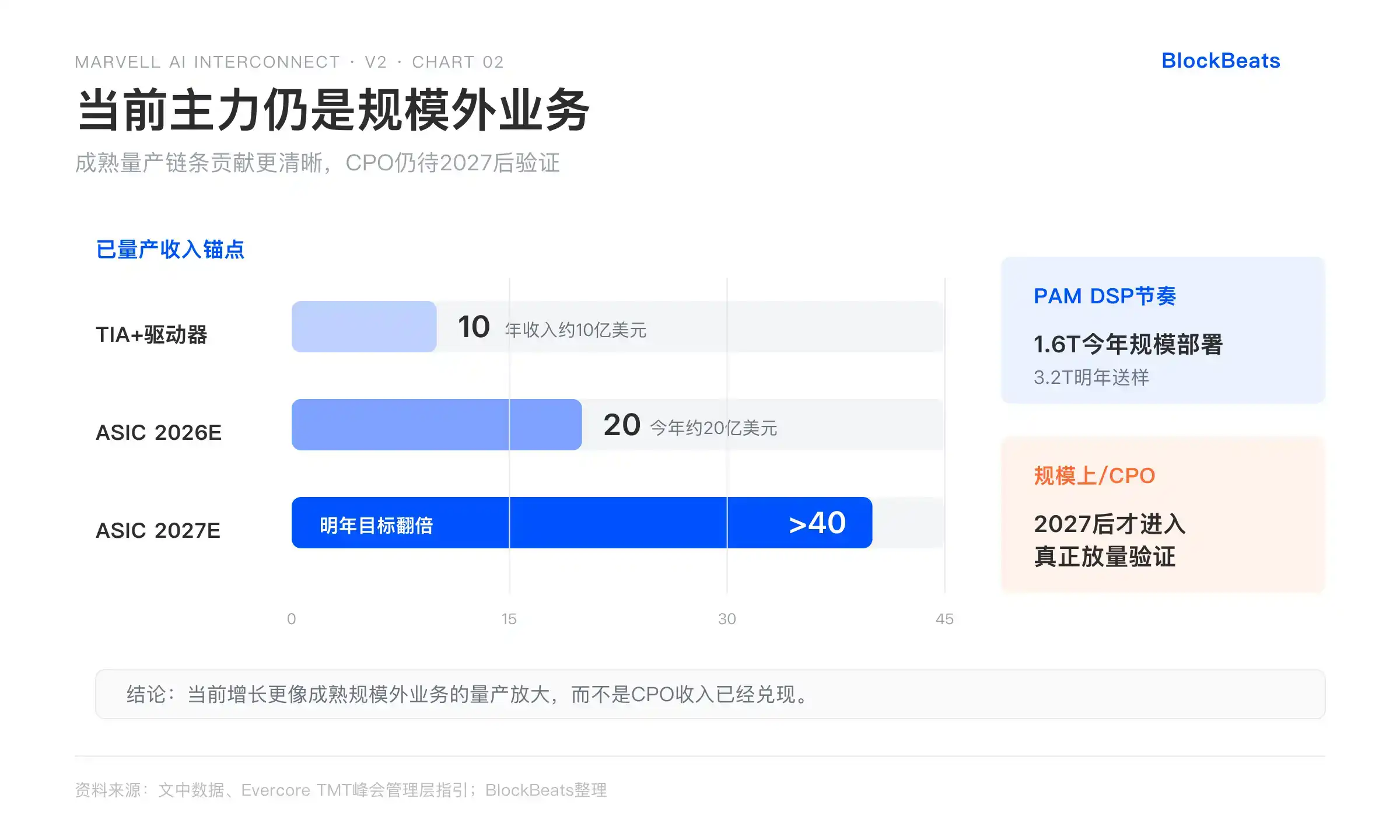
The current mainstay of the interconnect business remains the Scale-Out segment. PAM DSP, TIA drivers, and 400G, 800G, 1.6T pluggable optical modules have formed mature product lines. Being first to market each generation helps the company maintain market share, with TIA plus driver business reaching an annual revenue level of around $1 billion. Complete coverage from long-haul coherent to more streamlined high-speed PAM gives the company a favorable position in the market for horizontal scaling between data centers.

The Scale-Up business is transitioning from its start-up phase into acceleration. As AI clusters scale from tens of thousands of GPUs or XPUs to the million-unit level, front-end compute acts like an engine upgrade, while back-end interconnect is like a highway needing expansion from a single lane to multiple lanes. Internal cluster bandwidth demand is roughly 10 times that of the front-end. Power and density bottlenecks are pushing the industry from traditional pluggable optical modules toward Near-Package Optics and CPO. This shift can significantly increase chip loading per rack and expand the overall market size.

The core of CPO lies in co-packaging the optical engine with the XPU or switch, reducing electrical-to-optical conversion losses to improve bandwidth density and lower overall power consumption. This is not simply swapping a part but a system-level solution addressing the new bottlenecks of massive-scale clusters. Marvell, through SerDes IP, DSP capabilities accumulated from previous acquisitions and recently integrated Celestial AI technology, is attempting to build integration advantages in this direction. However, the current contribution from the Scale-Up business remains limited, with true volume ramp-up awaiting mass production landing after 2027.

If Scale-Up represents higher per-unit content value and market expansion opportunities, then how does Marvell's technical roadmap, capacity preparation, and ramp-up execution look in this emerging field?
How Does the CPO Mass Production Path Look Post-Celestial Acquisition?

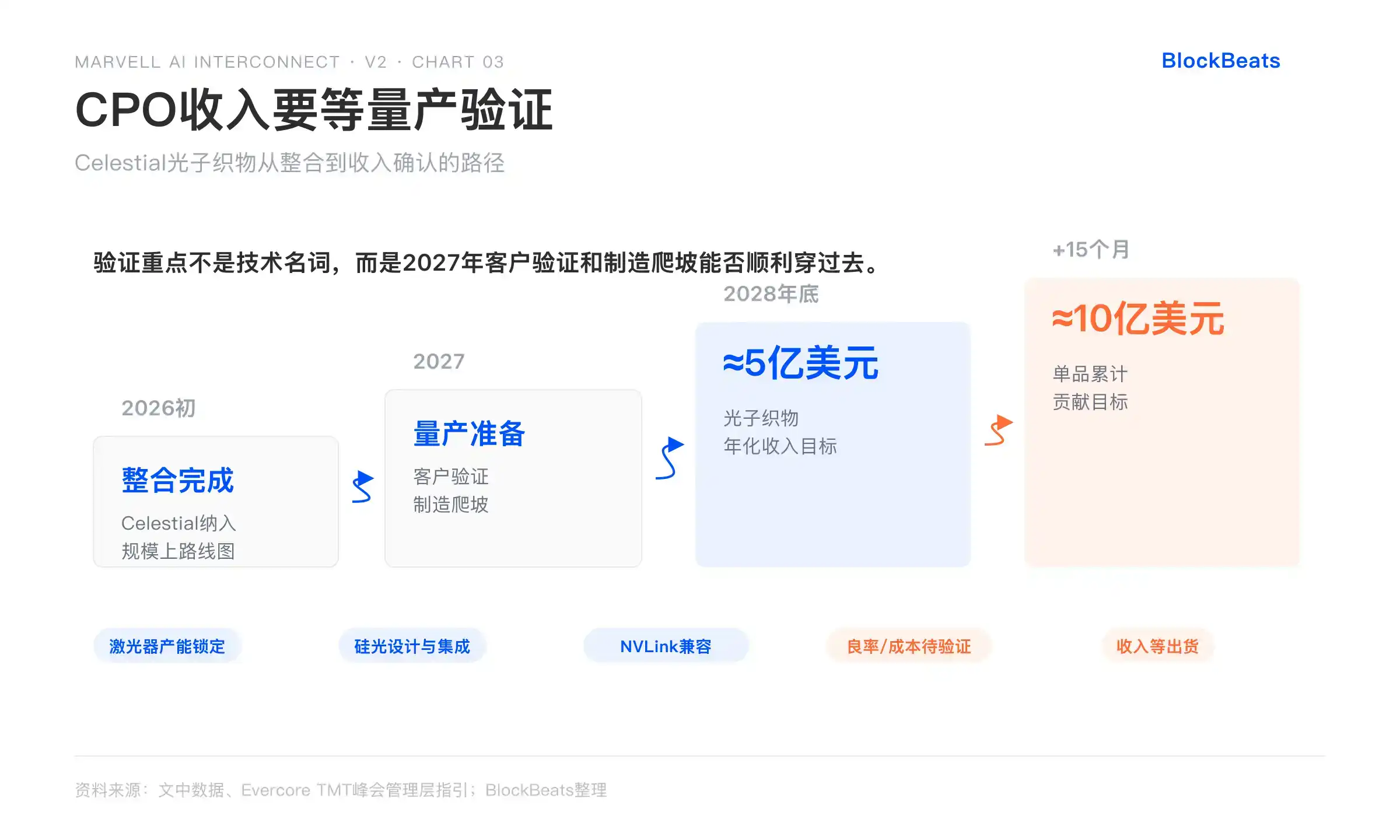
The Celestial AI acquisition was completed and integrated in early 2026. Its Photonic Fabric technology has been incorporated into Marvell's Scale-Up roadmap and will be co-packaged with custom XPUs and Scale-Up switches. Management expects to enter formal mass production preparation in 2027, targeting approximately $500 million in annualized revenue from the Photonic Fabric by the end of 2028, subsequently moving towards doubling, with a cumulative contribution of around $1 billion over 15 months (on a per-product basis). This path is somewhat optimized compared to earlier outlooks but still relies on smooth progress in customer validation and manufacturing ramp.

Supply chain details show improved certainty. Laser lead times are tight, but Marvell has secured relevant capacity. The company focuses on silicon photonics chip design and integration, not laser production itself. Collaboration with NVIDIA on NVLink Fusion further covers silicon photonics, network interoperability between custom XPUs and NVIDIA clusters, and OCTEON baseband support for AI-RAN. This not only enhances technical compatibility but also bolsters credibility in hyperscaler tenders, making Marvell's heterogeneous computing solutions more likely to be included in next-generation AI factory planning.

If million-XPU clusters widely adopt CPO, leading to significantly reduced power consumption and increased bandwidth density, it would directly increase Marvell's content value per rack and support revenue and margin expansion. Conversely, if the 2027 production ramp is slower than guidance, customer validation cycles lengthen, or yield and cost curves fall short of expectations, the 2028 contribution could be below current market-implied levels, increasing pressure to meet overall guidance. All current statements remain forward-looking guidance; actual shipments and share data will require harder validation by 2027.

With its full-stack layout from SerDes, DSP to optical engines and custom XPUs, and support from ecosystem partners, can Marvell maintain differentiation and translate it into actual share gains in the competition?
Can Marvell Maintain Its Differentiation Against Broadcom?

Marvell's leadership in the PAM DSP market, comprehensive coverage from long-haul coherent to 1.6T and 3.2T, and integration advantages of custom ASICs with OCTEON are real achievements. The NVIDIA collaboration also provides an additional option for heterogeneous computing. These elements give the company competitiveness in certain hyperscaler projects, especially in scenarios requiring rapid mass production and ecosystem compatibility.

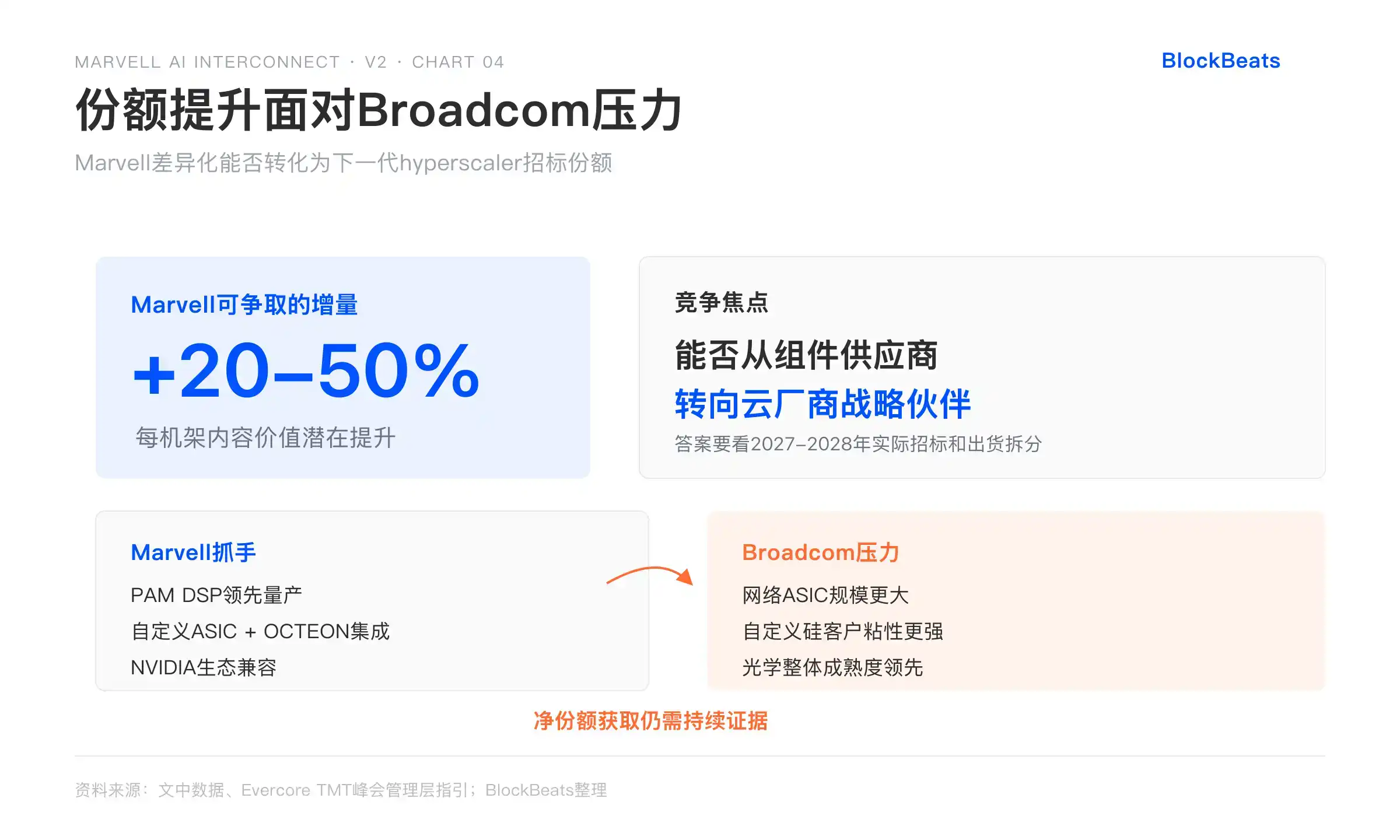
However, Broadcom still maintains a clear lead in network ASICs, overall optics scale, and maturity. Broadcom's custom silicon projects are larger in scale with stronger customer stickiness. In overlapping areas of Scale-Out and Scale-Up, Marvell still needs to rely on higher integration and specific technological routes to compete for incremental share. The positioning as an "Interconnect Strategic Partner" is currently more of a goal; its ultimate realization depends on actual tender results and shipment breakdowns in 2027-2028, not the current breadth of its portfolio.

For investors, this means that in the next generation of hyperscaler tenders, Marvell's content value per rack could potentially increase by 20-50% from current levels, supporting revenue visibility and margin expansion potential. However, if the CPO ramp is slower than guidance, or if Broadcom gains an advantage in more custom projects, 2028 growth could fall short of the optimal scenario implied by the current valuation, increasing stock price correction pressure. The current high-beta nature amplifies gains driven by narrative while also amplifying volatility if execution falls short of expectations.
CPO Large-Scale Adoption Remains the Largest Unverified Variable

Despite strong AI orders, PAM's lead in mass production, and NVIDIA compatibility providing real medium-term momentum and option value, CPO, as a new technology, still faces core constraints for sustainable growth into 2028 regarding yield, cost curves, thermal management, supply chain stability, and whether hyperscaler capital expenditures can maintain the current pace. Historical experience shows that new technologies typically require multiple iterations from early mass production to generating meaningful revenue; CPO is still in this early stage.

Marvell has a decent track record of meeting guidance, but this ramp target is relatively aggressive. Valuation has already risen sharply in 2026, incorporating many best-case scenario assumptions. Increased market discussion crowding has also pushed up volatility. Broadcom's scale advantage won't disappear in the short term, and net share gains still require ongoing evidence. The current phase is one of acceleration, but early signs of late-stage crowding have emerged—sharp price swings and a shift in discussion focus towards execution pressure are manifestations of this characteristic.

Investors should not only focus on the vision presented at the summit but should closely track the actual revenue breakdown in 2027, shipment milestones, specific CPO customer validation progress, and the pace of hyperscaler capital expenditures. These variables are most likely to alter current judgments. If 2027 milestones are met strongly, the trend of structural improvement in interconnect content value will gain firmer support; if delays occur or market share falls short of expectations, high valuations will face correction pressure. The structural opportunity in AI interconnect indeed exists, and Marvell's full-stack layout provides differentiated options, but the ultimate degree of realization depends on execution details, making 2027 the key validation window.

Похожее

ETH Bull and Bear Views Compilation: Can Ethereum's Value Flow Back to ETH?

Titled "ETH Bull and Bear Views: Can Ethereum's Value Flow Back to ETH?", this article synthesizes the current heated debate around Ethereum's native token, ETH, following Bankless co-founder David Hoffman's decision to sell his entire ETH holdings. The **bullish case**, represented by figures like Tom Lee (BitMine CEO) and Raoul Pal, argues that ETH's core thesis remains intact. They contend Ethereum is the essential, secure, and neutral foundational layer for future finance—encompassing stablecoins, RWA, DeFi, L2s, and Agentic AI. Bulls bet on ETH's long-term revaluation as institutional adoption of on-chain finance grows, with significant buying activity from entities like BitMine and Consensys cited as evidence. Conversely, the **bearish perspective**, led by Hoffman and analysts like Markus Thielen, questions ETH's value capture mechanism. They acknowledge Ethereum's network success but argue that the value created by L2s, DeFi, and applications does not sufficiently accrue to the ETH token itself. Bears point to ETH's prolonged underperformance versus the broader crypto market, lack of traditional cash flows, weakening "ultrasound money" narrative, and apparent institutional retreat (e.g., Harvard Management Company exiting its ETH ETF position) as key concerns. The debate highlights a pivotal shift: ETH is no longer just a community belief asset. The central question is whether ETH can transition from being a "**used infrastructure**" to a "**continuously bought and held core asset**" as more value enters the Ethereum ecosystem. The market is now critically examining the direct link between network growth and ETH's value.

marsbit31 мин. назад

ETH Bull and Bear Views Compilation: Can Ethereum's Value Flow Back to ETH?

marsbit31 мин. назад

Crypto is dead, Perps are forever

The crypto industry is shifting from a focus on creating native assets (like altcoins and protocol tokens) to becoming a "global asset pipeline." Native cryptocurrencies, except for Bitcoin, are seen as failing in their value storage and utility promises, with demand driven largely by speculation. Attention and liquidity are now moving toward real-world assets (RWAs) like U.S. stocks, bonds, gold, and oil traded on-chain via perpetual contracts (Perps). Stablecoins like USDT and USDC set the precedent, proving blockchain's core strength is efficient global settlement and transfer, not inventing new monetary systems. Meanwhile, assets like Ethereum and many DeFi tokens struggle as their narratives weaken against tangible traditional assets and the rapid real-world progress of AI. Perpetual contracts have emerged as a pivotal innovation. They simplify trading by offering pure price exposure to any asset, bypassing complexities of ownership, custody, and traditional market hours. Projects like Hyperliquid gained traction by combining CEX-like efficiency with on-chain transparency, capitalizing on post-FTX distrust, macroeconomic volatility, and the surge in demand for 24/7 stock trading. In conclusion, while the era of speculative native "crypto assets" may be over, perpetual contracts persist as the industry's most potent financial instrument—transforming all assets into globally accessible, constantly tradable instruments centered on price speculation.

marsbit37 мин. назад

Crypto is dead, Perps are forever

marsbit37 мин. назад

Tencent, Alibaba, ByteDance in a Battle for the Skill Store

Skill is becoming a key concept in the AI field, essentially serving as a structured "instruction manual" for AI Agents that specifies tool calls, decision logic, and output standards. This allows Agents to execute predefined tasks. As the number of Skills grows, distribution platforms have emerged. Major tech companies are swiftly entering this space. In March, Tencent, Alibaba, and ByteDance launched Skill stores within their respective Agent platforms. Subsequently, players like Zhipu AI, Meituan, and Xiaohongshu joined the fray. This competition for the "Skill store" is fundamentally a battle for the AI-era user entry point; whoever controls distribution controls the users. While ByteDance's Coze has experimented with paid Skills, most platforms offer them for free. The real value lies not in the stores themselves but in using them to attract and retain users within an ecosystem, driving revenue from services like cloud computing, model calls, or advertising. The landscape features three main player types: 1) **Internet giants** (e.g., Alibaba, ByteDance, Tencent, Meituan), leveraging Skills to drive traffic and monetize through their broader ecosystems (cloud services, transactions, ads). 2) **Large model companies** (e.g., Zhipu AI, Moonshot AI), using Skill stores to increase user engagement and monetize model API calls. 3) **Content platforms** (e.g., Xiaohongshu), treating Skills as a new content format to generate traffic and ad revenue. However, transforming Skill stores into a sustainable business faces significant hurdles. Key challenges include: the **difficulty in pricing Skills** due to inconsistent outputs across different models and contexts; **lack of cost transparency** (varying token consumption); **security risks** like Skill poisoning; and the **absence of standardized protocols** for development and evaluation. Unlike standardized mobile apps, Skills are often personalized workflows resistant to uniformity, which hinders the establishment of a reliable review and monetization system akin to the App Store. While there is genuine user demand for paid Skills—particularly in enterprise (e.g., contract review) and certain personal productivity scenarios—current platforms offer developers limited and unpredictable distribution. The future of Skill stores depends on overcoming these standardization, evaluation, and safety challenges to make acquiring a Skill as straightforward as downloading an app. For now, the stores function more as display shelves than robust marketplaces.

marsbit37 мин. назад

Tencent, Alibaba, ByteDance in a Battle for the Skill Store

marsbit37 мин. назад

The Crypto Scene Is Dead, Perpetual Swaps Are Eternal

The crypto industry is undergoing a fundamental shift. The era defined by minting novel, native digital assets (altcoins) is fading. These assets, lacking real-world cash flows or clear value, are losing relevance as attention and capital flow elsewhere. Two powerful external forces are reshaping the space. First, traditional assets like U.S. stocks, bonds, gold, and oil are being tokenized and traded on-chain. Second, the explosive growth of AI, with its tangible products, has overshadowed crypto's once-dominant "future narrative." This marks a critical pivot: crypto is transitioning from being a "factory for new assets" to becoming a "global conduit for existing assets." Its validated utility is not complex financial reinvention but efficient global settlement, transfer, and trading—the original promise of blockchain. Stablecoins like USDT and USDC exemplify this, offering faster dollar movement rather than replacing it. Consequently, native ecosystems like Ethereum face profound challenges. While still crucial infrastructure, ETH struggles to capture value as users interact with Layer 2s or trade traditional assets without needing to hold it. DeFi's grand narrative of rebuilding finance has narrowed to core needs like cheap transfers and deep liquidity. The true breakout innovation is the perpetual contract (Perp). It brilliantly bypasses the complexities of direct asset ownership (custody, compliance, dividends) by creating pure price exposure. Users can speculate on the price movement of *any* asset—NVIDIA, gold, oil—24/7, globally, and with leverage. This "price casino" model, while risky and ethically fraught, delivers unmatched liquidity and accessibility. Projects like Hyperliquid succeeded not by inventing new mechanics but by perfecting the timing and execution of this model. Key drivers included making on-chain Perps feel like centralized exchanges, post-FTX trust migration towards transparency, and rising demand to trade macro assets and equities round-the-clock. In conclusion, the crypto world's most enduring successes are the dollar (via stablecoins), Bitcoin, and trading. Its new frontier is not creating alternative assets but providing a seamless, perpetual trading layer—a new API—for the world's existing financial system. The age of native altcoins is over; the age of perpetual synthetic exposure has begun.

Odaily星球日报45 мин. назад

The Crypto Scene Is Dead, Perpetual Swaps Are Eternal

Odaily星球日报45 мин. назад

Торговля

Спот
Фьючерсы

Популярные статьи

Как купить S

Добро пожаловать на HTX.com! Мы сделали приобретение Sonic (S) простым и удобным. Следуйте нашему пошаговому руководству и отправляйтесь в свое крипто-путешествие.Шаг 1: Создайте аккаунт на HTXИспользуйте свой адрес электронной почты или номер телефона, чтобы зарегистрироваться и бесплатно создать аккаунт на HTX. Пройдите удобную регистрацию и откройте для себя весь функционал.Создать аккаунтШаг 2: Перейдите в Купить криптовалюту и выберите свой способ оплатыКредитная/Дебетовая Карта: Используйте свою карту Visa или Mastercard для мгновенной покупки Sonic (S).Баланс: Используйте средства с баланса вашего аккаунта HTX для простой торговли.Третьи Лица: Мы добавили популярные способы оплаты, такие как Google Pay и Apple Pay, для повышения удобства.P2P: Торгуйте напрямую с другими пользователями на HTX.Внебиржевая Торговля (OTC): Мы предлагаем индивидуальные услуги и конкурентоспособные обменные курсы для трейдеров.Шаг 3: Хранение Sonic (S)После приобретения вами Sonic (S) храните их в своем аккаунте на HTX. В качестве альтернативы вы можете отправить их куда-либо с помощью перевода в блокчейне или использовать для торговли с другими криптовалютами.Шаг 4: Торговля Sonic (S)С легкостью торгуйте Sonic (S) на спотовом рынке HTX. Просто зайдите в свой аккаунт, выберите торговую пару, совершайте сделки и следите за ними в режиме реального времени. Мы предлагаем удобный интерфейс как для начинающих, так и для опытных трейдеров.

1.4k просмотров всегоОпубликовано 2025.01.15Обновлено 2026.06.02

Как купить S

Sonic: Обновления под руководством Андре Кронье – новая звезда Layer-1 на фоне спада рынка

Он решает проблемы масштабируемости, совместимости между блокчейнами и стимулов для разработчиков с помощью технологических инноваций.

2.3k просмотров всегоОпубликовано 2025.04.09Обновлено 2025.04.09

Sonic: Обновления под руководством Андре Кронье – новая звезда Layer-1 на фоне спада рынка

HTX Learn: Пройдите обучение по "Sonic" и разделите 1000 USDT

HTX Learn — ваш проводник в мир перспективных проектов, и мы запускаем специальное мероприятие "Учитесь и Зарабатывайте", посвящённое этим проектам. Наше новое направление .

1.8k просмотров всегоОпубликовано 2025.04.10Обновлено 2025.04.10

HTX Learn: Пройдите обучение по "Sonic" и разделите 1000 USDT

Обсуждения

Добро пожаловать в Сообщество HTX. Здесь вы сможете быть в курсе последних новостей о развитии платформы и получить доступ к профессиональной аналитической информации о рынке. Мнения пользователей о цене на S (S) представлены ниже.

活动图片