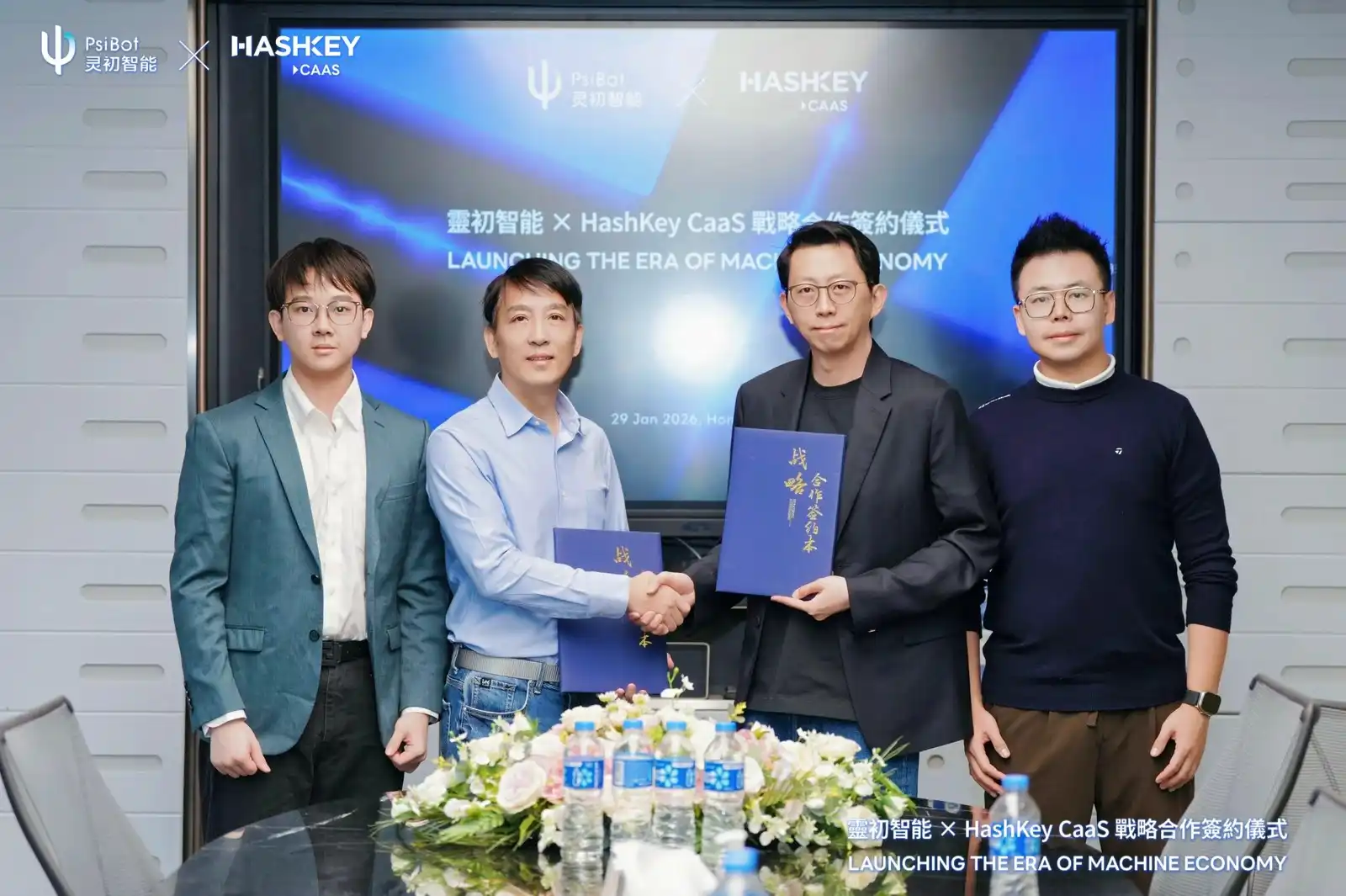
HashKey CaaS and Lingchu Intelligence Form Strategic Partnership to Jointly Build AI Autonomous Payment Infrastructure

marsbitОпубликовано 2026-01-29Обновлено 2026-01-29

Введение

HashKey CaaS and Lingchu Intelligence have entered into a strategic partnership to jointly develop AI autonomous payment infrastructure. The collaboration will focus on data tokenization for robots and the implementation of the HP2 (HashKey Payment Protocol) autonomous payment network, aiming to integrate AI with the digital financial system and build key infrastructure for the embodied intelligence economy. As part of the agreement, Lingchu will deploy 10 dual-arm robots integrated with HashKey CaaS’s HP2 payment protocol, designed for Web3 and AI agents. These robots will gain controlled payment permissions, enabling them to act as autonomous agents to conduct on-chain transactions—such as purchasing services, accessing data interfaces, and earning on-chain income through task execution. Each autonomous transaction will be recorded as an auditable on-chain financial record, transforming the robots from mere smart devices into independent participants in the digital economy. Additionally, HashKey CaaS will tokenize the operational data generated by Lingchu’s robots, turning them into tradable digital assets with monetary value. HashKey’s CEO of On-Chain Business Group, Li Chen, stated that this partnership marks the first application of the HP2 protocol in embodied AI, supporting the integration of robots into the digital financial ecosystem. Wang Qibin, CEO of Lingchu Intelligence, emphasized that the collaboration will help accelerate the transition from R&D to an ecosy...

HashKey CaaS has announced a strategic partnership with Lingchu Intelligence, a robotics company focused on the field of embodied AI. The two parties will engage in in-depth collaboration around robot data tokenization and the HP2 (HashKey Payment Protocol) autonomous payment network, promoting the integration of AI and the digital financial system, and jointly building the key infrastructure for the embodied intelligent economy.

As part of this collaboration, Lingchu Intelligence will deploy 10 dual-arm robots and integrate them with HashKey CaaS's HP2 payment protocol, which is specifically designed for Web3 and AI Agents. Through HP2, the robots will gain controlled payment permissions, enabling them to perform on-chain interactions as "autonomous agents," including autonomously purchasing services, calling data interfaces, and earning on-chain revenue by executing tasks. Throughout this process, every autonomous transaction generated by the robots will be fully recorded as auditable on-chain financial credentials, transforming the robots from traditional "intelligent devices" into genuine "digital economic entities" capable of independently participating in economic activities.

Simultaneously, HashKey CaaS will convert the operational data generated by Lingchu Intelligence's robots during actual operation into tradable tokenized digital assets, endowing "robot data" with asset attributes and transactional value.

Li Chen, CEO of HashKey On-Chain Business Group, stated: "This collaboration marks the first application of the HP2 protocol in the field of embodied AI. HashKey CaaS's on-chain new financial infrastructure will support robots and AI in truly integrating into the digital financial system, achieving autonomous on-chain data transactions and value circulation, and laying the foundation for embodied intelligence to participate in the real economy."

Wang Qibin, CEO of Lingchu Intelligence, stated: "The widespread application of embodied intelligence relies on the confirmation of data value and an automated value exchange system. Through the partnership with HashKey, Lingchu Intelligence will accelerate its transition from technological research and development to ecosystem development oriented towards the machine economy."

In the future, the two parties will continue to explore more applications of embodied intelligence in scenarios such as payment and autonomous services, accelerate the implementation of related technologies and models, and promote the shift of the AI economy from conceptual validation to large-scale practice.

Связанные с этим вопросы

QWhat is the strategic partnership between HashKey CaaS and Lingchu AI about?

AThe strategic partnership between HashKey CaaS and Lingchu AI focuses on robot data tokenization and the HP2 (HashKey Payment Protocol) autonomous payment network. They aim to integrate AI with the digital financial system and build key infrastructure for the embodied intelligent economy.

QHow many robots will Lingchu AI deploy as part of this collaboration?

ALingchu AI will deploy 10 dual-arm robots as part of this collaboration.

QWhat is the HP2 payment protocol designed for?

AThe HP2 payment protocol is designed for Web3 and AI Agents, enabling robots to have controlled payment permissions, act as autonomous agents for on-chain interactions, purchase services, call data interfaces, and earn on-chain income through task execution.

QHow will HashKey CaaS utilize the operational data from Lingchu AI's robots?

AHashKey CaaS will convert the operational data generated by Lingchu AI's robots into tokenized digital assets, giving the data asset attributes and transactional value.

QWhat did HashKey's On-Chain Business Group CEO, Li Chen, say about this partnership?

ALi Chen stated that this partnership is the first application of the HP2 protocol in the embodied intelligence field. HashKey CaaS's on-chain financial infrastructure will support robots and AI in integrating into the digital financial system, enabling autonomous on-chain data settlement and value transfer, laying the foundation for embodied intelligence to participate in the real economy.

Похожее

The Economist: In Asia, Stablecoins Are Becoming the New Financial Infrastructure

Stablecoins are rapidly emerging as a new financial infrastructure across Asia, driven by real-world needs for efficient and low-cost transactions. Despite cautious or strict regulatory stances in countries like India, cryptocurrency adoption continues to thrive. India, which imposes heavy taxes and transaction fees, still leads the global crypto adoption index, with inflows reaching approximately $338 billion from mid-2024 to 2025. A key application is cross-border remittances. With 24 million migrant workers in Southeast Asia, traditional remittance fees averaging 6.5% per $200 transfer pose a significant burden. Stablecoins, unlike volatile cryptocurrencies like Bitcoin, offer a stable, fast, and accessible alternative. From January to July last year, global stablecoin transfers exceeded $4 trillion. Businesses are also adopting stablecoins to streamline payments, reducing intermediaries, delays, and costs. Monthly stablecoin transactions between enterprises surged from under $100 million in early 2023 to over $6 billion by mid-2025. Additionally, Asia’s vast gig economy—over 210 million workers—benefits from instant salary settlements via stablecoins, bypassing traditional banking delays. However, the same features that benefit legitimate transactions—speed, low cost, and accessibility—also risk being exploited for illicit activities. The future of stablecoins in Asia will depend on how effectively regulators balance innovation with oversight. Success could reshape global finance; failure may leave crypto with a practical—but illegal—use case.

marsbit49 мин. назад

The Economist: In Asia, Stablecoins Are Becoming the New Financial Infrastructure

marsbit49 мин. назад

Pump.fun Launches GitHub Creator Fee Sharing: Integrating 'Tipping' into the Meme Coin Factory's Funding Pipeline

Pump.fun, a prominent and controversial meme coin launch platform on Solana, has introduced a new feature allowing users to direct "creator fees" to any GitHub account via its mobile app. This update, presented as a way to support developers, is more than a simple tipping mechanism; it represents a strategic shift in the platform’s incentive structure and growth model. The platform enables users to create and trade tokens with extreme ease, leading to the minting of millions of mostly speculative meme coins. However, high failure rates and intense attention competition have posed significant challenges. By integrating GitHub—a core identity system for developers—Pump.fun aims to productize financial support for open-source contributors, incorporate external developers into its incentive flow, and build a narrative that shifts from pure speculation to “supporting builders.” This move is part of a broader trend toward social and community-oriented features, reflecting Pump.fun’s effort to evolve from a high-volume “token factory” into a sustainable ecosystem. Potential benefits include attracting new users and transactions, though risks remain around fee redistribution, speculative token dynamics, and increased regulatory and content moderation complexity. The update underscores Pump.fun’s attempt to balance growth, incentives, and narrative in the volatile meme coin market.

marsbit1 ч. назад

Pump.fun Launches GitHub Creator Fee Sharing: Integrating 'Tipping' into the Meme Coin Factory's Funding Pipeline

marsbit1 ч. назад

Торговля

Спот
Фьючерсы
活动图片